

Retail Payment Experience: Lessons from Zarin Fabrics President David Zarin
Last Updated on March 6, 2026 by Dimitri Akhrin
Modern retail businesses rely on seamless payment systems, reliable POS technology, and flexible checkout experiences to build long-term customer trust. Retail payment experience has changed dramatically over the past decade. Today’s customers often discover brands online before ever stepping into a store, and their expectations for convenience, personalization, and seamless transactions have never been higher.
To explore how modern retail businesses adapt to these changes, we spoke with David Zarin, President of Zarin Fabrics, one of the largest decorative fabric retailers in the United States.
Founded in 1936, Zarin Fabrics has built a reputation for high-quality textiles and exceptional service, serving interior designers, theater professionals, hospitality groups, and homeowners for nearly 90 years. The company is known for its extensive inventory and its white-glove custom services, including upholstery, drapery fabrication, and installation.
Although decorative fabrics and payment processing may seem like entirely different industries, both rely heavily on customer trust, frictionless transactions, and reliable point-of-sale experiences. In this interview, David Zarin shares insights on how retail has evolved—and why smooth payment systems remain essential to delivering a premium customer experience.
Q&A with David Zarin, President of Zarin Fabrics
How Customer Discovery Has Changed
BAMS: Zarin Fabrics has been around since 1936. What’s changed most in how customers shop with you—and what’s stayed the same?
David Zarin: What’s changed the most is how people discover us. Today, many new customers find us online first. They check our Instagram, read reviews, and explore our website before they ever visit our showroom. Some will even order swatches online before stepping foot in the store.
What hasn’t changed is what happens once they arrive. People still want guidance. They’re not looking to be “sold” something—they want someone to help translate their ideas into reality.
Often a customer walks in with a photo of their living room or a mood board. Our job is to help them interpret that vision through fabric, color, and texture. In many ways, it’s similar to what companies like BAMS focus on—removing friction from the decision-making process so customers can move forward confidently.
Personalizing the Experience for Designers and Consumers
BAMS: You work with both professional designers and everyday homeowners. How do you personalize those different experiences?
David Zarin: Interestingly, the core approach is very similar.
Whether it’s a first-time apartment owner or a seasoned interior designer, both want to feel heard and understood. We ask questions, show samples, and take the time to understand what they’re trying to achieve.
The biggest difference is scale.
A designer might need hundreds of yards of fabric shipped to multiple locations, while a homeowner may be looking for a single roman shade that transforms their living room.
But regardless of the size of the project, everyone expects clarity, transparency, and efficiency at checkout. That’s why upgrading our POS system years ago was so important. The ability to process custom orders quickly and securely is just as critical as having the right fabrics in stock.
Why the Payment Experience Matters for Customer Trust
BAMS: How does the payment experience affect trust, especially in a business built on long-term relationships?
David Zarin: It matters tremendously.
Take a restaurant owner who’s reupholstering 40 banquettes before opening night. They need to place deposits quickly, track invoices, and confirm timelines.
The same applies to residential clients. We’ve had families work with us for generations, and if something feels clunky or confusing during checkout, it can undermine that trust.
That’s why smooth payment systems are so important. The ability to process deposits, partial payments, and final balances seamlessly isn’t just a back-end function—it’s part of the overall customer experience.
For retailers managing custom projects, having reliable payment systems is essential. Businesses that rely on flexible payment structures often benefit from modern merchant solutions that simplify transactions and reduce processing friction. Our guide on how to reduce eCommerce payment processing fees explores how payment infrastructure can impact both operational efficiency and customer satisfaction.
Advice for Retailers Managing Custom Orders

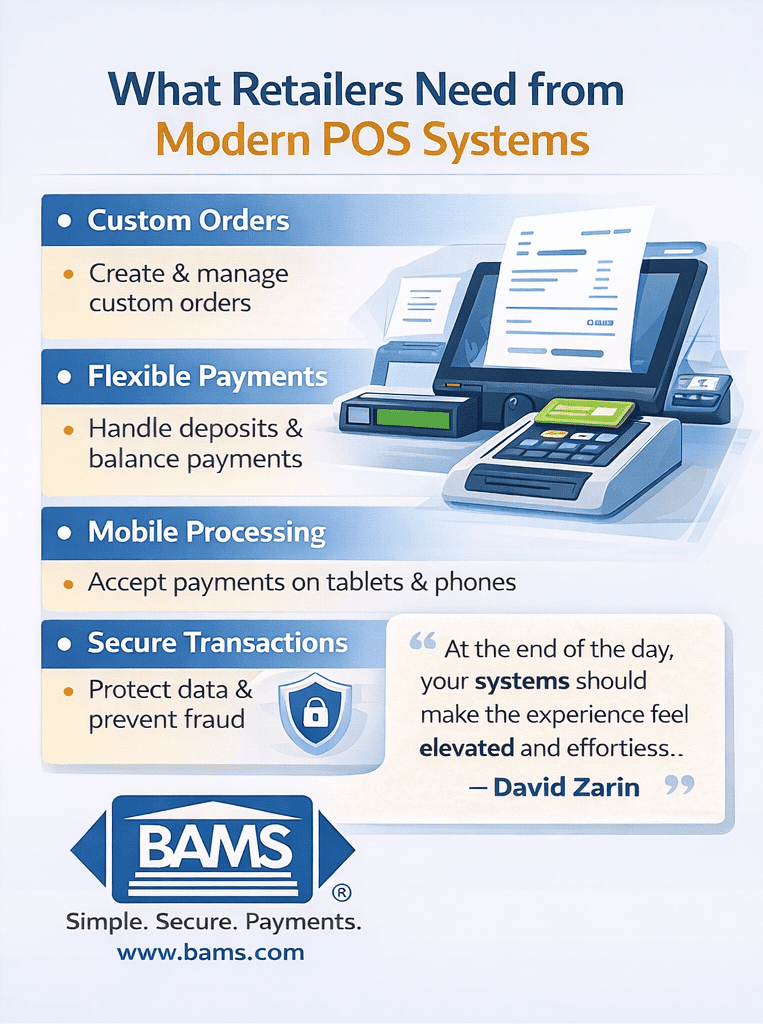
Modern retail POS systems support custom orders, flexible payments, mobile checkout, and secure transactions to improve the customer experience.
BAMS: What advice would you give to other retailers managing both custom orders and in-person sales?
David Zarin: Invest in systems that make your team look knowledgeable and make your customers feel respected.
That means digital invoicing that updates automatically, card readers that work reliably, and flexible systems for managing custom orders.
But technology alone isn’t enough. Your team also needs training so they can use those tools confidently. The customer doesn’t care how advanced your software is if it slows things down.
At the end of the day, your systems should make the experience feel elevated and effortless.
Retail businesses managing both in-store and custom transactions often discover that payment infrastructure plays a larger role in operational efficiency than expected. Understanding the key factors impacting eCommerce payment processing costs can help businesses evaluate whether their current systems support long-term growth.
What’s Next for Zarin Fabrics?
BAMS: What’s next for Zarin Fabrics?
David Zarin: We’re seeing growing demand nationwide. Designers and hospitality clients across the country are ordering from us because they can’t find the same combination of inventory and service elsewhere.
We’re also investing heavily in content. That includes video swatch books, behind-the-scenes tours, and educational guides on fabric care.
Fabric can feel intimidating to people who aren’t familiar with it, so our goal is to demystify the process. Whether someone spends $100 or $10,000, we want them to feel confident and in control of their decisions.
And ultimately, that confidence depends on both product knowledge and a smooth, modern transaction experience.
Why Seamless Payments Matter for Modern Retail
Seamless payment systems improve customer trust by enabling fast checkout, flexible payment options, and reliable retail POS technology.
Retail businesses today operate in a hybrid environment where in-person experiences and digital discovery intersect.
Customers often research products online before visiting a store, and they expect checkout to be fast, secure, and flexible. According to the National Retail Federation, improving payment efficiency and customer experience remains a top priority for retailers navigating digital transformation.
For businesses managing custom orders, hospitality projects, or multi-location clients, payment systems must support:
-
deposits and partial payments
-
invoice tracking
-
secure card transactions
-
flexible checkout experiences
These capabilities help maintain trust and ensure operations run smoothly.
Retailers evaluating their payment infrastructure should also understand how processing costs impact long-term profitability. Our guide on reducing eCommerce processing costs explains how businesses can lower transaction fees while maintaining a seamless checkout experience.
As retailers modernize their infrastructure, the right payment systems can become a strategic advantage rather than just a back-office necessity.
Frequently Asked Questions
What is a point-of-sale (POS) system in retail?
A point-of-sale system is the technology retailers use to process transactions, manage inventory, and record customer purchases. Modern POS systems often include digital invoicing, mobile payment processing, and integrated inventory management.
Why are seamless payments important for retail businesses?
Smooth payment experiences help build customer trust, reduce checkout friction, and improve operational efficiency. Research shows that customers are more likely to complete purchases when checkout processes are simple and reliable.
How do payment systems support custom retail orders?
Retailers that handle custom orders often need flexible payment options such as deposits, installment payments, and invoice tracking. Payment platforms that support these features help businesses manage complex projects more efficiently.
What features should retailers look for in a payment processor?
Retail businesses typically benefit from processors that offer secure transactions, flexible payment options, modern POS integration, and transparent pricing structures.
How has technology changed the retail shopping experience?
Technology has transformed how customers discover products, research brands, and complete purchases. Many shoppers now begin their buying journey online before visiting a physical store, making seamless payment and POS systems even more important.
Sources
1. National Retail Federation: The State of Retail Payments
https://nrf.com
2. Federal Reserve: Consumer Payment Choice Research
https://www.federalreserve.gov
3. Harvard Business Review: The Future of Retail Customer Experience
https://hbr.org
Be sure to read the other entries in our ongoing Executive Interview series, including our recent interview with Microblink CEO Hartley Thompson


