Credit Card Processing Fees Explained for eCommerce
Last Updated on April 28, 2026 by Dimitri Akhrin
How to decode your merchant statement and cut processing costs by 15-30%
Learn exactly where your money goes when customers pay with credit cards. This guide breaks down interchange fees, processor markups, and hidden charges to help you audit your true costs and negotiate better rates.
TL;DR
- Your quoted rate is not your real cost. Calculate your effective rate (total fees divided by total volume) to see what you actually pay. Most eCommerce businesses pay 2.5% to 3.5%, but hidden fees can push this above 4%.
- Processing fees have three parts. Interchange goes to banks (non-negotiable), assessments go to networks (non-negotiable), and processor markup is where you can save money through negotiation.
- Interchange-plus pricing wins for established businesses. Tiered pricing obscures costs and favors processors. Flat-rate pricing overpays at higher volumes. Interchange-plus offers transparency and the lowest effective rates.
- Easy wins exist in hidden fees. PCI non-compliance fees ($500 to $2,000 annually) disappear with 30 minutes of compliance work. Statement fees, batch fees, and monthly minimums are often negotiable or removable.
- Monitor monthly, not annually. Processors add fees and rates creep upward. Track your effective rate monthly to catch increases before they compound into significant margin erosion.
What This Guide Covers
This guide breaks down the real cost of accepting credit cards for your eCommerce business. You will learn exactly where your money goes when customers pay with plastic, and more importantly, how to stop overpaying.
We cover interchange fees, assessment fees, processor markups, and the hidden charges that inflate your effective rate. By the end, you will understand your true processing costs and have a clear framework for reducing them by 15-30%.
This guide is for eCommerce managers processing $50,000 or more monthly who suspect they are paying too much. If you have never audited your merchant statement or negotiated with your processor, start here.
Why Processing Fees Deserve Your Attention Now
Total credit and debit card swipe fees hit $187.2 billion in 2024, up 70% since the pandemic. That is not a typo. Credit card processing fees have become the fastest-growing operating expense for most merchants. Card acceptance costs are driven largely by interchange fees set by card networks and issuing banks, forming the largest portion of merchant processing expenses as outlined by the Federal Reserve.
The average swipe fee rate for Visa and Mastercard credit cards rose to 2.35% in 2024, up from 2.26% the previous year. That incremental increase adds up fast when you process hundreds of thousands in monthly volume.
Here is the real problem: your quoted rate rarely reflects your actual cost. Processors bury additional charges in statement fees, PCI compliance fees, and batch fees. A business processing $100,000 monthly at a “competitive” 2.5% rate often pays $3,500 or more when all fees are included.
The cost of ignoring this? You either absorb margin erosion or pass costs to customers through higher prices. Neither option helps you compete. Understanding your true transaction fees gives you leverage to negotiate better terms and choose the right pricing model.
Core Concepts: Understanding Where Your Money Goes
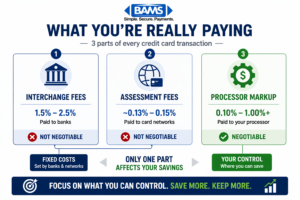
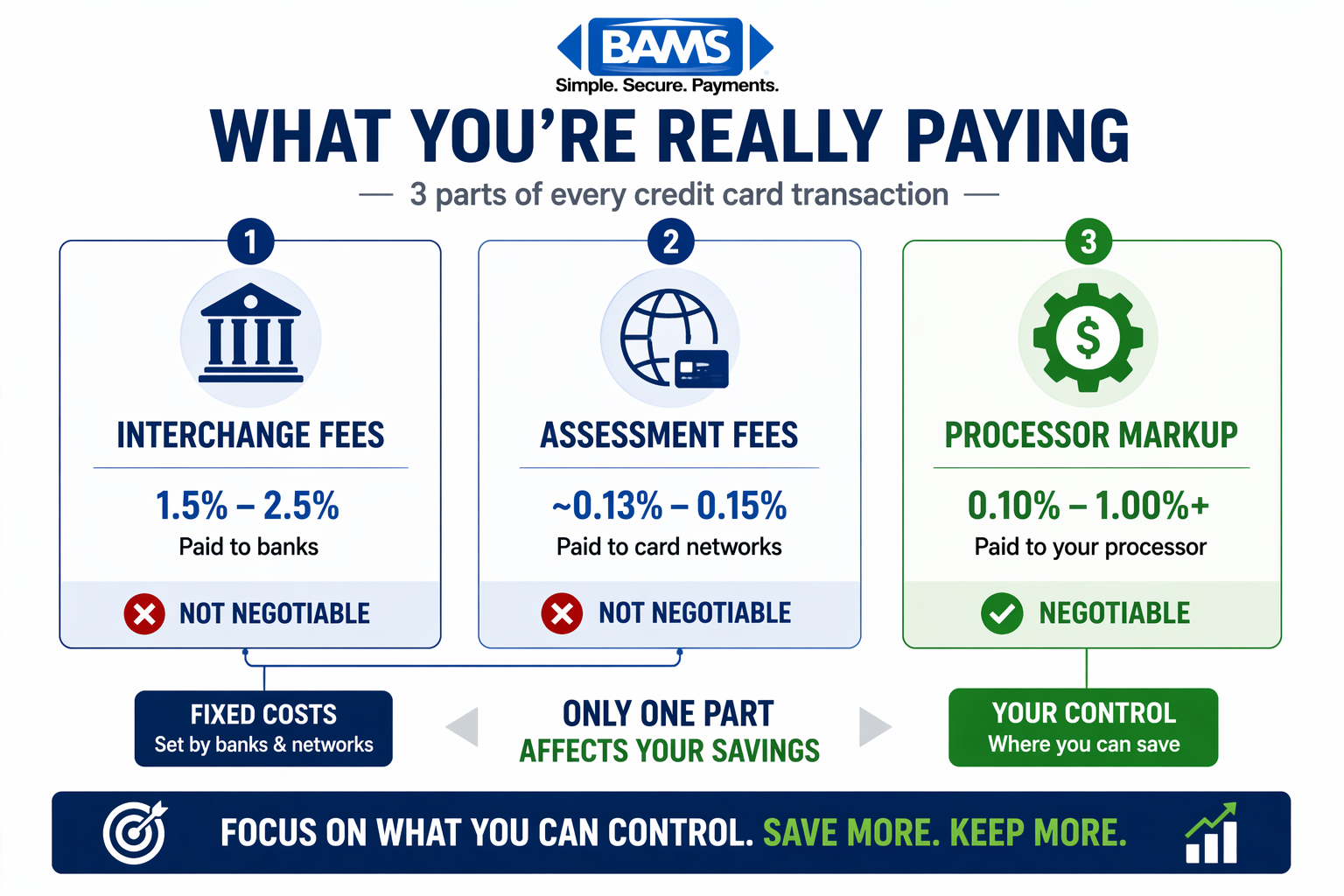
A simple breakdown of credit card processing fees, highlighting which costs are fixed and where businesses can negotiate to reduce expenses.
The Three-Part Fee Structure
Every credit card transaction involves three separate fees that combine into your total processing cost. Understanding each component is essential for identifying where you are overpaying.
Interchange fees go directly to the card-issuing bank. These are non-negotiable and set by Visa, Mastercard, and other networks. They typically range from 1.5% to 2.5% depending on card type, transaction method, and merchant category.
Assessment fees go to the card networks themselves. These are also fixed, usually 0.13% to 0.15% of the transaction. You cannot negotiate these rates.
Processor markup is what your payment processor charges for handling the transaction. This is where negotiation happens. Markups vary wildly, from 0.10% to over 1.00% depending on your processor and pricing model.
Each card transaction includes interchange, network assessments, and processor fees, which together determine the total cost of payment acceptance as outlined by Visa.
The Hidden Fee Problem
Beyond the core three-part structure, processors add fees that rarely appear in initial quotes. PCI compliance fees alone can add $500 to $2,000 annually, while statement fees, batch fees, and gateway fees compound the total.
Your effective rate (total fees divided by total sales) tells the real story. If your quoted rate is 2.5% but your effective rate is 3.4%, you are paying 36% more than expected.
The Strategic Fee Reduction Framework
Reducing processing costs requires a systematic approach across five stages: Audit, Analyze, Optimize, Negotiate, and Monitor. Each stage builds on the previous one.
The Audit stage reveals what you actually pay. The Analyze stage identifies which fees are negotiable versus fixed. The Optimize stage addresses operational changes that lower interchange costs. The Negotiate stage leverages your data to secure better terms. The Monitor stage ensures savings persist over time.
Most merchants skip directly to negotiation without completing the first three stages. This approach fails because you cannot negotiate effectively without knowing your true costs and which levers actually move.
Step 1: Audit Your Current Processing Costs
Objective
Calculate your true effective rate and identify every fee category on your merchant statement.
Execution Guidance
Pull your last three months of merchant statements. Calculate your effective rate by dividing total fees by total processing volume. If you processed $150,000 and paid $4,800 in fees, your effective rate is 3.2%.
Create a spreadsheet listing every fee line item. Categorize each as interchange, assessment, processor markup, or ancillary fee. Common ancillary fees include PCI compliance, statement fees, batch fees, gateway fees, and chargeback fees.
What to Avoid
Do not rely on your processor’s summary reports. They often obscure fee breakdowns. Do not assume your quoted rate equals your effective rate. Do not ignore small monthly fees, as they compound over time.
Success Indicators
You have completed this step when you can state your exact effective rate, list every fee category, and calculate the dollar amount for each. You should know precisely how much you paid in interchange versus processor markup.
Step 2: Analyze Your Fee Structure Type
Objective
Identify your current pricing model and determine if it serves your transaction profile.
Execution Guidance
Processors use three primary pricing models. Flat-rate pricing charges the same percentage on every transaction (common with Stripe and Square). Tiered pricing groups transactions into qualified, mid-qualified, and non-qualified buckets. Interchange-plus pricing passes through actual interchange costs plus a fixed markup.
Flat-rate pricing works for low-volume businesses with simple needs. Tiered pricing almost always favors the processor because they control which bucket each transaction lands in. Interchange-plus pricing offers transparency and typically delivers the lowest effective rate for established eCommerce businesses.
Review your statements to identify your model. Flat-rate shows identical percentages across transactions. Tiered shows different rates for different transaction types. Interchange-plus shows varying interchange fees plus a consistent markup.
What to Avoid
- Do not accept tiered pricing without understanding how transactions get categorized.
- Do not assume flat-rate is “simpler” if you process over $50,000 monthly, as the simplicity costs you money.
- Do not ignore the markup component in interchange-plus pricing.
Success Indicators
You can name your pricing model, explain how it affects your costs, and determine whether switching models would save money. You understand why interchange-plus typically benefits higher-volume merchants.
Step 3: Optimize Your Transaction Data Quality
Objective
Lower your interchange costs by ensuring transactions qualify for the best available rates.
Execution Guidance
Interchange rates vary based on transaction data quality. Card-not-present transactions (eCommerce) pay higher rates than card-present transactions. However, you can reduce rates by providing complete transaction data.
Ensure your payment gateway captures AVS (Address Verification Service) data for every transaction. Include Level 2 data (tax amount, customer code) for B2B transactions. Settle batches within 24 hours to avoid downgrades.
Use 3D Secure authentication (Verified by Visa, Mastercard SecureCode) to shift fraud liability and potentially qualify for lower interchange rates. This also reduces chargebacks, which carry their own fees.
What to Avoid
- Do not let transactions sit unsettled for multiple days.
- Do not skip AVS verification to speed checkout.
- Do not ignore Level 2/Level 3 data if you sell to businesses or government entities.
Success Indicators
Your downgrade rate (transactions that did not qualify for the best interchange tier) drops below 5%. Your chargeback rate stays under 0.5%. You see fewer “non-qualified” transactions on your statements.
Improving data quality often depends on your payment setup. Using an integrated payment gateway ensures accurate data transmission, faster settlement, and better qualification for lower interchange rates.
Step 4: Eliminate Hidden and Unnecessary Fees
Objective
Remove fees that provide no value or that you can avoid through operational changes.
Execution Guidance
Review your fee list from Step 1. Target these common unnecessary charges: PCI non-compliance fees (become compliant), statement fees (request electronic statements), minimum monthly fees (negotiate removal if you exceed minimums), and early termination fees (negotiate removal at contract renewal).
Completing your annual PCI Self-Assessment Questionnaire eliminates this charge entirely. Most processors provide free compliance tools.
Question every fee you do not understand. Ask your processor to explain the value provided. If they cannot justify it, request removal.
What to Avoid
- Do not pay PCI non-compliance fees when compliance takes 30 minutes annually.
- Do not accept “industry standard” as justification for fees.
- Do not assume all fees are non-negotiable.
Success Indicators
You have eliminated or reduced at least three ancillary fees. Your PCI compliance status shows current. Your monthly fee total (excluding interchange and assessment) has decreased.
Step 5: Negotiate Better Processor Terms
Objective
Use your audit data to secure lower processor markup and better contract terms.
Execution Guidance
Armed with your effective rate calculation and fee breakdown, contact your processor or request quotes from competitors. Focus negotiation on the processor markup, not interchange (which is fixed).
For interchange-plus pricing, target a markup of 0.15% to 0.25% plus $0.05 to $0.10 per transaction for established eCommerce businesses processing $100,000 or more monthly.
Request month-to-month terms instead of long-term contracts. Ask for fee waivers on setup, PCI compliance, and monthly minimums. Get all pricing in writing before signing.
What to Avoid
- Do not focus solely on the percentage rate while ignoring per-transaction fees.
- Do not sign contracts longer than one year.
- Do not accept verbal promises without written confirmation.
Success Indicators
You have reduced your processor markup by at least 0.10% to 0.20%. Your contract includes month-to-month terms or a clear exit clause. You have eliminated at least two ancillary fees through negotiation.
Step 6: Implement Ongoing Monitoring
Objective
Maintain visibility into processing costs and catch fee increases before they compound.
Execution Guidance
Calculate your effective rate monthly. Create a simple tracking spreadsheet with columns for processing volume, total fees, and effective rate. Flag any month where your effective rate increases by more than 0.10%.
Review interchange rate updates from Visa and Mastercard (typically April and October). These changes affect your costs even with interchange-plus pricing. Ensure your processor passes through actual rates without padding.
Schedule a quarterly review of your full fee breakdown. Processors occasionally add new fees or increase existing ones without prominent notice.
What to Avoid
- Do not assume your rates stay fixed after negotiation.
- Do not ignore processor communications about fee changes.
- Do not wait until annual review to check your effective rate.
Success Indicators
You track your effective rate monthly. You catch fee increases within 30 days of implementation. Your effective rate stays within 0.15% of your negotiated target.
Practical Application: Before and After
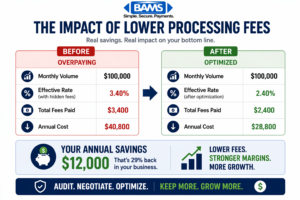
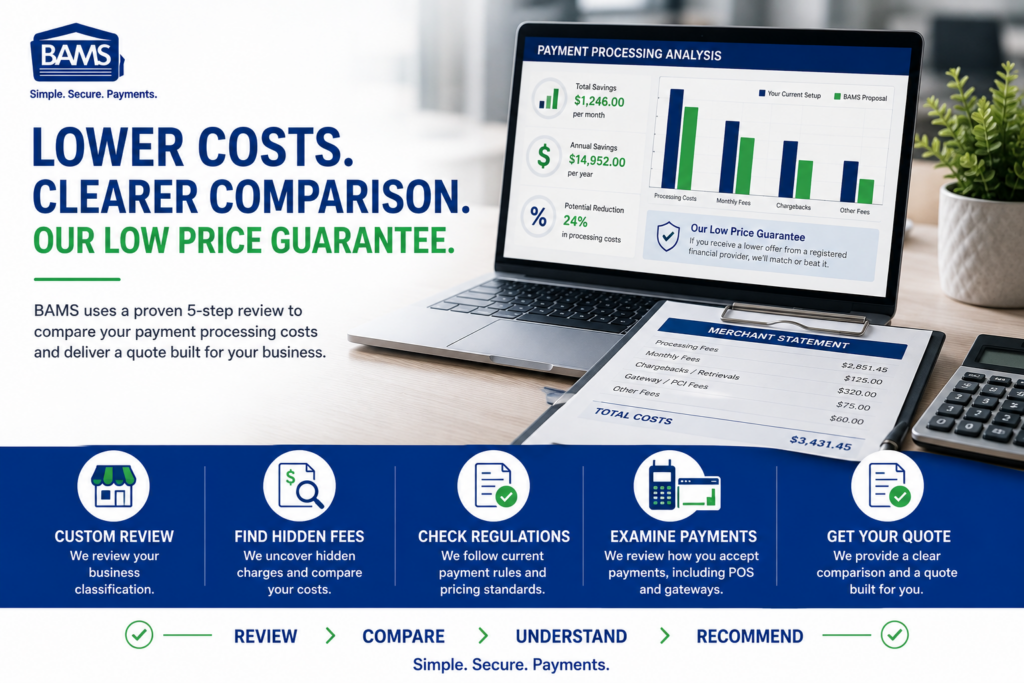
A before-and-after comparison showing how optimizing your processing setup can significantly reduce fees and improve margins.
Scenario: Mid-Size eCommerce Business
Consider an online retailer processing $150,000 monthly with a quoted rate of 2.7%. Before optimization, their monthly statement showed:
- Processing fees: $4,050 (2.7%)
- PCI non-compliance fee: $99
- Statement fee: $15
- Gateway fee: $25
- Batch fee: $30
- Total: $4,219 (2.81% effective rate)
After completing the framework, the same business achieved:
- Processing fees: $3,450 (2.3% on interchange-plus)
- PCI compliance: $0 (became compliant)
- Statement fee: $0 (electronic statements)
- Gateway fee: $25
- Batch fee: $0 (negotiated removal)
- Total: $3,475 (2.32% effective rate)
Monthly savings: $744. Annual savings: $8,928. The audit and negotiation process took approximately eight hours.
Common Mistakes That Inflate Processing Costs
Accepting the first quote. Processors expect negotiation. Your initial quote includes room for reduction.
Ignoring the effective rate. Focusing on quoted rates while ignoring actual costs leads to overpayment. Always calculate total fees divided by total volume.
Staying on tiered pricing. Tiered pricing benefits processors, not merchants. The qualification criteria are opaque and often unfavorable.
Neglecting PCI compliance. The compliance process takes 30 minutes. The non-compliance fee costs hundreds annually. This is the easiest fee to eliminate.
Signing long-term contracts. Three-year contracts with early termination fees lock you into rates that become uncompetitive. Month-to-month terms preserve your negotiating leverage.
What to Do Next
Start with your most recent merchant statement. Calculate your effective rate using the formula: total fees divided by total processing volume. That single number tells you whether you have work to do.
If your effective rate exceeds 3.0% and you process over $50,000 monthly, you likely have room for improvement. Begin the audit process outlined in Step 1.
Consider this guide a reference document. Return to it when your processor announces fee changes, when you renew your contract, or when your business volume changes significantly. Processing costs evolve, and your approach should too.
For businesses ready to reduce processing costs without the DIY approach, BAMS offers transparent interchange-plus pricing with dedicated account management. Their team handles the audit and negotiation process, typically reducing effective rates by 20% or more for qualifying merchants.
Frequently Asked Questions
What are credit card processing fees?
Credit card processing fees are charges merchants pay to accept card payments. They include three components: interchange fees paid to the card-issuing bank, assessment fees paid to card networks like Visa and Mastercard, and processor markup charged by your payment processor. Together, these typically total 2.5% to 3.5% of each transaction for eCommerce businesses.
Why do merchants have to pay processing fees for credit card transactions?
Processing fees cover the infrastructure and risk involved in card payments. Banks assume fraud risk and extend credit to cardholders. Card networks maintain the payment rails connecting millions of merchants and banks. Processors handle transaction routing, security, and settlement. Each party takes a cut for their role in enabling the transaction.
How are credit card processing fees determined?
Interchange fees are set by card networks based on factors including card type (rewards cards cost more), transaction method (card-not-present costs more), merchant category, and data quality. Assessment fees are fixed percentages set by networks. Processor markup depends on your negotiated agreement, processing volume, and pricing model.
Which types of transactions incur higher processing fees?
Rewards credit cards carry higher interchange than standard cards because issuers fund rewards through fees. Card-not-present transactions (online purchases) cost more than in-person swipes due to higher fraud risk. International cards, corporate cards, and transactions with incomplete data also incur premium rates.
How can businesses minimize their credit card processing fees?
Start by calculating your effective rate to understand true costs. Switch to interchange-plus pricing for transparency. Optimize transaction data quality to qualify for lower interchange tiers. Eliminate unnecessary fees like PCI non-compliance charges. Negotiate processor markup based on your volume and competitive quotes. Monitor costs monthly to catch increases early.
What is the difference between a surcharge and a convenience fee?
A surcharge is an additional charge applied specifically to credit card transactions to offset processing costs. A convenience fee is charged for using an alternative payment channel, like paying online instead of in person. Surcharges are prohibited in some states and by some card networks, while convenience fees have different regulatory requirements. Check your state laws and processor agreements before implementing either.