7 Ways Chargebacks Erode Your Funding Timeline
Last Updated on September 11, 2026 by Dimitri Akhrin
How reserve holds, batch delays, and processor risk flags quietly break your deposit schedule
Learn how chargeback activity disrupts your cash flow calendar long before disputes appear on a bank statement. This guide reveals the hidden cost of delayed deposits, from reserve increases to lost next-day funding eligibility.
TL;DR
- Chargebacks cost more than the lost transaction – Reserve or holdback requirements, funding delays and changing risk controls can reduce the cash available to your business beyond the value of the original dispute.
- Next-day funding advantages disappear under reserve pressure – Your deposits may still arrive on time, but if 10% or more is withheld in reserves, your effective funding speed is much slower than it appears.
- Set internal fraud and dispute alerts before risk levels become critical – Visa’s current monitoring framework evaluates fraud and disputes together rather than relying on the old standalone chargeback threshold. Ask your processor which current network and account-level criteria apply to you.
- Model reserve exposure before your processor imposes it – A simple scenario showing how a 5%, 10%, or 15% reserve affects weekly cash gives you the visibility to act before funding surprises hit.
- Processor transparency is your best defense – Ask your processor what chargeback ratio triggers funding changes, how much notice you’ll get, and whether a dedicated contact monitors your risk profile. If you can’t get clear answers, your cash flow predictability is already at risk.
Why Chargebacks Break Your Cash Flow Calendar Before They Hit Your Bank Statement
Most eCommerce managers track chargebacks as a line-item loss. A $169 dispute here, a $200 reversal there. But the real cost of delayed deposits from chargeback activity rarely shows up in your dispute dashboard. It shows up in the funding timeline your processor quietly adjusts behind the scenes.
When your chargeback ratio climbs, your processor responds with reserve holds, batch delays, and risk flags that erode the predictable cash flow your operations depend on. The transaction you lost is a known cost. The deposit you expected on Tuesday that arrives on Friday (or gets held for 90 days) is the cost that breaks your payroll cycle, stalls your inventory restock, and forces you onto a short-term credit line you didn’t budget for.
Mastercard projects global chargeback volume will grow 37% from 2025 to 2029, reaching about 359 million transactions annually. That’s not just a dispute-cost problem. Rising chargeback activity can also increase the operational and risk-management pressure surrounding merchant accounts.

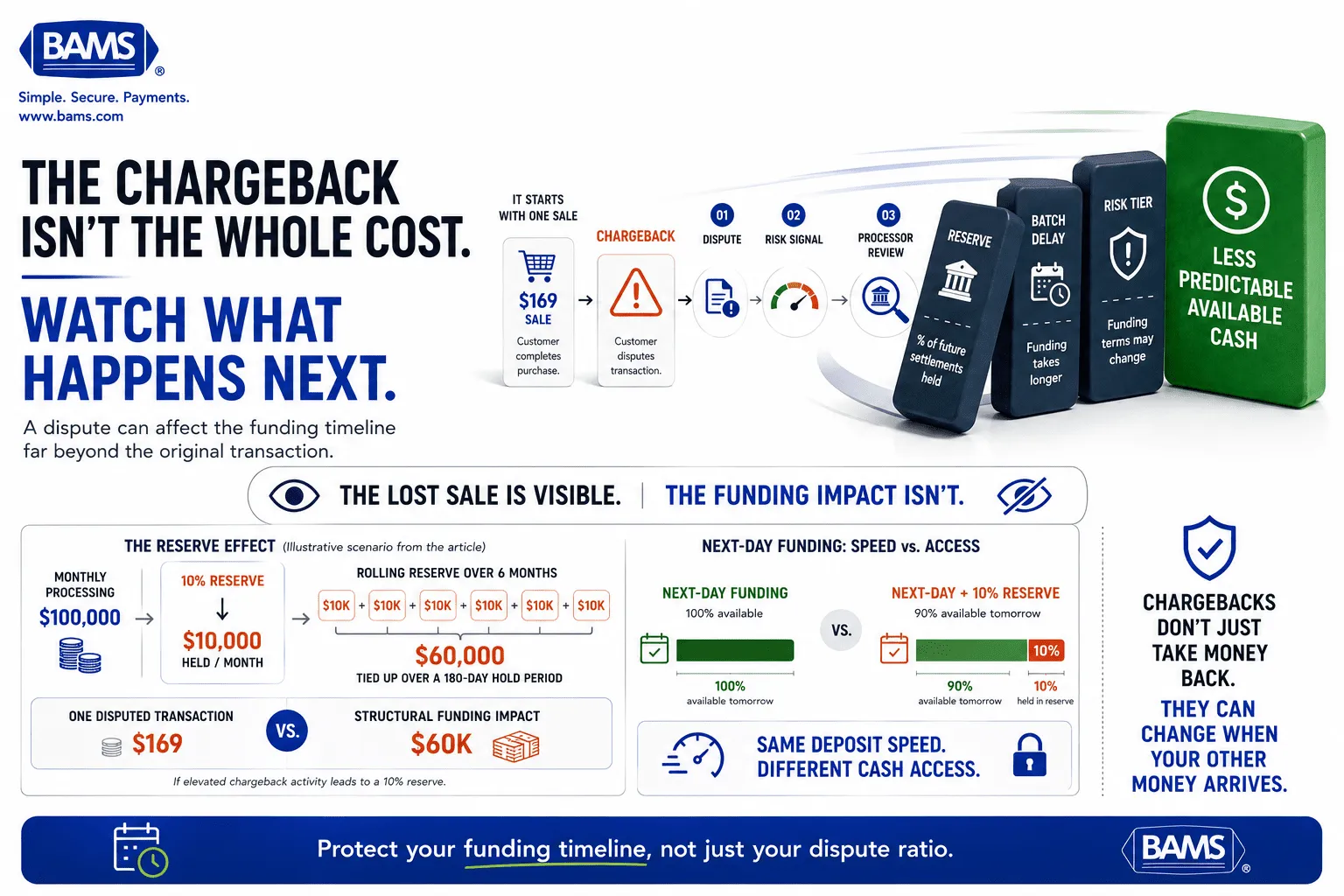
The cost of a chargeback can extend beyond the disputed transaction. Rising dispute activity can affect reserves, available cash and the predictability of future deposits.
What This List Covers (and What It Doesn’t)
This guide is for eCommerce managers running established online businesses who rely on predictable daily or next-day funding to time inventory purchases, supplier payments, and ad spend. If your cash flow planning assumes deposits land on a fixed schedule, every item here applies to you.
This is not a chargeback prevention checklist or a guide to winning disputes. Those matter, but they address the symptom. This list focuses on the upstream funding disruptions that chargebacks trigger: the reserve increases, batch timing failures, and processor risk reclassifications that silently reshape when your money actually arrives.
How These Items Were Selected
Each item below represents a specific mechanism through which chargeback activity disrupts funding predictability. Selection criteria: the disruption must affect deposit timing or available cash (not just dispute costs), it must be actionable at the merchant level, and it must be something most eCommerce operators either overlook or discover too late.
8 Ways Chargeback Activity Erodes Cash Flow Predictability
1. Rolling Reserve Escalation Locks Up Working Capital for Months
Why it matters: Chargeback activity can influence the risk controls applied to a merchant account, including reserve or holdback requirements. OCC guidance notes that acquirers may establish merchant reserve or holdback accounts to mitigate chargeback and credit risk, including by withholding a portion of daily proceeds. That directly reduces the cash available for payroll, ads and inventory.
What it looks like today:Some processors withhold 5% to 20% of settlement when chargeback ratios become elevated. On $100,000 in monthly revenue, a 10% reserve means $10,000 per month becomes illiquid. Over a 180-day hold period, that’s $60,000 in trapped capital.
How to apply it: Model reserve holds into your cash flow projections from day one, not after they’re imposed. Build a simple spreadsheet that calculates your available cash at current revenue minus a hypothetical 5%, 10%, and 15% reserve. Know your processor’s reserve trigger thresholds before you hit them.
2. Batch Timing Disruptions Delay Deposits Without Warning
Why it matters: Your deposit speed depends on clean batch settlement. When a batch contains flagged transactions or open disputes, processors may hold the entire batch for review rather than settling the clean transactions separately. One disputed transaction can delay funding for dozens of legitimate sales.
What it looks like today: Merchants on a next-day funding arrangement often assume every batch settles on the same timeline. In practice, batches containing transactions linked to active disputes or fraud alerts can be flagged for manual review, pushing settlement from one business day to three or more.
How to apply it: Optimize your transaction batching schedule to close batches at consistent times daily, and work with your processor to understand which dispute statuses trigger batch-level holds versus transaction-level holds. Separating high-risk product categories into distinct merchant IDs can isolate batch contamination.
3. Processor Risk Reclassification Changes Your Funding Tier
Why it matters: Processors assign merchants to risk tiers that determine deposit speed, reserve requirements, and processing rates. A sustained chargeback ratio increase can trigger reclassification from a standard-risk tier to a high-risk tier, fundamentally changing your funding terms without a contract renegotiation.
What it looks like today: Mastercard reports that first-party and third-party fraudulent chargebacks account for around 45% of merchant chargeback volume globally. That makes fraud and dispute activity an important part of the risk profile processors and acquirers monitor.
How to apply it: Ask your processor which fraud and dispute metrics affect your risk classification, reserve requirements and funding terms. Track those metrics regularly so you can respond to a negative trend before it leads to additional account controls.
4. Dispute Response Windows Create Invisible Cash Flow Gaps
Why it matters: A chargeback can reduce available cash while the dispute is being handled, creating a gap between recognized revenue and usable funds. Even when a merchant successfully challenges a dispute, the timing of the resolution can still affect short-term cash flow.
What it looks like today: Mastercard reports an average U.S. chargeback amount of $110. At 50 disputes in a month, that represents roughly $5,500 in disputed transaction value before considering additional operational or third-party costs associated with managing chargebacks.
How to apply it: Create a “disputed funds” line item in your weekly cash flow forecast. Track every open dispute by expected resolution date and model the funds as unavailable until resolution. This prevents you from spending money you technically have but can’t access.
5. Chargeback Monitoring Programs Add Fees That Compound Funding Pressure
Why it matters: Card-network monitoring has evolved beyond a single traditional chargeback ratio. Visa’s current Visa Acquirer Monitoring Program evaluates fraud and disputes together and monitors performance at both the acquirer and merchant levels. Excessive activity can therefore become a broader payment-risk issue rather than simply a dispute-management problem.
What it looks like today: Visa’s current framework also includes early-warning mechanisms designed to identify accounts approaching relevant program levels before they cross them. This makes trend monitoring more useful than relying on an outdated universal chargeback percentage.
How to apply it: Ask your processor which current network and internal risk metrics apply to your account. Set internal alerts below those levels and monitor the direction of fraud and dispute activity so you have time to investigate changes before they become a funding or compliance issue.
How to apply it: Set internal chargeback ratio alerts at 0.65% (well below the 0.9% Visa threshold). This gives you a 4-to-6-week intervention window before a monitoring program enrollment becomes likely. Treat the alert as a trigger to audit recent disputes, not as a passive metric.
6. Next-Day Funding Advantages Disappear When Reserves Increase
Why it matters: Next-day funding is one of the most effective tools for cash flow planning in eCommerce. But the speed advantage is neutralized when your processor increases reserves or adds conditional holds in response to chargeback activity. You still receive “next-day” deposits, but the deposited amount is reduced by the reserve percentage, making your actual available cash unpredictable.
What it looks like today: Many merchants still receive funds on a 1 to 3 business day settlement cycle, so any reserve increase on top of an already-slow timeline compounds the delay. Merchants who have optimized for next-day funding through partners like BAMS gain the most from protecting that speed, because even a small reserve hold erases a significant portion of the working capital advantage that faster deposits provide.
How to apply it: Calculate your “effective funding speed” by measuring not just when deposits arrive, but what percentage of your gross settlement actually lands. If you’re on next-day funding but 10% is held in reserve, your effective access to Tuesday’s sales isn’t Wednesday. It’s Wednesday for 90% and six months later for the rest.
7. Seasonal Chargeback Spikes Trigger Reserve Adjustments at the Worst Time
Why it matters: eCommerce businesses often see chargeback spikes 30 to 60 days after peak sales periods (holiday season, major promotions). This means reserve increases and funding restrictions hit during Q1 or post-promotion periods when cash flow is already under pressure from lower revenue and higher return rates.
What it looks like today: A merchant who processes $500,000 during a holiday push may see chargebacks from that period arrive in January and February. If the resulting ratio triggers a reserve increase, the processor withholds funds during the exact months when the business needs cash to cover supplier invoices, return processing costs, and reduced daily revenue.
How to apply it: Build a 90-day chargeback forecast tied to your promotional calendar. Use your own historical dispute rate from comparable sales periods to estimate likely exposure, then model how that activity could affect available cash. This gives you a business-specific forecast instead of relying on a universal industry percentage.
8. Lack of Processor Communication Turns Funding Changes Into Surprises
Why it matters: Many processors adjust funding terms, reserve requirements, or risk classifications through automated systems with minimal merchant notification. The first sign of a funding change is often a smaller-than-expected deposit, not a proactive call from your account manager. This turns a manageable adjustment into an operational crisis.
What it looks like today: eCommerce operators who work with processors offering dedicated account management and proactive chargeback defense receive advance warning when their metrics approach risk thresholds. BAMS, for example, pairs next-day funding with dedicated account managers who flag chargeback ratio trends before they trigger reserve changes. This turns a reactive problem into a plannable event.
How to apply it: Ask your processor three specific questions: (1) At what chargeback ratio will my reserve terms change? (2) How much advance notice will I receive before a funding adjustment? (3) Is there a dedicated contact who monitors my account’s risk profile? If you can’t get clear answers, that’s a signal your funding predictability is at risk.
The Pattern: Chargebacks Are a Funding Problem Disguised as a Dispute Problem

Chargebacks become a cash flow problem when dispute activity begins influencing processor risk decisions. Monitoring the chain upstream gives you more time to respond before funding terms change.
Across all eight items, a consistent pattern emerges: the direct cost of a chargeback (the lost transaction plus the fee) is the smallest part of the financial impact. The larger costs are structural. Reserve holds, batch delays, risk reclassification, and monitoring program fees all operate on different timelines than the original dispute, creating cash flow disruptions that are difficult to trace back to their source.
The businesses that maintain predictable cash flow despite rising chargeback volumes share two traits. First, they model chargebacks as a funding-forecast variable, not just a dispute metric. Second, they maintain processor relationships that provide transparency into how risk decisions affect settlement timing. The tradeoff is clear: invest time in upstream monitoring and processor communication, or pay the downstream cost in trapped capital and missed operational windows.
Where to Start: Prioritizing for Real-World Constraints
You don’t need to implement all eight items simultaneously. Start with three actions that provide the highest leverage with the least operational lift:
- Model your reserve exposure (Item 1): Build a simple scenario showing how a 5%, 10%, or 15% reserve would affect your weekly available cash. This takes an hour and changes how you think about chargeback risk.
- Set an internal fraud and dispute alert (Item 5): Base it on your processor’s current risk criteria and use it as an early warning when activity begins moving toward levels that could affect your account.
- Ask your processor the three questions from Item 8: The answers will tell you immediately whether your current funding arrangement is resilient or fragile.
From there, layer in batch timing optimization and seasonal forecasting as your monitoring systems mature. The goal isn’t zero chargebacks. It’s ensuring that the chargebacks you do receive never surprise your cash flow calendar.
Frequently Asked Questions
What is next-day funding in merchant services?
Next-day funding means your processor deposits the proceeds from your daily credit card transactions into your bank account by the next business day. This is faster than the standard 1 to 3 business day settlement cycle most processors offer. For eCommerce businesses, next-day funding reduces the gap between making a sale and having usable cash, which directly improves your ability to time inventory purchases, ad spend, and supplier payments.
How do chargebacks affect my deposit timing if I have next-day funding?
Chargebacks can erode next-day funding benefits in two ways. First, disputed amounts can reduce the funds available through current or future settlements. Second, rising fraud or dispute activity may lead your processor or acquirer to apply additional risk controls, including reserve or holdback requirements. Your deposits may still arrive on schedule while a smaller portion of your gross settlement remains immediately available.
What is a rolling reserve and when does it get triggered?
A reserve or holdback is money an acquirer or processor retains to help manage potential exposure from chargebacks and other merchant risks. The percentage, structure, release schedule and triggers depend on your merchant agreement and risk profile. Current network monitoring should not be reduced to the old Visa or Mastercard chargeback percentages, so ask your processor which criteria apply specifically to your account.
How does next-day funding improve cash flow planning for online retailers?
Next-day funding turns your daily sales into next-day working capital, which lets you operate on a predictable deposit calendar. This means you can time inventory reorders to match incoming cash, negotiate early-payment discounts with suppliers, and reduce or eliminate reliance on short-term credit lines. The key is maintaining the conditions (low chargeback ratios, clean batch settlement) that keep next-day funding uninterrupted.
When should a business consider switching to a processor that offers next-day funding?
Consider switching when your current settlement timeline (2 to 3 business days or longer) is forcing you to use credit lines or delay operational spending. If you’re regularly timing payroll, ad spend, or inventory purchases around deposit arrivals, faster funding directly reduces that friction. Also evaluate whether your current processor provides transparency into how chargebacks affect your funding terms, since speed without predictability doesn’t solve the underlying problem.
How can I optimize my batch timing for faster funding?
Close your transaction batches at the same time each day, ideally aligned with your processor’s settlement cutoff window. Batches submitted after the cutoff may not begin processing until the next business day, adding an extra day to your funding timeline. Additionally, work with your processor to understand whether disputed transactions within a batch trigger holds on the entire batch or only on the flagged transaction, and structure your batching accordingly.


