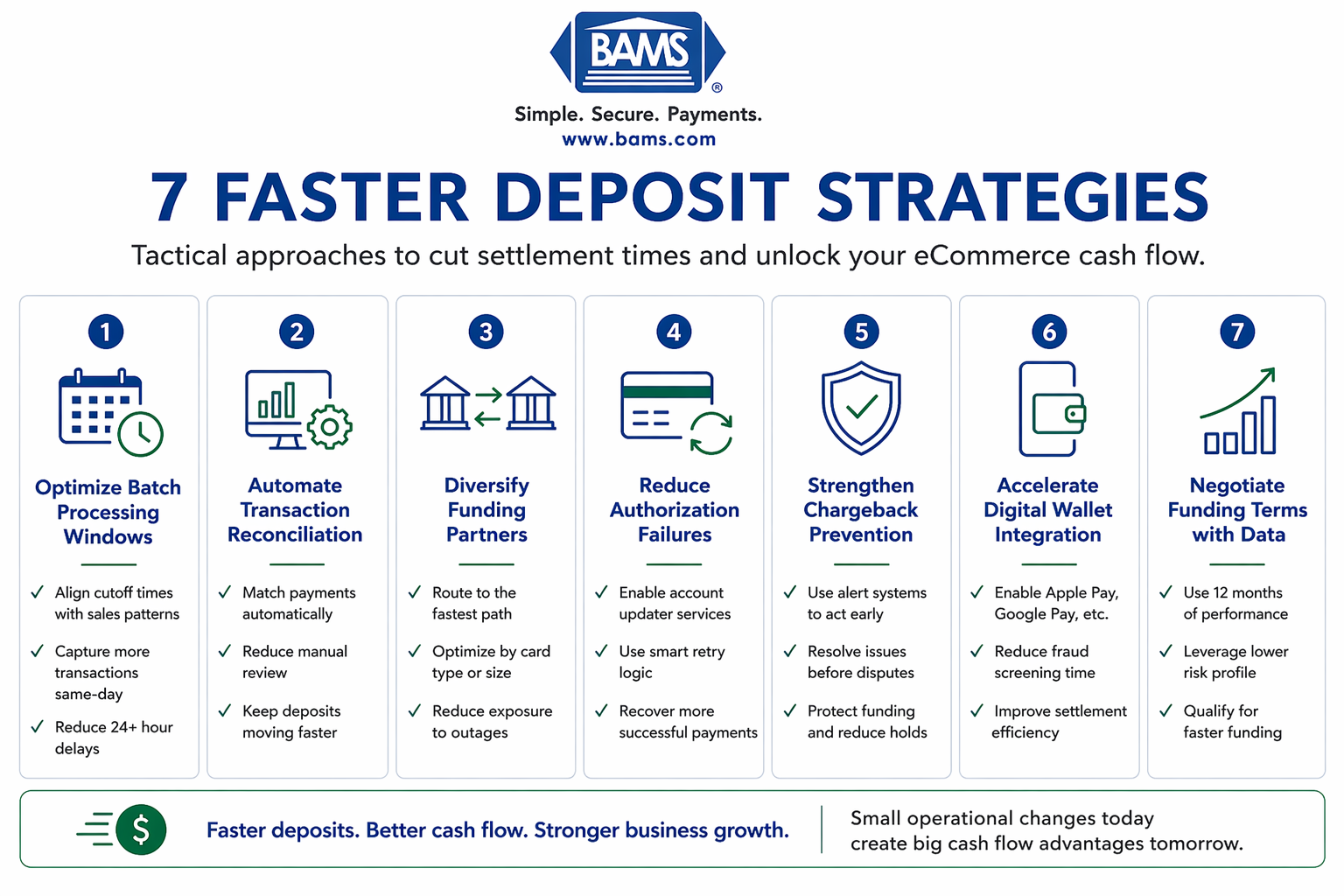
Faster Deposit Strategies for eCommerce Cash Flow
Last Updated on June 16, 2026 by Dimitri Akhrin
Tactical approaches to cut settlement times without adding operational complexity to your payment stack
Learn how to reduce the gap between earning revenue and accessing it. This guide covers specific bottlenecks in deposit timelines and practical fixes that work within your existing systems.
TL;DR
- Batch timing matters more than you think – Missing your processor’s daily cutoff by minutes adds 24 hours to deposits. Request evening batch windows that match eCommerce sales patterns.
- Authorization failures slow everything down – Enable account updater services and retry logic to recover failed transactions and reduce reconciliation exceptions that delay batch processing.
- Chargebacks impact funding terms, not just fees – High ratios trigger reserve requirements that lock portions of your deposits. Proactive alert systems prevent disputes from becoming chargebacks.
- Digital wallets can reduce friction – Apple Pay and Google Pay often create cleaner transaction flows that reduce fraud screening time and exception handling.
- Your performance data is negotiating leverage – If your chargeback rates and volume have improved since signing, you may qualify for next-day funding terms. Compile 12 months of metrics and request a review.
Why Delayed Deposits Cost More Than You Think
Your eCommerce business processed $47,000 in sales last week. The money sits somewhere between your customers’ banks and yours, unavailable for restocking inventory that’s running low or paying suppliers who offered early payment discounts.
This gap between earning revenue and accessing it creates a hidden tax on growth. According to Modern Treasury, businesses need better visibility into payment operations, reconciliation, and money movement to manage cash flow effectively. Delayed deposits force costly workarounds: credit lines, missed discounts, and stalled expansion plans.
Standard 3-5 day settlement timelines made sense when payment infrastructure moved slower. Today, waiting nearly a week for your own money often reflects outdated processing, not technical necessity.
What This Guide Covers (And What It Skips)
This guide targets eCommerce managers at established businesses with 10-50 employees who need faster deposit strategies without adding operational complexity. You already understand payment processing basics. You need tactical approaches that work within existing systems.
We skip generic advice about “shopping around for rates” or “negotiating with your processor.” Instead, each strategy addresses specific bottlenecks in the deposit timeline, from batch processing windows to funding partner selection.
The focus stays on cost-effective payment processing changes you can implement within current operations, not wholesale platform migrations.
How We Selected These Strategies
Each strategy meets three criteria: it directly reduces time-to-deposit, it works for mid-size eCommerce operations without enterprise-level resources, and it produces measurable results within 30-60 days. We excluded approaches requiring significant capital investment or specialized technical staff.
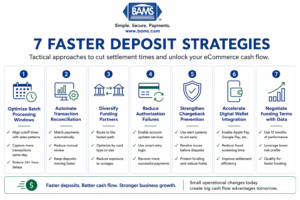
A visual framework of the seven operational strategies that reduce deposit delays and improve eCommerce cash flow performance.
1. Optimize Your Batch Processing Windows
Why It Matters
Most payment processors batch transactions once daily. Miss the cutoff by minutes, and your deposits wait an extra 24 hours. For businesses processing $500,000+ annually, this timing gap compounds into significant cash flow delays.
What It Looks Like Today
Modern processors offer flexible batch windows, some as late as 9:00 PM local time. Older arrangements often default to early afternoon cutoffs designed for brick-and-mortar retail patterns, not eCommerce operations where peak sales happen evenings and weekends.
How to Apply It
Audit your current batch cutoff time against your sales patterns. If 40% of daily transactions occur after your batch closes, you’re adding a day to nearly half your deposits. Request a later cutoff or switch to a processor offering evening batch windows. Track the percentage of transactions captured in same-day batches before and after the change.
2. Implement Automated Transaction Reconciliation
Why It Matters
Manual reconciliation creates bottlenecks. When discrepancies require human review, deposits pause. Payment security enhancements that automate matching between orders, payments, and bank deposits eliminate these friction points.
What It Looks Like Today
Automated reconciliation tools now handle exception management that previously required accounting staff. This helps mid-size businesses reduce manual review and keep deposit workflows moving.
How to Apply It
Connect your payment gateway to accounting software with automated matching rules. Set tolerance thresholds for minor discrepancies (shipping adjustments, partial refunds) that don’t require manual review. Reserve human attention for genuine anomalies. Target 95%+ automatic reconciliation within 60 days of implementation.
3. Diversify Funding Partners Strategically
Why It Matters
Single-processor dependency means their infrastructure problems become your cash flow problems. Diversification isn’t about redundancy; it’s about routing transactions through the fastest available path.
What It Looks Like Today
Multi-processor setups route transactions based on card type, transaction size, or time of day. High-value B2B transactions might flow through processors offering Level 3 processing rates, while consumer transactions route to partners with faster settlement.
How to Apply It
Identify your top three transaction categories by volume and value. Evaluate whether your current processor optimizes for each category or applies one-size-fits-all processing. Add a secondary processor for your highest-volume category if settlement times or rates differ meaningfully.
4. Reduce Authorization Failures Proactively
Why It Matters
Failed authorizations don’t just lose sales; they create reconciliation exceptions that slow deposits for successful transactions. Each declined transaction requires investigation before batch processing completes.
What It Looks Like Today
Network tokenization, account updater services, and intelligent retry logic recover transactions that would have failed with static card data. These tools address recurring payment failures caused by expired or replaced cards.
How to Apply It
Enable account updater services through your processor to automatically refresh stored card credentials. Implement retry logic with optimal timing (failed morning transactions often succeed in evening attempts when daily limits reset). Monitor authorization rate improvement monthly, targeting 2-3% gains in the first quarter.
5. Strengthen Chargeback Prevention Systems
Why It Matters
Chargebacks don’t just cost fees and lost revenue. They trigger reserve requirements that lock portions of your deposits. High chargeback ratios can shift you to delayed funding tiers or mandatory rolling reserves.
What It Looks Like Today
Prevention has shifted from reactive dispute response to proactive alert systems. Visa explains that early dispute visibility helps merchants address issues before they escalate into chargebacks that affect performance and funding terms.
How to Apply It
Enroll in chargeback alert networks through your processor. Set automated refund thresholds for disputes below certain amounts where fighting costs more than conceding. Review your PCI compliance status to ensure payment security enhancements don’t create gaps that increase fraud-related chargebacks. Target chargeback ratios below 0.5% to maintain optimal funding terms.
6. Accelerate Digital Wallet Integration
Why It Matters
Digital wallet transactions (Apple Pay, Google Pay, Shop Pay) often create cleaner payment data than traditional card entry. They also carry lower fraud rates, reducing the security holds and exception handling that can slow deposits.
What It Looks Like Today
Digital wallet acceptance is now a core part of modern checkout optimization. These payment methods use tokenization that can reduce fraud screening time and simplify payment handling.
How to Apply It
Audit your checkout flow for digital wallet prominence. Move wallet options above manual card entry. Track the percentage of transactions through each method and compare settlement times.
7. Negotiate Funding Terms Based on Performance Data
Why It Matters
Processors assess risk based on historical data. If your chargeback rates, average ticket size, and business tenure have improved since you signed, you’re likely overpaying in delayed funding terms that no longer match your risk profile.
What It Looks Like Today
In higher-rate environments, the cost of delayed deposits becomes more noticeable. Processors increasingly offer tiered funding based on demonstrated performance rather than industry averages.
How to Apply It
Compile 12 months of processing data: chargeback ratio, average transaction value, refund rate, and monthly volume consistency. Request a funding terms review with specific data points demonstrating reduced risk. Target guaranteed next-day funding if your metrics support it. If your current processor won’t adjust terms, this data package can also speed up conversations with alternative providers.
The Pattern Across These Strategies
Each approach addresses one of three bottlenecks: timing (when transactions enter the settlement pipeline), exceptions (what triggers manual review), or terms (what funding speed your risk profile supports).
The strategies compound. Faster batch windows mean nothing if chargebacks trigger reserve holds. Automated reconciliation accelerates deposits only when authorization rates minimize exceptions requiring review. Cost-effective payment processing emerges from optimizing the entire flow, not isolated improvements.
Notice that none of these strategies require switching your entire payment stack. They’re modular improvements to existing operations, each measurable within 30-60 days.
Where to Start Without Overwhelming Your Team
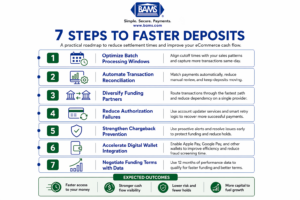
A step-by-step roadmap to reduce settlement delays and unlock faster access to revenue for eCommerce operations.
Begin with strategies 1 and 4: batch timing optimization and authorization rate improvement. These require minimal implementation effort and produce measurable results within 30 days.
Add chargeback prevention (strategy 5) in month two. The combination of faster batching, fewer failed transactions, and reduced chargebacks creates the performance data needed for strategy 7’s funding term negotiations.
Reserve digital wallet expansion and processor diversification for quarter two, when you have baseline metrics showing the impact of initial changes. Not every business needs all seven strategies. Select based on where your current deposits lose the most time.
Frequently Asked Questions
What are faster deposit strategies in merchant services?
Faster deposit strategies are specific operational changes that reduce the time between when a customer pays and when funds reach your bank account. These include optimizing batch processing windows, using processors with next-day funding, automating reconciliation to eliminate manual review delays, and maintaining low chargeback ratios to avoid reserve requirements that hold portions of your deposits.
How can I improve my payment authorization rates?
Enable account updater services to automatically refresh expired card credentials. Implement intelligent retry logic that attempts failed transactions at optimal times. Use network tokenization for stored payment methods. These changes typically improve authorization rates within the first quarter, directly reducing reconciliation exceptions that slow deposits.
What role does fraud protection play in payment optimization?
Strong fraud protection reduces chargebacks, which directly impacts your funding terms. High chargeback ratios can trigger reserve requirements where processors hold portions of your deposits as security. They can also move you to delayed funding tiers. Proactive fraud prevention through address verification, CVV matching, and chargeback alert services keeps your ratio low and your deposits flowing at standard speed.
When should I consider expanding my payment options?
Expand payment options when you see meaningful settlement or approval differences between payment methods. Digital wallets can reduce manual entry friction and create cleaner payment signals. If your checkout flow buries wallet options below manual entry, you’re adding unnecessary friction to the payment experience.
Which payment processing fees can I reduce to optimize costs?
Focus on interchange optimization through proper transaction categorization. B2B transactions qualifying for Level 3 processing rates can lower transaction costs. Review your pricing model to ensure you’re not overpaying on debit transactions. Reducing chargebacks also helps eliminate dispute fees and reserve-related costs.
How long does it take to see results from deposit optimization strategies?
Batch timing changes can show immediate results once your processor updates the cutoff window. Authorization rate improvements typically show measurable gains within 30 days. Chargeback prevention often takes 60-90 days to affect your ratio meaningfully since processors calculate ratios on rolling periods. Funding term renegotiations usually require a longer performance window to support your case.
Sources