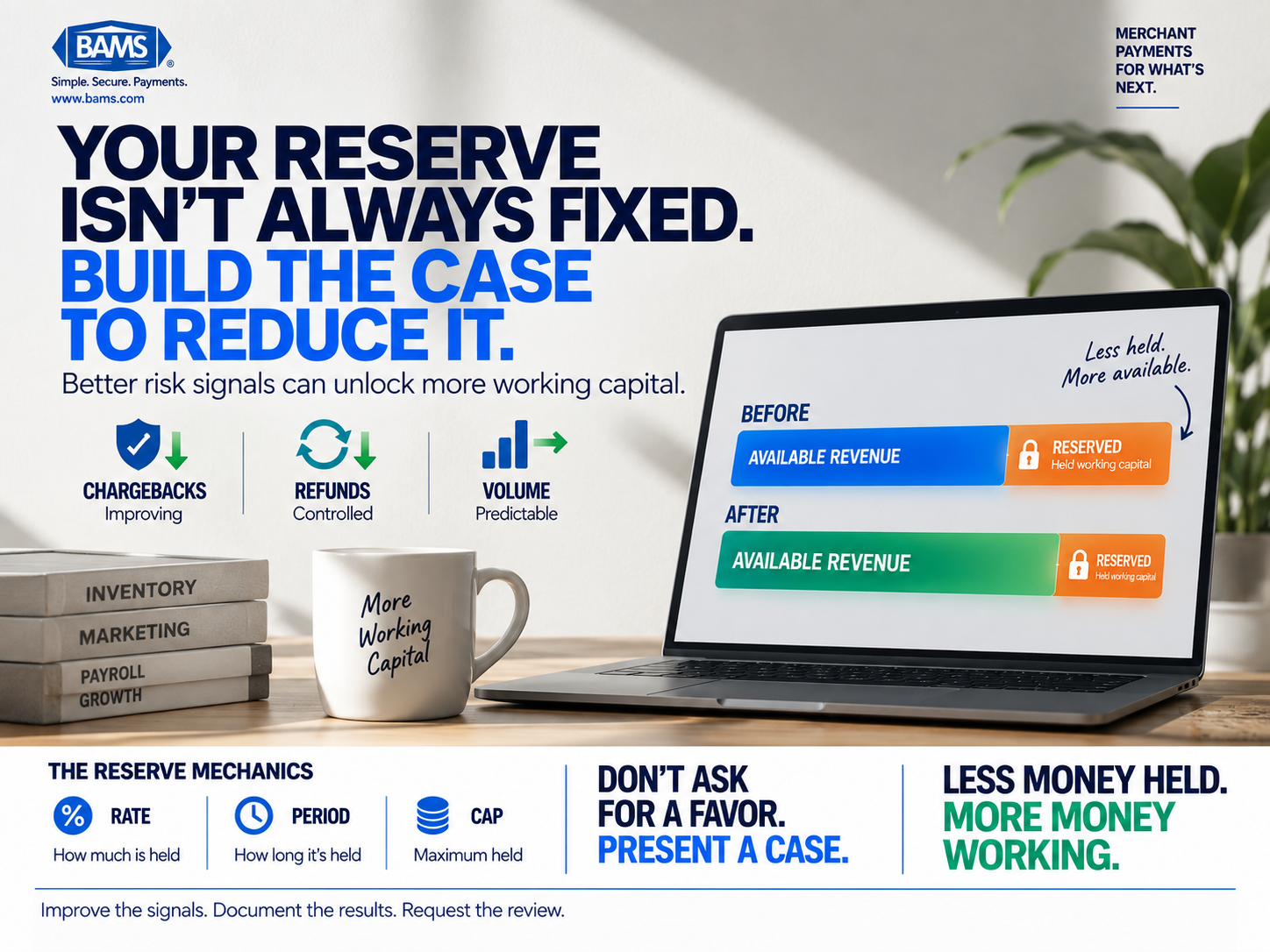
How to Reduce Rolling Reserves for Ecommerce
Last Updated on September 21, 2026 by Dimitri Akhrin
Manage chargeback ratios, hit release milestones, and unlock trapped working capital faster
Learn which operational metrics processors use to set rolling reserve percentages and how to improve them. This guide covers chargeback ratio management, reserve release schedule milestones, and concrete steps to lower your hold rates.
TL;DR
- Your reserve percentage is negotiable — Processors reassess reserve terms based on your operational performance, not just your industry category. Treating reserves as fixed leaves working capital unnecessarily locked up.
- Chargeback ratio is the primary lever — Maintaining a ratio below 0.65% for six or more consecutive months is the strongest evidence you can present when requesting a reserve reduction. Fix dispute root causes before requesting a review.
- Build a formal review package — Don’t just call and ask. Present three to six months of chargeback, refund, and volume data with a specific reduction request. Processors respond to evidence, not requests.
- Get your reserve release schedule in writing — Verbal promises don’t survive staff turnover. Secure documented milestones (e.g., step-down from 10% to 5% now, full release review at twelve months) as part of your processing agreement.
- Monitor monthly to protect your gains — Reserve reductions can be reversed if your metrics deteriorate. Set a recurring monthly review of chargeback ratio, refund rate, and volume trends to catch problems before they trigger a reserve increase.
Guide Orientation: What This Covers and Who It’s For
This guide explains how eCommerce merchants can actively reduce their rolling reserves by managing the operational signals that processors use to set (and adjust) hold percentages. If you run an established online business and a chunk of your revenue sits locked in a reserve account each month, this is for you.
By the end, you’ll understand exactly which metrics processors watch, how to build a track record that earns lower holds, and how to approach your reserve release schedule as a concrete milestone rather than an abstract hope. We focus on mainstream eCommerce businesses, not just high-risk verticals.
This guide does not cover initial underwriting decisions or how to get approved for a merchant account. It starts after you already have one and want to improve its terms.
Why Rolling Reserves Matter More Than You Think
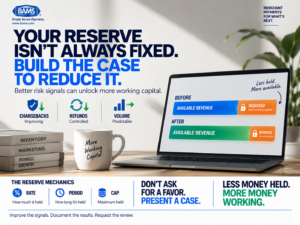
Rolling reserves are not necessarily permanent. Stronger payment performance and documented operating history can give merchants evidence to request lower holds and unlock more working capital.
Most eCommerce managers first encounter reserves during a growth phase. Sales climb, processing volume increases, and suddenly 5% to 10% of monthly revenue stops arriving on schedule. That held capital isn’t a fee you can write off. It’s your working capital, trapped in a rolling cycle that quietly constrains inventory purchases, marketing spend, and payroll timing.
The cost compounds quickly. OCC guidance recognizes merchant reserve and holdback accounts as tools acquirers use to manage merchant processing risk. For a business processing $200,000 per month, even a 5% reserve means $10,000 is out of reach as funds cycle through the reserve. At 10%, that’s $20,000 tied up in working capital.
The critical insight most merchants miss: your reserve percentage is not fixed. Processors set it based on risk signals they reassess periodically. Chargeback ratio management, transaction consistency, and proactive communication all influence whether your hold goes up, stays flat, or comes down. Treating reserves as a static cost of doing business means leaving cash on the table indefinitely.
The merchants who reduce their reserves fastest are the ones who treat the reserve as an operational outcome they can influence, not a processor favor they need to beg for.
Core Concepts: Reserves, Risk Signals, and Release Mechanics
What a Rolling Reserve Actually Is
A rolling reserve is a percentage of your processed sales that your payment processor holds in a separate account for a defined period. It exists to cover potential chargebacks, refunds, or fraud losses. After the hold period expires (typically 30 to 180 days), those funds release back to you on a rolling basis.
This is not a fee. The money is still yours. But it’s inaccessible during the hold window, which creates a real cash flow gap that grows proportionally with your sales volume.
The Difference Between Reserve Rate and Reserve Cap
Your reserve rate is the percentage withheld from each batch (e.g., 10% of daily settlements). Your reserve cap is the maximum total amount the processor will hold at any time. Some agreements include a cap; many don’t. Understanding whether your agreement has a cap, and at what amount, determines how much total cash exposure you carry.
How Processors Decide Your Terms
Reserve decisions aren’t based on a single performance metric. OCC guidance calls for ongoing merchant reviews that consider factors such as transaction trends, returns and chargebacks and also evaluates how merchant reserves are established and reviewed. This means two merchants in the same industry can have different reserve terms based on their individual risk and operating history.
Common Misconception: Reserves Are Permanent
Many merchants assume their initial reserve terms are locked for the life of the account. They aren’t. Processors reassess risk periodically, and merchants can request formal reviews. The key is knowing what evidence to present and when to ask.
The Framework: Four Phases of Reserve Reduction
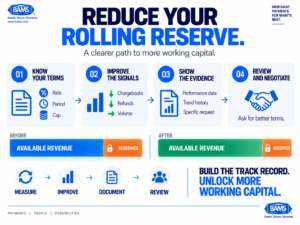
Reducing rolling reserves starts with understanding your current terms, improving the risk signals behind them and presenting documented evidence when requesting a processor review.
Reserve reduction follows a predictable path. Think of it as four interconnected phases, each building on the last:
- Phase 1: Baseline Assessment — Understand your current reserve terms, the metrics driving them, and your processor’s review cadence.
- Phase 2: Signal Improvement — Systematically improve the risk signals (chargeback ratio, refund patterns, transaction consistency) that processors use to justify holds.
- Phase 3: Documentation and Review Request — Compile your performance data and formally request a reserve reduction with evidence.
- Phase 4: Ongoing Maintenance — Protect your improved terms by monitoring the same signals continuously and catching regressions early.
Each phase has specific actions, timelines, and success criteria. The rest of this guide breaks them down.
Step-by-Step: How to Reduce Your Reserve Requirements
Step 1: Audit Your Current Reserve Agreement
Objective: Know exactly what you’re working with before trying to change it.
Pull your merchant processing agreement and locate the reserve clause. Identify four numbers: your reserve rate (percentage withheld), the hold period (days before release), any reserve cap (maximum total held), and the review schedule (if stated). Many merchants have never read this section of their agreement, which means they’re managing blind.
Next, calculate your actual cash flow impact. Multiply your average monthly processing volume by the reserve rate. That’s the amount perpetually locked. If you process $150,000/month at a 10% reserve with a 180-day hold, roughly $90,000 of your revenue is inaccessible at any given time. Seeing the real number changes how urgently you approach the next steps.
What to avoid: Don’t assume your reserve terms match what you were told verbally at onboarding. Verbal agreements don’t govern; the signed processing agreement does. As covered in this breakdown of how information gaps at onboarding create funding problems, incomplete documentation at setup often leads to more restrictive default terms.
Success indicator: You can state your exact reserve rate, hold period, cap (or lack thereof), and the dollar amount currently held without checking your agreement.
Step 2: Map Your Chargeback Ratio and Dispute Trends
Objective: Establish a clean, documented chargeback trajectory that supports a reduction request.
Your chargeback ratio is one of the most important metrics in reserve and risk decisions. Mastercard operates an Excessive Chargeback Program that monitors merchant chargeback performance on an ongoing basis. Visa’s VAMP framework similarly monitors fraud and dispute performance and requires remediation when applicable program thresholds are exceeded. Maintaining a consistently low and improving dispute ratio gives you a stronger case when requesting lower reserve requirements.
Pull your chargeback data for the last six months minimum. Calculate your ratio for each month (total chargebacks divided by total transactions). What you want to see is a stable or declining trend. A single spike three months ago, even if you’ve recovered, weakens your position. Processors look for consistency.
If your ratio is above 0.75%, focus on building a chargeback prevention system before requesting a review. Alerts, descriptor optimization, and evidence collection can reduce chargebacks by 40-60% within 90 days when implemented systematically.
What to avoid: Don’t cherry-pick your best months. Processors will pull their own data. If your numbers don’t match, you lose credibility. Also avoid focusing only on won disputes. Processors care about total disputes filed, not just losses.
Success indicator: You have a month-by-month chargeback ratio chart showing a stable trend below 0.65% for at least three consecutive months.
Step 3: Stabilize Transaction Patterns and Refund Rates
Objective: Remove the secondary risk signals that keep your reserve elevated even when chargebacks are low.
Chargeback ratio gets the most attention, but processors also watch transaction pattern volatility and refund rates. A sudden 300% spike in processing volume (common during promotions or seasonal peaks) can trigger a reserve increase even if chargebacks stay flat. The processor sees unpredictable volume as unpredictable risk.
To stabilize patterns, notify your processor before major promotions or seasonal volume changes. This sounds simple, but most merchants don’t do it. A five-minute email or call to your account manager saying “We expect volume to double next month due to a product launch” reframes the spike as planned growth rather than an anomaly. As explored in this analysis of how authorization rates affect risk scoring, processor algorithms interpret sudden changes as elevated risk unless context is provided.
Refund rates matter too. High refund percentages signal product or fulfillment problems. Processors view them as leading indicators of future chargebacks. Track your refund rate monthly and investigate any month where it exceeds 3-5% of transactions. Common fixes include improving product descriptions, tightening quality control, and setting clearer delivery expectations.
What to avoid: Don’t suppress legitimate refunds to improve your numbers. Refused refunds convert directly into chargebacks, which are far more damaging to your reserve terms than refunds ever were.
Success indicator: Your monthly processing volume varies by less than 30% month-over-month (or spikes are pre-communicated), and your refund rate stays below 3%.
Step 4: Build Your Reserve Review Package
Objective: Assemble the evidence that makes a processor’s risk team comfortable reducing your hold.
This is where most merchants fail. They call their processor and say, “Can you lower my reserve?” That’s a request with no supporting argument. Instead, build a formal review package that does the risk team’s analysis for them.
Your package should include: three to six months of chargeback ratio data (showing a stable, low trend), your refund rate trend over the same period, a summary of any chargeback prevention tools or processes you’ve implemented, your processing volume trend (showing predictable growth), and a specific request (e.g., reduce from 10% to 5%, or shorten the hold from 180 days to 90 days).
The specific request matters. OCC guidance recognizes that merchant reserves should be reviewed and that reserve funds should be released according to the terms of the merchant agreement. Your request might be to reduce a 10% reserve to 5%, shorten the hold period or establish a defined future review milestone. Asking for a concrete change, rather than “whatever you can do,” gives the risk team a clear proposal to evaluate.
If your processor offers dedicated account management, this is the time to leverage that relationship. Providers like BAMS, which pair merchants with dedicated account managers, make this process significantly smoother because your manager already understands your business context and can advocate internally on your behalf.
What to avoid: Don’t request a review before you have at least three months (ideally six) of clean data. A premature request that gets denied makes the next request harder. Don’t threaten to leave your processor as leverage; it rarely works and can trigger defensive holds.
Success indicator: You have a one-page summary with supporting data that any risk analyst could review in under five minutes and reach a clear conclusion.
Step 5: Negotiate the Reserve Release Schedule
Objective: Secure a written release schedule with defined milestones, not just a verbal promise.
Even if your processor agrees to reduce your reserve, the terms of that reduction matter enormously. A vague “we’ll review again in six months” is not the same as “reserve drops to 5% effective next billing cycle, with a full release review at the twelve-month mark.”
Push for a reserve release schedule that includes specific dates or milestones. A good schedule looks like this: current rate drops from 10% to 5% immediately, hold period shortens from 180 to 90 days, full reserve release review after twelve consecutive months below 0.5% chargeback ratio. Get it in writing as an amendment to your processing agreement or in a formal email from your account manager.
If your processor won’t commit to a written schedule, that’s a signal worth noting. It may indicate that their risk policies are inflexible or that your account doesn’t have the internal advocacy it needs. This is one area where the quality of your merchant services relationship becomes tangible. Processors with proactive account management and transparent chargeback risk management practices are more likely to formalize step-down terms.
What to avoid: Don’t accept a verbal agreement without documentation. Personnel changes at processors happen regularly, and verbal commitments don’t survive staff turnover. Also don’t agree to conditions you can’t maintain (e.g., a chargeback ratio below 0.1% for twelve months) just to get the reduction.
Success indicator: You have a written document specifying your new reserve rate, hold period, and the conditions or timeline for the next review.
Step 6: Monitor and Protect Your Improved Terms
Objective: Prevent backsliding that triggers a reserve increase.
Securing a lower reserve is not the finish line. Processors can (and do) increase reserves if your risk profile deteriorates. A single bad month won’t usually trigger an increase, but two or three months of rising chargebacks, a fraud incident, or a sudden volume spike without communication can reverse months of progress.
Set up a monthly review cadence. On the first business day of each month, check three numbers: your chargeback ratio, your refund rate, and your processing volume trend. If any metric moves in the wrong direction, investigate immediately rather than waiting to see if it self-corrects.
Invest in early warning systems. Chargeback alerts from services like Verifi or Ethoca notify you of disputes before they become formal chargebacks, giving you a window to issue refunds and keep your ratio clean. BAMS offers proactive chargeback defense as part of their merchant services, which can catch disputes before they escalate into ratio problems that affect your reserve terms.
What to avoid: Don’t treat reserve reduction as a one-time project. The merchants who maintain low or zero reserves are the ones who built monitoring into their monthly operations permanently. Also don’t ignore small upticks. A chargeback ratio that creeps from 0.4% to 0.6% over three months is a trend, not noise.
Success indicator: You have a recurring calendar event for monthly metric review, and you can identify the cause of any chargeback ratio increase within 48 hours of detecting it.
Practical Examples: Reserve Reduction in Context
Scenario A: The Seasonal eCommerce Brand
A home goods retailer processes $120,000/month with a 10% rolling reserve and a 180-day hold. During holiday season, volume jumps to $350,000. The processor, seeing a 190% spike with no advance notice, increases the reserve to 15%. The merchant now has over $100,000 locked up during their most capital-intensive quarter.
The fix: the merchant pre-communicates the seasonal pattern with historical data, showing that this spike happens every year with no corresponding chargeback increase. After the season, they present six months of clean data and request a step-down to 5% with a 90-day hold. The processor agrees, and the merchant recovers roughly $50,000 in accessible working capital.
Scenario B: The Subscription Box Company
A subscription business processes $80,000/month with a 7% reserve. Their chargeback ratio hovers around 0.8%, driven primarily by customers who forget they subscribed. Rather than requesting a reserve review with that ratio, they first implement clear billing descriptors, pre-charge email reminders, and a simplified cancellation flow. Over four months, their ratio drops to 0.35%. They then submit a review package and secure a reduction to 3% with a path to zero at twelve months.
The lesson: fixing the root cause of chargebacks before requesting a review produces dramatically better outcomes than asking for leniency while the problem persists.
Common Mistakes and Pitfalls
- Requesting a review too early. Three months of clean data feels like enough. It usually isn’t. Six months is the minimum most risk teams take seriously. Patience here saves you from a denied request that makes the next one harder.
- Focusing only on chargebacks while ignoring refund rates. A 0.3% chargeback ratio with a 12% refund rate still signals fulfillment or product problems. Processors see refunds as a leading indicator.
- Not reading the reserve clause in your agreement. You cannot negotiate what you don’t understand. Some agreements include automatic step-down provisions that merchants never trigger simply because they didn’t know to ask.
- Treating the processor as an adversary. Processors don’t hold reserves to punish you. They hold reserves to manage financial exposure. When you present data that reduces their exposure, reducing your reserve becomes a straightforward business decision for them.
- Assuming all processors handle reserves identically. Reserve policies, review flexibility, and willingness to formalize step-down schedules vary significantly between providers. If your current processor won’t engage on reserve terms after twelve months of clean performance, that’s a data point about the relationship.
What to Do Next
Start with Step 1. Pull your processing agreement today and identify your current reserve rate, hold period, and cap. Calculate the actual dollar amount sitting in your reserve right now. That number is your motivation.
If your chargeback ratio is already below 0.65% and you have six months of stable data, you may be ready to build your review package this week. If your ratio needs work first, focus on the prevention fundamentals and set a calendar reminder to revisit this guide in 90 days.
Reserve reduction is incremental. You likely won’t go from 10% to zero in a single conversation. But moving from 10% to 5%, or shortening your hold from 180 days to 90, can free up tens of thousands of dollars in working capital. That’s real money you can reinvest in growth rather than leaving it locked in a processor’s holding account.
Revisit your metrics monthly. Treat this guide as a reference you return to before each review request, not a checklist you complete once. The merchants who maintain the best reserve terms are the ones who made monitoring a habit, not a project.
Frequently Asked Questions
What is reserve and hold management in merchant services?
Reserve management is the process of understanding, monitoring, and actively influencing the percentage of your processed sales that a payment processor holds back as financial protection. It includes tracking your reserve rate, hold period, and cap, then taking operational steps (like reducing chargebacks and stabilizing transaction patterns) to qualify for lower holds over time. Effective reserve management treats held funds as a variable you influence, not a fixed cost.
Why do payment processors withhold reserves from merchants?
Processors hold reserves to cover their financial exposure if a merchant generates chargebacks, fraud losses, or refunds that exceed the merchant’s ability to pay. The reserve acts as an insurance pool. If a merchant closes suddenly or experiences a wave of disputes, the processor uses the reserve to cover cardholder refunds. The amount held reflects the processor’s assessment of how likely and how large those losses could be.
How do rolling reserves work in payment processing?
A rolling reserve withholds a set percentage of each day’s (or batch’s) processed transactions and holds that amount for a defined period, typically 30 to 180 days. After the hold period expires, those specific funds release back to the merchant. Because new funds are always being held while older funds release, there’s a perpetual balance in the reserve account. The “rolling” nature means the total held amount stabilizes over time rather than growing indefinitely, unless a cap is also in place.
When can a merchant expect to have their reserves released?
Individual reserve funds release after the hold period specified in your processing agreement (commonly 90 to 180 days after the transaction date). A full reserve release, where the processor stops withholding entirely, typically requires six to twelve months of consistently low chargeback ratios, stable processing volume, and a formal review request. Some merchants achieve full release after twelve months of clean performance, though timelines vary by processor and industry.
Which factors influence the percentage of reserves withheld by payment processors?
The primary factors are your industry category, chargeback ratio history, refund rate, processing volume consistency, average transaction size, and business tenure with the processor. Secondary factors include your financial stability, fulfillment model (digital vs. physical goods), delivery timeframes, and whether you pre-communicate volume changes. Processors weigh these factors differently, but chargeback ratio and industry category typically carry the most weight.
How can merchants reduce their reserve requirements over time?
Reduce your chargeback ratio below 0.65% and maintain it there for at least six months. Stabilize your refund rate below 3%. Pre-communicate any expected volume spikes to your processor. Then build a formal review package with documented performance data and submit a specific reduction request (e.g., from 10% to 5%). Get any agreed changes in writing with a defined schedule for the next review. Repeat the process at each milestone until you reach your target terms.