
Transaction Volume Forecasting: A Guide for Peak Season
Last Updated on September 21, 2026 by Dimitri Akhrin
How processors read your sales spikes as risk signals—and what to do about it before peak season hits
Learn how payment processors evaluate transaction volume forecasting signals and why seasonal spikes trigger reserve holds, funding delays, and hidden cost increases. This guide walks you through proactive steps to protect margins and cash flow.
TL;DR
- Your processor’s risk logic is a cost driver — Sudden volume spikes trigger automated risk flags that lead to reserve holds, delayed settlements, and account reviews, regardless of whether the spike represents fraud or genuine sales growth.
- Forecast and communicate early — Submit a detailed transaction volume forecast to your processor 8 to 12 weeks before peak season. Include specific dollar amounts, transaction counts, date ranges, and average ticket sizes to pre-authorize higher limits.
- Effective rate matters more than quoted rate — Audit your processing statements to calculate what you actually pay after interchange downgrades, assessment fees, and chargebacks. This number, not your contract rate, is your true seasonal cost baseline.
- Settlement timing is a cash flow lever — During peak season, the difference between next-day funding and T+3 settlement can mean tens of thousands of dollars stuck in transit when you need it for inventory and operations.
- Post-peak data is negotiation leverage — Use your clean peak season performance (low chargebacks, accurate forecast, high volume) to renegotiate terms, release reserves, and permanently raise your approved volume ceiling for the next cycle.
Guide Orientation: What This Covers and Who It’s For
This guide explains how payment processing costs spike during seasonal volume increases, not just because you’re running more transactions, but because your processor’s risk logic changes how it treats your account. If you manage eCommerce payments for a business doing $500K to $10M in annual revenue, and you’ve ever been surprised by a reserve hold, delayed deposit, or rate increase during your busiest selling period, this is for you.
By the end, you’ll understand how processors evaluate transaction volume forecasting signals, why those evaluations translate directly into higher costs or funding delays, and what specific steps you can take before peak season to protect your margins and cash flow. This guide does not cover checkout UX optimization, cart abandonment tactics, or general holiday marketing strategy.
Why Seasonal Processing Costs Deserve Strategic Attention
Most eCommerce managers think of payment processing as a fixed operational cost. You negotiate a rate, sign a contract, and move on. But processing costs are not static. They shift based on your transaction patterns, average ticket size, chargeback ratio, and most critically, how your actual volume compares to what your processor underwrote you for.
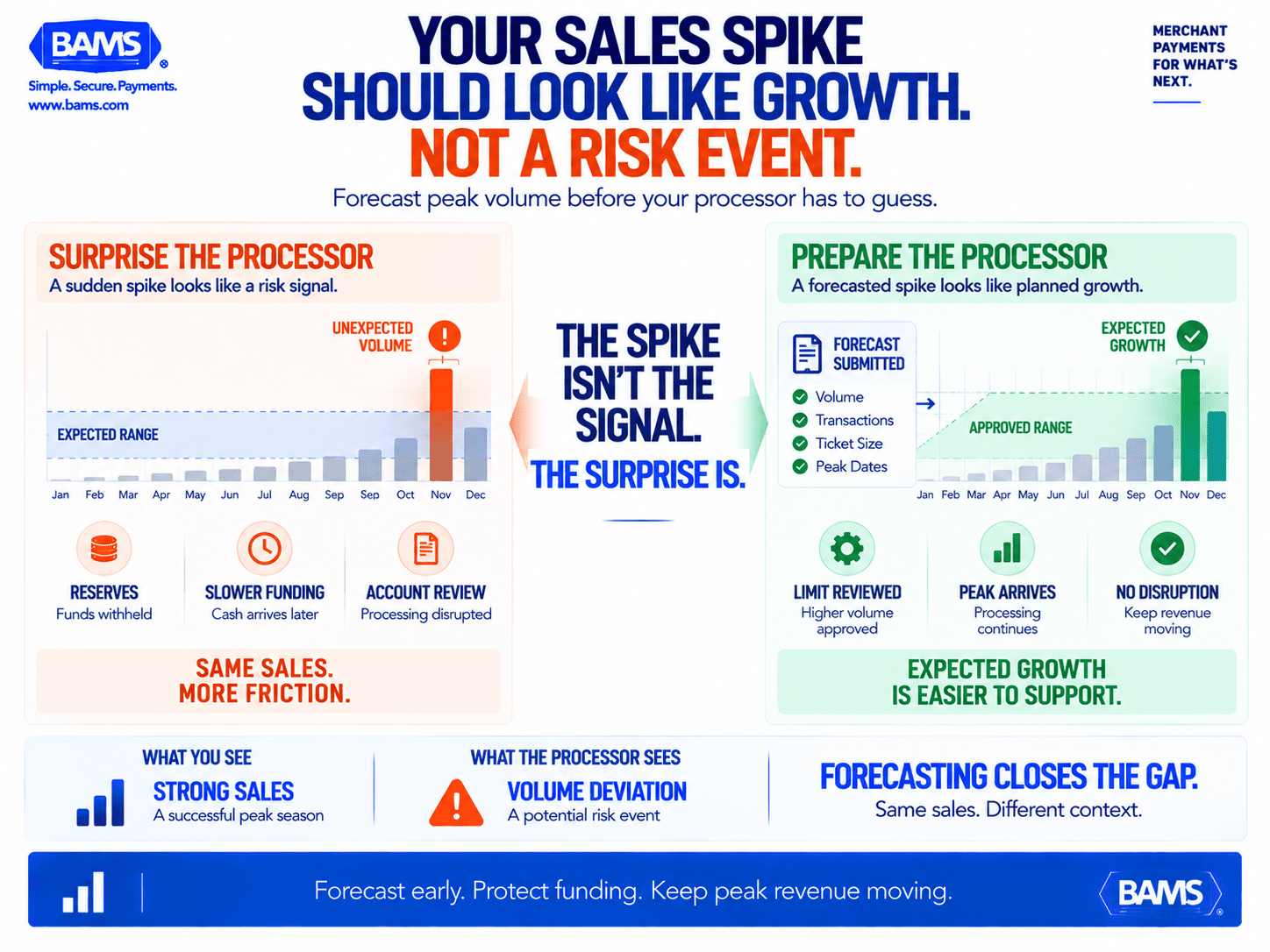
When your sales double during a product launch or holiday rush, your processor doesn’t celebrate with you. It flags the deviation. Processors often read rapid volume increases as a risk signal rather than a growth signal, and the consequences are tangible: reserve holds that lock up a percentage of your revenue, delayed settlements that starve your cash flow at the worst possible moment, or outright account reviews that freeze processing entirely.
The cost of ignoring this dynamic is steep. You’re not just paying more per transaction during peak season. You’re potentially losing access to the revenue you’ve already earned, right when you need it to fund inventory, shipping and customer acquisition. The Federal Reserve reports that U.S. noncash payments rose to 236.6 billion in 2024 from 204.8 billion in 2021, driven primarily by card payments. For individual merchants, even smaller seasonal increases can push actual processing above the volume originally underwritten for the account.
The businesses that control seasonal processing costs aren’t the ones with the lowest negotiated rates. They’re the ones who manage their processor relationship proactively, treating payment processing strategies as a seasonal planning function rather than a set-and-forget contract.

Peak volume is not the problem. Unexpected peak volume is. Forecasting and early processor communication help merchants keep more revenue available when demand is highest.
Core Concepts: How Processors Actually Think About Your Account
Underwriting Thresholds vs. Actual Volume
When you opened your merchant account, your processor approved you based on projected monthly volume, average transaction size and industry risk category. These projections set your underwriting thresholds. If your actual processing stays within those bounds, settlements flow normally. When you exceed them, especially suddenly, the processor’s risk controls may require additional review. The Office of the Comptroller of the Currency notes that processing high transaction volume carries risk and that banks need appropriate resources and infrastructure to manage high sales volume.
Reserve Holds and Rolling Reserves
A reserve hold is when your processor withholds a portion of your settled funds as a buffer against potential chargebacks or fraud losses. Rolling reserves accumulate a percentage of each day’s transactions and release them after a set period (commonly 90 to 180 days). These aren’t penalties. They’re risk mitigation tools your processor deploys when it perceives elevated exposure. The problem is that they’re often triggered without warning during the exact period you need capital most.
Risk Signals vs. Growth Signals
Your processor’s risk engine doesn’t distinguish between a fraud spike and a successful flash sale. Both look like sudden volume deviations. Processors treat unexpected transaction surges as threats, not sales events. The distinction between a risk signal and a growth signal is something you have to communicate proactively. If you don’t, the system defaults to caution.
Effective Rate vs. Quoted Rate
Your quoted rate (the interchange-plus or flat rate in your contract) is not your actual cost. Your effective rate includes interchange downgrades, assessment fees, chargeback fees, and any penalties triggered by volume deviations. During peak season, the gap between quoted and effective rates often widens significantly, making your true processing costs much higher than expected.
The Framework: Seasonal Cost Control in Four Phases
Reducing seasonal processing costs follows a four-phase cycle that aligns with how processors evaluate and respond to merchant behavior. Each phase maps to a specific window relative to your peak selling period.
- Phase 1: Audit (12-8 weeks before peak) — Analyze current processing statements, identify your underwriting limits, and benchmark your effective rate.
- Phase 2: Forecast and Communicate (8-4 weeks before peak) — Build a transaction volume forecast and submit it to your processor to pre-authorize higher limits.
- Phase 3: Optimize (4 weeks before through peak) — Adjust payment routing, authentication flows, and settlement timing to minimize cost during high volume.
- Phase 4: Review and Renegotiate (post-peak) — Use peak season data as leverage to renegotiate terms, adjust reserves, and prepare for the next cycle.
These phases aren’t optional extras. They’re the difference between a peak season that generates profit and one that generates revenue your processor holds hostage.
Peak season payment planning starts before sales increase. These six checks help merchants prepare processors for higher volume and reduce the risk of reserves, funding delays and unexpected cost increases.
Step-by-Step: How to Reduce Processing Costs Before and During Peak Season
Step 1: Audit Your Processing Statements and Underwriting Limits
Objective: Know exactly what your processor approved you for, what you’re actually paying, and where the gaps are before volume increases.
Pull your last 6 to 12 months of processing statements. Calculate your effective rate by dividing total fees (including all line items, not just the interchange rate) by total processed volume. Compare this to your quoted rate. If the gap exceeds 0.3%, you likely have interchange downgrades or hidden fees inflating your costs.
Next, locate your approved monthly processing volume and maximum transaction size. These are in your merchant agreement or underwriting documents. If you can’t find them, call your processor and ask directly. You need these numbers because they define the boundary between normal processing and a risk flag.
What to avoid: Don’t assume your current rate is your actual cost. Don’t skip this step because “rates haven’t changed.” Effective rates drift over time as card network fees adjust and transaction mix shifts. Also avoid relying solely on your processor’s dashboard summary, which often excludes assessment fees and per-transaction charges.
Success indicators: You have a documented effective rate, a clear understanding of your approved volume ceiling, and a list of any fees or downgrades that appear inconsistent with your pricing agreement. If your effective rate is notably higher than expected, you may also want to examine whether your gateway is dropping Level 2/3 data fields that cause interchange downgrades.
Step 2: Build a Transaction Volume Forecast
Objective: Create a credible projection your processor can use to pre-authorize higher limits and avoid triggering risk reviews during your peak period.
Pull historical transaction data from your previous peak seasons. Identify your highest single-day volume, highest weekly volume, and average ticket size during those periods. Then factor in any planned promotions, product launches, or marketing campaigns that could push volume beyond historical peaks.
Your forecast should include: projected monthly volume (in dollars), projected transaction count, expected average ticket size, and the specific date range of your anticipated peak. Be specific. “We expect a 40% increase in November” is less useful than “We project $320,000 in processing volume between November 15 and December 5, with an average ticket of $85 and peak daily volume of $18,000.”
What to avoid: Don’t inflate projections to create a buffer. Processors evaluate forecast accuracy, and consistently overestimating can undermine credibility. Don’t submit vague estimates. And don’t wait until two weeks before peak to start this process. BAMS recommends contacting your processor 8 to 12 weeks before peak season to request volume limit increases.
Success indicators: Your forecast is documented, data-backed, and submitted to your processor with enough lead time for underwriting review. You’ve received written confirmation of any temporary or permanent limit increases.
Step 3: Pre-Negotiate Reserve Terms and Settlement Timing
Objective: Prevent surprise reserve holds and ensure your settlement schedule supports cash flow during high-volume periods.
Once your processor has your forecast, explicitly ask about reserve requirements. Will your projected volume trigger a rolling reserve? If so, what percentage and for how long? Can you negotiate a lower reserve percentage by providing additional documentation (bank statements, inventory purchase orders, shipping contracts)?
Settlement timing matters enormously during peak season. If your processor settles on a T+2 or T+3 schedule (two to three business days after transaction), a week of heavy sales could mean $50,000 to $150,000 sitting in limbo while you need to reorder inventory or fund ad spend. This is where merchant services partners with faster settlement options provide a measurable advantage. BAMS, for example, offers next-day funding that keeps capital accessible during exactly the periods when delayed deposits create the most operational strain.
What to avoid: Don’t assume your current settlement terms will hold during peak volume. Some processors automatically shift to slower settlement or impose temporary reserves when volume exceeds underwritten limits. Don’t wait for the hold to appear on your statement before addressing it.
Success indicators: You have written confirmation of your reserve terms during peak season, you know your exact settlement timeline, and you’ve explored faster funding options if your current schedule creates cash flow gaps.
Step 4: Optimize Payment Authentication and Routing
Objective: Reduce per-transaction costs and decline rates during high volume by ensuring your payment stack is configured for peak performance.
Review your payment authentication flow. Are you using 3D Secure (3DS) on all transactions, or selectively based on risk scoring? Blanket 3DS application increases friction and cart abandonment. Risk-based authentication lets low-risk transactions pass through with minimal friction while applying step-up authentication only where needed, reducing both declines and chargeback exposure.
Examine your transaction retry strategy. Failed transactions that are automatically retried without intelligent logic generate additional processing attempts, each potentially incurring fees. Configure your retry logic to wait appropriate intervals and limit attempts to avoid both unnecessary costs and card network penalties for excessive retries.
For businesses processing B2B orders alongside consumer transactions, consider whether routing high-ticket B2B orders through ACH instead of card networks could eliminate significant per-transaction costs during peak periods. A $5,000 wholesale order processed via card at 2.5% costs $125 in processing fees. The same order via ACH might cost $0.50 to $3.00.
What to avoid: Don’t make major changes to your payment stack during peak season itself. Test authentication and routing changes at least four weeks before your volume increase. Don’t disable fraud screening to reduce friction, as this trades short-term conversion for long-term chargeback costs that compound your effective rate.
Success indicators: Your authentication flow is configured for risk-based decisioning, retry logic is optimized, and any routing changes have been tested and validated before volume increases.
Step 5: Monitor in Real-Time During Peak
Objective: Catch cost anomalies, funding delays, and risk flags as they happen rather than discovering them on next month’s statement.
During peak season, shift from monthly statement reviews to daily monitoring. Track three metrics daily: authorization approval rate, settlement timing (are funds arriving on schedule?), and chargeback ratio. A sudden drop in approval rate could indicate your processor has flagged your account. A delay in settlement could signal a reserve hold has been applied without notification.
Set up alerts for any transaction that exceeds your typical average ticket size by more than 200%. These outlier transactions are the ones most likely to trigger individual transaction holds. If you spot one, contact your processor proactively to confirm it’s legitimate rather than waiting for them to flag it.
What to avoid: Don’t rely on automated dashboards alone. Processor dashboards often lag by 24 to 48 hours. If you have a dedicated account manager (through your processor or a merchant services partner like BAMS), use that relationship for real-time communication during peak periods. Don’t ignore small settlement delays, as they often precede larger holds.
Success indicators: You’re reviewing key metrics daily, you have a direct communication channel with your processor or account manager, and you’re catching anomalies within 24 hours rather than 30 days.
Step 6: Post-Peak Review and Renegotiation
Objective: Use your peak season performance data to improve terms, release reserves, and build a stronger baseline for the next cycle.
Within 30 days of your peak season ending, compile your performance data: total volume processed, chargeback ratio, average ticket size, and any reserve holds that were applied. If your chargeback ratio stayed below 1% and your volume matched your forecast, you have strong leverage to request better terms.
Specifically, ask for: release of any reserve holds, a permanent increase to your approved monthly volume so next peak doesn’t trigger the same flags and a rate review based on your demonstrated volume. Federal Reserve data shows that card payments increased to 187.7 billion transactions in 2024 from 157.7 billion in 2021. Your clean peak season data gives you concrete performance history to bring into that review.
What to avoid: Don’t let reserves sit indefinitely. Some processors won’t proactively release reserves. You need to request it. Don’t skip this step because you’re tired from peak season. The window for renegotiation is strongest when your performance data is fresh and your next peak is far enough away that you have leverage.
Success indicators: Reserves are released, your approved volume ceiling reflects actual peak performance, and you have documented terms that reduce the risk of holds during the next cycle.
Practical Examples: Two eCommerce Scenarios
Scenario A: The Blindsided Brand
An online home goods retailer processes $80,000 per month on average. During a November sale, volume jumps to $210,000. The processor’s risk system flags the 160% increase. A 10% rolling reserve is applied, locking up $21,000 for 180 days. Settlement shifts from T+1 to T+3. The retailer can’t reorder best-selling inventory fast enough, losing an estimated $35,000 in additional sales. Total cost of inaction: $56,000 in locked capital and lost revenue.
Scenario B: The Prepared Brand
A similar retailer processes $90,000 per month. Ten weeks before Black Friday, the eCommerce manager submits a forecast projecting $225,000 in November volume, supported by prior-year data and a planned ad spend increase. The processor approves a temporary limit increase. No reserve is applied. Settlement stays at next-day funding. The retailer reinvests revenue daily into restocking and ad spend, capturing an additional $40,000 in sales that Scenario A’s retailer missed.
The difference isn’t luck or better rates. It’s proactive account management and transaction volume forecasting. The cost of the forecast? A few hours of analysis and one email to the processor.
Common Mistakes and Pitfalls in Seasonal Payment Processing Strategies
- Treating rate negotiation as the only cost lever. Your quoted rate matters, but reserve holds, settlement delays, and interchange downgrades often cost more than the rate difference between processors. Focus on total cost of processing, not just the basis-point number on your contract.
- Waiting until volume spikes to contact your processor. By the time a reserve hold appears, the damage is done. The communication window is 8 to 12 weeks before peak, not during it.
- Ignoring chargeback ratios during peak. Higher volume with the same number of chargebacks improves your ratio. But if chargebacks increase proportionally (or worse, disproportionately due to rushed fulfillment), you compound your risk profile and invite longer reserve terms.
- Assuming all processors handle seasonal volume the same way. Risk appetite varies significantly between processors. Some are built for predictable, steady-state volume. Others, particularly merchant services partners with dedicated account management, are structured to support seasonal businesses without punitive holds.
- Failing to document processor commitments. Verbal assurances about reserve terms or limit increases are worthless during a dispute. Get everything in writing before peak season starts.
What to Do Next
Start with one action: pull your last three processing statements and calculate your effective rate. Compare it to your quoted rate. If the gap surprises you, that’s your signal that seasonal cost control needs to move from background concern to active planning function.
Then check your merchant agreement for your approved monthly volume ceiling. If your next peak season will push you above that number, you now know exactly when to start the conversation with your processor. Mark the 8-to-12-week window on your calendar.
This isn’t a one-time project. Each peak season generates data that strengthens your position for the next one. Treat your payment processing setup as a seasonal planning function, review it quarterly, forecast before every peak, and renegotiate after every successful cycle. The merchants who do this consistently don’t just reduce costs. They turn their payment infrastructure into a competitive advantage.
Frequently Asked Questions
What is a seasonal volume playbook in merchant services optimization?
A seasonal volume playbook is a structured plan that aligns your payment processing setup with anticipated sales peaks. It includes auditing your current terms, forecasting transaction volume, pre-negotiating reserve and settlement terms with your processor, optimizing payment routing, and conducting post-peak reviews. The goal is to prevent cost spikes and funding disruptions that processors impose when volume exceeds underwritten limits without advance notice.
Why do payment processors impose reserve holds during peak season?
Processors impose reserve holds because sudden volume increases look identical to fraud patterns in their automated risk systems. When your actual transactions significantly exceed your approved monthly volume, the processor’s underwriting model flags your account as higher risk. The reserve acts as a financial buffer against potential chargebacks or losses. You can often prevent this by submitting a volume forecast 8 to 12 weeks before your peak period and requesting a temporary limit increase.
When should businesses review their payment processing setup before peak seasons?
Begin your review 12 weeks before your anticipated peak. Use weeks 12 through 8 for statement audits and effective rate calculations. Use weeks 8 through 4 for submitting volume forecasts, requesting limit increases, and negotiating reserve terms. Use weeks 4 through 1 for testing any changes to authentication flows, retry logic, or payment routing. Making changes during peak season itself introduces unnecessary risk.
How can businesses use data to forecast transaction volume for seasonal planning?
Pull historical transaction data from your previous two to three peak seasons. Identify your highest single-day volume, highest weekly volume, and average ticket size during those periods. Then layer in any new variables: planned promotions, increased ad spend, new product launches, or expanded market reach. Present your forecast to your processor with specific dollar amounts, transaction counts, date ranges, and average ticket sizes rather than percentage-based estimates.
How does settlement timing affect cash flow during peak selling periods?
If your processor settles on a T+2 or T+3 schedule, a week of $30,000 daily sales means $60,000 to $90,000 is in transit at any given time. During peak season, this capital gap can prevent you from restocking inventory, funding ad campaigns, or covering increased shipping costs. Next-day funding options compress this gap significantly, keeping revenue accessible within one business day of the transaction.
What’s the difference between effective rate and quoted rate in payment processing?
Your quoted rate is the interchange-plus or flat rate in your merchant agreement. Your effective rate is what you actually pay after all fees are included: interchange downgrades, assessment fees, per-transaction charges, chargeback fees, and any penalties. During peak season, the effective rate often climbs above the quoted rate due to increased downgrades and risk-related fees. Calculate it by dividing total monthly fees by total monthly processing volume.


