
5 Funeral Home Liability Gaps Where FTC and Surcharge Rules Collide
Last Updated on September 22, 2026 by Dimitri Akhrin
How payment surcharges quietly violate price disclosure regulations and compound compliance risk for funeral operators
Learn five specific ways funeral home surcharging practices create FTC disclosure violations. This guide shows operators how to audit where card network caps and price list requirements intersect to reduce funeral home liability.
TL;DR
- Surcharges that don’t appear on your General Price List create FTC disclosure violations – If the transaction total differs from the GPL quote because of a payment fee, you have a compliance gap regardless of whether the surcharge itself is legal.
- Visa and Mastercard prohibit surcharging their debit and prepaid cards – Your payment setup should distinguish eligible credit-card transactions from debit and prepaid transactions before applying a surcharge.
- Phone and after-hours pricing quotes must include all fees – The FTC found 26% of funeral providers couldn’t provide pricing after hours at all, and incomplete quotes that omit surcharges compound the risk.
- Surcharge limits depend on the card network and your cost of acceptance – Visa limits U.S. credit-card surcharges to the applicable merchant discount rate or 3%, whichever is lower. Mastercard applies its own cost-based cap and published maximum.
- Start by comparing your GPL to your last 30 days of receipts – If any family paid more than the listed price due to processing fees, close that gap first, then audit your terminal’s card-type identification.
Why Funeral Home Liability Spikes Where Pricing Rules Meet Payment Processing
Most funeral home operators understand the Funeral Rule in broad strokes: give families an itemized price list, don’t bundle without disclosure, don’t require embalming without consent. What they don’t understand is how their payment processing setup can quietly create violations of those same rules.
Surcharging on credit card transactions, for example, may seem like a straightforward way to offset processing fees on high-ticket services. But payment-related charges still need to fit within your broader pricing and disclosure practices. When a surcharge also violates applicable card-network requirements, the compliance risk becomes more complicated.
The result is funeral home liability that doesn’t stem from dishonesty. It stems from two compliance systems (FTC disclosure and card network rules) operating in parallel without anyone connecting them.
What This Guide Covers (and What It Doesn’t)
This guide is for family-owned funeral service operators running one to ten locations who accept credit and debit payments on transactions that regularly exceed $5,000. If you’ve added surcharging, dual pricing, or convenience fees without auditing how those charges interact with your General Price List, this is for you.
We’re not covering the full scope of Funeral Rule compliance. The FTC publishes detailed guidance on the Funeral Rule, including itemized price information, telephone pricing and cash-advance disclosures. Instead, we focus on five specific gaps where funeral-pricing practices and payment-processing rules can intersect.
How We Identified These Five Gaps
Each gap was selected based on three criteria: it involves a documented enforcement pattern or regulatory requirement, it’s triggered by routine payment acceptance decisions (not edge cases), and it creates compounding risk when combined with other gaps on this list. The order follows the sequence most operators encounter them, from initial pricing documents through final transaction settlement.

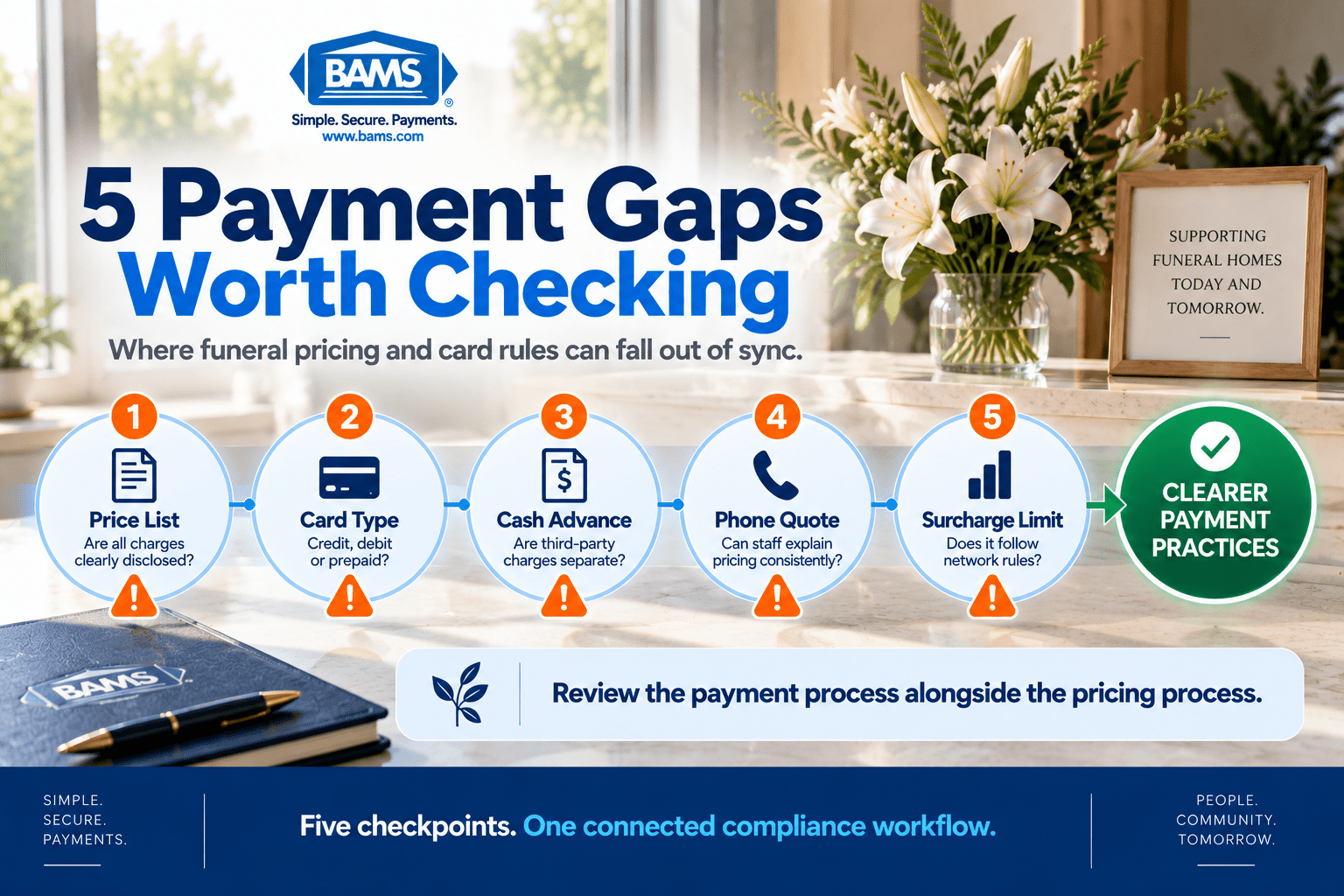
5 Gaps Where FTC Disclosure Rules and Surcharging Mechanics Create Funeral Home Liability
1. The General Price List Doesn’t Reflect the Actual Transaction Total
Why it matters: The Funeral Rule requires accurate, itemized pricing for funeral goods and services. If your payment process adds a surcharge or other fee, review how that charge is disclosed across your pricing documents, arrangement process and final transaction. The goal is to make sure the family understands the charges before payment and that your payment practices remain consistent with applicable card-network and state requirements.
What it looks like today: Many operators added surcharging in the last two years as processing costs rose on high-ticket services. The surcharge gets programmed into the terminal or POS system but never makes it onto the printed GPL or the Casket Price List. Families see the added cost only on their receipt.
How to apply it: Audit your GPL, Casket Price List and Outer Burial Container Price List alongside your payment disclosures. If you surcharge, make sure staff can clearly explain the charge before payment and that your pricing process remains consistent across in-person and telephone conversations.
2. Surcharges Applied to Debit Cards in States That Prohibit It
Why it matters: Visa’s U.S. surcharge guidance limits surcharging to credit cards; Visa debit and prepaid cards cannot be surcharged. Visa also limits the surcharge to the applicable merchant discount rate or 3%, whichever is lower. Your payment setup therefore needs to identify whether a transaction is eligible before automatically applying a surcharge.
What it looks like today: A surcharge configuration may create risk if the payment system applies a fee before confirming whether the transaction is an eligible credit-card transaction. Funeral homes should verify how their terminal, gateway or processor identifies card type before relying on automatic surcharging.
How to apply it: Confirm that your terminal or payment gateway can identify card type before applying a surcharge. Ask your processor for a written explanation of how the system handles credit, debit and prepaid transactions. If the process is unclear, pause automatic surcharging until you can confirm that the configuration complies with the applicable network and state requirements.
3. Cash Advance Items Listed Without Distinguishing Third-Party Costs from Your Markup
Why it matters: The Funeral Rule requires cash advance items to be listed separately on the Statement of Funeral Goods and Services Selected. If you add a charge for obtaining a cash advance item or retain certain rebates, commissions or discounts, the Rule also requires the applicable disclosure. Avoid blending unrelated payment-processing costs into these charges in a way that makes the pricing difficult for families to understand.
What it looks like today: Cash advance items can become difficult to explain when third-party costs, funeral-home charges and payment-related costs are blended together. Keeping those categories distinct makes the pricing easier for families and staff to understand.
How to apply it: Separate your cash advance markup from your processing cost recovery. If you mark up cash advance items, disclose it on the GPL as required. If processing fees are the reason for the markup, consider whether faster settlement from your processor would reduce the need to front those costs in the first place. When you get paid faster, the pressure to pad cash advance line items drops.
4. Phone and After-Hours Pricing Quotes That Omit Surcharge or Fee Disclosures
Why it matters: The Funeral Rule requires funeral providers to give callers accurate price information from their required price lists and answer other pricing questions with readily available information. If payment-related fees may affect the final amount, staff should understand how those charges are communicated so families receive consistent information.
What it looks like today: After-hours calls often go to answering services or on-call directors who have access to the GPL but no training on surcharge disclosures. The operational gap is simple: the person answering the phone doesn’t know about the payment processing fee because it lives in a different system than the price list.
How to apply it: Create a one-page surcharge disclosure script and attach it to every copy of the GPL your staff references, including digital versions on tablets and phones. Train after-hours staff specifically on payment-related fees. If your current pricing model makes this too complex to explain by phone, that complexity is itself a compliance risk worth simplifying.
5. Surcharge Rates That Exceed Card-Network Limits
Why it matters: Visa and Mastercard do not currently use identical U.S. surcharge limits. Visa limits a surcharge to the merchant’s applicable discount rate or 3%, whichever is lower. Mastercard applies a cost-based surcharge cap and publishes its own maximum surcharge limit. Merchants also must comply with applicable state and federal law and the disclosure rules of the network involved.
What it looks like today: Operators who set surcharge rates based on their average effective processing rate sometimes land above the 3% cap because they’re averaging in the higher interchange tiers. The terminal applies a flat percentage that doesn’t adjust per transaction. Meanwhile, the actual interchange rate on a given card might be 2.1%, making a 3% surcharge profitable but a 3.5% surcharge a violation.
How to apply it: Do not use one assumed percentage across every card network. Confirm the surcharge limit that applies to each network you accept and make sure the surcharge does not exceed the applicable cost-based limit. Review the configuration with your processor before activating automatic surcharging.
A merchant services partner for funeral homes can help you evaluate your payment setup and effective processing costs. BAMS also explains cost-plus (interchange-plus) pricing, which can make processing costs easier to review.
The Pattern Across All Five Gaps
Every gap on this list shares a root cause: the person managing FTC compliance and the person managing payment processing are either the same overextended operator or two people who never compare notes. Price disclosure regulations assume the price on the list is the price the consumer pays. Payment processing mechanics (surcharges, convenience fees, cash discounts) change the price after the list is printed.
The compounding risk is real. Gap 1 (GPL doesn’t match the transaction) makes Gap 4 (phone quotes are incomplete) worse. Gap 2 (debit surcharging) makes Gap 5 (exceeding network caps) more likely because misrouted debit transactions inflate your average rate calculations. These aren’t five separate problems. They’re one system with five failure points.
The operators who avoid liability treat funeral service itemization and payment acceptance as a single workflow, not two departments.

Where to Start Without Overhauling Everything
You don’t need to fix all five gaps this week. Start with Gap 1: compare your GPL to your actual transaction receipts for the last 30 days. If family receipts exceed your GPL due to payment surcharges, you have a critical Funeral Rule compliance gap that requires immediate correction.
Does your terminal or gateway automatically identify card types—credit versus debit/prepaid—before applying a surcharge? If the processor cannot confirm this, prioritize fixing it immediately.
The remaining gaps (cash advance transparency, phone disclosure, and surcharge caps) can be addressed in sequence. The goal isn’t perfection overnight. It’s closing the highest-liability gap first and building a system where your pricing documents and your payment processing stay in sync going forward.
Frequently Asked Questions
What is the FTC Funeral Rule and why does it affect payment processing?
Can funeral homes legally surcharge credit card transactions?
Credit-card surcharging is permitted in many jurisdictions but is subject to card-network requirements and applicable state law. Visa and Mastercard both restrict surcharging to eligible credit-card transactions, not their debit or prepaid cards. Because state requirements can change, confirm the rules that apply to each location where your funeral home operates before implementing a surcharge program.
How does the FTC Funeral Rule affect pricing transparency for funeral services?
The Funeral Rule requires accurate itemized information for funeral goods and services and specific disclosures on required pricing documents. Payment-related charges should also be communicated clearly and reviewed alongside the separate card-network and state requirements that apply to the transaction.
What is the difference between surcharging and dual pricing (cash discount)?
Surcharging adds a fee on top of the listed price when a customer pays by credit card. Dual pricing shows a higher regular price and a lower cash or debit price. It has fewer card-network restrictions but requires clear disclosure on price lists, during arrangements, and by phone.
When must funeral homes provide itemized price disclosures to consumers?
Funeral homes must give the General Price List to people who inquire in person about funeral goods, services or prices. The Funeral Rule mandates that providers offer accurate price information from their required price lists and answer pricing questions using readily available information for telephone inquiries.
How can funeral homes reduce processing costs without surcharging?
Negotiate interchange-plus pricing, qualify for lower tiers with enhanced data, or switch to a processor with next-day funding. Reducing your effective processing rate often matters more than recovering costs through surcharges, especially when surcharging introduces compliance complexity.

