
Gift Card Sales Channels: A Practical Guide for SMBs
Guide Orientation: What This Covers and Who It’s For
This guide is for small business owners in retail, dining, or services who already have a gift card program (or are close to launching one). It’s for owners who want to grow gift card sales channels without adding headcount, expensive platforms, or operational complexity. You won’t find enterprise software comparisons here. Instead, you’ll get a practical framework for identifying which channels and promotions actually drive redemption and repeat visits, not just card purchases.
By the end, you’ll be able to evaluate your current gift card program against outcome-level metrics. You’ll also be able to choose the right mix of gift card sales channels for your budget and run targeted promotions that convert gift card buyers into loyal, returning customers. This guide does not cover open-loop (Visa/Mastercard-branded) gift card programs or wholesale/B2B gift card distribution.
TL;DR
- Measure redemption, not just sales – Cards sold is a vanity metric. Redemption rate, overspend at redemption and return visit rate are the numbers that tell you whether your gift card program is actually building your business.
- Pick two or three owned channels and execute them well – Your register, your website and your customer email list are higher-leverage gift card sales channels than third-party marketplaces. They also cost less to maintain.
- Connect gift cards to your loyalty program – Over half of loyalty members already use points for self-gifting. Let them earn or redeem points through gift card purchases to create a trackable pipeline from gift card to repeat customer.
- Design promotions around redemption, not purchase – Incentivize the recipient to visit (a free add-on at redemption, a time-limited bonus card) rather than only incentivizing the buyer. That’s how gift cards drive foot traffic.
- Review and reinvest quarterly – Use each quarter’s data to shift effort toward channels with the highest redemption rates and cut what doesn’t produce outcomes. Growth comes from doing fewer things better, not adding complexity.
Why Growing Gift Card Revenue Without Growing Overhead Matters Now
Gift cards are one of the few products a small business can sell that generate revenue twice: once at purchase and again when the recipient walks through the door. But most small operators treat gift cards as a passive, seasonal afterthought rather than a year-round growth channel. The result is a program that moves plastic during the holidays and collects dust the rest of the year.
The cost of that passivity is real. Every unredeemed card is a missed foot-traffic opportunity. Every card sold through a channel you can’t track is a marketing dollar you can’t measure. And every promotion you run without understanding redemption behavior is a guess dressed up as strategy.
Meanwhile, consumer behavior is shifting. According to Fiserv, consumers remain split 50/50 on whether they prefer physical or digital gift cards. That means small businesses clinging exclusively to physical card racks at the register can miss the half of buyers who prefer digital. The businesses that grow gift card revenue without growing overhead pick the right gift card sales channels. Then they measure the right outcomes and let the data shape their next move.
Core Concepts: Redemption-First Thinking for Gift Card Marketing Strategies
Cards Sold vs. Cards Redeemed
Most gift card content focuses on “cards sold” as the primary success metric. It’s a vanity metric. A card sold generates a one-time transaction. A card redeemed generates a store visit, a new customer interaction and (in most cases) spending above the card’s face value. The metric that matters is redemption rate, because redemption is where repeat business begins.
Closed-Loop Gift Cards
For small businesses, closed-loop gift cards (redeemable only at your business) are the standard. They cost less to administer, keep the customer relationship in-house and give you direct visibility into redemption patterns. Every concept in this guide assumes a closed-loop program.
Attribution vs. Counting
Counting tells you how many cards you sold last month. Attribution tells you which channel drove those sales, which promotion triggered the purchase and whether the recipient came back after redeeming. Attribution is what turns a gift card program from a line item into a growth engine. Without it, you’re optimizing blind.
The Overhead Trap
Small businesses often assume that growing gift card sales means adding new technology, hiring staff, or partnering with expensive third-party platforms. The overhead trap is the belief that scale requires complexity. In reality, the highest-leverage moves for small operators involve doing fewer things better: choosing two or three channels, tracking them rigorously and doubling down on what works.

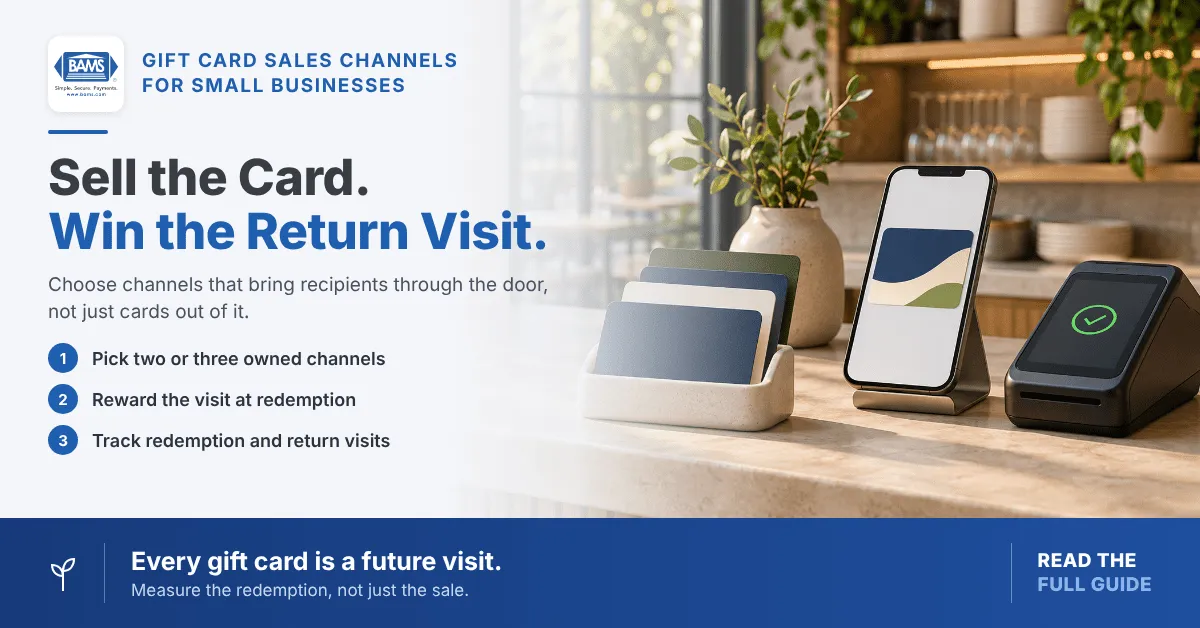
Pick two or three channels you own, reward the visit at redemption and track whether recipients come back.
The Framework: Channel, Promotion, Measurement
Growing gift card sales without growing overhead follows a three-phase cycle. Each phase feeds the next, creating a loop that gets smarter over time.
- Channel Selection: Identify and activate the two or three gift card sales channels that match your business type, customer behavior and existing infrastructure. Resist the urge to be everywhere.
- Promotion Design: Build time-bound promotions tied to specific channels, with clear redemption incentives (not just purchase incentives). Every promotion should have a measurable trigger and a trackable outcome.
- Outcome Measurement: Track redemption rate, redemption-to-return-visit conversion and average spend at redemption. Use these numbers to refine channel mix and promotion strategy for the next cycle.
This isn’t a one-time setup. It’s a quarterly rhythm. Each cycle gives you better data, which means less wasted effort and lower cost per result.
Step-by-Step: Building a Gift Card Program That Grows Revenue
Step 1: Audit Your Current Gift Card Performance
Objective: Establish a baseline so you can measure improvement against real numbers, not assumptions.
Before adding channels or running promotions, you need to know where you stand. Pull your gift card data from the last 12 months and answer three questions: How many cards were sold? How many were redeemed? What was the average spend at redemption (did customers spend above the card value)?
If your payment processor provides transaction-level reporting, use it. Payment processing reports can reveal patterns in terminal traffic, average transaction size and payment type that illuminate gift card behavior you’d otherwise miss. Look for seasonal spikes, day-of-week patterns and whether digital or physical cards dominate your sales.
Anti-patterns: Don’t skip this step because you think your numbers are too small to matter. Even 50 cards sold in a year gives you a redemption rate, an average value and a starting point. Avoid combining gift card revenue with general sales in your analysis; keep it isolated so you can see the program’s true contribution.
Success indicators: You can state your redemption rate, your average card value, your average spend at redemption and your peak sales periods with confidence. If you can’t, your audit isn’t finished.
Step 2: Choose Two or Three High-Leverage Gift Card Sales Channels
Objective: Concentrate effort on channels that match your customer base and operational capacity.
The temptation is to sell gift cards everywhere: in-store, online, through social media, via third-party marketplaces. For a small business with a lean team, that’s a recipe for diluted effort and inconsistent customer experience. Instead, pick two or three channels and execute them well.
For most small businesses in retail, dining, or services, the highest-leverage channels are:
- Point of sale (in-store): Your register is your most reliable channel. Train staff to mention gift cards during checkout, especially during the six weeks before major holidays. Physical cards at the counter remain effective for impulse purchases.
- Your website or online ordering platform: A digital gift card option on your website captures buyers who aren’t in your store. This is especially critical given that consumers are split 50/50 between physical and digital gift cards. A simple purchase page with email delivery is enough.
- Email and SMS to existing customers: Your customer list is a channel you already own. Targeted messages to past customers during key moments (birthdays, holidays, slow seasons) typically convert better than broad social media posts because the audience already knows your business.
Anti-patterns: Don’t invest in third-party marketplace distribution until your owned channels are performing well. Marketplace fees eat into margins and you lose visibility into who bought the card and why. Avoid launching a channel you can’t consistently maintain; an abandoned online gift card page is worse than not having one.
Success indicators: Each active channel has a distinct tracking mechanism (separate SKU, unique promo code, or identifiable transaction type) so you can attribute sales and redemptions back to the source.
Step 3: Tie Gift Cards to Your Loyalty Program
Objective: Turn your loyalty program into a gift card distribution and redemption engine.
Loyalty programs and gift cards are natural partners, but most small businesses treat them as separate initiatives. The data says otherwise: more than half (52%) of loyalty and membership program members use points to buy themselves a gift. Approximately four in 10 shoppers are incentivized to redeem loyalty points for gift cards. That means your loyalty members are already primed to engage with gift cards if you make the connection explicit.
The simplest integration is to let loyalty members earn bonus points on gift card purchases. You can also let them redeem accumulated points for a gift card they can give to a friend. The friend becomes a new customer. The member feels rewarded. Both transactions are trackable.
If you haven’t built a loyalty program yet, starting an electronic loyalty card program through your payment processor is one of the lowest-friction ways to create this connection. Several loyalty program types suit small businesses specifically, from simple punch cards to points-based systems that integrate with your existing POS.
Anti-patterns: Don’t create a loyalty-gift card connection that’s so complex your staff can’t explain it in 15 seconds. Avoid offering loyalty points for gift card purchases without tracking whether those cards get redeemed. Points-for-purchase without redemption tracking is a cost center, not a growth strategy.
Success indicators: You can measure how many gift cards were purchased through loyalty point redemption and you can track whether recipients of those cards visited your business. A well-designed loyalty model gives you this visibility without additional software.
Step 4: Design Promotions Around Redemption, Not Just Purchase
Objective: Shift promotional strategy from “sell more cards” to “bring more people through the door.”
Most gift card promotions incentivize the buyer: “Buy a $50 card, get a $10 bonus.” That’s fine, but it optimizes for purchase volume, not redemption. The promotion that builds your business is the one that gets the recipient to visit, spend and return.
Consider structuring promotions with a redemption incentive. For example, the bonus card is only valid during a specific window (your slowest month). Or the recipient gets a small additional perk when they redeem in-store (a free appetizer, a sample product, 10% off their next visit). This turns the gift card into a foot-traffic tool with a built-in return mechanism.
Timing matters. A Black Friday gift card campaign increased one small tour operator’s November 2023 gift card sales by 1,450%. That campaign contributed to more than $17,500 in gift card revenue across two holiday seasons. That business didn’t have a large marketing team. It had a focused, time-bound promotion on the right channel at the right moment.
Anti-patterns: Don’t run gift card promotions year-round. Perpetual discounts train customers to wait rather than act. Avoid bonus card promotions where the bonus has no expiration; you lose the urgency that drives redemption visits. Promotional bonus cards can carry an expiration date. However, federal gift card rules require a promotional card to state that it is promotional and show its expiration date. Purchased cards generally can’t expire for at least five years. Don’t run promotions you can’t track back to a specific channel.
Success indicators: Your promotion has a defined start and end date, a channel-specific tracking code and a redemption incentive that drives a visit. You can measure cards sold during the promotion and cards redeemed from the promotion as separate data points.
Step 5: Track Redemption and Post-Redemption Behavior
Objective: Build a measurement system that tells you which channels and promotions actually drive repeat business.
This is where most small business gift card programs stall. They track sales but not redemption. They know a card was used but not whether the customer came back. Closing this loop is the single highest-value improvement you can make.
At minimum, track three metrics per channel and per promotion:
- Redemption rate: What percentage of cards sold were actually redeemed? Low redemption means your cards aren’t reaching motivated recipients, or your redemption experience needs work.
- Overspend at redemption: How much did the customer spend above the card’s face value? This is your gift card program’s real revenue contribution, because any spend above the balance is incremental.
- Return visit rate: Did the person who redeemed a gift card come back within 90 days? This is the metric that separates a gift card program that builds your business from one that just moves plastic.
Your POS system and payment processor are your primary data sources. A Payment Processing Company like BAMS offers transparent reporting and cost-efficient processing. That gives small businesses the transaction-level visibility needed to track these metrics without bolting on expensive analytics platforms.
Anti-patterns: Don’t treat “cards sold” as your headline metric in isolation. Avoid aggregating all gift card data into a single number; break it out by channel and promotion so you can see what’s working. Don’t wait until year-end to review; quarterly reviews keep the feedback loop tight.
Success indicators: You can answer the question, “Which channel produced the highest redemption rate last quarter?” with data, not intuition.
Step 6: Optimize the Gift Card Customer Experience at Redemption
Objective: Make the redemption moment so smooth and positive that the recipient wants to return as a regular customer.
The gift card customer experience doesn’t end at purchase. It peaks at redemption. And for many businesses, that’s exactly where it falls apart. Staff don’t know how to process the card. The system requires a manager override. The customer feels like they’re creating a problem rather than being welcomed.
Fix the redemption experience and you fix your return-visit rate. Train every staff member on gift card processing so there’s no fumbling. Display the remaining balance on the receipt so the customer knows they have a reason to come back. If the card has a remaining balance, verbally invite them to return. These are zero-cost improvements that compound over time.
For digital gift cards, make sure the redemption process works on a phone screen without requiring the customer to print anything. Test it yourself. If it takes more than two taps and a barcode scan, simplify it.
Anti-patterns: Don’t treat gift card customers as less valuable than cash-paying customers. Avoid policies that create friction at redemption (minimum purchase requirements, exclusions on popular items). These save pennies and cost you a repeat customer.
Success indicators: Gift card redemption transactions take the same amount of time as a standard transaction. Customers who redeem gift cards receive a clear indication of any remaining balance and a reason to return.
Step 7: Reinvest Based on What the Data Shows
Objective: Use quarterly data to shift budget and effort toward the gift card sales channels and promotions that produce redemptions and return visits.
After one full cycle (typically one quarter), you’ll have enough data to make informed decisions. The question isn’t “Did we sell more cards?” It’s “Which channel produced cards that got redeemed and did those redemptions lead to return visits?”
If your in-store channel produces high sales volume but low redemption, the cards might be impulse purchases that recipients don’t value. If your email channel produces fewer sales but higher redemption and overspend, that’s your growth lever. Double down on it.
This is also where you evaluate whether a promotion’s bonus structure is working. When 5.25% of one small operator’s 2024 bookings came directly from gift card redemptions, that wasn’t an accident. It was the result of focused promotion, channel discipline and reinvestment in what worked.
Reinvestment doesn’t mean spending more money. It means reallocating the same budget toward higher-performing channels and cutting what doesn’t produce outcomes. That’s how you grow without growing overhead.
Anti-patterns: Don’t keep running the same promotion on the same channels quarter after quarter without reviewing results. Avoid the sunk-cost trap of maintaining a channel that produces sales but not redemptions just because you already set it up.
Success indicators: Your channel mix and promotion strategy look different in Q3 than they did in Q1, because the data told you what to change. Your cost per redeemed card is decreasing over time.
Practical Example: A Neighborhood Restaurant’s Gift Card Growth
Consider a hypothetical neighborhood restaurant doing $400,000 in annual revenue. Its gift card program is basic: physical cards at the register, no online option, one holiday push in December. Last year, they sold 200 cards averaging $40 each ($8,000 in gift card revenue). They have no idea how many were redeemed.
After Applying the Framework
Audit: The owner pulls POS data and discovers that 130 of the 200 cards were redeemed (65% redemption rate). Average spend at redemption was $58, meaning customers spent $18 above the card value on average. But 90% of sales happened in a two-week December window and there’s no data on return visits.
Channel selection: The owner adds a digital gift card purchase option to the restaurant’s website (cost: minimal, using existing website platform). The owner also begins sending monthly emails to a 600-person customer list. Physical cards remain at the register. Three channels, all owned.
Loyalty integration: The restaurant’s existing punch-card loyalty program is updated so that loyalty members earn a bonus stamp when they purchase a gift card. Recipients who redeem a gift card receive a card inviting them to join the loyalty program themselves.
Promotion design: Instead of one December push, the owner runs three focused promotions. The first is a Mother’s Day email campaign (“Buy a $50 card, recipient gets a free dessert at redemption”). The second is a back-to-school August promotion at the register, followed by the traditional December holiday push. Each promotion uses a different tracking code.
Results after two cycles: Gift card sales increase to 340 cards ($15,300 revenue) without adding staff or new technology. The email channel produces fewer sales (80 cards) but the highest redemption rate (78%) and the highest overspend ($22 average). The owner shifts more promotional energy toward email. Twelve gift card recipients join the loyalty program, creating a measurable pipeline from gift card to repeat customer.
Common Mistakes and Pitfalls
Chasing sales volume over redemption quality. Selling 500 cards that sit in drawers does less for your business than selling 200 cards that bring 160 new faces through the door. Always optimize for the visit, not the purchase.
Treating gift cards as a December-only product. Holidays matter and 42% of consumers plan to purchase gift cards to supplement the presents they buy. Birthdays, graduations and Mother’s Day create the same need, so spreading promotions across multiple moments captures demand you’re currently ignoring.
Adding channels before measuring existing ones. If you can’t tell which of your current gift card sales channels produces the best redemption rate, adding a new channel just adds noise. Measure first, expand second.
Ignoring the redemption experience. A clunky, confusing redemption process undoes every dollar you spent acquiring that customer. The recipient’s first impression of your business might be the moment they hand over a gift card. Make it seamless.
Overcomplicating loyalty-gift card integration. If your staff can’t explain the connection in one sentence, simplify it. Complexity kills adoption at the counter.
What to Do Next
Start with the audit. Pull your gift card sales and redemption data from the last 12 months and calculate your redemption rate. That single number will tell you more about your program’s health than any sales total.
If you don’t have redemption data, that’s your first fix. Work with your payment processor to ensure gift card transactions are tracked at the transaction level, not just as a lump sum. Once you have a baseline, pick one channel to improve and one promotion to test next quarter.
This isn’t a project with a finish line. It’s a quarterly practice. Each cycle gives you better information and better information means less wasted effort. Revisit this guide before each quarterly review to pressure-test your channel mix and promotion design against the framework. Small, consistent adjustments compound into meaningful growth without requiring you to hire, overspend, or overcomplicate.
Frequently Asked Questions
What is gift card processing and how does it work for small businesses?
Gift card processing is the system that handles the sale, activation, balance tracking and redemption of gift cards through your point-of-sale terminal or online platform. For small businesses using closed-loop cards (redeemable only at your location), the process is straightforward. You purchase blank cards or set up a digital card option and your payment processor activates them at the time of sale. The system then tracks the balance until the recipient redeems it. The key is ensuring your processor gives you transaction-level data so you can track not just sales, but redemptions and spending behavior.
Why should a small business focus on closed-loop gift cards instead of open-loop cards?
Closed-loop gift cards (usable only at your business) are the better choice for most small operators. They cost less to administer, keep the entire customer relationship in-house and give you direct visibility into redemption patterns. Open-loop cards (branded with Visa or Mastercard) are useful for corporate gifting or incentive programs, but they don’t drive foot traffic to your specific location. For a business trying to build repeat visits, closed-loop cards are the tool that aligns with that goal.
How can I scale my gift card program without adding expensive technology?
Focus on owned gift card sales channels first: your point of sale, your website and your existing customer email list. These channels require minimal additional investment and give you direct control over tracking and promotion. Avoid third-party marketplace distribution until your owned channels are performing well and producing measurable redemption data. The biggest scaling lever isn’t new technology; it’s better measurement of what you already have, followed by disciplined reinvestment in the channels that produce the highest redemption rates.
What metrics should I track beyond the number of gift cards sold?
Three metrics matter more than sales volume. Redemption rate shows what percentage of sold cards were actually used. Overspend at redemption shows how much customers spent above the card’s face value. Return visit rate shows whether the person who redeemed a card came back within 90 days. Together, these tell you whether your gift card program is building your business or just generating one-time transactions.
How do loyalty programs and gift cards work together?
Loyalty programs and gift cards reinforce each other when connected intentionally. Allow loyalty members to earn bonus points on gift card purchases, or let them redeem points for a gift card they can give to someone else. The recipient becomes a potential new customer and the loyalty member feels rewarded. Research shows that 52% of loyalty program members use points to buy themselves gifts. That means your existing members are already inclined to engage with gift cards if you make the option visible.
When should I consider switching to a unified gift card processing system?
Consider a unified system when you’re running gift cards across multiple channels (in-store, online, email) and can’t easily compare performance across them. If your POS tracks physical card sales but your website platform tracks digital sales separately, you’re making decisions with incomplete data. A unified system through your payment processor consolidates this data so you can attribute sales and redemptions to specific channels and promotions without manual reconciliation.
Sources
- Fiserv: Quick Wins for Retailers to Optimize Gift Cards for Year End Holiday Season
- Carat from Fiserv: Q3 2024 Gift Card Gauge
- FareHarbor: Holiday Promotions That Work: $17,500 in Gift Card Sales in Just Two Seasons
- Consumer Financial Protection Bureau: Regulation E § 1005.20 Requirements for Gift Cards and Gift Certificates


