
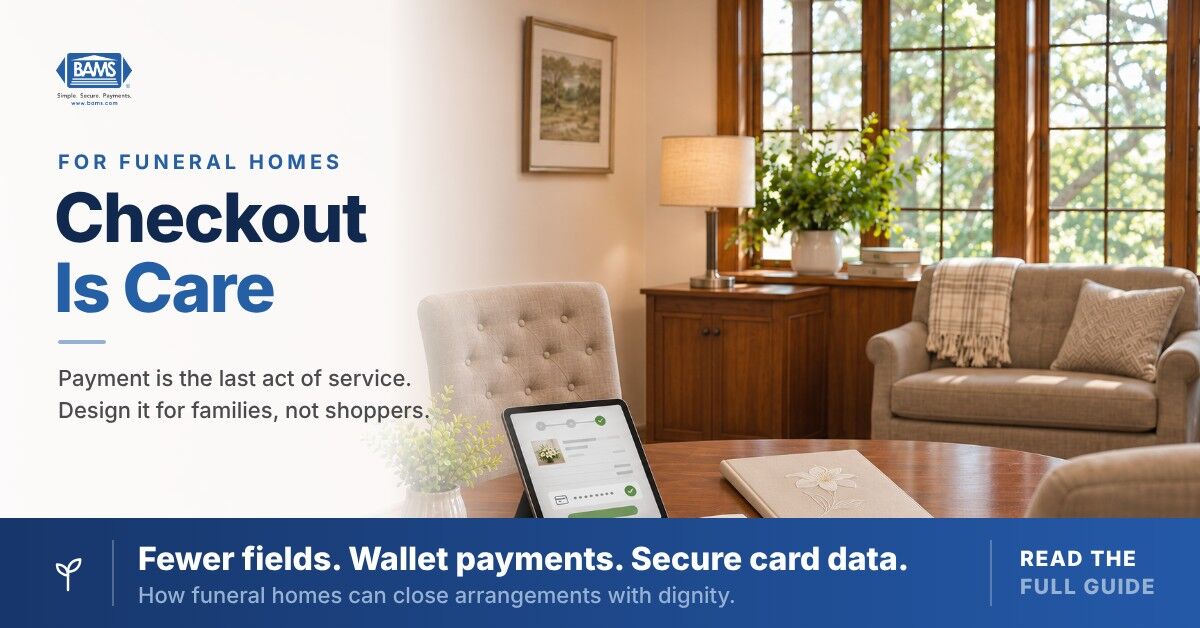
eCommerce Payment Processing: Why Checkout Is Care
The Checkout Counter Nobody Wants to Stand At
A family just lost someone. They’ve spent hours choosing a casket, writing an obituary, coordinating with clergy. And now they’re standing at a counter, or sitting at a screen, trying to figure out how to pay $12,000 while a card reader blinks impatiently. The eCommerce payment processing systems most funeral homes rely on were designed for retail speed, not human grief. That mismatch isn’t a minor inconvenience. It’s a failure of care.
TL;DR
- Payment is care, not paperwork – In funeral services, the checkout experience is the final act of service a family receives and it shapes how they remember you.
- Retail payment systems don’t fit – Generic eCommerce payment processing tools add unnecessary friction (long forms, no wallet support) to an already painful moment.
- PCI compliance protects trust – Secure payment integration isn’t just a regulatory requirement; it’s a promise to families that their vulnerability won’t be exploited.
- Design for dignity, not speed – Digital wallet support, transparent fees and next-day funding aren’t perks. They’re the minimum standard for a service built around people, not transactions.
Why Funeral Homes Borrowed Retail’s Playbook
It made sense at the time. When funeral service operators started accepting cards and online payments, they adopted whatever their processor offered. Generic terminals. Standard checkout flows. Off-the-shelf POS integrations built for volume retail or restaurants. The logic was simple: a transaction is a transaction.
And for years, that was close enough to true. Families paid in person, wrote checks, or called with a card number. But as more arrangements move online, as preneed planning grows and as families increasingly expect the same digital fluency they get from every other service provider, the gap between “good enough” and “actually appropriate” has become a chasm.
The standard checkout experience asks a grieving person to behave like a shopper. Create an account. Fill in field after field. Choose a shipping method (for what, exactly?). Retry a declined card while a sibling watches. That’s not a neutral experience. It’s an actively harmful one.
Payment Is the Last Act of Service, Not the First Act of Accounting
Here’s what we actually believe: in funeral services, the checkout experience is an extension of care, not a back-office function. Every screen a family sees, every field they fill in, every confirmation email they receive either reinforces the trust you’ve built or quietly undermines it. PCI compliance, secure payment integration and a seamless checkout experience aren’t technical checkboxes. They’re promises you make to people in their worst week.
What Happens When You Treat Payment Like Care
Consider what a typical funeral home transaction looks like. Arrangements often run into the thousands of dollars. That’s not an impulse purchase. It’s a high-stakes, emotionally loaded financial event, often handled by someone who didn’t plan to be making it.
Now consider the friction baked into most payment flows. Standard online checkouts ask for account creation, shipping details and field after field of data. For a retail purchase, that’s annoying. For a family arranging a funeral at 11 p.m. on a Tuesday, it’s cruel. Every unnecessary field is another moment where someone might stop, close the laptop and call in the morning instead, delaying the arrangement and your cash flow.
Retailers measure checkout success in conversion. In funeral services, “conversion” isn’t really the right word. But completion is. You want families to finish the process with dignity intact, not abandon it because the payment screen felt like filing taxes.
Digital Wallets Remove One More Pain Point
Digital wallet support matters here more than most funeral operators realize. Many families already pay this way everywhere else online. When a daughter paying for her father’s services can tap Apple Pay instead of hunting for a credit card number, you’ve removed one small piece of pain from a painful day. That’s not a feature. That’s an ethic.
Secure eCommerce Payment Processing Starts With PCI
PCI compliance is the foundation that makes all of this possible. Without it, digital wallet support, online invoicing and recurring billing for preneed plans all become liabilities instead of assets. But here’s where many funeral home operators get stuck: they assume PCI compliance is expensive, complicated and someone else’s problem. In reality, the PCI Security Standards Council sets one standard for any business that stores, processes or transmits card data. Your processor should help you meet it. As we cover in our guide to PCI compliance fees, those fees should include real support, not just a line item on your statement.
The right partner makes eCommerce payment processing easier. As a Payment Processing Company, BAMS offers PCI compliance support and tokenized storage for card data. It also offers next-day funding for qualifying merchants at no extra cost, in as little as ten hours after batching. That helps when you’re paying florists, clergy and staff. In addition, a dedicated account representative understands that high-ticket, low-volume transactions aren’t the same as selling sneakers online.
The operational difference is real. When your payment stack integrates cleanly with your accounting tools and your arrangement software, you stop double-entering data, chasing declined cards manually and wondering when funds will actually hit your account. Instead, you start running a business that feels as professional behind the scenes as it looks to the families you serve.
The Cost of Getting This Wrong
If payment really is the last act of service, then getting it wrong has consequences beyond a failed transaction. A clunky checkout erodes the trust you spent three hours building in the arrangement room. A surprise processing fee on a family’s statement generates the kind of phone call no director wants to take. The FTC Funeral Rule already requires an itemized General Price List, so families expect the payment step to be just as clear. A data breach, even a minor one, doesn’t just trigger fines. It ends reputations.
Funeral homes that treat eCommerce payment processing as an afterthought are making a bet: that families won’t notice, won’t care, or won’t remember. But families remember everything about the week they buried someone they loved. The payment experience is part of that memory, whether you designed it to be or not.
If your current processor can’t explain its pricing clearly, can’t fund you the next business day, or can’t support the payment methods your families already use, those are signs worth paying attention to.

Payment is the last act of service.
A Different Way to Think About “Checkout”
We’d suggest retiring the word “checkout” entirely in this context. Retail checks out. Funeral homes close arrangements. The language matters because it shapes how you design the experience.
When you think “close an arrangement,” you design for completion, dignity and clarity. You offer digital wallets because they reduce keystrokes. Then you ensure PCI compliance because you’re handling someone’s financial information during a vulnerable moment. You choose a payment partner who answers the phone. A frozen terminal at 4 p.m. on a Saturday isn’t a minor inconvenience; it’s a family standing in your lobby with nowhere to go.
The mental model shift is simple: your payment system is not infrastructure. It is hospitality.
The Families Will Remember
Funeral directors often say families remember how they felt, not what they paid. But how they paid shapes how they felt. A smooth, respectful, secure transaction is invisible. A bad one is unforgettable. Build your payment experience like it’s the last impression you’ll ever make. Because for that family, it is.
Frequently Asked Questions
How can funeral homes ensure PCI compliance without a dedicated IT team?
Most small operators can meet PCI requirements through their payment processor’s built-in compliance tools and annual self-assessment questionnaires. The key is choosing a merchant services partner that includes compliance support as part of the relationship, not as an upsell.
Why does digital wallet support matter for high-ticket funeral transactions?
Digital wallets eliminate manual card entry, reducing friction and errors on high-ticket transactions. They also align with how most consumers already pay online, making the experience feel familiar during an unfamiliar and stressful moment.
What should a funeral home look for in a payment gateway?
Prioritize transparent pricing, next-day funding, secure payment integration with your arrangement software and responsive human support. A payment gateway built for retail volume won’t address the specific needs of low-volume, high-value transactions.


