

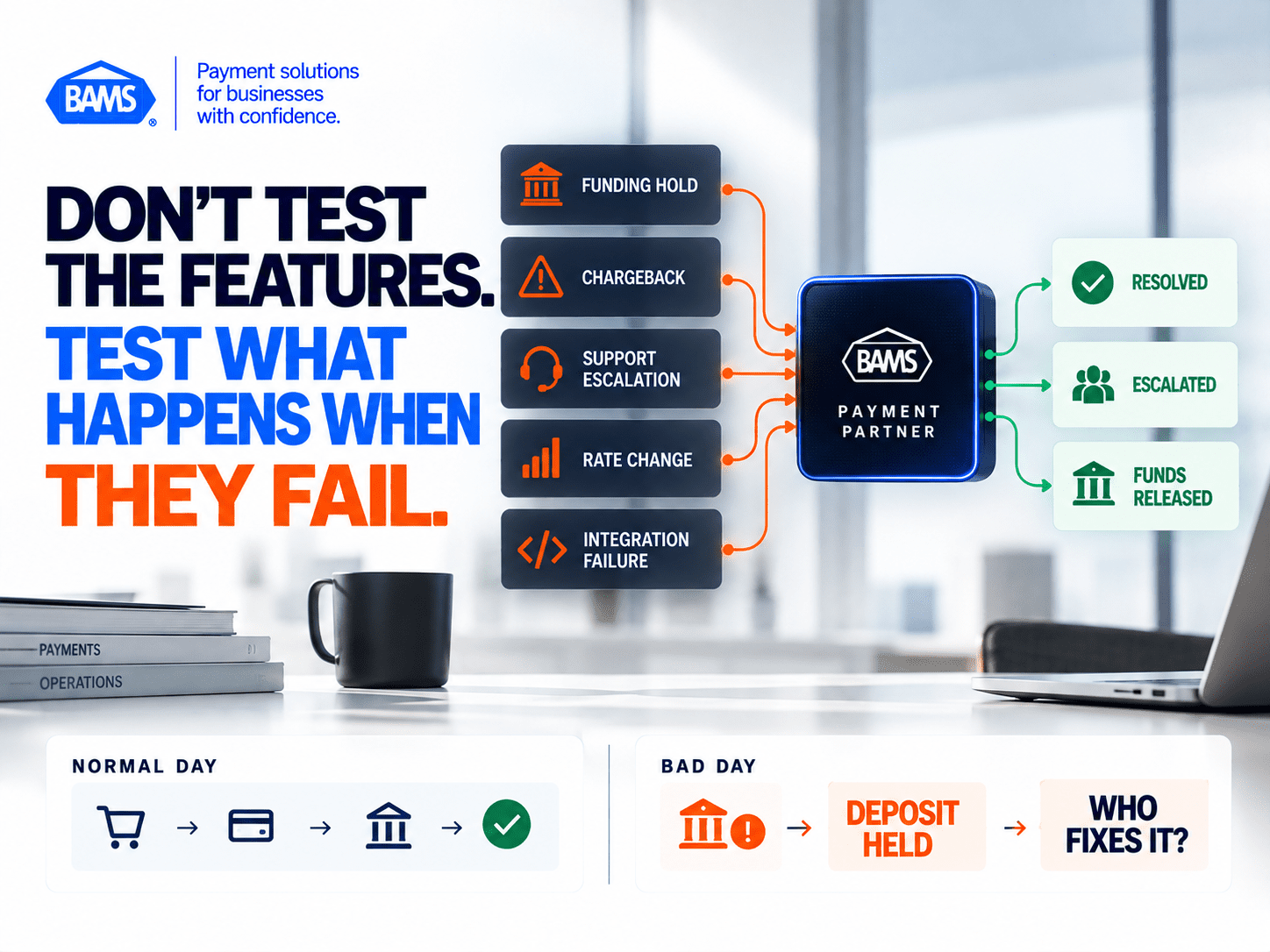
How to Stress-Test B2B Payment Solutions
Last Updated on October 21, 2026 by Dimitri Akhrin
Evaluate payment partners by what happens when transactions fail, not what the feature list promises
Learn a concrete framework for evaluating B2B payment solutions against real operational failures like delayed deposits, chargebacks, and integration breakdowns. This guide shows you which questions to ask and which red flags to catch before signing a contract.
TL;DR
- Evaluate payment partners by stress scenarios, not spec sheets — The real test is what happens during a funding hold, a chargeback cluster, or an integration failure, not how fast transactions process on a normal day.
- Dedicated human support is infrastructure, not a perk — A named account manager who knows your business and can release a hold or file a chargeback response directly reduces resolution time from days to minutes.
- Rate creep is silent and expensive — Calculate your effective processing rate monthly (total fees ÷ total volume) and compare it to your contracted rate. Demand written notice before any fee changes.
- Chargeback handling separates vendors from partners — A partner who alerts you before disputes formalize, helps build evidence, and tracks patterns can recover revenue that a passive processor simply writes off.
- Start with one test today — Call your current processor’s support line, time how long it takes to reach a human with authority over your account, and let that answer guide your next decision.
Guide Orientation: What This Covers and Who It’s For

Payment infrastructure is easy to evaluate when everything works. The real test is what happens during a funding hold, dispute cluster, integration failure or urgent escalation.
This guide helps ecommerce managers evaluate B2B payment solutions based on what happens when things go wrong, not just what’s promised when things go right. If you run an established online business with 10 to 50 employees and you’ve ever waited days for a deposit, fought a chargeback blind, or spent an hour on hold with a faceless support line, this is written for you.
By the end, you’ll have a concrete framework for stress-testing any payment partner against the scenarios that actually break operations: failed transactions, delayed funding, surprise chargebacks, and integration failures. You’ll know which questions to ask, which red flags to catch, and how to measure accountability before you sign a contract.
This guide does not compare specific processor feature lists or rank platforms. It focuses on the operational variables that determine whether your payment infrastructure holds up under real pressure.
Why Accountability in Payment Infrastructure Matters Now
Payment processing is easy to ignore when everything works. The problem is that everything doesn’t always work, and the cost of a partner who disappears during a crisis is measurable in lost revenue, strained cash flow, and operational paralysis.
The Federal Reserve has noted that many small businesses face working capital constraints and can benefit from faster access to customer payments. When your payment partner can’t resolve a settlement delay quickly, you absorb that delay directly. Payroll, inventory purchases, and marketing budgets all depend on predictable cash flow, and a funding gap can create wider operational disruption.
The shift toward electronic payment rails is accelerating. ACH B2B payments rose from 3.6 billion in 2015 to 8.7 billion in 2024, while check usage dropped sharply. This means more transactions are flowing through digital infrastructure, and the consequences of a processor failure are more immediate and more widespread than they were even five years ago.
The cost of inaction is concrete. The Federal Reserve has noted that delayed access to customer payments can increase a business’s need for short-term financing to cover inventory and operating costs. Choosing a payment partner based on a spec sheet comparison, without testing for accountability, means accepting that cash flow risk without a safety net.
Core Concepts: What Accountability Actually Means in Payment Processing
Accountability vs. Availability
Most payment processors advertise 24/7 support. Availability means someone answers. Accountability means that person can actually do something: escalate a hold, trace a missing deposit, or intervene in a chargeback dispute with context about your business. These are fundamentally different capabilities, and conflating them is one of the most expensive mistakes ecommerce operators make.
Operational Stress Points
Every payment stack has predictable failure modes. The five most common for ecommerce businesses are: deposit delays (funds don’t arrive when expected), chargeback surprises (disputes appear without advance warning or context), integration failures (POS or gateway breaks after an update), rate creep (fees increase quietly over time), and compliance holds (accounts frozen without clear explanation). A payment partner’s value is defined by how they perform across these five scenarios, not by their transaction speed on a normal Tuesday.
Local Presence as Infrastructure
“Local support” sounds like a soft differentiator. It isn’t. When your account is frozen and you need someone to review documentation in person, or when a chargeback requires rapid evidence gathering, having a dedicated account manager who understands your business model is a structural advantage. It reduces resolution time, eliminates the “explain your situation to a new agent” loop, and creates a single point of responsibility. This guide treats local, human-first support as a measurable infrastructure variable, not a marketing claim.
Feature lists tell you how a payment system performs normally. A stress test shows what happens when deposits are held, disputes spike, rates change or integrations fail.
The Stress-Test Framework for Evaluating B2B Payment Solutions
Instead of comparing feature checklists, this guide uses a five-stage stress-test framework. Each stage maps to a real operational scenario that reveals how a payment partner performs under pressure. The stages are:
- Stage 1: Funding Speed Under Duress — What happens to your deposits when something goes wrong?
- Stage 2: Chargeback Response Architecture — How does the partner handle disputes before, during, and after they land?
- Stage 3: Human Escalation Path — Can you reach a person with authority, and how fast?
- Stage 4: Pricing Transparency Over Time — Does the rate you signed for stay the rate you pay?
- Stage 5: Integration Resilience — What breaks when your systems update, and who fixes it?
These stages are sequential in the sense that each builds on the previous one. A partner who fails at Stage 1 (funding reliability) will almost certainly fail at Stages 2 through 5. But you should evaluate all five independently, because a partner who excels at funding speed might still have a broken escalation path.
Step-by-Step Breakdown: Stress-Testing Your Payment Partner
Step 1: Test Funding Speed Under Duress
Objective: Determine whether your payment partner delivers funds on time when conditions aren’t ideal, not just during normal processing.
Funding speed is the most visible promise any processor makes, and the easiest to verify. But the number that matters isn’t the standard deposit time listed on their website. It’s the deposit time when a transaction triggers a review, when your volume spikes unexpectedly, or when a batch includes a flagged card type.
Ask your prospective partner these questions directly: What is your standard funding timeline? What triggers a funding hold, and how long do holds typically last? What is the process for releasing a hold, and who initiates it? Nacha reports that American businesses processed 8.1 billion B2B payments through the ACH Network in 2025, underscoring how heavily businesses now rely on electronic payment infrastructure.
Anti-patterns to avoid: Accepting “next-day funding” as a blanket promise without asking about exceptions. Signing a contract without understanding hold triggers. Assuming that funding delays are always your bank’s fault rather than your processor’s.
Success indicators: Your partner can name specific hold triggers in writing. They offer a documented escalation process for funding delays. They can provide references from businesses with similar transaction volumes who have experienced and resolved funding issues.
Step 2: Evaluate Chargeback Response Architecture
Objective: Understand whether your partner defends chargebacks proactively or simply passes them through as administrative notifications.
Chargebacks are not just a financial loss. They’re an operational disruption that consumes staff time, threatens your processing ratios, and can result in account termination if your chargeback rate exceeds network thresholds. The difference between a partner who sends you a chargeback notification email and one who alerts you in advance, helps gather evidence, and files the response on your behalf is the difference between losing $500 and recovering it.
Evaluate the partner’s chargeback process across three phases. Pre-dispute: Do they offer alerts when a customer initiates a dispute, before it becomes a formal chargeback? During dispute: Do they assist with evidence compilation and response filing, or do they leave you to navigate the card network’s process alone? Post-dispute: Do they analyze chargeback patterns to help you reduce future occurrences?
A partner like BAMS, for example, offers proactive chargeback defense with dedicated account managers who help build response cases, rather than forwarding a form letter and wishing you luck. This kind of hands-on involvement is what separates a payment vendor from a payment partner.
Anti-patterns to avoid: Assuming all processors handle chargebacks the same way. Ignoring chargeback ratios until your account is flagged. Treating chargebacks as a cost of doing business rather than a process that can be managed.
Success indicators: The partner can describe their chargeback alert system and average response time. They assign a specific person (not a ticket queue) to your disputes. They track your chargeback ratio and flag trends before they become critical.
Step 3: Map the Human Escalation Path
Objective: Verify that you can reach a decision-maker with authority over your account within a defined timeframe, every time.
This is where most large payment processors fail ecommerce operators. Their support infrastructure is built for volume, not resolution. You call a number, explain your situation to a Tier 1 agent, get transferred, explain again, get transferred again, and eventually receive a ticket number with a 48-to-72-hour resolution window. Meanwhile, your deposits are frozen or your gateway is down.
The stress test here is simple. Before you sign, call the partner’s support line. Time how long it takes to reach a human. Ask that human a specific technical question about your account type. Note whether they can answer it or need to escalate. Then ask who your dedicated point of contact would be after signing, and whether that person has the authority to release a hold, adjust a rate, or intervene in a dispute without further approvals.
Dedicated account management is not a luxury feature. It’s the mechanism that makes every other promise enforceable. If your partner can’t name the person responsible for your account, they can’t be held accountable for anything that happens to it.
Anti-patterns to avoid: Confusing chatbot availability with human support access. Accepting “we’ll get back to you” as a resolution process. Signing with a partner whose support model requires you to re-explain your business context on every call.
Success indicators: You have a named account manager with a direct phone number. That person can describe your business model, transaction volume, and risk profile. Escalation from first contact to someone with decision authority takes less than 15 minutes.
Step 4: Audit Pricing Transparency Over Time
Objective: Confirm that the rates you’re quoted at signing are the rates you’ll actually pay six months, twelve months, and two years later.
Rate creep is one of the most common and least discussed problems in payment processing. It works like this: you sign a contract with a competitive interchange-plus rate. Six months later, a “regulatory fee” appears on your statement. A year later, your “non-qualified” surcharge increases. Two years in, you’re paying 40 to 60 basis points more than you agreed to, and the increases were buried in statement footnotes you didn’t read.
To stress-test for pricing transparency, request a complete fee schedule, not just the headline rate. Ask specifically about: PCI compliance fees, batch fees, statement fees, early termination fees, annual fees, and any fees categorized as “miscellaneous” or “regulatory.” Then ask the partner to show you a sample merchant statement from an existing client (redacted for privacy) so you can see how fees are actually presented.
The most important question is this: Does your contract include a rate-lock provision, and if so, for how long? If the answer is no, ask what notice period is required before any fee increase takes effect. A partner who can’t answer these questions clearly is a partner who will cost you more than they quoted.
Anti-patterns to avoid: Comparing only headline processing rates without examining the full fee structure. Ignoring the fine print on rate adjustment clauses. Failing to review monthly statements line by line for the first six months.
Success indicators: The partner provides a complete, itemized fee schedule before you sign. Their contract specifies a rate-lock period or a clear notification process for changes. Monthly statements are readable and match the agreed fee structure exactly.
Step 5: Stress-Test Integration Resilience
Objective: Determine what happens to your payment flow when your ecommerce platform, POS system, or gateway updates, and who is responsible for fixing it.
Integration failures are the operational scenario ecommerce managers fear most, because they’re the hardest to predict and the most disruptive when they occur. Your ecommerce platform pushes an update, and suddenly your checkout page throws errors. Your POS system receives a firmware update, and card-present transactions stop processing. Your payment gateway changes its API, and your custom integration breaks.
The stress test for integration resilience involves three questions. First, how many platforms and gateways does the partner natively support, and is yours among them? Second, when an integration breaks, who is responsible for diagnosing and fixing it: you, the platform, or the payment partner? Third, what is the partner’s average resolution time for integration-related outages?
For businesses that rely on mobile payment solutions or multi-channel selling, integration resilience is especially critical. A payment partner that supports your current stack but can’t adapt when you add a new sales channel or upgrade your platform is a partner with a built-in expiration date.
Anti-patterns to avoid: Assuming that “works with Shopify” means the integration is maintained and supported. Signing without asking who handles integration troubleshooting. Ignoring compatibility with your secondary sales channels (in-store POS, mobile, marketplace).
Success indicators: The partner maintains documented integrations with your specific platform version. They have a technical support team (not just sales) that handles integration issues. They can provide a case example of resolving an integration failure for a similar business.
Practical Examples: What Accountability Looks Like in Action
Scenario A: The Friday Afternoon Funding Hold
An ecommerce business processing $80,000 per week sees its Friday deposit held without explanation. With a faceless processor, the owner calls a general support line at 4:30 PM, waits 35 minutes, reaches an agent who can see the hold but can’t release it, and is told to expect a callback “within 2 business days.” That means Monday at the earliest. The business misses a supplier payment over the weekend.
With an accountable partner, the owner calls their dedicated account manager directly. The manager identifies the hold trigger (a single transaction flagged for unusual amount), verifies the transaction’s legitimacy within 20 minutes, and initiates the release. Funds arrive Saturday morning. The supplier payment goes out on time.
Scenario B: The Chargeback Cluster
A mid-size online retailer receives five chargebacks in one week from a single card issuer. With a passive processor, each chargeback arrives as a separate email notification with a generic response template and a 10-day deadline. The retailer scrambles to compile evidence for each case individually, misses one deadline, and loses $1,200.
With a proactive partner, the account manager notices the cluster pattern, contacts the retailer immediately, and identifies that all five disputes originated from a single compromised card number used in a fraud ring. The partner files coordinated responses with consolidated evidence, flags the card number to prevent future fraudulent orders, and recovers four of the five disputes. The retailer loses $240 instead of $1,200.
Scenario C: The Silent Rate Increase
A business signs with a processor at an effective rate of 2.4%. Over 18 months, incremental fees push the effective rate to 2.95%. The owner doesn’t notice because the increases are spread across obscure line items. At $500,000 in annual processing volume, that’s $2,750 in unexpected costs per year.
With a transparent partner, the owner receives a clear notification 30 days before any fee change, with an explanation of the reason and the exact impact on their monthly statement. The owner can negotiate, accept, or switch, but they’re never surprised.
Common Mistakes and Pitfalls
Optimizing for the wrong metric. Many ecommerce managers choose a payment partner based on the lowest quoted rate, then discover that hidden fees, slow funding, and poor support cost far more than the basis points they saved. Total cost of processing includes the operational cost of dealing with problems, not just the transaction fee.
Treating payment infrastructure as a set-and-forget decision. Your business changes. Your transaction volume grows, your product mix shifts, your sales channels expand. A payment partner that was right for you at $200,000 in annual volume may not be right at $2 million. Review your payment infrastructure at least annually.
Ignoring the contract’s exit terms. Early termination fees, equipment leases, and long-term commitments can trap you with an underperforming partner. Read the exit clause before you sign the entry clause.
Assuming all processors handle disputes identically. They don’t. The gap between a partner that forwards chargeback notifications and one that actively defends your revenue is often the gap between profit and loss on disputed transactions.
What to Do Next
Start with one step: call your current payment partner’s support line and time how long it takes to reach a human who can answer a specific question about your account. That single data point will tell you more about your partner’s accountability than any sales deck or feature comparison.
If the answer disappoints you, pull your last three monthly statements and calculate your true effective processing rate (total fees divided by total volume). Compare that number to the rate you were quoted when you signed. The gap, if there is one, quantifies the cost of working with a partner who isn’t transparent.
Use the five-stage stress-test framework from this guide as a structured evaluation tool the next time you review your payment infrastructure. You don’t need to switch partners today. But you do need to know whether your current partner can be held accountable when the next deposit delay, chargeback cluster, or integration failure hits. Because it will hit. The only question is whether someone picks up the phone when it does.
Frequently Asked Questions
What should I prioritize when comparing B2B payment solutions?
Prioritize operational accountability over feature lists. The most important variables are funding speed during exceptions (not just standard processing), chargeback response quality, human escalation access, pricing transparency over time, and integration support. A partner who excels on a spec sheet but can’t resolve a funding hold in under an hour is a liability, not an asset.
How do I know if my payment processor’s fees have increased without notice?
Calculate your effective processing rate each month by dividing total fees by total processing volume. If that percentage trends upward over several months without a corresponding change in your transaction mix (more international cards, higher average ticket, etc.), you’re likely experiencing rate creep. Review line items like “regulatory fees,” “PCI non-compliance fees,” and “miscellaneous charges” for unexplained additions.
Why does local or dedicated support matter for payment processing?
Dedicated support means your contact already knows your business model, transaction patterns, and risk profile. This eliminates the re-explanation loop that wastes critical time during urgent issues like funding holds or account freezes. It also creates a single point of responsibility, which means someone’s reputation is tied to your account’s performance. That’s accountability in its most practical form.
What is a good chargeback rate, and when should I worry?
Card networks like Visa and Mastercard generally flag merchants whose chargeback rate exceeds 1% of transactions. If you’re approaching 0.75%, you should already be working with your payment partner to identify patterns and reduce disputes. A partner who doesn’t proactively monitor your chargeback ratio and alert you before you hit thresholds is not managing your risk.
How often should I review my payment processing setup?
At minimum, review annually. Review more frequently if your transaction volume changes by more than 20%, you add a new sales channel (in-store, mobile, marketplace), your ecommerce platform undergoes a major update, or you notice unexplained fee increases. Payment infrastructure should evolve with your business, not lag behind it.
Can POS systems for local businesses integrate with ecommerce payment processing?
Yes, and this integration is increasingly important for businesses selling across multiple channels. The key question is whether your payment partner supports unified reporting and settlement across both your online gateway and your in-store or mobile payment systems. Fragmented processing across separate providers creates reconciliation headaches and makes it harder to track your true cost of payments.

