

7 Questions to Ask Before Merchant Account Approval
Last Updated on October 21, 2026 by Dimitri Akhrin
A diagnostic checklist that exposes hidden reserve terms before they blindside your cash flow
Learn which pre-agreement questions eCommerce operators skip during merchant account approval and why those gaps lead to surprise reserves. This checklist helps you negotiate transparent terms and protect working capital as you scale.
TL;DR
- Reserves are negotiable, not fixed – Most eCommerce operators accept reserve terms at onboarding and never revisit them, even after months of clean processing. Request a reserve review schedule in your agreement.
- Ask the questions before you sign – Get the reserve trigger matrix, internal chargeback thresholds, communication protocols, and release schedules in writing during the pre-agreement phase.
- Declare your growth upfront – Processors flag volume spikes as risk events. Projecting your 12-month volume (with a 20-30% buffer) during underwriting prevents growth from triggering unnecessary holds.
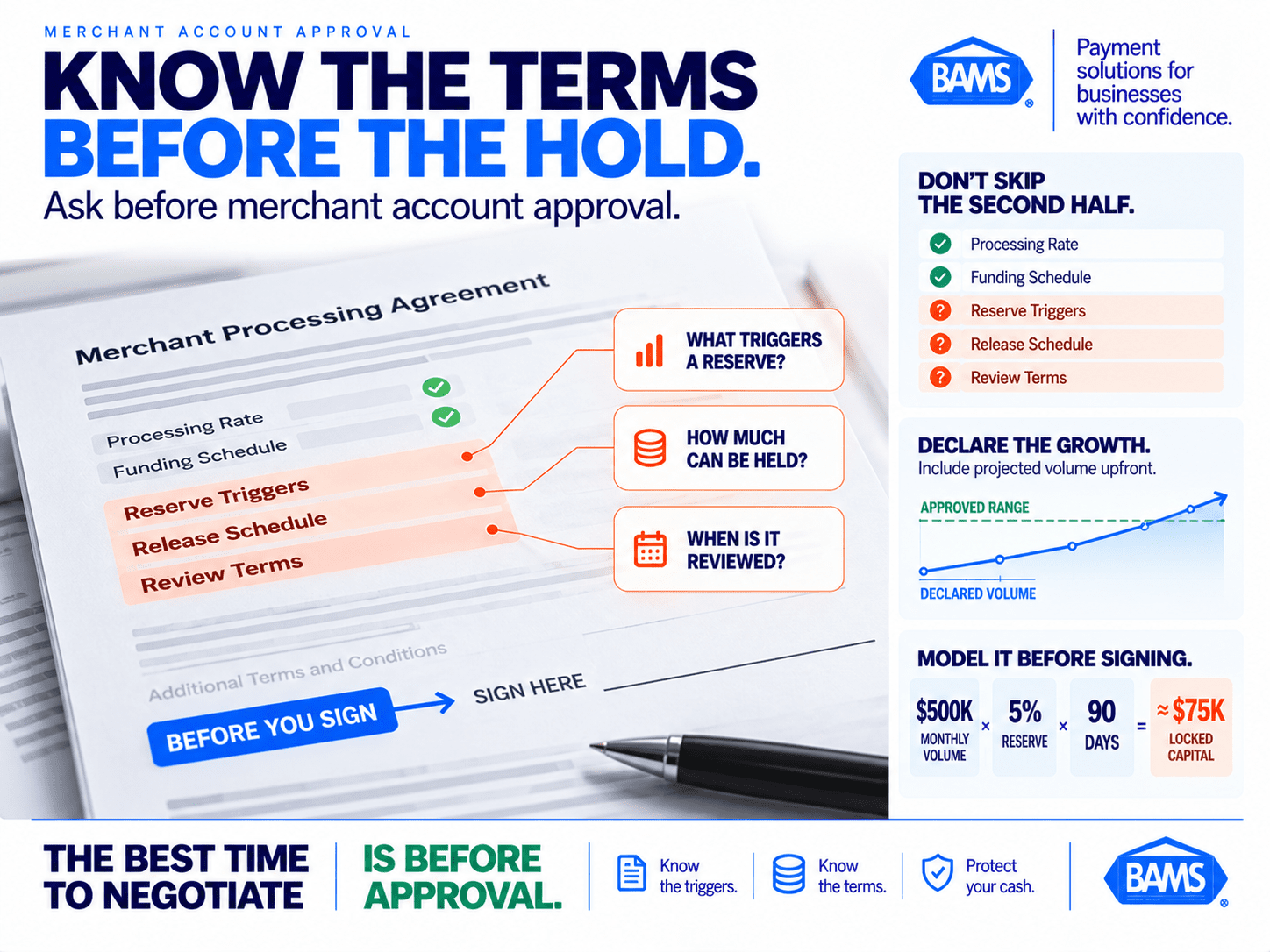
- Model the cash flow impact – A 5% rolling reserve with a 90-day release on $500K monthly volume locks up roughly $75K at all times. Run this calculation before committing to terms.
- Treat reserve reduction as a relationship outcome – The merchants who reduce reserves fastest are the ones who maintain transparent, ongoing communication with their processor and present performance data proactively.

The best time to understand reserve terms is before processing begins. Ask about the triggers, thresholds and release conditions while the agreement is still negotiable.
The Reserve Conversation Most eCommerce Operators Never Have
Scaling an eCommerce business introduces a cash flow problem most operators don’t see coming: the reserve. Your payment processor quietly holds back a percentage of every transaction, sometimes 5%, sometimes 10%, and you don’t find out until deposits start looking thinner than expected. The merchant account approval process felt smooth. The rates looked competitive. But buried in the processing agreement were reserve terms that now tie up tens of thousands of dollars in working capital.
Here’s the pattern. A business grows, transaction activity changes and the processor or acquiring bank may reassess the account’s risk profile. The OCC explains that acquirers may establish merchant reserve or holdback accounts to manage chargeback and credit exposure and may fund those reserves by withholding a portion of daily proceeds. The percentage withheld, review process and release conditions depend on the merchant agreement and the specific risk profile rather than a universal industry schedule.
What This Checklist Covers (and What It Doesn’t)
This guide is for eCommerce managers at established businesses processing consistent volume who want to reduce reserve requirements as they grow, not accept them as permanent overhead. It’s not a high-risk merchant survival guide. It’s a diagnostic framework for mainstream operators who landed in reserve territory because of growth velocity, not product category.
We’re excluding processors that specialize exclusively in high-risk verticals. Instead, we’re focused on the due diligence steps that separate operators who negotiate reserves down from those who absorb them indefinitely. Each item below was selected based on its direct impact on reserve management outcomes: whether it changes the processor’s risk calculation, gives you leverage in a review conversation, or prevents an avoidable escalation.
Reserve management starts before onboarding. These eight questions help expose how reserves are triggered, changed, reviewed and eventually released.
8 Pre-Agreement Questions That Determine Your Reserve Trajectory
1. Ask for the Reserve Trigger Matrix in Writing
Why it matters: Most processors have internal thresholds that trigger reserve placement or increases, but they rarely volunteer this information during onboarding. Without knowing the specific metrics (chargeback ratios, refund rates, volume ceilings) that activate a reserve, you’re operating blind.
What it looks like today: Merchant activity may be monitored after approval against parameters established for the account. The OCC identifies daily sales volume, average ticket size and chargeback activity among the parameters that acquiring banks may monitor for significant variances. The specific threshold that triggers additional review or a reserve action varies by acquirer and merchant agreement.
How to apply it: Before signing, request a written document outlining every condition that initiates, increases, or releases a reserve. If the processor can’t or won’t provide this, that’s diagnostic information in itself. Compare what you receive against your current transaction patterns and projected growth to identify where you’re most likely to trip a threshold.
2. Define Your Volume Trajectory Before the Processor Defines It for You
Why it matters: Processors set expected volume ranges during underwriting. When your actual processing exceeds those ranges (which it will, if you’re growing), the system flags it as anomalous activity. That flag often results in a reserve hold, not a congratulatory email.
What it looks like today:Card authorization completes in roughly two seconds, while funding typically takes two to five business days and can stretch longer when volume anomalies trigger manual review. The gap widens when your declared volume doesn’t match reality.
How to apply it: Declare your projected volume for the next 12 months during the application process, including seasonal peaks. Overestimate by 20% to 30%. It’s easier to process below your declared ceiling than to explain why you’ve exceeded it. Build a merchant services checklist that includes volume declaration as a setup item, not an afterthought.
3. Separate Reserve Type from Reserve Duration
Why it matters: Not all reserves work the same way, and conflating them costs you negotiating leverage. A rolling reserve (where funds release on a schedule) is fundamentally different from an upfront reserve (a lump sum held indefinitely) or a capped reserve (held until a threshold is met, then stopped).
What it looks like today: Reserve structures vary by acquirer and merchant agreement. The OCC notes that merchant reserves may be funded as a lump sum or by withholding part of daily proceeds until a specified balance is reached. The structure, amount and release conditions should therefore be reviewed as separate contractual variables rather than assumed from an industry benchmark.
How to apply it: During pre-agreement discussions, ask which reserve type applies to your account and whether alternatives are available. A rolling reserve with a 90-day release is significantly better for cash flow than an upfront reserve with no defined release trigger. Treat reserve terms as a negotiable treasury variable, not a fixed penalty.
4. Audit the Processor’s Communication Protocol for Reserve Changes
Why it matters: The difference between a manageable reserve and a cash flow crisis is often just advance notice. Processors that notify you 30 days before increasing a reserve give you time to adjust. Processors that notify you after the fact leave you scrambling.
What it looks like today: Many processors bury reserve-change notifications in email updates or portal dashboards that operators rarely check. Transparent payment processor compliance means proactive, direct communication, not a buried line item in a monthly statement.
How to apply it: Ask three specific questions before signing: How much notice will I receive before a reserve is placed or increased? What channel will that notification use? Is there an appeal or review window before the change takes effect? Document the answers. If the processor’s communication protocol is vague, build your own monitoring cadence around weekly deposit reconciliation.
5. Map Your Chargeback Ratio to the Processor’s Threshold (Not the Industry Average)
Why it matters: Do not rely on a generic industry chargeback percentage when evaluating your own account. Card networks maintain their own monitoring programs and your processor may apply additional account-level risk criteria. Visa’s current Visa Acquirer Monitoring Program evaluates fraud and dispute activity using defined program metrics at both the acquirer and merchant level. Your processor’s internal monitoring criteria may be different from network program thresholds.
What it looks like today: Processors may monitor chargeback activity alongside transaction volume, average ticket size, return patterns and other account behavior. A reserve decision therefore may not be based on one dispute percentage alone.
How to apply it: Ask your processor for their specific internal chargeback and refund thresholds during underwriting. Then build your chargeback risk management strategy around those numbers, not the card network defaults. Track your ratio weekly, not monthly, so you can intervene before crossing a threshold.
6. Negotiate a Reserve Review Schedule Into the Agreement
Why it matters: Reserves placed during onboarding or after a risk event tend to persist long after the conditions that triggered them have resolved. Without a scheduled review, the burden falls entirely on you to initiate the conversation, and most operators never do.
What it looks like today: Some processors offer quarterly account reviews. Most don’t, unless you ask. The result is that merchants with six months of clean processing history continue paying the same reserve rate they were assigned when their account was flagged.
How to apply it: Before signing, ask whether the agreement can include a defined reserve review cadence and the performance information considered during that review. OCC examination guidance specifically addresses the frequency of merchant account reviews and the processes used to increase or decrease reserve balances. Agree on a cadence that makes sense for your account rather than assuming a universal 90-day standard.
7. Stress-Test the Reserve Release Schedule Against Your Cash Flow Model
Why it matters: A 5% rolling reserve with a 90-day release sounds manageable in isolation. But when you model it against payroll, inventory purchasing cycles, and ad spend, the compounding effect on working capital becomes clear. Most operators don’t run this calculation until after they’re in the agreement.
What it looks like today: An eCommerce business processing $500,000 monthly with a 5% rolling reserve and 90-day release has approximately $75,000 locked up at any given time. For a business with 10 to 50 employees, that’s often the equivalent of a full payroll cycle.
How to apply it: Before signing, build a simple cash flow model that accounts for the reserve percentage, release cycle, and your monthly obligations. Calculate the maximum capital that will be held at any point. If that number creates operational risk, negotiate the percentage, the release cycle, or both before you commit.
8. Identify Whether Your Processor Uses Static or Dynamic Risk Assessment
Why it matters: Static risk assessment assigns a reserve at onboarding and rarely revisits it. Dynamic risk scoring adjusts your reserve requirements based on ongoing performance data. The difference determines whether good behavior is rewarded or ignored.
What it looks like today: Ongoing merchant monitoring is an established part of acquiring risk management. Mastercard’s merchant compliance framework includes ongoing monitoring programs for chargeback and fraud performance. Processors and acquirers may also use their own risk models and account-specific parameters, so ask how improved performance is reflected in reserve reviews rather than assuming reductions happen automatically.
How to apply it: Ask directly: does your risk model automatically reduce reserves when my metrics improve, or do I need to request a review? If the answer is the latter, refer back to item 6 and ensure you have a review schedule in place. The combination of dynamic scoring and scheduled reviews creates the fastest path to reducing rolling reserves and payout holds over time.
The Pattern Beneath the Checklist
Three themes run through every item above. First, reserves are a function of information asymmetry. The processor knows their thresholds, their scoring model, and their review cadence. You often don’t. Closing that gap before signing is the single highest-leverage action you can take.
Second, growth is a risk signal until you prove otherwise. Processors don’t distinguish between healthy scaling and erratic behavior unless you give them the data to do so. Declaring volume projections, maintaining clean chargeback ratios, and requesting regular reviews all serve the same purpose: converting your growth story into a risk narrative the processor can underwrite.
Third, reserve reduction is a relationship outcome, not a policy outcome. The merchants who reduce reserves fastest are the ones who treat their processor relationship as a two-way communication channel, not a utility bill.
Where to Start
You don’t need to address all eight items simultaneously. If you’re about to sign a new processing agreement, start with items 1, 2, and 6. These three give you visibility into the reserve trigger conditions, protect you against volume-based flags, and ensure you have a mechanism to revisit terms as your performance data improves.
If you’re already in an agreement with a reserve in place, start with items 5 and 7. Understanding your processor’s internal thresholds and modeling the cash flow impact of your current reserve will tell you whether renegotiation is urgent or can wait for your next scheduled review. The goal isn’t to eliminate reserves entirely. It’s to ensure they reflect your actual risk profile, not the default settings your processor applied at onboarding.
Frequently Asked Questions
What is reserve and hold management in merchant services?
Reserve and hold management refers to the practice of a payment processor withholding a percentage of your transaction volume as collateral against future chargebacks, refunds, or financial exposure. This can take the form of rolling reserves (released on a schedule), upfront reserves (a lump sum held before processing begins), or capped reserves (held until a dollar threshold is reached). Managing these effectively means understanding the terms, monitoring the triggers, and negotiating reductions as your risk profile improves.
Why do payment processors withhold reserves from merchants?
Processors hold reserves to protect themselves against financial liability. If a merchant generates chargebacks or refunds after funds have already been deposited, the processor is on the hook for those losses. Reserves act as a buffer. The percentage and duration depend on factors like your industry, chargeback ratio, average ticket size, processing history, and volume consistency. New accounts and rapidly scaling businesses typically face higher reserves because they present less historical data for the processor to evaluate.
How do rolling reserves work in payment processing?
A rolling reserve withholds a fixed percentage of each transaction (commonly 5% to 10%) and holds those funds for a set period, usually 90 to 180 days. After the holding period expires, the oldest funds are released back to you on a rolling basis. This means you always have a certain amount of capital locked up, but it cycles through rather than accumulating indefinitely. The key variables to negotiate are the percentage withheld and the length of the release cycle.
When can a merchant expect to have their reserves released?
Release timing depends on your reserve type and agreement terms. Rolling reserves release on their defined schedule (often 90 days after each transaction batch). Upfront or capped reserves may release only after a formal account review or after you’ve maintained clean processing metrics for a specified period. If your agreement doesn’t include a reserve review schedule, you’ll likely need to request a release proactively by presenting your performance data to your processor or account manager.
Which factors influence the percentage of reserves withheld by payment processors?
Several factors contribute: your industry’s risk classification, chargeback ratio, refund rate, average transaction size, delivery timeframes, processing volume relative to your declared projections, and your account’s historical performance. Processors also consider whether you sell physical or digital goods, whether you use subscription billing, and how long your business has been operating. These factors are weighted differently by each processor, which is why asking for your specific processor’s trigger matrix is essential.
How can merchants reduce their reserve requirements over time?
The most effective approach combines consistent performance data with proactive communication. Maintain a low chargeback ratio (well below your processor’s internal threshold, not just the card network limit), keep refund rates stable, process within your declared volume range, and request regular account reviews. Having a scheduled reserve review clause in your agreement gives you a formal mechanism to present your case. Processors that use dynamic risk scoring may reduce reserves automatically, but many still require you to initiate the conversation.


