Why Your Payment Gateway Is Costing You More Than Fees
How small businesses can reclaim cash flow with secure, faster payment solutions
Discover why traditional payment processors hold your revenue hostage and how modern secure payment gateways eliminate costly delays. Learn to evaluate solutions that protect transactions while keeping cash flowing.
TL;DR
- Deposit delays are a choice, not a necessity – Modern payment technology can verify transactions instantly, so multi-day holds reflect outdated systems rather than security requirements
- Digital wallet payments improve transaction quality – Biometric authentication means these payments arrive pre-verified, which should translate to faster fund releases
- Evaluate processors on funding speed first – A slightly higher rate with next-day deposits often costs less than a lower rate with weekly batches once you factor in bridging costs
- Cash flow access is a competitive advantage – The businesses pulling ahead often have the same revenue but better access to it, enabling faster decisions on inventory, marketing, and growth
Your Money Is Stuck in Limbo While Your Bills Keep Coming
You processed $47,000 in sales last week. Your payment processor is holding it for five to seven business days. Meanwhile, your supplier wants payment tomorrow, payroll hits Friday, and your ad spend needs replenishing by Monday.
This is the quiet crisis of eCommerce cash flow. The sale happened. The customer paid. But the money exists in some digital purgatory, visible in your dashboard but untouchable in your bank account.
For eCommerce managers running established operations, delayed deposits create a cascading effect that ripples through every decision you make.
The Industry Trained You to Accept Slow Money
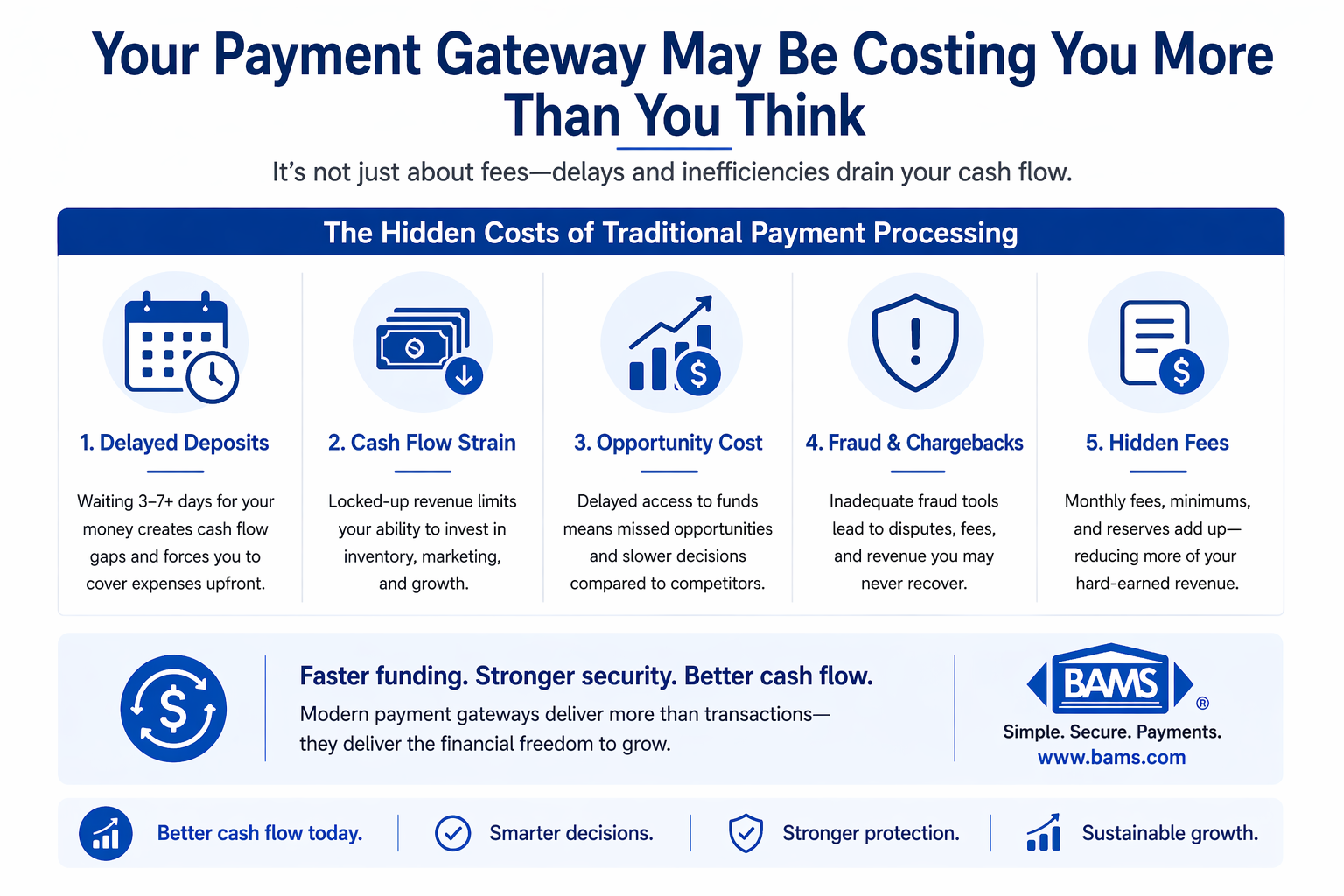
Payment gateways don’t just charge fees. Delays, hidden costs, and inefficiencies quietly drain your cash flow and limit business growth.
Somewhere along the way, we collectively accepted that waiting days for your own revenue was just “how payments work.” The big processors normalized it. They built empires on holding your cash while earning interest on the float.
The standard pitch goes like this: security requires time, verification takes days, fraud prevention means delays. And for years, businesses believed it because they had no alternative framing.
This made sense when eCommerce was new and processors needed time to assess risk. The infrastructure exists for faster, more secure transactions. The delay is no longer a technical necessity.
It’s a business model choice, and you’re funding it.
Speed and Security Are Not Opposing Forces
Here’s what I actually believe: the best integrated payment gateway for small businesses delivers your money fast because it has better security, not despite it.
The processors who move slowly aren’t being cautious. They’re being lazy with outdated risk models that treat every transaction like a potential threat instead of building systems smart enough to know the difference.
What Actually Drives Deposit Speed
Let me walk you through what separates processors who release funds quickly from those who sit on your money.
The difference starts with real-time risk assessment. According to Visa, modern payment systems are designed to process transactions securely while maintaining speed and efficiency.
Modern secure payment gateway technology can evaluate transaction legitimacy in milliseconds. Behavioral analysis, device fingerprinting, velocity checks: these happen instantly. There’s no technical reason to hold funds for days while “reviewing” what algorithms already cleared.
The PCI Security Standards Council emphasizes that strong data security and compliance standards are critical for protecting transactions without slowing down processing. The processors investing in genuine fraud prevention can move faster because they have confidence in their systems.
Consider how digital wallet payments changed the equation. When a customer pays with Apple Pay or Google Pay, biometric authentication happens on their device before the transaction even reaches you. The customer proved their identity with their fingerprint or face.
Yet many processors treat these verified transactions with the same suspicion as a manually keyed credit card number from a new customer. That’s not caution. That’s institutional inertia.
I’ve seen eCommerce operations transform when they switch to processors offering guaranteed next-day funding. The change isn’t just financial, it’s operational. Inventory decisions happen based on actual available capital. Marketing spend scales with real revenue. Supplier relationships improve because you pay on time instead of juggling due dates around deposit schedules.
The fraud prevention conversation often gets framed backwards. Businesses worry that faster deposits mean higher risk. In reality, the processors with sophisticated security can afford to release funds quickly because they’ve already verified the transaction is legitimate. Slow deposits often signal outdated systems, not careful ones.
The Hidden Cost of Waiting for Your Own Money
If deposit timing doesn’t affect your business decisions, you’re either exceptionally well-capitalized or you’re not paying attention.
Every day your revenue sits unreleased, you’re making choices based on incomplete information. You’re passing on inventory at good prices because the cash isn’t there yet. You’re delaying ad campaigns during peak windows. You’re paying credit card interest to bridge gaps that shouldn’t exist.
For a business processing $500,000 annually, a five-day average deposit delay means roughly $6,800 is perpetually in transit. That’s not your processor’s money. It’s yours, working for them instead of you.
The eCommerce managers who thrive understand that payment processing isn’t just a transaction cost. It’s a cash flow tool. The right processor becomes a competitive advantage. The wrong one becomes an anchor.
According to the Federal Reserve, interchange structures significantly impact the total cost of payment processing, reinforcing the importance of evaluating both speed and cost together.
Reframe How You Evaluate Payment Partners
Modern payment gateways outperform traditional processors by delivering faster funding, stronger security, and better cash flow visibility.
Stop asking “what’s your processing rate?” as the first question. Start asking “when do I get my money?”
A processor charging 2.9% with next-day funding often costs less than one charging 2.4% with weekly batched deposits, once you factor in the financing costs of bridging those gaps. The math changes when you treat deposit speed as a line item.
Think of your payment gateway as a cash flow partner, not a transaction utility. The best partners understand that your success depends on predictable access to your revenue. They build their systems around that reality instead of around their own convenience.
Accepting digital wallets isn’t just about customer convenience anymore. It’s about transaction quality. These payments come pre-verified, which gives you leverage to expect faster settlement.
Your Revenue Deserves to Work for You
The eCommerce businesses pulling ahead aren’t necessarily selling better products or running smarter ads. Some of them simply have better access to their own money.
That’s not a minor operational detail. That’s a structural advantage that compounds over time. When your deposits arrive tomorrow instead of next week, every decision you make has more options behind it.
The question isn’t whether you can survive with slow deposits. You’ve been doing that. The question is what you could build if that constraint disappeared.
Frequently Asked Questions
What is a payment gateway and why is it important for eCommerce?
A payment gateway securely transmits transaction data between your online store and payment processors. It protects customer payment information, enables authorization in real time, and directly affects how quickly you receive deposited funds.
How do I choose the best payment gateway for my business?
Prioritize deposit speed, transparent fee structures, and security features over brand recognition alone. Ask specifically about funding timelines and chargeback support before committing.
When should I consider switching my payment gateway?
Switch when deposit delays consistently affect your cash flow decisions, when fees increase without added value, or when support becomes reactive instead of proactive. The switching cost is usually lower than the ongoing cost of staying.