Next-Day Funding vs Same-Day: eCommerce Cash Flow
Last Updated on October 6, 2026 by Dimitri Akhrin
How batch cycles, weekend volume, and deposit timing shape your restocking calendar and supplier payments
Learn how same-day and next-day funding options interact with weekend batch cycles, processor timing, and eCommerce deposit patterns. This comparison covers cost, reliability, and operational impact for online stores processing $50K–$500K monthly.
TL;DR
- Next-day funding wins for most eCommerce businesses — It eliminates the 2 to 3 day standard delay at a fraction of same-day’s cost, giving you reliable daily deposits you can plan around.
- Same-day funding has a narrow use case — It’s worth the premium only if you have same-day financial obligations like perishable inventory or COD supplier payments. Most online retailers don’t.
- Neither option solves weekends — Saturday and Sunday sales sit until Monday regardless of your funding speed, because ACH networks don’t process on non-business days.
- The payment rail matters more than the label — “Same-day” and “next-day” depend on your processor’s batch cut-off time, the ACH submission window, and your bank’s posting schedule. Ask your processor for specifics.
- Predictability beats raw speed — A consistent next-day deposit rhythm improves cash flow planning, inventory management, and ad spend decisions more than saving a few hours on deposit timing.
Same-Day vs Next-Day Funding: What the Timing Gap Actually Means
The difference between same-day funding and next-day funding looks small on paper. One business day. Maybe a few hours. But for an eCommerce operation processing thousands of orders over a weekend, that timing gap determines whether you restock inventory on Monday morning or scramble to cover supplier invoices on Wednesday.
This comparison isn’t about which option sounds faster. It’s about how each interacts with the payment rails your transactions actually travel on, the batch cycles your processor uses, and the weekend patterns that define eCommerce revenue. If you manage an online store doing meaningful volume, the funding speed you choose shapes your entire cash flow calendar.
We’re evaluating both options across cost, reliability, weekend behavior, platform compatibility, and real-world operational impact for eCommerce businesses processing between $50K and $500K monthly.
Quick Verdict: Same-Day Funding vs Next-Day Funding
For most eCommerce businesses, the decision is less about speed and more about predictability.
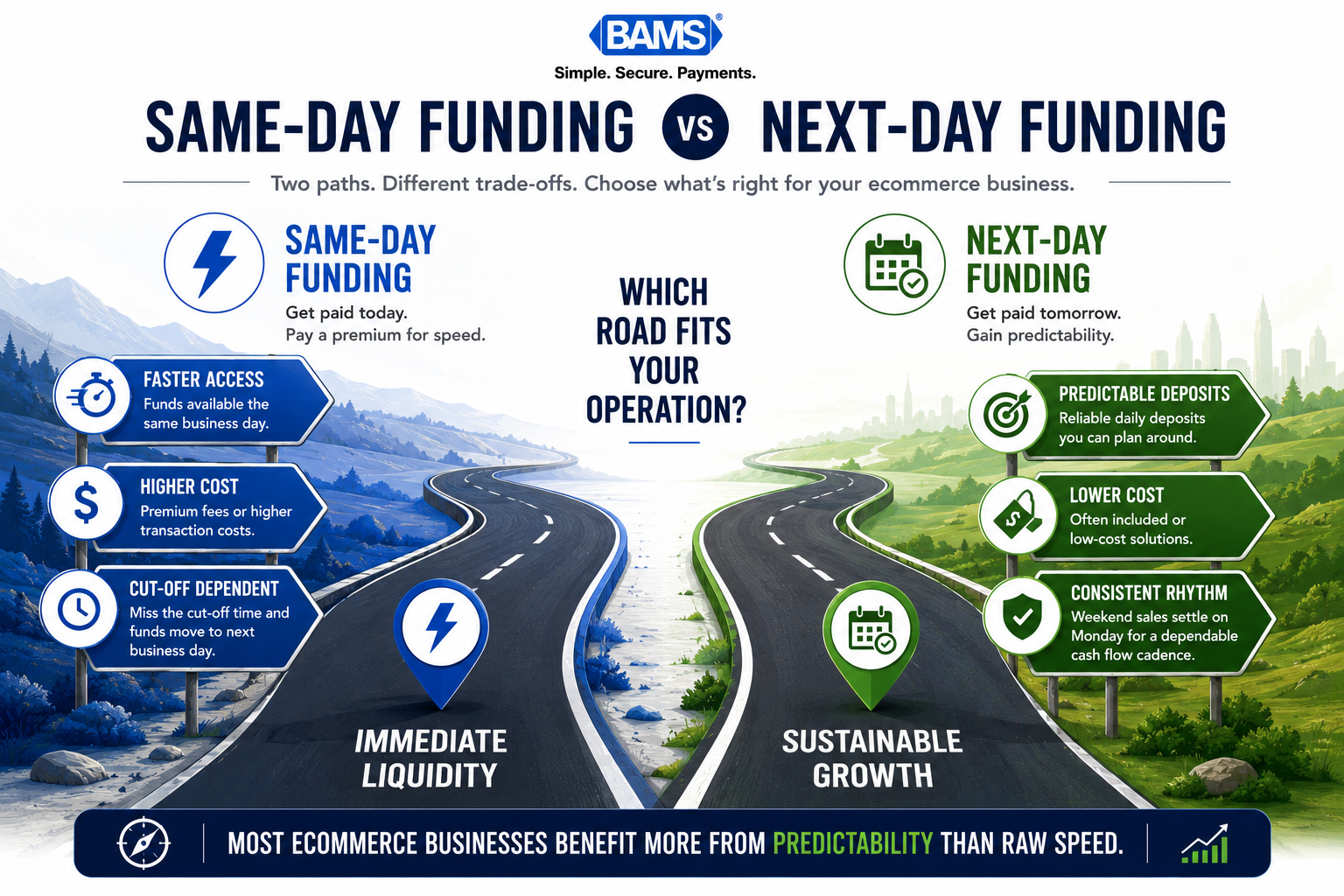
Choose same-day funding if your business depends on intraday liquidity, you run razor-thin margins with same-day supplier payments, or you operate in a high-velocity fulfillment model where hours genuinely matter.
Choose next-day funding if you want reliable, predictable deposits without premium fees, your cash flow planning operates on a daily (not hourly) cycle, and you need a solution that works consistently across weekends and holidays. For most eCommerce businesses, next-day funding delivers the better balance of speed, cost, and reliability.
|
Criterion |
Same-Day Funding |
Next-Day Funding |
Winner |
|---|---|---|---|
|
Deposit Speed |
Funds arrive same business day |
Funds arrive next business day |
Same-Day |
|
Cost |
Higher per-transaction or flat fees |
Often included or low-cost |
Next-Day |
|
Weekend Reliability |
Limited by bank operating hours |
Predictable Monday deposits for weekend batches |
Next-Day |
|
Payment Rail Options |
Same-Day ACH, FedNow |
Standard ACH, next-day batch |
Same-Day (more options) |
|
Platform Compatibility |
Varies widely by gateway |
Broadly supported |
Next-Day |
|
Cash Flow Predictability |
Faster but less consistent |
Highly predictable daily rhythm |
Next-Day |
|
eCommerce Suitability |
Niche use cases |
Covers most operational needs |
Next-Day |
How We’re Evaluating: The Criteria That Matter for Merchant Funding
Generic comparisons treat funding speed like a checkbox. We’re going deeper. Here are the seven dimensions that actually affect your eCommerce operation, weighted by what matters most to businesses managing daily revenue cycles.
- Deposit speed — How quickly funds hit your bank account after a batch closes. This is the headline number, but it’s not the whole story.
- Cost and fee structure — Same-day access usually comes at a premium. We’ll quantify the tradeoff.
- Weekend and holiday behavior — eCommerce doesn’t stop on Saturday. Your funding shouldn’t either (or at least, you should know when it does).
- Payment rail mechanics — Standard ACH, Same-Day ACH, and FedNow each behave differently. Your processor’s choice of rail dictates your actual deposit timing.
- Platform and gateway compatibility — Not every eCommerce platform supports every funding speed. Integration matters.
- Cash flow predictability — Faster isn’t always better if timing varies day to day.
- Operational impact — What can you actually do differently with the money arriving sooner?
Head-to-Head: Same-Day Funding vs Next-Day Funding Breakdown
Deposit Speed
Same-day funding gets money into your account on the same business day the batch settles. In practice, this means transactions processed before a morning cut-off (often 10:30 AM ET for Same-Day ACH) can land by afternoon. FedNow pushes this even further with near-instant settlement, though merchant adoption remains limited.
Next-day funding deposits arrive the following business day after batch close. If your processor batches at midnight, funds typically land by the next afternoon. This is the standard for most merchant accounts today.
Verdict: Same-day wins on raw speed. But the gap narrows significantly when you consider that many same-day processors have early cut-off times. If your peak sales happen in the evening (common for eCommerce), those transactions miss the same-day window and settle on the same timeline as next-day anyway.
Cost and Fee Structure
Same-day funding typically adds 0.5% to 1.5% per transaction, or a flat daily fee ranging from $5 to $25 depending on volume. Some processors bundle it into a higher overall rate. These costs compound quickly at scale.
Next-day funding is frequently included at no additional charge with competitive merchant accounts, or carries a nominal monthly fee. The cost difference over a year for a business processing $200K monthly can exceed $12,000.
Verdict: Next-day funding wins decisively on cost. Unless the few hours of earlier access directly generates revenue (not just convenience), the premium for same-day rarely pays for itself. 50% of small business financing applicants seek $100,000 or less, which means every dollar saved on processing fees matters for working capital.
Weekend and Holiday Behavior
Same-day funding sounds like it should solve the weekend problem. It doesn’t. Banks don’t process ACH on weekends or federal holidays. FedNow operates 24/7/365, but very few merchant processors currently route deposits through it. Your Saturday and Sunday sales still batch and settle on Monday, regardless of your funding speed tier.
Next-day funding creates a predictable pattern: weekend transactions batch Sunday night, and funds arrive Monday (or Tuesday at the latest). You know exactly when to expect the deposit, which makes cash flow planning straightforward.
Verdict: Tie with a slight edge to next-day for predictability. Neither option truly solves the weekend gap today. But next-day funding sets clearer expectations, so you can plan your Monday restock orders and ad spend accordingly. For a deeper look at how payment rails behave over weekends, the mechanics are worth understanding.
Payment Rail Mechanics
Same-day funding relies on Same-Day ACH (three processing windows per business day) or FedNow (real-time, 24/7). Same-Day ACH has a per-transaction limit of $1 million, which is more than sufficient for merchant deposits. FedNow currently caps at $500,000 per transaction. The infrastructure exists, but processor adoption varies widely.
Next-day funding uses standard ACH batch processing, the backbone of U.S. payment settlement. Batches close once daily, typically in the evening, and settle the next business day. It’s reliable, well-understood, and universally supported.
Verdict: Same-day offers more rail options, but next-day’s simplicity is an advantage. Standard ACH is battle-tested and doesn’t require your processor to support newer infrastructure. The payment rail your processor actually uses matters more than the rail that theoretically exists.
Platform and Gateway Compatibility
Same-day funding availability depends heavily on your payment gateway, processor, and even your bank’s receiving capabilities. Not all eCommerce platforms pass transaction data fast enough to meet same-day cut-off times. Shopify Payments, for instance, has its own settlement schedule that may not align with same-day windows.
Next-day funding is broadly compatible across major eCommerce platforms, gateways, and processors. If your platform supports standard batch settlement (virtually all do), next-day funding works without special configuration.
Verdict: Next-day wins on compatibility. Same-day funding often requires specific processor-gateway-bank alignment that can be fragile. If you’re running a multi-channel eCommerce operation, next-day is the safer, more portable choice. Understanding how eCommerce payment processing flows work helps you identify where bottlenecks hide.
Cash Flow Predictability
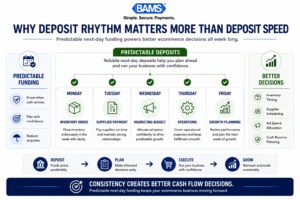
The biggest benefit of faster funding isn’t getting money sooner—it’s knowing when it will arrive.
Same-day funding introduces variability. Transactions processed before the cut-off arrive same-day; those after the cut-off roll to the next day. This creates two different deposit timelines on any given day, which complicates reconciliation and forecasting.
Next-day funding delivers one deposit per business day, representing the previous day’s batch. Your accounting team knows exactly what to expect and when. This consistency is especially valuable during high-volume periods like holiday sales or flash promotions.
Verdict: Next-day funding wins. Predictability compounds into better planning, cleaner books, and fewer surprises. For eCommerce managers tracking daily revenue against ad spend and inventory costs, a reliable deposit rhythm is more valuable than a few hours of speed.
Operational Impact
Same-day funding matters most when you have same-day obligations: perishable inventory, COD supplier payments, or payroll that must clear today. These scenarios exist but are uncommon in standard eCommerce.
Next-day funding covers the vast majority of eCommerce operational needs. You can restock inventory, fund ad campaigns, and pay suppliers the day after sales occur. 53% of employer firms that applied for financing in 2024 were seeking working capital, the exact use case where next-day deposits eliminate the need for short-term borrowing.
Verdict: Next-day funding wins for eCommerce. The operational difference between “money this afternoon” and “money tomorrow morning” rarely changes what you can do. The difference between “money tomorrow” and “money in three days” (standard funding) changes everything.
Use Case Mapping: Which Funding Speed Fits Your Situation
If you run a high-volume eCommerce store with predictable daily orders, choose next-day funding. You’ll get reliable Monday deposits for weekend sales, lower fees, and cleaner cash flow forecasting. This covers most online retailers.
If you operate a perishable-goods business with same-day supplier payments, consider same-day funding. The premium is justified when a few hours of delay means spoiled inventory or missed supplier windows.
If you’re scaling ad spend aggressively and reinvesting daily revenue, next-day funding gives you the speed you need without the cost penalty. You can adjust campaigns each morning based on yesterday’s deposits.
If you run flash sales or limited drops with massive single-day volume, next-day funding handles the surge without requiring special cut-off time management. Same-day processing during high-volume events can actually create batch errors.
If you process cross-border transactions with currency conversion, neither option fully solves the delay. International settlement adds 1 to 3 business days regardless of your domestic funding speed, and this is one area where both options share a gap.
What Both Options Get Wrong
Neither same-day nor next-day funding solves the fundamental weekend banking gap. Until FedNow achieves broad merchant processor adoption, Saturday and Sunday sales sit in limbo until Monday. Both options also assume your bank can receive deposits on the timeline your processor sends them, which isn’t always the case with smaller regional banks.
The industry also lacks transparency around cut-off times. Processors advertise “same-day” or “next-day” without clearly disclosing the batch close time, the ACH submission window, or the receiving bank’s posting schedule. These hidden variables create the real delays merchants experience.
Migration and Switching Costs
Switching from standard funding (2 to 3 business days) to next-day funding is usually straightforward. Most processors offer it as an account upgrade with minimal paperwork. The transition typically takes 1 to 5 business days.
Moving from next-day to same-day funding is more involved. Your processor may require additional underwriting, a reserve account, or a new fee agreement. Some processors don’t offer same-day at all, meaning you’d need to switch providers entirely.
Switching processors carries its own costs: gateway reconfiguration, potential downtime, PCI compliance re-validation, and the learning curve with a new platform. For eCommerce businesses, the integration with your shopping cart and accounting software is the biggest friction point. Before switching, verify that your new processor supports your specific platform and that the funding speed applies to your transaction types (not just card-present sales).
If you’re evaluating a move, providers like BAMS offer same day funding and next-day funding with interchange-plus pricing and dedicated account management, which can simplify the transition for eCommerce merchants who want faster deposits without overpaying.
Next-Day Funding vs Same-Day: The Final Call
For most eCommerce businesses, next-day funding is the right choice. It delivers the speed that actually matters (eliminating the 2 to 3 day standard delay), costs significantly less than same-day alternatives, and works reliably across platforms and payment rails.
Same-day funding has legitimate use cases, but they’re narrower than the marketing suggests. If your business doesn’t have same-day financial obligations, you’re paying a premium for hours you can’t monetize.
The real upgrade for eCommerce operators isn’t shaving hours off deposit timing. It’s moving from unpredictable, multi-day settlement to a consistent next-day rhythm that lets you plan inventory, manage ad spend, and pay suppliers with confidence. That’s the change that shows up in your bottom line. To see how this plays out in a real eCommerce context, explore how funding speed directly impacts online retail operations.
Frequently Asked Questions
What is next-day funding in merchant services?
Next-day funding means the money from your credit and debit card transactions is deposited into your bank account the next business day after your batch closes. For most eCommerce businesses, this means sales processed on Monday arrive Tuesday, and weekend sales arrive Monday. It’s a significant upgrade over standard 2 to 3 day settlement timelines.
How can a business qualify for next-day funding?
Qualification depends on your processor, but common requirements include a U.S.-based bank account, a processing history showing consistent volume, and meeting the processor’s risk criteria. Some providers require a minimum monthly volume. Businesses with high chargeback ratios or in high-risk industries may face additional underwriting. Many processors, including BAMS, offer next-day funding as a standard feature for qualifying merchants.
What are the differences between next-day funding and standard funding?
Standard funding typically takes 2 to 3 business days from batch close to deposit. Next-day funding cuts that to one business day. The practical difference is significant: with standard funding, Friday sales might not arrive until Wednesday. With next-day funding, they arrive Monday. This gap directly affects your ability to restock, pay suppliers, and reinvest in marketing.
When should a business consider using same-day funding services?
Same-day funding makes sense when you have financial obligations that must be met the same day you receive revenue. Examples include perishable inventory purchases, COD supplier payments, or same-day payroll for gig workers. If your obligations operate on a daily or weekly cycle (which covers most eCommerce), next-day funding typically provides sufficient speed at lower cost.
Which factors affect the approval for next-day funding?
Key factors include your average transaction size, monthly processing volume, chargeback ratio, industry risk classification, and how long you’ve been processing payments. Your bank’s ability to receive ACH deposits on a next-day timeline also matters. Some regional banks post deposits later in the day, which can make next-day funding feel like it takes longer even though the processor sent the money on time.
Does next-day funding work on weekends and holidays?
No. Because ACH networks don’t process on weekends or federal holidays, next-day funding only applies to business days. Saturday and Sunday transactions batch together and typically deposit on Monday (or Tuesday if Monday is a holiday). FedNow operates 24/7, but very few merchant processors currently route deposits through it, so the weekend gap persists for most businesses.