5 Signals in Apple Pay Dispute Data to Guide Chargebacks
Last Updated on July 22, 2026 by Dimitri Akhrin
A cash-flow-first framework for deciding when to fight a chargeback and when to absorb the loss
Learn five diagnostic signals hidden in your existing processor reports that reveal whether an Apple Pay chargeback is worth contesting. This guide helps lean eCommerce teams make faster, smarter dispute decisions without a dedicated fraud platform.
TL;DR
- Check for tokenization evidence first – Apple Pay transactions authenticated via Device Account Numbers give you strong proof against “unauthorized use” claims, making them worth fighting.
- Sort disputes by reason code – Friendly fraud (buyer’s remorse) dominates Apple Pay chargebacks and carries a much higher win rate than product-related disputes. Treat them differently.
- Know your breakeven dollar amount – If the transaction is below the threshold where your win rate justifies the $82+ internal cost per dispute, absorb the loss and focus on prevention.
- Use timing as a fraud-type indicator – Disputes filed 30+ days after a biometric-authenticated Apple Pay transaction are likely friendly fraud, which is your most winnable category.
- Monitor your chargeback ratio above all else – Crossing network thresholds (0.9% to 1.0%) triggers fines and processing restrictions that cost far more than any single dispute. Let your ratio guide how aggressively you fight.
Why Your Apple Pay Dispute Data Holds the Answers to Smarter Chargeback Decisions
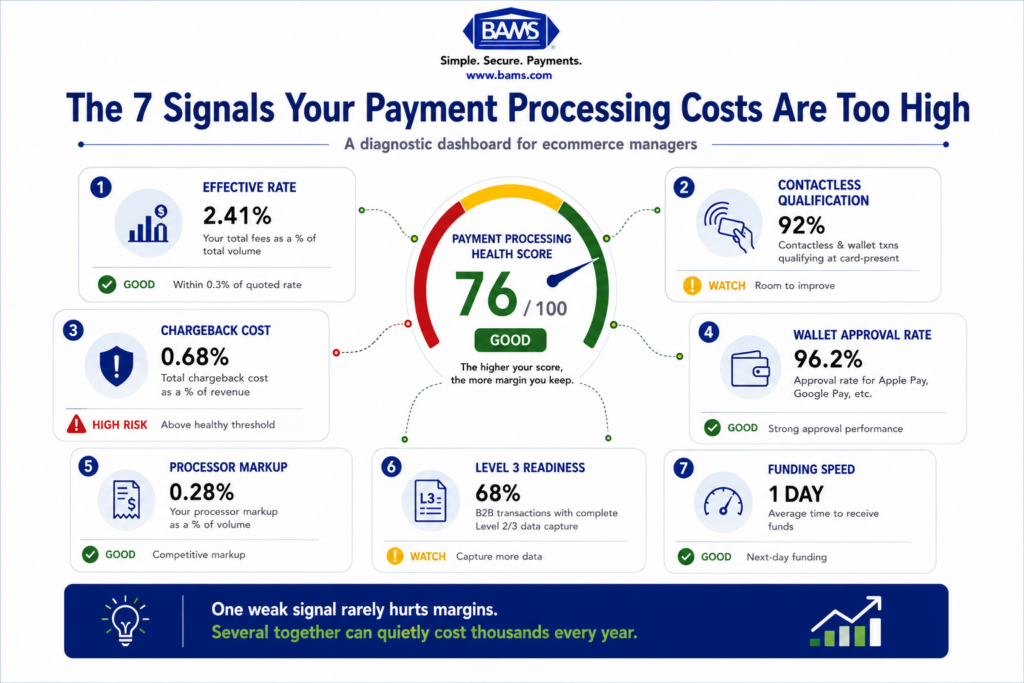
Mobile wallet adoption is accelerating, and with it comes a shift in how chargebacks hit your bottom line. Every chargeback represents more than a lost sale. Merchants also absorb operational costs, payment processing expenses, and the time required to investigate and respond to disputes. Knowing which disputes are worth contesting can have a meaningful impact on cash flow.
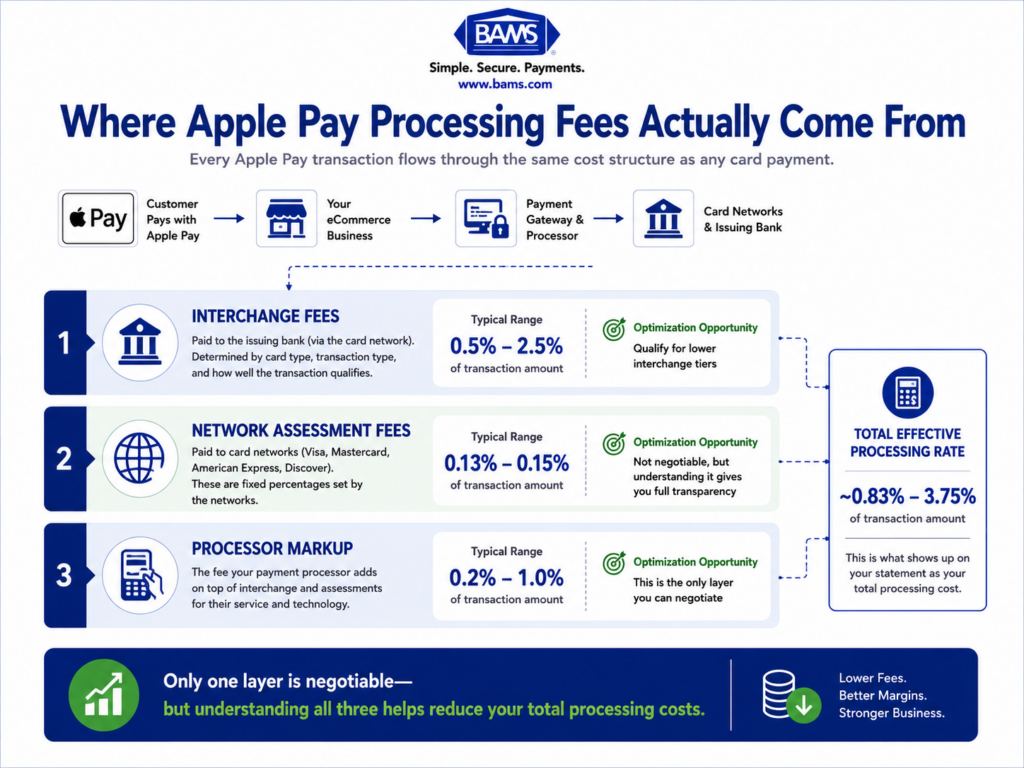
Here’s the tension: Apple Pay transactions carry stronger fraud prevention strategies by design (tokenization, biometric authentication, device-level verification), yet disputes still happen. The difference is that Apple Pay dispute data contains specific signals most merchants overlook. Those signals tell you whether a chargeback is worth contesting or whether absorbing the loss protects your merchant liability profile and your time.
Who This Is For and What It Covers
This guide is for eCommerce managers at established online businesses (10 to 50 employees) who process Apple Pay transactions and see chargebacks landing in their processor reports. You don’t need a dedicated fraud platform or a data science team. You need to know which fields in your existing reports actually predict whether you’ll win a dispute.
This is not a primer on how tokenization works. It’s not a guide to setting up Apple Pay. It’s a focused, cash-flow-first framework for reading five specific signals in your dispute data and making a fight-or-absorb decision in minutes, not days.
How These Five Signals Were Selected
Each signal below meets three criteria: it’s visible in standard processor or gateway reports (no third-party analytics required), it has a documented impact on dispute outcomes, and it changes the math on whether fighting is worth the internal cost. U.S. merchants pay an average of $82 in internal costs and $46 in third-party fees per chargeback, excluding lost goods. These signals help you avoid spending $128 on a fight you’ll lose.
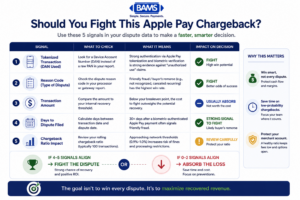
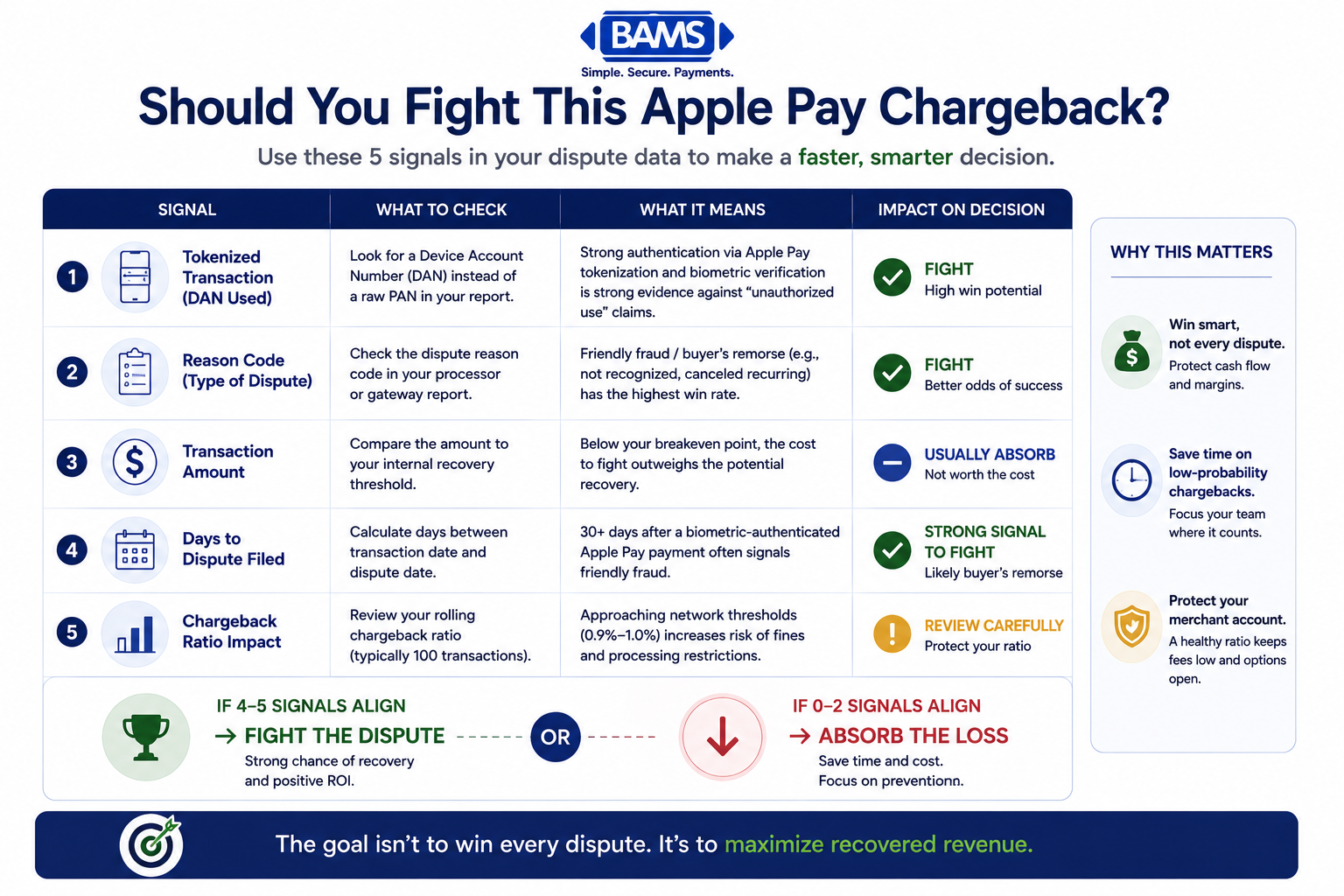
Not every Apple Pay chargeback deserves the same response. Evaluating five operational signals helps merchants decide when to fight a dispute and when to absorb the loss.
5 Signals in Your Apple Pay Dispute Data That Guide the Fight-or-Absorb Decision
1. The Transaction Used a Device Account Number (DAN), Not a Raw PAN
Why it matters: Apple Pay replaces the cardholder’s actual card number with a Device Account Number through tokenization. When a dispute arrives and your processor report shows the transaction was tokenized (flagged as a DAN or DPAN), you hold a piece of evidence that the transaction was initiated from a verified, biometric-authenticated device. This undercuts the most common chargeback claim: “I didn’t authorize this.”
Mastercard Developers explains how Device Primary Account Numbers (DPANs) and network tokenization help protect payment credentials while preserving transaction integrity during digital wallet transactions.
What it looks like today: In most processor dashboards, tokenized transactions carry a token indicator field or a transaction type code that distinguishes them from standard card-not-present entries. Look for fields labeled “token requestor” or “POS entry mode” codes specific to digital wallets.
How to apply it: When you see a DAN-based transaction disputed under reason code 10.4 (Visa) or 4837 (Mastercard) for unauthorized use, flag it as a strong candidate to fight. The tokenization and biometric authentication layers give you concrete representment evidence. Biometric security through digital wallets is one of the strongest defenses against unauthorized-use claims.
2. The Reason Code Points to Friendly Fraud, Not True Fraud
Why it matters:Friendly fraud accounts for roughly 75% of all disputes, and it’s the dominant chargeback type for Apple Pay transactions. The reason code on the dispute tells you whether the cardholder is claiming they didn’t make the purchase (unauthorized) versus they didn’t receive the goods or the product wasn’t as described. These are fundamentally different fights with different win rates.
What it looks like today: Your processor report lists a reason code for every dispute. Unauthorized-use codes on tokenized Apple Pay transactions are often winnable because the biometric and device verification data contradicts the claim. Product-not-received codes require shipping evidence, which is a separate operational question.
How to apply it: Sort your open disputes by reason code. For Apple Pay transactions with unauthorized-use codes, gather your DAN evidence and fight. For product-related codes, check your fulfillment data first. If you can’t prove delivery, absorb the loss and fix the fulfillment gap. Don’t waste $128 in dispute costs on a case where you lack shipping confirmation.
PCI Security Standards Council guidance explains how tokenization reduces exposure of sensitive cardholder data by replacing payment credentials with secure tokens during transactions.
3. The Dollar Amount Falls in Your High-Win or Low-Win Range
Why it matters: Not every chargeback is worth the same effort. Your processor history contains a pattern you may not have analyzed: the transaction amounts where you consistently win representments versus the amounts where you consistently lose. This varies by merchant category, average order value, and the card networks involved.
What it looks like today: Pull your last 12 months of dispute outcomes from your processor portal. Filter by result (won or lost) and sort by transaction amount. Most eCommerce operators discover a threshold, often around their average order value, where win rates drop sharply. Below that threshold, the internal cost of fighting exceeds the recovery.
How to apply it: Establish your breakeven line. If your average internal dispute cost is $82 and your win rate on transactions under $50 is below 30%, the expected recovery ($50 × 0.30 = $15) doesn’t justify the cost. Fight disputes above your threshold where the math works. Absorb below it and redirect that time toward preventing chargebacks upstream.
4. The Dispute Arrived Within or Outside the Typical Friendly-Fraud Window
Why it matters: Timing reveals intent. True fraud disputes tend to surface quickly (within days of the transaction) because the actual cardholder notices the charge. Friendly fraud disputes, where the buyer made the purchase but regrets it or forgets it, tend to arrive weeks or months later. Apple Pay’s biometric layer makes true fraud less likely, so late-arriving disputes on tokenized transactions are strong indicators of friendly fraud.
What it looks like today: Your processor report shows both the original transaction date and the dispute filing date. Calculate the gap. Disputes filed 30 or more days after a tokenized Apple Pay transaction are disproportionately likely to be friendly fraud, which is the category where merchants win around 7x more disputes compared to traditional card representments.
How to apply it: When the gap between transaction and dispute exceeds 30 days on an Apple Pay transaction, treat it as a fight-worthy case. Prepare your representment with the DAN evidence, delivery confirmation, and any post-purchase communication (order confirmation emails, tracking notifications). The timing pattern strengthens your narrative that the cardholder authorized and received the purchase.
5. Your Chargeback Ratio Is Approaching the Network Threshold
Why it matters: This signal flips the entire calculation. Visa and Mastercard monitor your chargeback rates, and crossing their thresholds (typically 0.9% to 1.0% of transactions) triggers monitoring programs that impose fines, higher processing fees, or account termination. When your ratio is climbing, the strategic move may be to absorb borderline disputes to keep the ratio down, even when you could win the fight. Merchant liability here isn’t just about one transaction. It’s about protecting your processing relationship.
What it looks like today: Your processor should provide monthly chargeback ratio reporting. If yours doesn’t surface this clearly, ask for it. Some processors, including BAMS, offer proactive chargeback defense and dedicated account management that flags ratio trends before they become critical, giving you time to adjust your fight-or-absorb strategy.
How to apply it: If your ratio is below 0.5%, fight aggressively on strong cases. Between 0.5% and 0.8%, be selective and prioritize high-dollar disputes with strong DAN evidence. Above 0.8%, shift to absorb mode on marginal cases and focus resources on prevention and authorization optimization to bring the ratio down. The cost of crossing the threshold far exceeds any individual dispute recovery.
The Pattern Across These Five Signals
Three themes connect these signals. First, Apple Pay’s tokenization and biometric authentication give you stronger evidence than traditional card transactions, which is why Apple Pay chargebacks run around 25% lower than standard card payments. Second, the fight-or-absorb decision is never about one variable. It’s the intersection of evidence quality (DAN data), dispute economics (dollar amount versus cost to fight), and portfolio health (your chargeback ratio). Third, the same processor reports you already have contain all five signals. The gap isn’t data access. It’s knowing which fields to check and in what order.
When you layer these signals together, you move from reacting to every dispute identically to making cash-flow-informed decisions. That shift is where eCommerce operators recover the most revenue without adding headcount or tools.

A structured decision process helps merchants prioritize high-value disputes while avoiding unnecessary representment costs.
Where to Start and What to Skip
You don’t need to build a five-signal dashboard on day one. Start with two actions: pull your chargeback ratio from your processor (Signal 5) to understand your strategic ceiling, then sort your open Apple Pay disputes by reason code (Signal 2) to separate friendly fraud from product issues. Those two steps take under an hour and immediately clarify which disputes deserve your energy.
Add the dollar-amount analysis (Signal 3) next month when you have a quiet afternoon. The DAN verification (Signal 1) and timing analysis (Signal 4) become second nature once you know what fields to look for. If your current processor doesn’t surface these fields clearly, that’s a sign your merchant services provider may not be built for the way disputes actually work today.
Frequently Asked Questions
What is Apple Pay and how does it work for eCommerce transactions?
Apple Pay is a digital wallet that replaces your actual card number with a Device Account Number (DAN) through tokenization. For online purchases, the customer authenticates with Face ID, Touch ID, or a passcode on their Apple device. The merchant never receives the raw card number, which reduces fraud exposure and changes how dispute evidence works in your favor.
How does tokenization affect my chargeback rates?
Tokenization reduces unauthorized card-not-present chargebacks by approximately 15%, and biometric authentication cuts fraud by an additional 20%. Together, these layers mean Apple Pay transactions carry a 25% lower chargeback rate compared to traditional card payments. However, friendly fraud (buyer’s remorse, forgotten purchases) still occurs because tokenization can’t prevent a legitimate purchaser from filing a dispute.
Why should I fight Apple Pay chargebacks differently than regular card disputes?
Apple Pay transactions carry built-in evidence that traditional card transactions don’t: device-level verification, biometric authentication, and tokenized transaction records. This evidence directly contradicts “unauthorized use” claims, which is why merchants win Apple Pay disputes at roughly 7x the rate of traditional card representments. Treating them the same means leaving winnable revenue on the table.
What is friendly fraud and why is it the biggest risk with mobile wallet payments?
Friendly fraud occurs when a legitimate cardholder makes a purchase and then disputes the charge, either intentionally (to get a refund while keeping the product) or unintentionally (they forgot the purchase or didn’t recognize the billing descriptor). Because Apple Pay’s biometric layer makes true unauthorized fraud rare, friendly fraud becomes the dominant dispute type. It currently accounts for an estimated 43.8% of all merchant chargeback losses.
How do I find the Device Account Number (DAN) in my processor reports?
Look for fields labeled “token indicator,” “token requestor ID,” “POS entry mode,” or “payment method type” in your processor dashboard or transaction export. Tokenized Apple Pay transactions are typically flagged with specific entry mode codes (like 09 for e-commerce token transactions) that distinguish them from standard card-not-present entries. If you can’t find these fields, contact your processor’s support team and ask them to enable token-level reporting.
When should I absorb a chargeback instead of fighting it?
Absorb when three conditions converge: the transaction amount is below your breakeven threshold (typically under $50 for most eCommerce merchants), you lack strong evidence (no delivery confirmation, no DAN data), or your chargeback ratio is approaching the 0.9% network threshold. Fighting a $30 dispute that costs $128 in internal and third-party fees doesn’t protect revenue. It destroys it.