Payment Gateway Insights eCommerce: What You’re Missing
Last Updated on June 22, 2026 by Dimitri Akhrin
Why most transaction reporting keeps you in the dark—and what real payment gateway insights should look like
Discover why payment gateway dashboards show you what happened but not why it matters. Learn what true transparency looks like and how better insights can end deposit delays.
TL;DR
- Payment gateways profit from opacity – The less you understand about deposit timing, the less likely you are to demand faster funding or switch providers.
- Dashboards show what happened, not why – Most transaction reporting tells you a batch settled but not why your deposit took five days instead of two.
- Transparency is the real differentiator – Evaluate processors by one question: can they explain exactly why something went wrong and when it will be fixed?
- Delayed deposits tax your growth – Every day your cash sits in limbo is capital you can’t deploy for inventory, marketing, or operations.
Your Payment Gateway Knows More Than It’s Telling You
You ran a strong sales week. Orders shipped. Customers paid. But when you check your bank account, the deposit is delayed again. No explanation, no timeline, just a vague “processing” status that tells you nothing.
This isn’t a glitch. It’s a feature of how most payment gateways operate. They collect your money, hold it, and drip-feed you just enough information to keep you from asking harder questions.
According to Visa, payment processing involves multiple stages including authorization, clearing, and settlement, each of which can impact funding timelines. Without transparency across these stages, merchants cannot identify inefficiencies.
The Myth of the “Smart” Payment Dashboard
Payment gateways have spent years marketing their dashboards as command centers for your business. Real-time analytics. Transaction reporting. Fraud detection. The pitch sounds impressive.
But here’s what most e-commerce managers discover after a few months: these dashboards show you what happened, not why it matters. You can see that a batch settled on Tuesday. You cannot see why your deposit didn’t arrive until Friday.
The conventional approach treats payment gateway insights as a reporting function, not a diagnostic tool. You get charts and graphs that look sophisticated but fail to answer the question keeping you up at night: where is my money, and when will I actually have it?
This worked when e-commerce was simpler. It doesn’t work now.
Payment Gateways Should Be Accountable, Not Just Functional
Here’s what I actually believe: A payment gateway that can’t tell you exactly why your deposit is delayed is a payment gateway that benefits from your confusion.
That’s not cynicism. It’s math. The longer processors hold your funds, the more interest they earn on the float. The less you understand about settlement timelines, the less likely you are to demand faster funding. Opacity isn’t a bug in the system. It’s the business model.
Why Payment Transparency Matters
Payment transparency allows merchants to understand exactly where their money is at any point in time. This includes knowing when transactions are approved, when batches are settled, and when funds will be deposited.
According to the Federal Reserve, payment timing structures directly affect how quickly merchants can access funds. Delays reduce liquidity and limit operational flexibility.
Without clear visibility, businesses are forced to operate with buffers, holding back capital to account for uncertainty rather than deploying it for growth.
Following the Money Trail
I’ve watched this pattern play out across dozens of e-commerce operations. A business scales from $50,000 to $500,000 in monthly revenue, and suddenly their cash flow becomes unpredictable. Same processor, same rates, but deposits that used to arrive in two days now take four or five.
When they ask their gateway for answers, they get generic responses about “risk assessment” or “standard processing times.” No specifics. No path to resolution.
The e-commerce managers who break this cycle share one thing in common: they stop accepting “that’s just how it works” as an answer.
- They demand transaction reporting that shows exactly where funds are in the settlement pipeline.
- They require clear explanations when deposits deviate from expected timelines.
- They choose partners who treat payment optimization as a service, not a sales pitch.
BAMS built their model around this principle, offering next-day funding and dedicated account managers who can actually explain what’s happening with your money. It’s one approach among several, but it represents what accountability looks like in practice.
What Changes If Transparency Becomes the Standard
If payment gateways were required to show you exactly why deposits take the time they take, several things would shift immediately.
First, you’d stop planning around worst-case scenarios. E-commerce managers currently build 5-7 day buffers into their cash flow projections because they can’t trust deposit timelines. That buffer represents capital you can’t deploy for inventory, marketing, or hiring.
Second, you’d catch problems before they cascade. A delayed deposit often signals something upstream: a flagged transaction, a risk score change, a compliance issue. With real payment gateway insights, you’d see these signals in time to act, not after the damage is done.
Third, you’d negotiate from knowledge instead of hope. Processors count on you not understanding interchange rates, batch timing, and reserve requirements. Transparency eliminates that asymmetry.
What Real Payment Gateway Insights Should Include

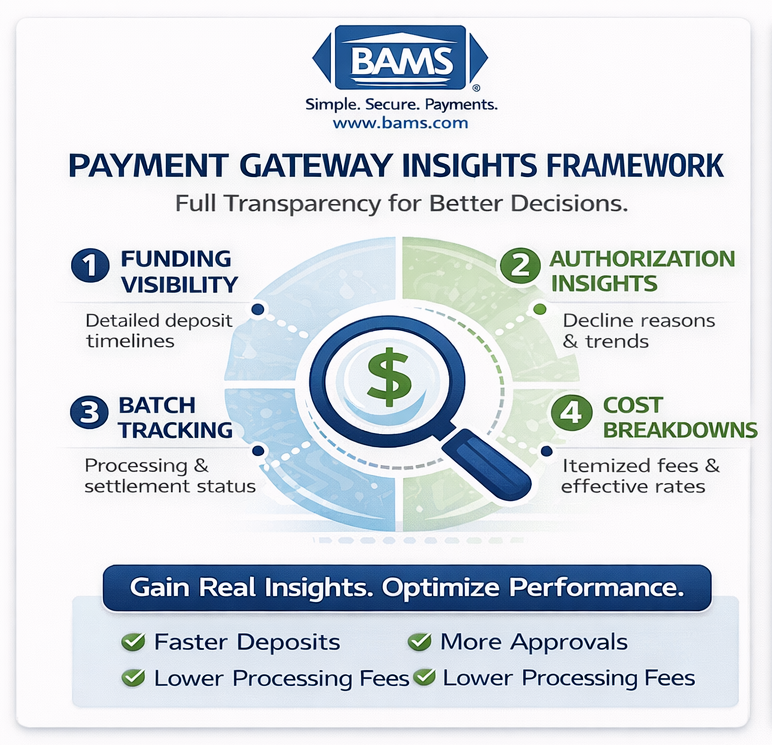
Key components of payment transparency including funding visibility, authorization insights, and cost breakdowns
True payment gateway insights go beyond surface-level reporting. They provide actionable data that allows merchants to make informed decisions.
- Funding timeline visibility: Exact deposit timing and reasons for delays
- Authorization breakdowns: Clear reasons for declines and approval trends
- Batch tracking: Visibility into when transactions are processed and settled
- Cost transparency: Detailed fee structures and effective rates
A modern eCommerce payment gateway should provide these insights as standard, not as additional features.
Payment Transparency Framework
| Area | Limited Visibility | Full Transparency |
|---|---|---|
| Funding | Estimated timelines | Exact deposit schedules |
| Authorization | Approval/decline only | Detailed decline reasons |
| Costs | Blended rates | Itemized fee breakdown |
| Reporting | Historical data | Actionable insights |

Comparison between limited payment reporting and full transparency for better decision-making
A Different Way to Think About Your Payment Partner
Stop evaluating payment gateways by their feature lists. Start evaluating them by a single question: When something goes wrong, can they tell me exactly why and exactly when it will be fixed?
If the answer is no, or “we’ll look into it,” or a support ticket that disappears into a queue, you’re not working with a partner. You’re working with a utility that happens to have your money.
The mental shift is simple but powerful: your payment processor should be as accountable to you as you are to your customers. You wouldn’t tell a customer “your order is processing” for five days without explanation. Why accept that treatment from the company handling your revenue?
The Real Cost of Staying in the Dark
Delayed deposits aren’t just inconvenient. They’re a tax on growth that compounds invisibly. Every day your cash sits in someone else’s account is a day you’re borrowing against your own success.
The e-commerce businesses that scale smoothly aren’t necessarily the ones with the best products or the biggest ad budgets. They’re the ones who eliminated uncertainty from their cash flow. They demanded answers, switched to partners who provided them, and stopped treating payment friction as inevitable.
Your gateway knows why your deposit is late. The only question is whether they’ll tell you.
Frequently Asked Questions
What are faster deposit strategies in merchant services?
Faster deposit strategies include choosing processors that offer next-day funding, optimizing batch settlement times, and maintaining clean transaction records that don’t trigger risk flags. The key is working with a provider who explains their timeline and sticks to it.
How can I improve my payment authorization rates?
Authorization rates improve when you reduce fraud signals, use updated card data, and implement automated item archival for expired payment methods. Better transaction reporting helps you identify which declines are preventable.
What role does fraud protection play in payment optimization?
Fraud protection directly impacts deposit timing. Aggressive fraud filters can delay legitimate transactions, while weak protection leads to chargebacks that freeze funds. The balance requires visibility into how your processor scores transactions.