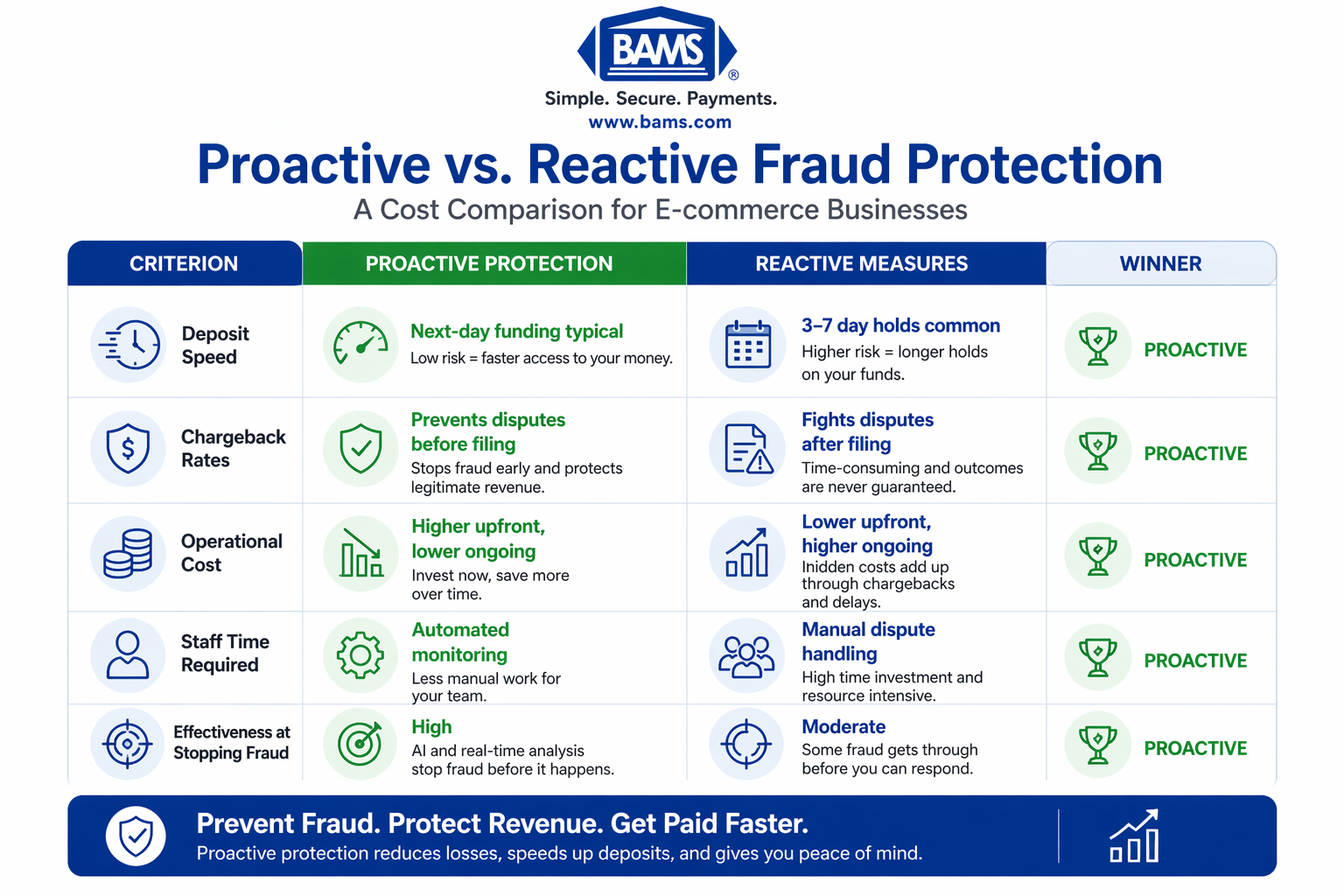
Proactive Fraud Protection vs Reactive: Cost Comparison
Last Updated on October 1, 2026 by Dimitri Akhrin
Why waiting for chargebacks to happen costs more than preventing them in the first place
Compare proactive and reactive fraud protection measures side-by-side. Learn which approach delivers faster deposits, lower chargeback rates, and better ROI for your e-commerce business.
TL;DR
- Proactive fraud protection prevents chargebacks before they happen – AI-based systems analyze transactions in real-time, catching fraud before authorization while maintaining high approval rates for legitimate purchases
- Reactive measures cost more in the long run – Fighting chargebacks after they’re filed means paying dispute fees, losing merchandise, and spending staff time on manual processes
- Deposit speed directly connects to fraud prevention – Low chargeback ratios signal lower risk to processors, resulting in faster fund releases and reduced reserve requirements
- Switch to proactive protection when chargebacks exceed 0.5% – Or when deposit delays regularly impact operations, or when staff spends more than 5 hours weekly on fraud-related tasks
- Neither approach eliminates friendly fraud completely – Customers who receive products but dispute charges anyway require manual intervention regardless of your fraud prevention strategy
Proactive vs. Reactive Fraud Protection: What E-commerce Managers Need to Know
Your deposits are delayed again. A chargeback dispute landed in your queue this morning. You’re spending hours on damage control instead of growing your business. Sound familiar?
The root cause often traces back to your fraud protection measures. E-commerce businesses face a fundamental choice: wait for fraud to happen and respond, or stop it before it impacts your cash flow. This comparison breaks down proactive versus reactive fraud protection approaches, helping you understand which strategy protects your bottom line and keeps deposits flowing predictably.
For established online businesses processing significant transaction volumes, this decision directly affects how quickly you access funds and how much you lose to chargebacks annually.
Quick Verdict: Which Approach Fits Your Business?
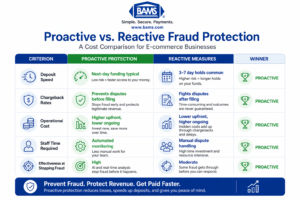
Proactive fraud protection reduces chargebacks, speeds up deposits, and lowers long-term costs compared to reactive approaches.
Choose proactive fraud protection if you want faster deposits, lower chargeback rates, and predictable cash flow. The upfront investment pays off through reduced losses and operational efficiency.
Choose reactive measures if you’re a very small operation with minimal transaction volume and tight budgets, though you’ll likely pay more in the long run through chargebacks and delayed funds.
For most e-commerce businesses with 10-50 employees, proactive protection delivers measurably better outcomes.
|
Criterion |
Proactive Protection |
Reactive Measures |
Winner |
|---|---|---|---|
|
Deposit Speed |
Next-day funding typical |
3-7 day holds common |
Proactive |
|
Chargeback Rates |
Prevents disputes before filing |
Fights disputes after filing |
Proactive |
|
Operational Cost |
Higher upfront, lower ongoing |
Lower upfront, higher ongoing |
Proactive |
|
Staff Time Required |
Automated monitoring |
Manual dispute handling |
Proactive |
|
False Positive Rate |
AI reduces by up to 40% |
Rule-based systems flag more |
Proactive |
|
Implementation Complexity |
Requires integration |
Minimal setup |
Reactive |
How We Evaluated These Approaches
We assessed proactive and reactive fraud protection across seven dimensions that matter most to e-commerce managers dealing with delayed deposits and high processing costs.
- Impact on deposit timing: How each approach affects when you access your money
- Chargeback prevention effectiveness: Stopping disputes versus fighting them
- Total cost of ownership: Upfront fees plus ongoing losses and labor
- Operational burden: Staff time required for fraud management
- Authorization rates: How many legitimate transactions get approved
- Scalability: Performance as transaction volume grows
- Integration requirements: Technical effort to implement
These criteria reflect the real priorities of e-commerce operations where cash flow predictability and processing efficiency drive business health.
Chargeback Prevention Strategies: Head-to-Head Analysis
Impact on Deposit Timing
Proactive protection keeps your deposits moving. When fraud gets caught before transactions complete, payment processors see lower risk in your account. This translates to faster fund releases, often next-day. Processors reward merchants with clean transaction histories by reducing reserve requirements and hold periods.
Reactive measures create a cycle of delays. Each chargeback flags your account for additional scrutiny. Processors respond by holding funds longer, sometimes 7-10 days, to cover potential disputes. High chargeback ratios can trigger rolling reserves that lock up 5-10% of your revenue for months.
Verdict: Proactive protection wins decisively. The connection between fraud prevention and deposit speed is direct and measurable.
Effectiveness at Stopping Chargebacks
Proactive systems use real-time transaction analysis to identify fraud patterns before authorization. Visa explains that reducing dispute risk starts with stronger transaction controls, earlier risk detection, and better prevention practices before a chargeback is ever filed. This means catching actual fraud while approving legitimate purchases.
Reactive approaches fight chargebacks after customers file them. You’re gathering evidence, submitting documentation, and hoping to win disputes. Even successful disputes cost time and resources. By the time a dispute reaches this stage, you’ve already absorbed operational friction that proactive controls are designed to reduce.
Verdict: Proactive protection prevents the problem. Reactive measures manage the symptoms. Prevention costs less than cure.
Total Cost of Ownership
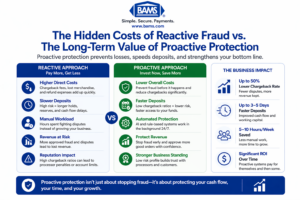
Reactive fraud management leads to higher costs and delays, while proactive protection improves cash flow, reduces risk, and increases operational efficiency.
Proactive solutions require investment in technology, integration, and potentially higher processing fees for advanced payment security enhancements. However, these costs are predictable and often offset by reduced chargebacks, lower reserve requirements, and faster access to funds.
Reactive approaches appear cheaper initially. Basic fraud screening comes standard with most payment gateways. But the hidden costs add up: chargeback fees, lost merchandise, staff time on disputes, and the revenue locked in reserves. Without earlier intervention, these costs tend to compound as transaction volume grows.
Verdict: Proactive protection has higher upfront costs but lower total cost of ownership for businesses processing significant volume.
Operational Burden on Your Team
Proactive systems automate the heavy lifting. Machine learning models analyze transactions continuously, flagging only genuine concerns. Your team reviews exceptions rather than processing every alert. This frees e-commerce managers to focus on growth rather than fraud management.
Reactive workflows demand constant attention. Someone needs to monitor for chargebacks, gather evidence, submit responses within tight deadlines, and track outcomes. For a business handling hundreds of transactions daily, this becomes a significant time sink. Teams often end up spending more time responding to fraud than preventing it.
Verdict: Proactive protection reduces staff burden significantly, especially as transaction volume scales.
Authorization Rate Impact
Proactive systems with sophisticated AI maintain high authorization rates while blocking fraud. They distinguish between a legitimate customer making an unusual purchase and actual fraudulent activity. This balance keeps revenue flowing without excessive false declines.
Reactive approaches often use blunt rules that block legitimate transactions. Setting fraud thresholds too tight loses sales. Setting them too loose invites chargebacks. Finding the right balance requires constant manual adjustment.
Verdict: Proactive protection optimizes the tradeoff between security and sales conversion.
Use Case Mapping: Which Approach Fits Your Situation?
If you process 500+ transactions monthly with thin margins, choose proactive protection. Every chargeback eats directly into profit, and deposit delays strain cash flow. The investment pays for itself quickly.
If you sell high-value items with longer shipping times, choose proactive protection. These transactions attract sophisticated fraud and generate costly chargebacks. Stronger controls, better verification, and a dedicated chargeback defense strategy become essential.
If you’re a new business with fewer than 50 monthly transactions, reactive measures may suffice temporarily. Focus on basic verification such as CVV checks, AVS matching, and clear checkout communication while building volume.
If you operate in high-risk categories (digital goods, subscriptions, international sales), choose proactive protection. These segments face elevated fraud rates that reactive measures can’t adequately address.
If you’ve already hit chargeback thresholds, proactive protection is urgent. Card networks penalize merchants who exceed 1% chargeback ratios. You need to stop new chargebacks immediately, not just fight existing ones.
What Both Approaches Get Wrong
Neither proactive nor reactive fraud protection solves friendly fraud completely. Customers who legitimately receive products but dispute charges anyway present challenges for any system. These disputes often require manual intervention regardless of your approach.
Both approaches also struggle with emerging fraud tactics until patterns become established. Sophisticated fraud rings adapt quickly, and even AI-based systems need time to learn new attack vectors. No solution eliminates fraud entirely.
Switching Costs and Migration Considerations
Moving from reactive to proactive protection involves integration work. You’ll need to connect fraud prevention tools with your payment gateway, e-commerce platform, and possibly your CRM. Budget 2-4 weeks for technical implementation and testing.
Data migration matters less than you might expect. Proactive systems build their own transaction history quickly. However, your historical chargeback data helps calibrate risk thresholds initially.
The real switching cost is organizational. Your team needs to trust automated decisions and resist the urge to manually override fraud flags. This cultural shift takes time but delivers the efficiency gains that justify proactive investment.
Consider switching when chargebacks exceed 0.5% of transactions, when deposit delays regularly impact operations, or when staff spends more than 5 hours weekly on fraud-related tasks. Merchant services partners that combine proactive fraud tools with guaranteed next-day funding can help address both fraud prevention and deposit timing within a single payment operations strategy.
Final Recommendation: Make the Shift to Proactive Protection
For established e-commerce businesses dealing with delayed deposits and high processing costs, proactive fraud protection delivers clear advantages. You’ll see faster access to funds, lower chargeback rates, reduced operational burden, and better authorization rates.
The upfront investment pays dividends through predictable cash flow and reduced losses. The PCI Security Standards Council emphasizes that merchants need stronger security practices to reduce payment risk, which is why proactive protection is no longer a premium add-on for growing eCommerce businesses.
Start by auditing your current chargeback rates and deposit timing. Calculate the true cost of reactive fraud management, including staff time. Then evaluate proactive solutions against that baseline. The numbers typically make the decision clear.
Frequently Asked Questions
What are faster deposit strategies in merchant services?
Faster deposit strategies include maintaining low chargeback ratios, using payment processors that offer next-day funding, and implementing proactive fraud prevention. When processors see clean transaction histories with minimal disputes, they release funds faster. Some merchant services partners specifically offer next-day funding as a standard feature rather than a premium add-on.
How can I improve my payment authorization rates while maintaining security?
Use AI-based fraud detection that analyzes multiple data points rather than simple rule-based filters. These systems distinguish between unusual legitimate purchases and actual fraud, reducing false declines. Also ensure your checkout process captures complete customer information (billing address, CVV, phone number) to support accurate risk assessment without blocking good transactions.
What role does fraud protection play in payment optimization?
Fraud protection directly impacts three key metrics: deposit timing, processing costs, and revenue retention. Effective fraud prevention keeps chargeback ratios low, which reduces reserve requirements and speeds up fund access. It also prevents the direct costs of chargebacks and supports cleaner payment operations. As Modern Treasury explains, better transaction visibility and payment operations control help businesses make faster, more informed financial decisions.
Which payment processing fees can I reduce through better fraud management?
Better fraud management can reduce chargeback fees ($20-100 per dispute), reserve requirements (often 5-10% of revenue), and potentially your base processing rates. Processors offer better pricing to low-risk merchants. You may also reduce costs associated with fraud-related account reviews and compliance requirements.
How quickly can proactive fraud protection show results?
Most businesses see measurable improvements within 30-60 days of implementing proactive fraud protection. Chargeback rates typically decline first, followed by faster deposit timing as processors recognize your improved risk profile. Full optimization may take 3-6 months as AI systems learn your specific transaction patterns and customer behaviors.
What’s the difference between chargeback prevention and chargeback management?
Chargeback prevention stops fraudulent transactions before they complete, avoiding disputes entirely. Chargeback management fights disputes after customers file them, attempting to recover funds through evidence submission. Prevention is proactive and more cost-effective. Management is reactive and resource-intensive. Most effective strategies combine both, but prioritize prevention.
Sources