

Next-Day Funding: The Growth Lever NYC Operators Overlook
Last Updated on October 2, 2026 by Dimitri Akhrin
Why deposit timing belongs in your growth strategy, not buried in your processor contract
Discover why NYC eCommerce operators who treat next-day funding as a strategic input—not a back-office detail—capture growth windows their competitors miss. Learn how deposit timing impacts ad spend, inventory, and cash flow in high-velocity markets.
TL;DR
- Funding speed is a growth lever, not a back-office detail – In high-cost environments like NYC, every day your revenue sits in a settlement pipeline is a day you can’t reinvest it into ads, inventory, or operations.
- Two days of faster deposits can unlock $20K+ in working capital – Switching from standard 2-3 day funding to next-day funding permanently frees up trapped revenue without borrowing.
- Your processor’s promise isn’t the full picture – Batch timing, bank posting schedules, and ACH cutoffs all determine when cash actually hits your account. Optimize the whole chain.
- Think “cash flow velocity,” not “processing cost” – The real question isn’t just what you pay per transaction. It’s how fast each dollar of revenue becomes a dollar you can redeploy.
The Metric Nobody Watches Until It’s Too Late
Every eCommerce operator in New York City can tell you their ROAS, their conversion rate, their average order value. Ask them about deposit timing and you’ll get a shrug. Maybe a vague “two or three days, I think.” This is the blind spot. In a city where rent, ad costs, and inventory commitments move at a pace that punishes hesitation, next-day funding isn’t a back-office detail. It’s the difference between catching a growth window and watching it close.

The faster revenue becomes available cash, the faster a business can reinvest in growth.
Why Everyone Treats Funding Speed as a Checkbox
It’s understandable. For years, deposit timing was a line item buried in processor contracts. You picked your provider based on rates, maybe integration ease, and whatever funding schedule came with it was just… the schedule. Two to three business days felt normal because it was normal.
The payment industry reinforced this. Most content about payment optimization focuses on smart routing, retry logic, tokenization. Enterprise-grade tactics for enterprise-grade problems. For a growing NYC eCommerce brand doing $10,000 or $30,000 a day, nobody was framing deposit speed as something you choose strategically. It was plumbing. You didn’t think about it until something broke.
That worked when margins were wider, ad costs were lower, and you could absorb a few days of float without consequence. That era is over.
The Real Thesis: Deposit Speed Is a Growth Input, Not a Treasury Convenience
Here’s what we actually believe: funding speed is the most underleveraged growth lever in NYC eCommerce, and the operators who treat it as a planned input (not a passive outcome) are the ones compounding fastest.
NYC Payment Challenges That Make Timing Everything
Let’s walk through why this hits differently in New York.
The “Delay Tax” Is Real, and It Compounds
Cash flow remains one of the most important operational priorities for growing businesses, particularly those that rely on predictable payment settlement to fund inventory, payroll, and marketing.
For eCommerce operators, that challenge materializes as a timing problem: revenue comes in waves, but obligations (rent, ad spend, restocks) arrive on fixed schedules. When standard funding takes 2 to 3 business days from batch submission to deposit, you’re not just waiting. You’re paying for the wait. Settlement timing is also influenced by the U.S. payment infrastructure. The Federal Reserve provides information on payment system operations and settlement processes that affect how funds move between financial institutions.
For merchants receiving deposits through the ACH network, NACHA publishes operating rules and educational resources explaining ACH processing schedules, settlement timing, and payment processing best practices.
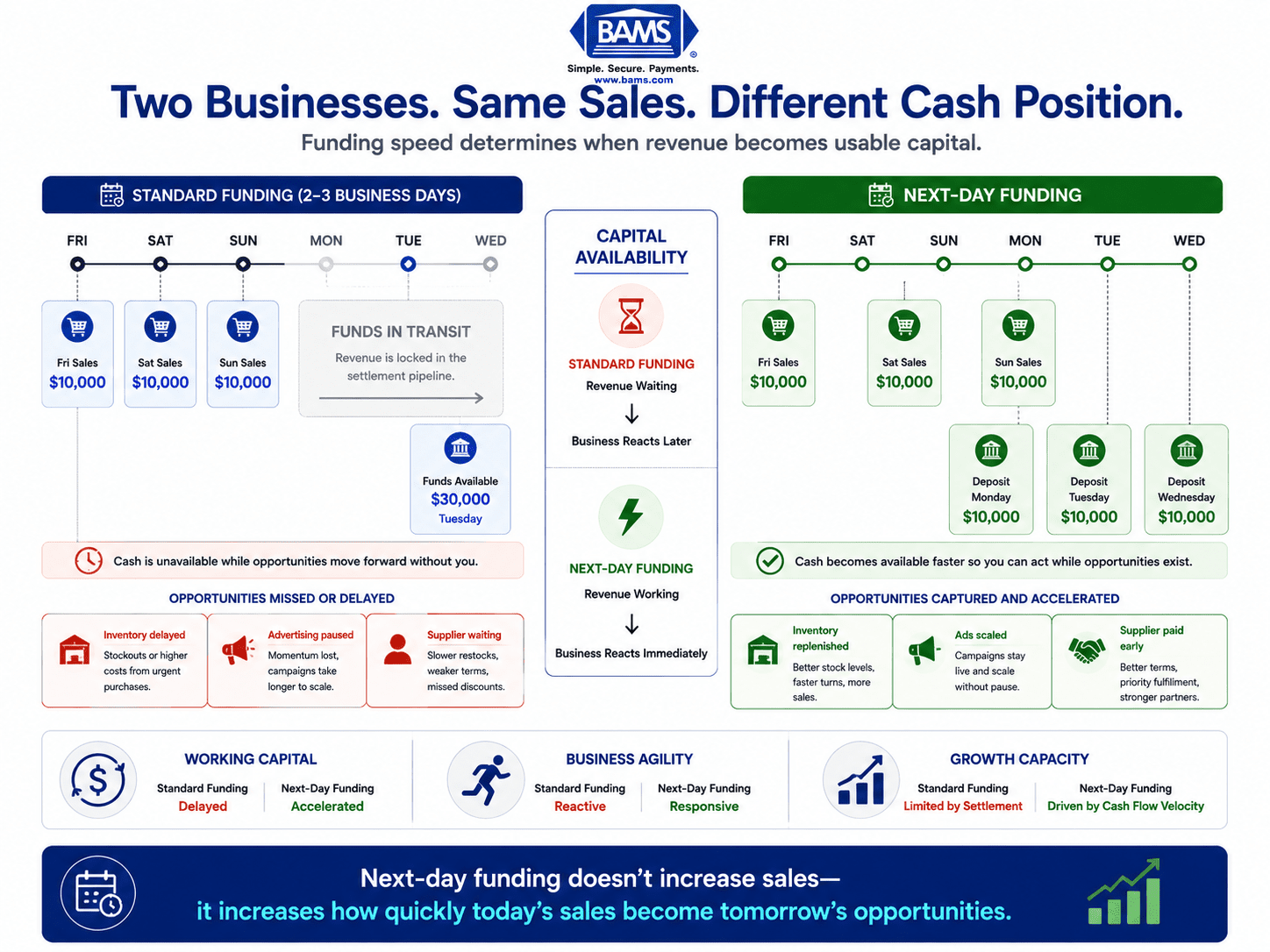
Consider what happens during a strong sales weekend. Friday through Sunday revenue doesn’t settle until Monday at the earliest, and often Tuesday or Wednesday with standard processing. That’s three to five days where your best sales performance is locked in transit. Meanwhile, your Meta ad account doesn’t pause its billing cycle because your processor is slow.
NYC operators feel this more acutely because the cost of everything around them is higher. Warehouse space in Brooklyn isn’t cheap. Neither is the talent running your fulfillment. When your cash is trapped in a settlement pipeline, you’re either borrowing against it (expensive) or throttling the very activities that generated it (more expensive).
Two Days of Float, $20,000 in Trapped Capital
The math is straightforward. Switching from three-day to next-day funding frees up two days of revenue as working capital. For a business processing $10,000 per day, that’s $20,000 that shifts from “in transit” to “available.” Not borrowed. Not financed. Just… accessible.
That $20,000 can restock a bestselling SKU before it goes out of stock. It can keep a high-performing ad campaign running through the weekend instead of pausing it Monday morning. It can cover a supplier’s early-payment discount. None of these are theoretical. We’ve seen operators describe these exact tradeoffs.
And here’s the part most people miss: the benefit isn’t one-time. It’s structural. Every day you operate with faster deposits, you operate with a permanently larger pool of available cash. It’s not a loan you repay. It’s a timing advantage that compounds.
Your Processor’s Promise Isn’t the Whole Story
One nuance that trips up even savvy operators: your processor might advertise next-day funding, but your bank’s posting schedule determines when you can actually use the money. A processor can release funds by 6 AM, but if your bank posts ACH deposits at 4 PM, you’ve lost half a business day. In some cases, funds can land in as little as 10 to 12 hours after a sale, but only when the entire chain (batch timing, processor release, bank posting) is aligned.
Merchant funding also depends on the operational and risk controls used throughout the processing relationship. The Office of the Comptroller of the Currency’s Merchant Processing handbook provides an authoritative overview of transaction processing, settlement, funding exposure, chargebacks, and the responsibilities of financial institutions involved in merchant acquiring.
This is why we think of funding speed as a system, not a feature. It requires looking at batch submission timing, your bank’s cutoff windows and your processor’s actual settlement behavior. BAMS NYC merchant services include next-day funding options paired with dedicated account management that can help qualifying merchants review and optimize the entire funding pipeline, not just the processor’s piece of it.
What Changes If You Take This Seriously
If deposit timing is a growth input, then the implications ripple outward. Your ad budget becomes more aggressive because you’re not rationing spend against uncertain deposit dates and your inventory planning gets tighter because you can restock in response to real demand, not forecasts made under cash constraints. Your reliance on credit lines and merchant cash advances drops, which means fewer fees eating into margin.
More subtly, your decision-making speed increases. NYC eCommerce is a game of reaction time. A product goes viral on TikTok, a competitor runs out of stock, a seasonal window opens earlier than expected. The operator with cash in hand acts. The operator waiting on a three-day settlement watches.
The cost of ignoring this isn’t dramatic. It’s quiet. It’s the campaign you didn’t scale. The restock you delayed by 48 hours. The processor switch you made chasing rates when the real bottleneck was upstream timing.
A Better Way to Think About It

Reducing settlement delays permanently increases the amount of working capital available for day-to-day business operations.
Stop thinking of payment processing as a cost center with a funding schedule attached. Start thinking of it as a cash flow velocity system. The question isn’t “how much do I pay per transaction?” (though that matters). The question is: “How fast does each dollar of revenue become a dollar I can redeploy?”
Velocity of capital redeployment. That’s the lens. Every hour between a customer’s purchase and your ability to use that revenue is friction. Some friction is unavoidable. But the gap between standard and optimized is often two full business days, and in a high-cost operating environment like New York, two days of float is a strategic liability disguised as a processing default.
When you frame it this way, funding speed stops being a line item to negotiate and becomes an operating principle to design around.
The Operators Who Get This Already Know
We don’t need to convince the eCommerce managers who’ve already felt the pinch of a Monday morning with no weekend deposits posted. They know. The real audience for this argument is every operator who’s been optimizing conversion rates and ROAS while leaving days of cash flow on the table. The fastest-growing NYC eCommerce brands aren’t just selling better. They’re getting paid faster, and reinvesting the difference before their competitors even see the deposit.
Frequently Asked Questions
Which factors affect the speed of payment deposits for NYC businesses?
Three things control actual deposit speed: your gateway’s batch submission timing, your processor’s settlement schedule, and your bank’s ACH posting window. All three need to be aligned. A payment setup audit can reveal where your specific bottleneck sits.
Why is payment optimization important for eCommerce in New York City?
NYC’s operating costs (rent, labor, advertising) run on fixed schedules that don’t wait for your deposits to clear. Faster cash flow management means you can reinvest revenue into inventory and ads without relying on credit, which directly protects margin in a high-cost market.
When should merchants conduct a payment processing audit?
Audit when you notice cash gaps between strong sales periods and actual fund availability, or before peak seasons when inventory commitments spike. Even a simple review of batch timing and next-day funding eligibility can surface thousands in trapped working capital.


