What is OptBlue by American Express?
Last Updated on September 4, 2026 by Dimitri Akhrin
American Express Acceptance Has Changed
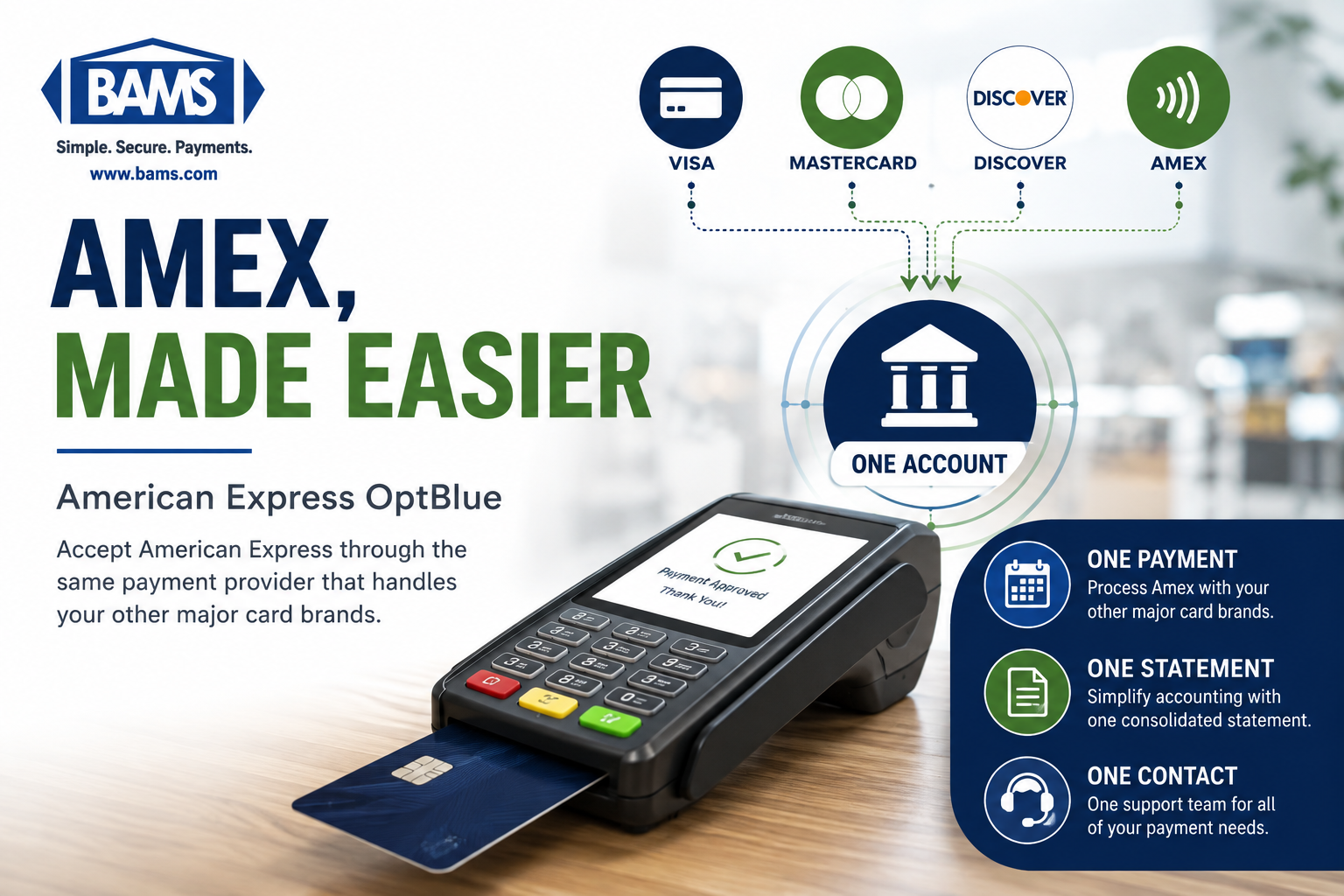
American Express OptBlue has made accepting Amex much simpler for small and mid-sized businesses. Instead of managing American Express through a completely separate relationship, eligible merchants can accept Amex through the same payment provider that handles their other major card brands.
That means fewer moving parts behind the scenes: one provider, one settlement process, one statement and one place to call when something needs attention.
“Don’t do business without it” is the merchant-side slogan of American Express. Yet, for decades, countless merchants have done exactly that. American Express processing was expensive and couldn’t be mixed with payment processing for any other card company, making it more problematic than it was worth for most small merchants. As a result, many stores simply declined to do business with the company altogether.
Luckily, American Express now offers a program that opens their payment products up to the small and startup merchants that have traditionally been stuck on the outside looking in. The program is called American Express OptBlue, and it’s turned Amex from a card once accepted only at premium retailers to one accessible by 99% of merchants across the U.S.
2026 update: American Express currently states that its cards can be accepted at 99% of places in the United States that accept credit cards. The statistic is based on February 2026 Nilson Report data and reflects how much the acceptance gap between Amex and the other major card networks has narrowed.
TL;DR
- OptBlue removes the need for a separate American Express processing relationship – Eligible merchants can accept Amex through the same payment provider that handles their other major card brands, simplifying settlement, reporting and support.
- The 2026 eligibility limit increased to $3 million in annual Amex volume – Most eligible U.S. merchants can use OptBlue while processing less than $3 million in estimated annual American Express charge volume. Certain industries currently have no annual volume threshold.
- One provider and one statement make reconciliation easier – American Express transactions can be included within the merchant’s broader processing environment instead of requiring a separate statement, settlement stream and service relationship.
- OptBlue pricing depends on the processor you choose – American Express establishes wholesale pricing while the payment provider sets the merchant-facing rate. BAMS currently advertises rates as low as 2.30% + $0.10 per transaction for qualifying merchants, so businesses should compare their actual total processing cost.
- BAMS can provide faster access to eligible Amex revenue – BAMS currently advertises 12-hour OptBlue funding based on the applicable batch schedule, helping qualifying merchants reduce the time between making a sale and accessing the funds.
What is OptBlue?
OptBlue is a program created by American Express specifically to address the problem of small merchants being effectively blocked out of doing business with the company. American Express has traditionally been positioned as a higher-end, more “elite” payment card than those offered by its major competitors. With that status came high transaction fees that were no issue for merchants selling expensive or luxury goods or doing juicy annual sales numbers, but that were extremely prohibitive for smaller merchants doing more modest business.
OptBlue was designed to reach out to those smaller merchants, specifically, ones doing less than a million dollars a year in sales, by removing the traditional signup process entirely and instead putting Amex access in the hands of the payment processors that merchants use for the rest of their card processing. By making their cards available through the same merchant accounts as the other major card issuers, American Express has removed a lot of the complexity, headache, and, most importantly, costs previously associated with accepting Amex payments.
2026 eligibility update: The $1 million threshold above is no longer current. Effective April 17, 2026, American Express increased the U.S. OptBlue merchant-acquiring threshold to $3 million in estimated annual American Express charge volume for eligible industries.
Some categories currently have no annual charge-volume threshold, including charity, healthcare, education, government, insurance, residential rent, utilities and certain online gaming categories. Industry restrictions still apply, so eligibility should be confirmed with an OptBlue provider.
How OptBlue Works Today
The basic idea is straightforward. An eligible merchant signs up through an OptBlue provider rather than establishing a separate direct American Express processing relationship.
American Express establishes wholesale pricing for OptBlue participants. The payment provider then sets the merchant-facing American Express rate, much like it sets pricing for the other card brands it processes.
Transactions can then flow through the same broader processing environment as the merchant’s Visa, Mastercard and Discover transactions. American Express describes the program as an all-in-one arrangement built around one payment, one statement and one servicing contact.
For the merchant, that is where much of the value comes from. The card brand changes, but the back-office workflow does not have to.
What Benefits Does OptBlue Offer to Merchants
Missing out on American Express payments might not seem like a big deal with Visa, Mastercard, and Discover all still available through standard merchant accounts. While it’s true that American Express has a smaller user base than the other three major card companies, offering it as a payment option still brings some major benefits. That was true for many merchants even when American Express was harder to deal with, but now that OptBlue has removed essentially all of the friction involved with AmEx, the benefits offered by the program make it an easy choice.

American Express OptBlue helps eligible merchants accept Amex through the same payment provider that handles their other major card brands.
Access to More Payment Options
First and foremost, OptBlue makes American Express accessible to smaller merchants doing under a million dollars in sales each year. More payment options mean greater choice for those merchants’ customers, and that is always good for business. OptBlue enables merchants to display the American Express logo in their windows and at their checkouts, potentially opening up business to a new base of higher-income customers and making the shopping experience more convenient for shoppers who have multiple cards but prefer to pay with Amex.
The volume limit has changed, but the customer-choice argument has only become more relevant.
American Express reports that the average transaction size on its cards was 58% higher than the average on other major credit and charge card networks based on U.S. year-end data reported in February 2026. It also reports that average annual spend per American Express card was 3.1 times that of cards on the other major networks.
Those figures do not mean every Amex customer will spend more at every business. They do show why merchants should think twice before turning away a payment method a customer actively prefers to use.
American Express also provides complimentary acceptance signage and Shop Small marketing resources that eligible merchants can use to make their Amex acceptance more visible.
Simplified Reporting and Support
Merchants who access American Express through the company’s traditional programs see their Amex sales and reporting entirely isolated from the rest of their credit card sales. That means each month they get two sets of merchant statements, making accounting needlessly complex and time-consuming. OptBlue eliminates that problem by bringing American Express transactions under the same account as a merchant’s Visa, Mastercard, and Discover transactions. OptBlue simplifies record keeping and accounting, and streamlines merchant support should issues ever arise.
This remains one of the clearest advantages of the program.
American Express currently describes OptBlue around three operational benefits: one payment alongside the other card brands, one consolidated statement from the provider and one servicing contact.
That sounds simple because it is. A merchant should not need a completely different reconciliation process just because one customer used American Express instead of another card.
BAMS merchants can also use reporting and analytics tools to review transactions, settlements and account activity without treating Amex as an isolated workflow.
Reduced Processing Fees
One major benefit of OptBlue is that American Express no longer controls processing fees. Instead, they are now offering wholesale rates to their payment processing partners and allowing the processors to set their own prices, which enables payment processors to offer much more competitive rates than have traditionally been available through Amex’s in-house programs.
Current clarification: American Express still establishes the underlying OptBlue wholesale rates. The participating payment provider sets the merchant-facing American Express rate and any applicable markup. That is why pricing can differ from one processor to another.
For example, a traditional American Express account could charge fees as high as 3.50% plus $0.35 on every transaction. Those fees exceed even third-party processors like PayPal. An OptBlue account through BAMS, on the other hand, offers merchants American Express processing with rates as low as 2.30% plus $0.10 per transaction – huge savings over the fees accessible directly through Amex.
Those BAMS figures remain published today. BAMS currently advertises OptBlue rates as low as 2.30% plus $0.10 per transaction for qualifying industry SIC/MCC codes, along with a waived statement fee.
“As low as” matters. The actual rate depends on the business, transaction profile and applicable pricing structure. Merchants should compare the effective cost rather than assuming every transaction will qualify for the lowest advertised rate.
Processor Choice Matters More Under OptBlue
OptBlue makes American Express pricing more flexible, but that also means the processor matters.
Two providers can offer OptBlue and still price the same merchant differently. One may use a more transparent cost-plus structure while another may bundle transactions into broader pricing categories.
Look at the whole statement. Ask how the American Express rate is built, what processor markup applies and whether additional transaction or statement charges appear.
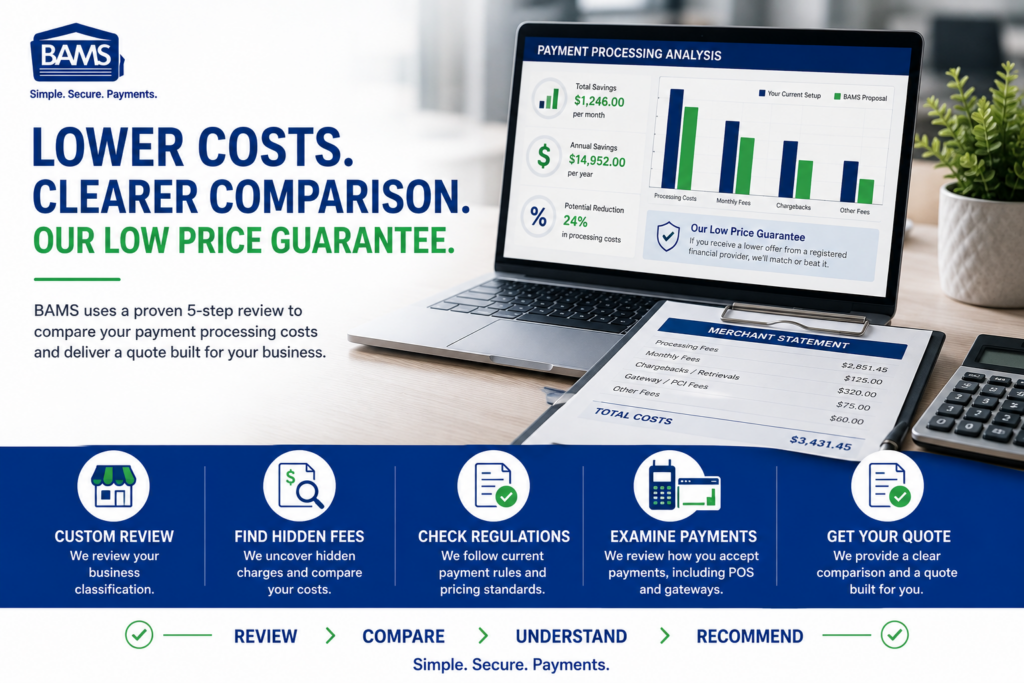
BAMS also offers a merchant account pricing comparison for businesses that want to evaluate American Express alongside their Visa, Mastercard and Discover costs rather than treating each card brand in isolation.
Faster Access to Funds
Funding holds are the bane of many merchants’ existence, as standard holds can see payouts delayed by two to three business days or more in extreme cases. Some payment processors, like BAMS, offer next-day funding to ease that burden, but with OptBlue, merchants can do even better by accessing 12-hour funding. BAMS OptBlue merchants will see the funds from all American Express transactions batched before 7 pm reach their bank accounts by 7 am the following day. That faster turnaround ensures a merchant’s hard-earned money spends more time in their pocket and less sitting in limbo, improving cash flow and overall financial health.
BAMS continues to advertise 12-hour funding for its OptBlue program. The current BAMS page distinguishes between transactions batched before and after 7 PM ET, so merchants should confirm the exact funding schedule that applies to their account.
Funding speed can matter most for businesses that rapidly turn sales back into inventory, payroll or supplier payments. A restaurant, retailer or eCommerce operation may process strong sales and still feel cash-flow pressure if that revenue takes several days to become usable.
Businesses that process other card brands can also review BAMS next day funding options for qualifying transactions.
OptBlue Can Make Reconciliation Easier
The value of having one statement becomes clearer as transaction volume grows.
Imagine a merchant that accepts four major card brands but needs to reconcile American Express separately every month. Accounting now has another statement, another funding stream and potentially another service relationship to monitor.
OptBlue reduces that fragmentation.
American Express transactions can appear within the provider’s normal reporting environment and settle through the same provider relationship. That means less time figuring out where a deposit came from and more consistency when the business reviews monthly processing costs.
This does not mean every processor’s reporting platform will look the same. The quality of reporting still depends on the provider. OptBlue simply makes consolidated reporting possible.
Which Merchants Should Consider OptBlue?
The program can make sense for many eligible businesses, but it becomes particularly useful when one or more of these situations applies:
- Customers regularly ask whether the business accepts American Express.
- The merchant wants to add Amex without managing another separate processing relationship.
- Accounting wants one statement and one settlement workflow for the major card brands.
- The business wants to compare provider-set Amex pricing instead of relying only on a direct arrangement.
- Faster access to American Express transaction revenue would help cash flow.
- The business is growing but remains within the OptBlue eligibility requirements.
The program should still be evaluated on cost. Accepting another payment type only makes sense when the economics work for the business.
What Happens When a Merchant Grows Beyond OptBlue?
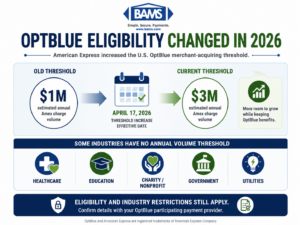
American Express raised the U.S. OptBlue merchant-acquiring threshold to $3 million in estimated annual Amex charge volume in April 2026.
The 2026 threshold increase gives many businesses significantly more room before they need to consider a different American Express arrangement.
For most eligible U.S. industries, the current threshold is $3 million in estimated annual American Express charge volume, measured on a rolling 12-month basis.
A business that grows beyond the applicable OptBlue threshold may need to transition to a direct American Express acceptance relationship or another eligible structure.
This is based on American Express volume, not necessarily total card volume. A business could process substantially more than $3 million across all card brands and still remain below $3 million in American Express volume.
Merchants approaching the threshold should talk with their processor before crossing it rather than waiting for a processing change to become urgent.
American Express OptBlue in 2026 at a Glance
| Feature | What It Means for the Merchant |
|---|---|
| Eligibility | Generally under $3 million in estimated annual Amex charge volume for eligible U.S. industries, with certain categories exempt from the threshold. |
| Provider relationship | Accept Amex through an OptBlue provider instead of maintaining a separate direct relationship. |
| Pricing | American Express provides wholesale pricing while the provider sets the merchant-facing rate. |
| Reporting | American Express activity can be consolidated with other accepted card brands. |
| Settlement | Payments can be funded through the same provider relationship as other card brands. |
| Support | The merchant works with one provider for questions about the major card brands accepted through that provider. |
Frequently Asked Questions
What is American Express OptBlue?
OptBlue is an American Express program that allows eligible U.S. merchants to accept Amex through participating payment providers instead of maintaining a separate direct American Express processing relationship.
Who qualifies for OptBlue in 2026?
American Express currently states that eligible U.S. merchants with less than $3 million in estimated annual American Express charge volume may qualify. Certain industries have no annual charge-volume threshold and other eligibility restrictions can apply.
Did the OptBlue limit increase?
Yes. American Express increased the U.S. merchant-acquiring threshold to $3 million effective April 17, 2026. Earlier versions of the program commonly used a $1 million threshold.
Does the $3 million limit refer to total credit card sales?
No. The threshold refers to estimated annual American Express charge volume, not necessarily the merchant’s total payment-processing volume across every card brand.
Who sets OptBlue processing rates?
American Express provides wholesale rates to participating providers. The provider then sets the merchant-facing American Express rate, which means pricing can vary between processors.
What are BAMS OptBlue rates?
BAMS currently advertises American Express OptBlue rates as low as 2.30% plus $0.10 per transaction for qualifying industry SIC/MCC codes. Actual rates depend on the merchant and account.
Can OptBlue simplify merchant statements?
Yes. One of the core OptBlue benefits is the ability to receive one statement from the provider covering the major card brands accepted through that relationship.
Does BAMS offer faster OptBlue funding?
BAMS currently advertises 12-hour funding for its OptBlue program. Funding timing depends on the batch schedule and the merchant’s account terms.
How widely is American Express accepted in the United States?
American Express reports that its cards can be accepted at 99% of U.S. locations that accept credit cards, based on February 2026 Nilson Report data.
Is OptBlue Worth It?
For an eligible merchant that wants to accept American Express without creating a separate payment workflow, OptBlue is much easier to justify today than Amex acceptance was years ago.
The strongest benefits are practical. Customers get another way to pay. The business can consolidate statements and support. Providers can compete on merchant-facing pricing. Funding can move on a schedule that fits more closely with the rest of the merchant’s card activity.
The ease, simplicity, and financial benefits of accepting Amex through OptBlue make it an easy choice for merchants doing business with one of American Express’s payment processing partners. BAMS is one of those OptBlue partners, and in addition to seamless and low-cost Amex access, we also offer guaranteed low pricing on transactions done with Visa, Mastercard, and Discover cards as well.
To find out more about how a BAMS merchant account can help you gain easy access to American Express while minimizing your existing monthly merchant statement, submit a request for your free five-point price comparison today!