Could This New Legislation Open All POS Systems to 3rd Party Integrations?
Last Updated on August 18, 2026 by Dimitri Akhrin
What the ACCESS Act Could Mean for POS Integrations
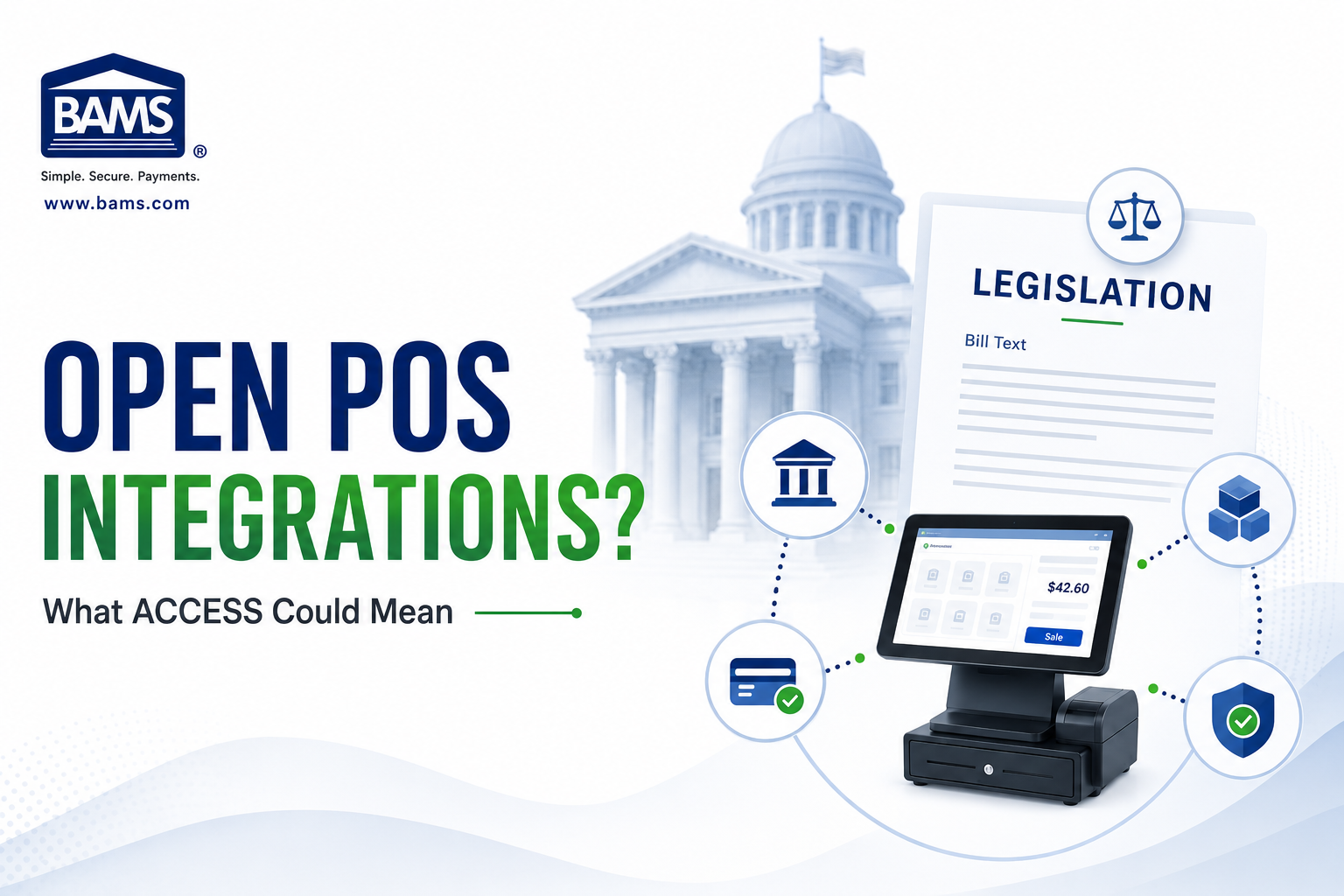
Third-party POS integrations give merchants more freedom to connect the systems they use for payments, accounting, inventory, loyalty and other parts of the business. That makes interoperability valuable even if the legislation discussed in this article does not directly regulate most POS providers.
The distinction matters because the ACCESS Act has changed since this article was originally written. The basic idea of portability and interoperability remains alive in Congress but the current legislation is aimed much more narrowly at large communications platforms.
In late 2019, a bipartisan bill was introduced to the United States Senate designed to seize back control over valuable user data from tech giants and return it to the users themselves by boosting portability. The Augmenting Compatibility and Competition by Enabling Service Switching Act, or ACCESS for short, aims to stop tech companies from walling off user data, making it harder for users to migrate their information from platform to platform and, in some cases, even trapping them into certain ecosystems by making it too expensive to switch. While the bill legislation is primarily aimed at social media giants like Facebook, it has wide-ranging potential impacts, including on point-of-sale systems and the merchants that use them.
Current Update: ACCESS Is Back, but It Is Not a POS-Specific Law

The ACCESS Act promotes interoperability for large communications platforms but does not automatically open every POS system to third-party integrations.
The original 2019 ACCESS Act did not become law. Congress has revisited the idea several times since then.
The current version is the ACCESS Act of 2025, S. 1634. Senators introduced it in May 2025 and the bill was referred to the Senate Committee on Commerce, Science and Transportation.
It is still proposed legislation. Merchants should not make technology decisions on the assumption that ACCESS will force their POS provider to change its integration policies.
There is another important limitation. The current legislation focuses on large communications platforms with more than 100 million active users in the United States. It would require covered platforms to support areas such as interoperability and structured data portability.
That is not the same as requiring every POS company to open its API, eliminate third-party integration fees or let a merchant export every piece of operational data.
The POS discussion in the original article is better understood as a look at where broader interoperability policy could lead rather than a description of what the ACCESS Act directly requires from POS companies.
Why the ACCESS Legislation is so Badly Needed
Data is worth a lot. And like anything with great value, people tend to want to hoard it. When it comes to consumer data, that hoarding makes sense for service providers, but it almost always results in poorer, more expensive services for the consumers themselves. By walling off data and system access, service providers, like POS companies, can effectively block out competition and innovation by trapping customers in their ecosystems and making it too difficult or too costly to migrate elsewhere. In the POS world, companies often charge fees as high as 30% to allow third-party service providers to access and integrate with their systems. In many cases, that makes it financially impractical to do so and the result is that innovative, new third-party products are frozen out or never come into existence in the first place. That enables the POS companies to provide inferior products, knowing full well that their customers simply don’t have any alternative. Industry leaders like Square, Clover and Toast all charge these kinds of outlandish fees for third-party companies to integrate and access customer data, but if ACCESS becomes law, that might soon change.
Historical context: The integration-fee examples above reflect the POS environment described when the original article was written. POS partner programs, API access and commercial integration terms can change over time. Merchants and developers should confirm current terms directly with the POS provider before making a comparison.
The current ACCESS Act also does not set a general cap on POS integration fees. Its importance to this discussion is the principle behind it: users should have more ability to move information and connect competing services rather than becoming locked into one technology ecosystem.
Why POS Integration Flexibility Still Matters
A POS is rarely just a cash register anymore.
It may need to communicate with accounting software, inventory management, loyalty programs, online ordering, employee scheduling, reporting tools or a payment processor. When those systems can connect, information moves with less manual work.
When they cannot, employees often become the integration.
Someone exports a file. Someone enters the same information into another system. A manager checks whether the numbers match. Every extra manual step takes time and creates another place where an error can happen.
BAMS explains this in more detail in its guide to POS integrations. A useful integration should extend what the POS can do or remove repetitive work from the business.
An Open API Is Useful, but It Is Not the Whole Story
Merchants sometimes hear that a POS has an API and assume that means anything can connect to it.
Not necessarily.
The provider may control which information an outside application can access. Certain functions may require approval. Some integrations may only be available through an app marketplace or certified partner program. Pricing can also vary depending on what the third party needs from the platform.
Before choosing a system, ask what the API actually allows.
Can an accounting application receive transaction data automatically and can inventory move between an eCommerce store and the physical POS? Can the merchant choose a payment processor or does the POS require its own processing service?
The word “integration” is useful only when the connection does what the business needs.
Data Portability Matters When You Want to Leave
Integration gets most of the attention while a business is using a system. Portability becomes important when the business wants to stop using it.
Ask what you can export before signing the contract.
Customer records, transaction history, inventory, product data and reports can become important business assets over years of operation. If the only way to retrieve them is through a limited report or a manual export process, switching systems can become much more difficult than expected.
This is where the original ACCESS argument still feels relevant even though the legislation does not directly open every POS. A business should understand what happens to its data when it changes technology.
Do not wait until the day you want to leave to find out.
What Merchants Can Look Forward to in the Future
Improved access to customer data and more frictionless transfer of data between service providers represent some major benefits to merchants using point of sale systems. First and foremost, easier access to integration will result in a boom of smaller players designing and implementing third-party plugins that will expand and enhance the core functionality of major systems like Square and Toast. That will provide merchants with both more choice and with higher quality products at more competitive prices. Secondly, by legally requiring frictionless data mobility, customers looking to switch platforms will be able to do so with less hassle, lower cost and minimized interruption to their operations. Switching from a company like Toast that charges notoriously high transaction fees will no longer be more trouble than its worth because Toast will be legally required to ensure the merchant’s historical data can be moved to a new provider at a minimal cost. That reality will force POS companies to up their service levels in order to hang on to their customer bases, as opposed to today’s strategy of simply making it as hard as possible to leave.
Current clarification: These outcomes were predictions based on the proposed 2019 legislation. The current ACCESS Act does not establish a general legal requirement forcing POS providers such as Toast, Square or Clover to make merchant data portable or open their platforms to all third-party integrations.
The broader idea is still useful. Easier integration and better portability can reduce switching friction. The market does not have to wait for federal legislation for individual POS companies to offer better APIs, broader partner ecosystems or simpler exports.
More Integrations Also Mean More Security Questions
Opening a POS to another system is not automatically good simply because the connection is possible.
Every integration deserves a security review, especially when it can affect the payment environment.
The PCI Security Standards Council explains that merchants retain responsibilities when third-party service providers are involved. Businesses should understand what each provider does, verify the provider’s applicable PCI compliance and clearly define shared responsibilities.
This becomes particularly important when a third-party application can interact with payment data or systems connected to card acceptance.
BAMS also provides PCI compliance guidance for merchants reviewing the security of their wider payment environment.
What to Ask Before Choosing a POS
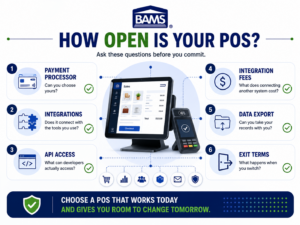
A flexible POS should support the systems your business uses today without making future integrations or switching unnecessarily difficult.
The ACCESS Act may never decide which POS is right for your business. A few practical questions can.
- Can I choose my payment processor? Find out whether payment processing is open or bundled with the POS.
- Which third-party integrations are available? Look at the tools you already use rather than counting the total number of apps.
- Is there an API? If there is, ask what developers can actually access.
- Are there integration fees? Find out who pays them and whether they change based on functionality or transaction volume.
- Can I export my data? Ask which records are portable and what format the system provides.
- What happens if I leave? Review cancellation terms, hardware ownership and data-access policies before signing.
A system can be excellent today and still become a problem later if the merchant has no practical way to connect new tools or move somewhere else.
How BAMS Fits Into a More Flexible POS Setup
To ensure merchants can fully enjoy the newfound choice and portability promised by ACCESS, it’s important that they also have a merchant services partner that offers the widest range of POS integrations possible. BAMS, a leading merchant services provider, offers merchant accounts that not only carry some of the lowest transaction fees in the payments industry, but also integrate with dozens of the most popular POS systems in the restaurant, retail and hospitality industries.
BAMS continues to maintain a broad integration catalog covering POS systems, payment gateways and eCommerce platforms. The goal is straightforward: merchants should be able to connect payment processing with the technology they already use when a compatible integration is available.
Integration choice should also be evaluated alongside processing cost. BAMS currently offers transparent merchant account pricing with options including interchange plus pricing for businesses that need a custom arrangement.
Contact us today for more information on how a BAMS merchant account can help your business get the most out of your POS while simultaneously slashing your monthly account statement thanks to the BAMS low-price guarantee.
Frequently Asked Questions
Did the original 2019 ACCESS Act become law?
No. The 2019 ACCESS Act did not become law. Lawmakers have introduced updated versions of the interoperability and data-portability proposal in later Congresses.
Is there a current ACCESS Act?
Yes. Senators introduced the ACCESS Act of 2025 as S. 1634 in May 2025. It was referred to the Senate Committee on Commerce, Science and Transportation and has not become law.
Would the ACCESS Act force every POS system to allow third-party integrations?
No. The current bill focuses on large communications platforms rather than POS systems as a general category. It should not be interpreted as a requirement that every POS provider open its API or integration ecosystem.
What is a third-party POS integration?
It is a connection between a POS system and another application or service. Examples can include accounting software, inventory tools, loyalty platforms, employee management systems and payment technology.
Why does data portability matter for merchants?
Portable data can make it easier to move from one system to another without rebuilding years of customer, inventory or transaction records manually.
Does having an API mean a POS is completely open?
No. The provider can still determine which functions the API exposes, which partners can use it and what commercial terms apply.
Can third-party POS integrations affect PCI compliance?
Yes. Merchants need to understand which third parties interact with their payment environment and what security responsibilities each provider has.
What should merchants prioritize when comparing POS systems?
Look at payment-processing flexibility, integration support, API access, data portability, contract terms and security. The best system is one that works for the business today witho`ut creating unnecessary barriers when its needs change.