10 Hidden Merchant Fees Your Processor Won’t Reveal
A monthly payment processor audit checklist that exposes the line items silently inflating your processing costs
Discover the 10 most commonly obscured merchant fees draining your margins and learn how to run monthly audits that catch them. This tactical checklist helps eCommerce managers cut processing costs by up to 60%.
TL;DR
- Hidden merchant fees inflate effective rates by 40-60% – Quoted rates rarely match what you actually pay. Calculate your effective rate (total fees ÷ total volume) every month.
- Monthly audits expose the biggest cost drivers – Ten specific checkpoints, from interchange-plus verification to cross-border fees, surface where your processor is marking up or hiding costs.
- Transparency is a leading indicator of partnership quality – Processors who hide fees also tend to delay funding and resist chargeback defense. Fee clarity predicts operational reliability.
- Start with three checkpoints, not all ten – Effective rate calculation, pricing model verification, and PCI fee benchmarking recover the most cost for the least effort in month one.
- A 30-minute monthly discipline can cut processing costs 15-30% – Consistent auditing, precise renegotiation asks, and tracking response times from your processor turn payments into a predictable advantage.
Hidden merchant fees have become a silent profit drain. Between interchange adjustments, assessment surcharges, PCI non-compliance penalties, and batch fees that appear without warning, eCommerce managers routinely discover their effective processing rate is far higher than the headline number their processor quoted. But waiting for outside enforcement to fix payment opacity is a losing strategy. The fix starts with monthly payment processor audits, a discipline most merchants skip entirely. This listicle is not a general primer on merchant services. It is a tactical playbook for exposing hidden fees and converting audit findings into cost-effective payment processing.
1. The Promise: What This List Delivers
This guide is written for eCommerce managers at established online businesses (10-50 employees) who already accept cards and want to stop overpaying. It excludes generic “shop around” advice, vendor comparison charts, and introductory explainers on how card networks function. Instead, you get ten concrete audit checkpoints you can run every month, the specific line items to scrutinize, and the questions to ask your processor when the numbers do not reconcile.
2. The Criteria: How These Items Were Selected
Each item on this list meets three tests: it surfaces a fee category commonly obscured on merchant statements, it can be verified using data you already have, and it produces a measurable decision (renegotiate, switch, or keep). Items are ordered by frequency of impact, not complexity.
3. Ten Audit Checkpoints to Expose Hidden Merchant Fees
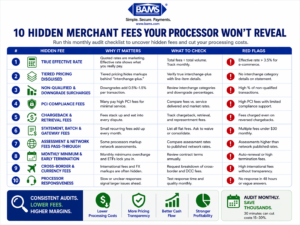
A complete monthly checklist to identify hidden merchant fees and reduce payment processing costs.
1. Calculate Your True Effective Rate Every Month
Why it matters: The quoted rate is marketing. The effective rate (total fees divided by total volume) is reality. Most merchants never calculate it, so they never notice drift.
What it looks like today: Effective rates above 3.0% for card-present retail or 3.5% for eCommerce typically indicate hidden markups, downgraded transactions, or bundled tier pricing masking interchange pass-through.
How to apply it: Pull your monthly statement, divide total fees by total processed volume, and track the number in a spreadsheet. Any month-over-month increase greater than 0.1% warrants a call to your processor.
2. Audit for Tiered Pricing Disguised as Interchange-Plus
Why it matters: Tiered pricing (qualified, mid-qualified, non-qualified) lets processors pocket the spread when transactions “downgrade.” Some statements list interchange-plus on the cover page but apply tiered logic underneath.
What it looks like today: Look for line items labeled “non-qualified surcharge” or buckets without specific interchange categories attached.
How to apply it: Demand a true interchange-plus statement showing the actual Visa or Mastercard category plus your processor’s markup as a separate line. If they cannot produce it, you are not on interchange-plus. A strong payment gateway setup should make this level of visibility easier to maintain.
3. Flag Non-Qualified and Downgrade Surcharges
Why it matters: Rewards cards, corporate cards, and keyed-in transactions often trigger downgrades that add 0.5-1.5% per transaction. These stack quickly at scale.
What it looks like today: A rising share of rewards card volume means more transactions hit premium interchange. Processors who mark up the spread profit every time.
How to apply it: Review the interchange category breakdown on your statement. If more than 15% of volume lands in non-qualified tiers, investigate whether it is transaction behavior or processor classification.
4. Verify PCI Compliance Fees Against Market Rates
Why it matters: PCI fees range from reasonable to predatory. Many merchants pay both an annual compliance charge and monthly non-compliance penalties without realizing they are separate charges.
What it looks like today: Some processors charge $30-$50/month for “PCI programs” that deliver little beyond a self-assessment questionnaire link.
How to apply it: Benchmark your annual PCI spend against the actual service provided. If the fee is high and the processor is not helping with compliance workflows, it needs justification.
5. Reconcile Chargeback and Retrieval Fees
Why it matters: Chargeback fees plus retrieval fees and representment charges create compounding costs that rarely appear in processor sales pitches.
What it looks like today: eCommerce dispute costs often stack through fees, lost revenue, labor, and slower cash flow.
How to apply it: Track chargeback fees as a percentage of disputes won. If you are paying fees on reversed chargebacks, push back.
6. Identify Statement, Batch, and Gateway Fees
Why it matters: Small recurring fees ($5-$25 each) for statements, daily batches, and gateway access are the easiest to ignore and the easiest to negotiate away.
What it looks like today: eCommerce merchants often pay a gateway fee to one vendor and a processing fee to another, duplicating infrastructure costs.
How to apply it: List every flat fee on your statement. Ask your processor to waive or consolidate any fee under $30/month. Most will, because the fee exists to be negotiated.
7. Check for Assessment and Network Fee Pass-Through Accuracy
Why it matters: Visa, Mastercard, and Discover publish assessment fees publicly. Some processors mark these up and pass the inflated number to you as “assessments.”
What it looks like today: Published assessments are typically low fractional percentages. Markups appear as rounded-up percentages or unexplained “network access” surcharges.
How to apply it: Compare your assessment line against current published rates. Any discrepancy is either an error or a markup, and both deserve an explanation in writing. Visa publishes fee and rule information that can help you verify these changes directly: Visa fee and network rules.
8. Review Monthly Minimum and Early Termination Clauses
Why it matters: Monthly minimums charge you for fees you did not incur. Early termination fees lock you into bad deals.
What it looks like today: Multi-year auto-renewing contracts with liquidated damages clauses remain common.
How to apply it: Read your contract’s termination section annually. If you are within 90 days of a renewal window, decide now whether to renegotiate or exit.
9. Audit Cross-Border and Currency Conversion Fees
Why it matters: International transactions carry cross-border fees and currency conversion markups that compound on each sale.
What it looks like today: Cross-border and DCC charges remain among the least transparent categories on many statements.
How to apply it: If international sales exceed 10% of volume, request a line-item breakdown of cross-border and DCC fees. Consider a processor with flatter international pricing if this category keeps growing.
10. Stress-Test Processor Responsiveness Against Your Contract
Why it matters: A processor that cannot explain a fee within 48 hours is a processor that profits from your confusion.
What it looks like today: Dedicated account management is increasingly the difference between a processor you audit monthly and one you trust. Fee transparency also tends to correlate with funding consistency and response quality.
How to apply it: Send one fee question per month via email. Measure response time and answer quality. Use the data at contract renewal. If funding speed is part of the issue, compare the operational impact against options like guaranteed next-day funding.
4. Pattern Recognition: What These Checkpoints Reveal Together
The common thread across all ten items is information asymmetry. Processors profit when you cannot see, cannot calculate, or cannot compare. Every checkpoint above is a mechanism for restoring visibility. The second-order insight: transparent pricing is not just a cost issue, it is a governance issue. A processor that hides fees is also likely to delay funding, resist chargeback defense, and bury contract renewals. Conversely, processors who publish interchange-plus statements, waive statement fees on request, and respond to audit questions within 48 hours tend to deliver better operational support across the board. Fee transparency is a leading indicator of partnership quality.
5. Constraints and Prioritization: Where to Start
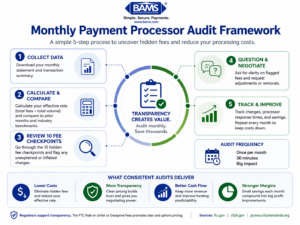
A simple framework for running monthly audits and identifying hidden payment processing fees.
You do not need to run all ten checkpoints month one. Start with items 1, 2, and 4: calculate your effective rate, verify your pricing model, and benchmark PCI fees. These three surface the largest dollar impact for the least effort. Add items 5 and 6 in month two. Tackle contract and cross-border items only when a renewal or expansion is on the horizon. A 30-minute monthly audit, applied consistently, typically recovers 15-30% of processing costs within one billing cycle.
Frequently Asked Questions
What are merchant fees and how do they work?
Merchant fees are the charges you pay to accept card payments. They include three layers: interchange (set by Visa and Mastercard and paid to the card-issuing bank), assessments (paid to the card networks), and the processor’s markup. Hidden merchant fees usually hide inside that third layer as statement fees, PCI charges, batch fees, or inflated assessments. The Federal Reserve provides a useful reference point for how interchange can vary by transaction type.
How often should I run a payment processor audit?
Monthly. Processors can adjust pricing, add new line items, or reclassify transactions between statements. A monthly audit takes 30 minutes once you build a template and catches drift before it compounds into thousands of dollars per year.
Which pricing model is better: interchange-plus or flat rate?
Interchange-plus is typically more cost-effective for businesses processing more than $15,000/month because it passes the true interchange cost through with a visible markup. Flat rate is simpler for smaller merchants but bundles all transactions into one rate, which means you overpay on debit and low-interchange cards.
How can I negotiate lower merchant processing rates?
Start with data. Calculate your effective rate, list every flat fee, and benchmark against published assessment rates. Then request a specific markup reduction rather than a vague ask. Processors respond to precise requests backed by statement analysis.
When should I consider switching payment processors?
Consider switching when your effective rate exceeds 3.5% for eCommerce without a clear reason, when your processor cannot provide a true interchange-plus statement on request, or when fee questions take more than 48 hours to answer. Time the switch to avoid early termination fees by reviewing your contract renewal window.
What are the most common hidden fees to look for?
The frequent offenders are non-qualified surcharges, inflated assessment pass-throughs, monthly PCI programs above market value, statement fees, batch fees, gateway fees duplicated across vendors, and cross-border markups on international transactions. Each one is individually small, which is why they escape notice, but together they often add 0.5-1.5% to your effective rate. Maintaining alignment with PCI Security Standards Council requirements also helps reduce avoidable compliance-related charges.