Faster Payment Settlement & Lower B2B Fees
Last Updated on October 15, 2026 by Dimitri Akhrin
How combining interchange optimization with next-day funding creates a compounding cash flow advantage
Learn how hidden merchant service charges inflate B2B processing costs and how Level 2/3 data optimization paired with faster payment settlement eliminates them. A practical guide for mid-market eCommerce operations ready to cut costs without a platform overhaul.
TL;DR
- Your effective rate is the only number that matters — Divide total fees by total volume to find what you actually pay. If the gap between this and your advertised rate exceeds 0.3%, you have hidden fees worth eliminating.
- Level 2/3 data optimization can save 0.5% to 1.0% per B2B transaction — Most processors do not submit enhanced data by default. Demand a qualification report to verify your transactions are actually hitting lower interchange tiers.
- Next-day funding is a cash flow lever, not a luxury — Compressing settlement from 2 to 3 days to 1 day frees up tens of thousands in working capital monthly. Do not pay a surcharge for it; look for processors that include it as standard.
- Interchange savings and faster settlement compound each other — Paying less per transaction and receiving funds sooner creates a combined effect on working capital that neither change delivers alone.
- Quarterly monitoring prevents fee creep — Interchange tables change twice a year, processors add fees quietly, and qualification rates drift. Recalculate your effective rate every quarter to keep costs from drifting back up.
Guide Orientation: What This Covers and Who It’s For
This guide is for eCommerce managers at established online businesses (roughly 10 to 50 employees) who suspect their B2B processing costs are higher than they need to be. If you handle high-ticket orders, sell wholesale, or invoice other businesses, you are almost certainly paying inflated merchant service charges because of hidden fees and missed interchange qualifications.
By the end, you will understand exactly how hidden fees accumulate on B2B transactions, how Level 2 and Level 3 data optimization lowers your effective rate, and why combining interchange savings with faster payment settlement creates a compounding cash flow advantage most processors never mention.
This guide does not cover enterprise-scale payment orchestration or near-zero fee promises. It focuses on practical, measurable cost elimination for mid-market eCommerce operations, without requiring a platform overhaul.
Why Eliminating Hidden Fees in Merchant Service Charges Matters Now
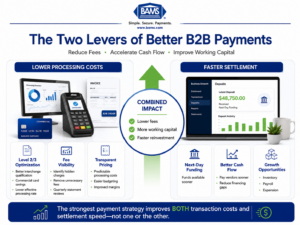
Reducing processing costs and accelerating settlement creates a compounding cash flow advantage for growing B2B businesses.
Businesses are increasingly adopting faster payment methods to improve cash flow, reduce payment friction, and gain quicker access to working capital. According to the U.S. Faster Payments Council’s 2025 Instant Payments Adoption Study, organizations continue expanding their use of faster payment capabilities across a growing number of business use cases.
Here is the core problem: your processor likely treats interchange optimization and settlement speed as two separate products. You negotiate rates in one conversation and funding timelines in another. Meanwhile, hidden fees (PCI non-compliance charges, batch fees, statement fees, interchange downgrades) quietly inflate your effective processing rate by 0.3% to 0.8% on every transaction.
On a $500 B2B order, that is $1.50 to $4.00 in unnecessary cost. Multiply that across thousands of monthly transactions, and you are looking at tens of thousands of dollars annually that never show up as a single line item. The cost of inaction is not dramatic. It is slow, steady margin erosion that compounds every month.
According to Federal Reserve research, 48% of businesses now cite cost reduction as a primary driver for adopting faster payment methods. Cassie Burica of the Federal Reserve System noted that businesses are choosing faster payments because it “helps them reduce cost and provides flexibility to pay and be paid as customers prefer.” The convergence of cost reduction and funding speed is not a future trend. It is the current competitive baseline.
Core Concepts: The Language of B2B Processing Costs
Effective Processing Rate vs. Advertised Rate
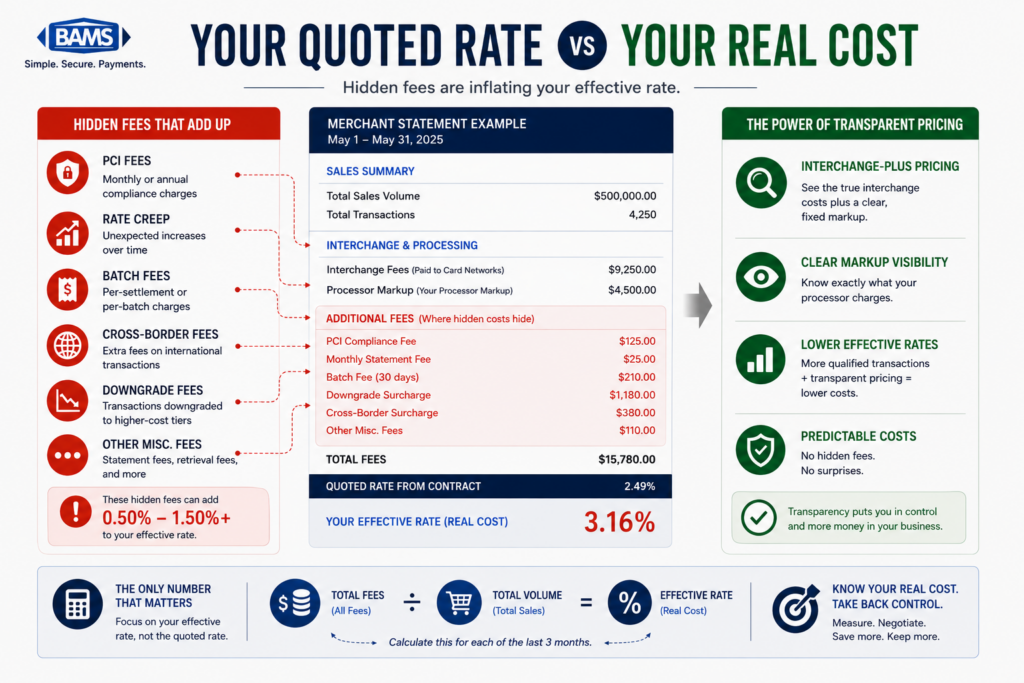
Your advertised rate (the number your processor quoted during onboarding) is not your actual cost. Your effective processing rate is total fees divided by total volume. This single number reveals what you truly pay per dollar processed. If your advertised rate is 2.4% but your effective rate is 3.1%, the gap is hidden fees. Learn how to calculate and interpret your effective processing rate before doing anything else.
Interchange-Plus Pricing vs. Flat Rate
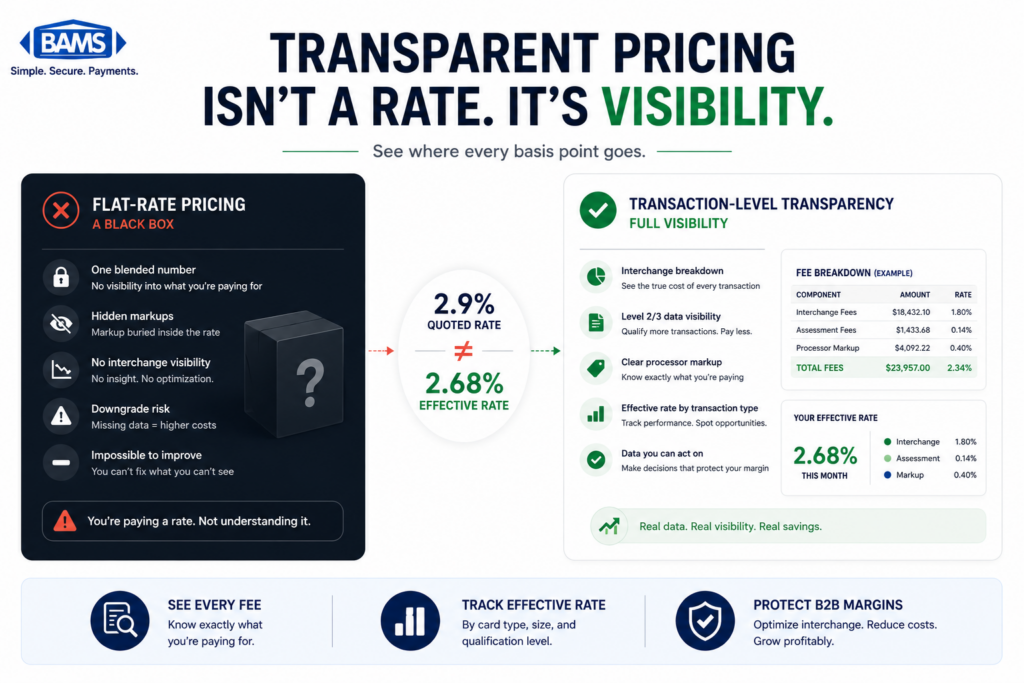
Interchange-plus pricing separates the card network’s base cost (interchange) from your processor’s markup. Flat-rate pricing bundles everything into one percentage. Flat rate is simpler, but it hides whether your transactions are qualifying at the lowest possible interchange tier. For B2B and high-ticket orders, interchange-plus pricing almost always costs less because it lets you target lower interchange categories through data optimization.
Visa’s payment processing guidance describes how interchange, assessments, and processor markups contribute to overall payment acceptance costs.
Level 2 and Level 3 Data
Visa and Mastercard offer reduced interchange rates for transactions that include enhanced data: purchase order numbers, tax amounts, item descriptions, commodity codes, and shipping details. Level 2 data includes basic tax and customer information. Level 3 adds line-item detail. B2B transactions that pass Level 3 data can qualify for interchange rates 0.5% to 1.0% lower than standard commercial card rates. Most processors do not submit this data by default.
The Visa Commercial Enhanced Data Program explains how enhanced transaction data supports commercial card qualification and lower interchange categories for eligible transactions.
Settlement Speed and Cash Flow Timing
Settlement is how quickly processed funds reach your bank account. Standard settlement is two to three business days. Next-day funding collapses that gap. The distinction matters because every day your money sits in transit is a day you cannot deploy it for inventory, payroll, or growth. Settlement speed is not a convenience feature. It is a cash flow lever.
The Framework: Interchange Savings and Settlement Speed as a Combined System
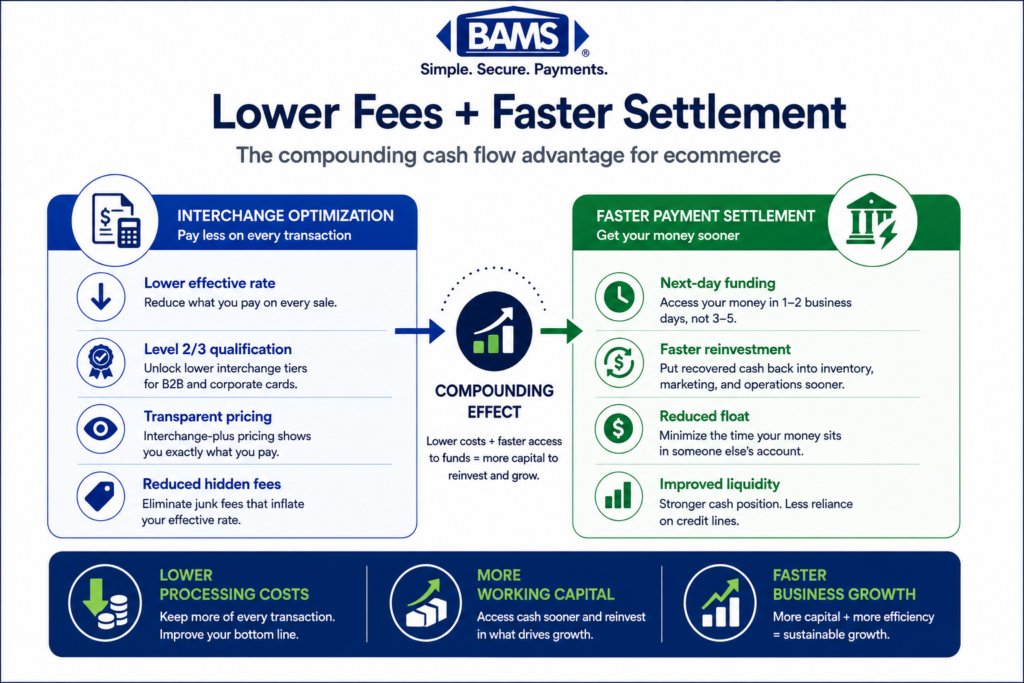
Most processors sell interchange optimization and faster settlement as separate upgrades. This guide treats them as two halves of one system. Here is why: reducing your per-transaction cost puts more money into each settlement. Accelerating settlement puts that money in your account sooner. Together, they create a compounding effect on working capital.
The framework has four phases:
- Phase 1: Audit — Identify what you are actually paying and where hidden fees live
- Phase 2: Qualify — Ensure your B2B transactions submit Level 2/3 data to hit lower interchange tiers
- Phase 3: Accelerate — Move from standard settlement to next-day funding
- Phase 4: Monitor — Build ongoing visibility so costs do not creep back up
Each phase reinforces the others. An audit without qualification changes nothing. Qualification without faster settlement leaves cash on the table. Speed without monitoring lets new hidden fees accumulate unnoticed.
Step-by-Step Breakdown: Eliminating Hidden Fees and Accelerating Cash Flow
Step 1: Run a Full Statement Audit to Find Your Real Effective Rate
Objective: Determine the gap between your advertised rate and your actual cost per dollar processed.
Pull your last three months of processing statements. Add up every fee: interchange, processor markup, batch fees, PCI compliance fees, statement fees, monthly minimums, and any line items labeled “miscellaneous” or “regulatory.” Divide total fees by total processing volume. That is your effective rate.
Compare this number to your advertised rate. If the gap exceeds 0.3%, you have hidden fees worth investigating. Common culprits include PCI non-compliance penalties (often $19.95 to $99.95 per month for not completing a self-assessment questionnaire), opaque billing markups, and interchange downgrades where transactions that should qualify at lower rates are processed at higher ones.
Anti-patterns: Do not rely on your processor’s summary dashboard alone. Dashboards often aggregate fees in ways that obscure individual charges. Work from the raw statement PDF or CSV export. Do not average across a single month; seasonal volume shifts can distort the picture.
Success indicators: You can state your effective rate to two decimal places. You can identify every fee category on your statement by name and amount. You have a list of fees that do not correspond to interchange or processor markup.
Step 2: Identify and Eliminate Non-Interchange Junk Fees
Objective: Remove or renegotiate fees that are not tied to card network costs or legitimate processing services.
With your audit complete, categorize every fee into three buckets: interchange (set by Visa/Mastercard, non-negotiable), processor markup (negotiable), and ancillary fees (often eliminable). Ancillary fees are where the most waste hides.
Common junk fees to target include: annual fees, monthly statement fees, batch processing fees (charged per batch close, sometimes multiple times daily), gateway fees that duplicate functionality your eCommerce platform already provides, and “technology” or “security” fees with vague descriptions. Some processors charge an IRS reporting fee, a regulatory compliance fee, or an account maintenance fee. None of these reflect actual costs the processor incurs on your behalf.
Call your processor and ask for written justification of each ancillary fee. If they cannot explain what service the fee pays for, request its removal. If they refuse, you have a clear signal about the relationship’s long-term viability.
Anti-patterns: Do not negotiate your markup rate while ignoring ancillary fees. A processor who drops your markup by 0.05% while keeping $150 per month in junk fees has given you nothing. Do not accept “industry standard” as a justification for any fee.
Success indicators: Your ancillary fee total drops by at least 30%. Every remaining fee on your statement has a clear, documented purpose. Your effective rate has decreased without changing your interchange qualification.
Step 3: Implement Level 2/3 Data Submission for B2B Transactions
Objective: Qualify your B2B and high-ticket transactions for the lowest available interchange tiers by passing enhanced transaction data.
This is where the largest per-transaction savings occur. Visa and Mastercard publish lower interchange rates for commercial, purchasing, and corporate cards when transactions include Level 2 data (tax amount, customer code, merchant postal code) and Level 3 data (line-item detail including product codes, descriptions, quantities, unit costs, and freight amounts).
The savings are substantial. A standard commercial card transaction might process at an interchange rate of 2.65% + $0.10. The same transaction with Level 3 data can qualify at 1.90% + $0.10. On a $2,000 B2B order, that is a $15 difference on a single transaction. Across 500 monthly B2B orders, that is $7,500 per month in interchange savings alone.
Implementation requires your payment gateway or processor to support Level 2/3 data passthrough. Not all do. Check whether your current gateway can transmit enhanced data fields. If it cannot, this is a valid reason to switch processors, not gateways. The right processor handles Level 2/3 qualification on their end using data your ecommerce platform already captures (order details, tax calculations, shipping information).
Anti-patterns: Do not assume your processor is already submitting Level 3 data because they said they support it. “Supporting” Level 3 and “actively submitting” Level 3 are different things. Ask for a qualification report showing what percentage of your transactions are hitting Level 3 interchange rates. If they cannot produce this report, they are not doing it.
Success indicators: You receive a monthly qualification report. At least 80% of your commercial card transactions qualify at Level 2 or Level 3 interchange rates. Your effective rate on B2B transactions drops by 0.4% or more.
Step 4: Move to Next-Day Funding to Compress Your Cash Conversion Cycle
Objective: Reduce the time between processing a transaction and having funds available in your operating account.
Standard settlement timelines of two to three business days mean that a Friday transaction might not hit your bank until Wednesday. For an eCommerce business processing $500,000 monthly, that delay represents $30,000 to $50,000 constantly in transit, unavailable for operations.
Next-day funding collapses this gap. You process a transaction today, and the funds arrive tomorrow. This is not a marginal improvement. It fundamentally changes how you manage inventory purchasing, vendor payments, and payroll timing. Elizabeth Grice of the U.S. Faster Payments Council noted that faster settlement is gaining traction in high-ticket, capital-intensive scenarios precisely because speed directly impacts cash flow.
When evaluating next-day funding options, ask three questions: Is there a per-transaction surcharge for faster settlement? Is next-day funding available for all transaction types or only card-present? What is the daily cutoff time for batch inclusion? Some processors offer next-day funding but charge 0.1% to 0.3% extra per transaction, which can erase your interchange savings. The best arrangements include next-day funding as a standard feature, not a premium add-on. Choosing a processor that bundles faster settlement with transparent pricing avoids this trade-off entirely.
Anti-patterns: Do not treat faster settlement as a luxury. Do not accept next-day funding only for transactions under a certain dollar threshold; B2B orders are often your highest-value transactions and benefit most from accelerated settlement. Do not confuse “next-day funding” with “next business day funding” (weekends and holidays matter).
Success indicators: Funds from today’s transactions appear in your bank account by the next business day. Your average days-sales-outstanding (DSO) on card transactions drops from 2 to 3 days to 1 day. You can quantify the working capital freed up by faster settlement.
Step 5: Combine Interchange Savings with Faster Settlement for Compounding Impact
Objective: Realize the full cash flow benefit of paying less per transaction and receiving funds sooner.
This is the step most guides skip because most processors treat cost and speed as unrelated product lines. But the math is straightforward. If Level 2/3 optimization saves you $7,500 per month on interchange, and next-day funding makes that $7,500 available one to two days sooner each cycle, you have both more money and faster access to it.
The practical impact shows up in three places. First, you can take advantage of early-payment discounts from suppliers (commonly 2/10 net 30, meaning a 2% discount for paying within 10 days). Second, you reduce or eliminate short-term borrowing to cover cash flow gaps between payables and receivables. Third, you gain the ability to reinvest in inventory or marketing without waiting for settlement cycles to catch up.
For a business processing $500,000 monthly with a 0.5% interchange reduction and next-day funding, the combined annual impact is roughly $30,000 in direct fee savings plus $5,000 to $15,000 in working capital efficiency gains (depending on how aggressively you deploy freed-up cash). BAMS is one processor that bundles both next-day funding and Level 2/3 data optimization into a single transparent pricing model, which eliminates the need to negotiate these as separate line items.
Anti-patterns: Do not optimize interchange and then accept a three-day settlement window. Do not accept faster funding if it comes with a surcharge that offsets your interchange savings. Do not treat these as sequential projects; evaluate them together when choosing or renegotiating with a processor.
Success indicators: Your effective rate has dropped and your settlement timeline has compressed simultaneously. You can calculate the combined annual dollar impact of both changes. Your cash conversion cycle on card transactions is measurably shorter than it was before.
Step 6: Build Ongoing Monitoring to Prevent Fee Creep
Objective: Establish a recurring review process so hidden fees do not reappear over time.
Processors change their fee schedules. Card networks update interchange tables twice a year (April and October). New fees get added to statements with minimal notice. If you audit once and never check again, your effective rate will drift upward within 12 months.
Set a quarterly review cadence. Each quarter, recalculate your effective rate, check your Level 2/3 qualification percentage, and scan for any new line items on your statement. Automate what you can: most accounting platforms can flag processing cost anomalies if you set up category-level tracking for merchant fees.
Request a quarterly business review from your processor. A processor who refuses to review your account performance regularly is not invested in your cost structure. During these reviews, ask for an updated qualification report, a comparison of your effective rate quarter over quarter, and advance notice of any upcoming fee changes.
Anti-patterns: Do not set and forget. Do not rely on your processor to proactively notify you of interchange table changes that affect your rates. Do not skip the review just because last quarter looked good.
Success indicators: Your effective rate remains stable or improves quarter over quarter. You catch new fees within one billing cycle of their introduction. Your Level 2/3 qualification rate stays above 80% for commercial card transactions.
Practical Examples: What This Looks Like in Context

A structured roadmap for reducing merchant processing costs while strengthening cash flow.
Scenario A: Wholesale eCommerce Seller, $400K Monthly Volume
A wholesale eCommerce operation processes 1,200 B2B orders per month with an average ticket of $333. Their advertised rate is 2.5%, but their effective rate is 3.15%. The gap comes from PCI non-compliance fees ($79.95/month), a monthly statement fee ($12.95), batch fees ($0.25 per batch, three batches daily), and zero Level 3 data submission.
After auditing: they eliminate $92.90 in monthly junk fees, negotiate batch fees down to one daily close, and implement Level 3 data passthrough. Their interchange rate on commercial cards drops from 2.65% to 2.05%. Combined with next-day funding (no surcharge), their effective rate falls to 2.45%. Annual savings: approximately $28,000 in direct fees plus measurably improved cash flow timing.
Scenario B: B2B SaaS with Annual Contracts Paid by Corporate Card
A SaaS company processes 80 transactions per month, but average ticket size is $8,500. Their processor does not support Level 3 data. Every transaction processes at the highest commercial interchange tier. Switching to a processor with Level 3 support and interchange-plus pricing drops their per-transaction interchange cost by $51 on average. That is $4,080 per month, or nearly $49,000 annually, on just 80 transactions.
Common Mistakes and Pitfalls
Negotiating rate before auditing fees. Many eCommerce managers focus on getting a lower markup percentage while ignoring $100+ in monthly ancillary fees. Always audit first, then negotiate.
Assuming your processor submits Level 3 data. “We support Level 3” is not the same as “We are actively submitting Level 3 data on your transactions.” Demand a qualification report. If your processor cannot produce one, they are not doing it.
Treating faster settlement as a premium luxury.86% of businesses reported using faster or instant payments in 2023. Next-day funding is a baseline expectation, not an upgrade. If your processor charges extra for it, factor that cost into your effective rate comparison.
Optimizing once and walking away. Interchange tables change twice a year. Processors add fees. Qualification rates drift if your product catalog or transaction mix shifts. Quarterly reviews are not optional.
What to Do Next
Start with one action: pull your last three processing statements and calculate your effective rate. That single number tells you whether this guide is worth an afternoon of your time or an urgent priority. If the gap between your advertised rate and your effective rate exceeds 0.3%, you have recoverable margin sitting in your processing fees.
From there, work through the steps in order. Audit first, eliminate junk fees second, then tackle Level 2/3 qualification and settlement speed together. Do not try to fix everything in one week. A methodical approach over 30 to 60 days produces durable results.
Revisit this guide quarterly as a reference checklist. Your transaction mix will evolve, interchange tables will update, and your processor’s fee schedule will change. The businesses that keep their processing costs low are the ones that treat cost management as an ongoing practice, not a one-time project.
Frequently Asked Questions
What is interchange-plus pricing and how does it work?
Interchange-plus pricing separates the card network’s base cost (interchange, set by Visa or Mastercard) from your processor’s markup. You see both components on your statement, which makes it possible to verify whether your transactions are qualifying at the correct interchange tier. This is the opposite of flat-rate pricing, where everything is bundled into a single percentage and you cannot tell what you are actually paying for interchange versus processor profit. For B2B and high-ticket eCommerce, interchange-plus almost always costs less because it allows you to target lower interchange categories through Level 2/3 data optimization.
Why should businesses consider Level 2/3 optimization for B2B transactions?
Visa and Mastercard offer significantly lower interchange rates for transactions that include enhanced data such as tax amounts, purchase order numbers, and line-item details. Level 3 data can reduce interchange costs by 0.5% to 1.0% per transaction compared to standard commercial card rates. On high-ticket B2B orders, this translates to savings of $10 to $50+ per transaction. Most processors do not submit this data by default, so businesses need to verify that their processor is actively qualifying transactions at Level 3, not just claiming to support it.
How can companies effectively reduce their merchant service charges?
Start by calculating your effective processing rate (total fees divided by total volume). Compare this to your advertised rate. The gap reveals hidden fees. Then work through three layers: eliminate ancillary junk fees (PCI non-compliance charges, statement fees, unnecessary batch fees), ensure your transactions qualify at the lowest interchange tier through Level 2/3 data, and negotiate your processor’s markup. Addressing all three layers typically reduces the effective rate by 0.3% to 0.8%.
What are the common hidden fees in merchant services that businesses should watch out for?
The most common hidden fees include PCI non-compliance penalties ($19.95 to $99.95 per month), monthly statement fees, annual account fees, per-batch processing fees (especially when multiple batches close daily), gateway fees that duplicate existing platform functionality, and vaguely labeled “technology,” “security,” or “regulatory” fees. Interchange downgrades are another hidden cost: when your processor fails to submit the required data for lower interchange tiers, your transactions process at higher rates without any visible fee line item.
When is the best time to negotiate processing fees with your merchant services provider?
The best time to negotiate is after you have completed a full statement audit and can present specific data: your effective rate, a list of ancillary fees you want removed, and your Level 2/3 qualification percentage. Processors respond to informed merchants differently than they respond to general rate complaints. Additionally, negotiate when your contract is approaching renewal or when you can demonstrate increased processing volume, both of which give you leverage.
Which payment processing model is more cost-effective for high-volume B2B transactions?
Interchange-plus pricing is almost always more cost-effective for high-volume or high-ticket B2B transactions. Flat-rate models (like 2.9% + $0.30) are designed for simplicity, not savings. They overcharge on debit transactions and miss Level 2/3 interchange qualification entirely. With interchange-plus, you pay the actual interchange rate plus a fixed markup, which means every optimization (Level 2/3 data, proper card type routing) directly reduces your cost. The higher your average ticket and the more commercial cards you accept, the greater the savings.