
7 Apple Pay Fraud Patterns That Survive Tokenization
Last Updated on August 11, 2026 by Dimitri Akhrin
The chargeback signals hiding in your token data — and why standard fraud filters miss them completely
Learn which Apple Pay fraud patterns bypass tokenization and how to spot the chargeback signals your fraud filters miss. Built for eCommerce managers who need a diagnostic framework tied to real processor data.
TL;DR
- Tokenization has limits – Apple Pay’s security protects the card number during transactions but doesn’t prevent stolen cards from being provisioned, friendly fraud disputes, or evidence gaps during chargebacks.
- Friendly fraud is the biggest wallet-era threat – Biometric authentication proves the device owner tapped “confirm,” but it won’t help you when a customer claims they never received the product. Pair Apple Pay orders with delivery signature confirmation.
- Your dispute evidence template needs a wallet version – Standard chargeback evidence (AVS match, card number, CVV) doesn’t apply cleanly to Apple Pay. Include cryptogram data, device authentication type, and token-specific identifiers.
- Shift fraud detection from card-level to behavior-level – Unique Device Account Numbers make velocity checks by card number useless. Cluster suspicious activity by email, shipping address, IP, and device fingerprint instead.
- Start with what’s already costing you money – Audit your last 90 days of chargebacks, tag which ones came from Apple Pay, and build your wallet-specific dispute process before layering in advanced behavioral detection.
The Fraud Patterns Tokenization Doesn’t Catch
Apple Pay is safer than traditional cards. That’s not debatable. Apple’s official Apple Pay documentation explains how tokenization, device authentication, and secure hardware work together to protect payment credentials during transactions.
But here’s the problem most eCommerce managers discover too late: Apple Pay fraud still happens, and when it does, the chargeback signals look different from what you’re used to seeing. The Device Account Number (DAN) that replaces a real card number during tokenization also obscures the data trail you rely on for dispute evidence. Your processor sees a token. Your fraud filters see a clean transaction. And weeks later, a chargeback lands with reason codes that don’t match your existing defense playbook.
Who This Is For (and What It Doesn’t Cover)
This guide is built for eCommerce managers at small-to-midsize online businesses who have already enabled Apple Pay (or plan to soon) and need to understand what specific fraud patterns survive tokenization. You don’t need a payments engineering background. You need a diagnostic lens tied to the transaction data your processor actually surfaces.
This is not a primer on how tokenization works or a general overview of digital wallet security. We’re skipping the architecture diagrams. Instead, we’re focused on the operational signals that predict chargebacks before they hit your merchant account, and the response steps that protect your revenue.
How We Selected These Patterns
Each pattern below meets three criteria: it persists despite tokenization and biometric layers, it generates chargeback activity that standard fraud filters frequently miss, and it produces data signals visible at the merchant or processor level (not buried inside Apple’s ecosystem). If a fraud type is effectively neutralized by tokenization, it’s not on this list.

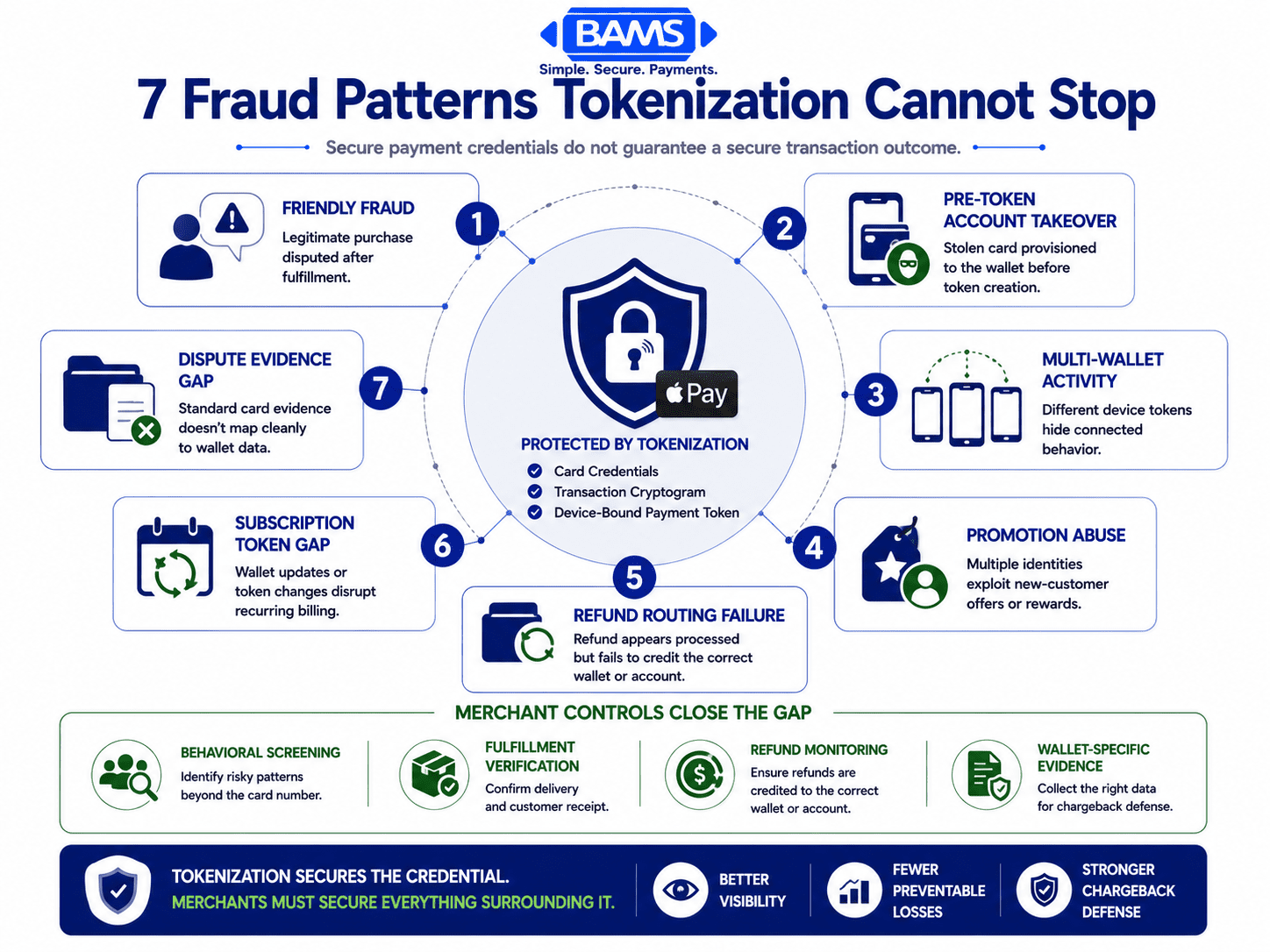
Tokenization protects payment credentials, but it cannot secure every part of the transaction. Customer behavior, fulfillment, refunds, subscriptions, and chargeback evidence still require merchant-level controls.
7 Apple Pay Fraud Patterns That Survive Tokenization
1. Friendly Fraud Amplified by Wallet Anonymity
Why it matters: Friendly fraud (a legitimate cardholder disputes a charge they actually made) is already the largest chargeback category for eCommerce. Apple Pay makes it worse because customers sometimes forget which card was tokenized inside their wallet, or they don’t recognize how the charge appears on their statement. The biometric authentication that proves “the device owner approved this” doesn’t help you in a dispute if the cardholder simply claims they didn’t receive the goods.
What it looks like today: You see a clean Apple Pay transaction with full biometric approval, followed 30 to 60 days later by a chargeback filed under reason codes like “merchandise not received” or “not as described.” Your fraud tools flagged nothing because the transaction was technically legitimate at the point of sale.
How to apply it: Match Apple Pay order IDs to shipping confirmation with delivery signatures. Build a dispute evidence template specifically for wallet transactions that includes device authentication metadata your processor can provide. Proactive chargeback defense services can flag these disputes before they finalize.
2. Account Takeover Before the Token Is Created
Why it matters: Tokenization protects the card number after it’s loaded into Apple Pay. It does nothing to prevent a stolen card from being provisioned in the first place. Apple blocked 5.4 million stolen credit cards from being used for fraudulent purchases recently, but cards that pass Apple’s verification still get tokenized. Once a stolen card lives inside a legitimate-looking Apple Pay wallet, every transaction it generates appears clean to your fraud filters.
What it looks like today: A new customer places an order using Apple Pay. The transaction passes AVS, CVV isn’t required (tokens replace it), and biometric authentication confirms the device owner approved the purchase. Weeks later, the actual cardholder discovers the unauthorized charge and files a dispute. Your processor shows a fully authenticated Apple Pay transaction, but you still lose the chargeback.
How to apply it: Layer behavioral signals on top of payment authentication. Watch for mismatches between the shipping address and the billing profile associated with the original card. Flag first-time customers using Apple Pay who request expedited shipping to addresses that differ from their account registration.
3. Multi-Wallet Card Spreading
Why it matters: A single stolen card number can be provisioned across multiple Apple Pay wallets on different devices. Each wallet generates a unique Device Account Number, so your fraud system sees what appears to be several different payment methods. Velocity checks based on card number won’t trigger because the underlying PAN is hidden behind distinct tokens.
What it looks like today: You receive five orders in 48 hours from five different “cards” (actually five different DANs linked to the same stolen Visa). Each order ships to a slightly different address. Your transaction analysis tools show no overlap because they’re comparing tokens, not source card numbers.
How to apply it: Shift velocity detection from card-level to behavior-level. Cluster orders by email domain, device fingerprint, IP subnet, and shipping address proximity. If your processor provides token-to-PAN mapping (some do upon request for fraud investigation), use it to retroactively link suspicious clusters.
4. Promo and Loyalty Abuse via Wallet Cycling
Why it matters: Merchants offering first-purchase discounts or loyalty rewards tied to payment method often can’t distinguish between a genuinely new Apple Pay customer and someone cycling through wallets. Because each DAN is unique, a single user can appear as multiple “new” customers to claim promotional pricing repeatedly.
What it looks like today: Your promotional campaign shows unusually high redemption rates from Apple Pay transactions. Average order values cluster suspiciously close to your discount threshold. Returns or chargebacks follow within the promotional window.
How to apply it: Tie promotional eligibility to account-level identifiers (email, shipping address, phone number) rather than payment method. Cross-reference Apple Pay promotional orders against your customer database for address or contact overlap before fulfillment.
5. Refund Manipulation Through Token Confusion
Why it matters: When a customer pays with Apple Pay and later requests a refund, the refund must route back through the token. Some merchants encounter processing errors where the refund fails silently (the token has changed or the card was removed from the wallet), leading the customer to file a chargeback for non-receipt of refund. This isn’t traditional fraud, but it creates the same revenue loss.
What it looks like today: Your refund log shows “processed” but the customer’s bank never received the credit. The customer files a dispute. You now face a chargeback on a transaction you already intended to refund, plus the chargeback fee. This pattern is especially common when customers switch devices or remove cards from their wallet between purchase and refund.
How to apply it: Monitor refund settlement reports for Apple Pay transactions separately. Confirm refund completion at the bank level, not just at the processor level. When a token-based refund fails, escalate to a manual credit using the original PAN (request it from your processor). A merchant services partner like BAMS that provides dedicated account management can help you catch failed refunds before they become chargebacks.
6. Subscription Billing Gaps After Token Updates
Why it matters: Apple Pay supports automatic card updates through token lifecycle management. When a customer’s physical card is reissued (new expiration date, replacement after loss), the token should update automatically. But “should” and “does” diverge often enough to create billing failures on recurring charges. The customer sees an unexpected charge attempt, doesn’t recognize it, and disputes it.
What it looks like today: Your subscription billing system retries a stored Apple Pay token. The token has been updated by the network, but the update didn’t propagate cleanly to your payment gateway. The charge either fails (creating involuntary churn) or succeeds against a card the customer thought was deactivated (creating a dispute). Either outcome costs you revenue.
How to apply it: Audit your subscription billing integration’s handling of network token updates quarterly. Set up alerts for Apple Pay subscription charges that decline after previously succeeding. Send proactive billing notifications to subscribers before each renewal so they can verify their wallet is current.
7. Dispute Evidence Gaps Caused by Tokenized Data
Why it matters: When you fight a chargeback, you need evidence: transaction ID, cardholder verification, AVS match, device data. Apple Pay transactions replace several of these data points with tokenized equivalents. Many merchants submit dispute responses using their standard evidence template and lose because the issuer’s system can’t reconcile the token-based data with what the cardholder reported.
What it looks like today: You receive a chargeback on an Apple Pay order. You pull your standard evidence package (order confirmation, tracking number, AVS result). But the AVS result may be blank or partial because Apple Pay bypasses traditional address verification. The card number in your system is a DAN, not the PAN the issuer has on file. Your representment fails on a technicality.
How to apply it: Build a separate dispute evidence template for Apple Pay transactions. Include the cryptogram (payment token cryptogram) your gateway captured, the device authentication type (biometric vs. passcode), and the transaction-specific token. Ask your processor for documentation on what Apple Pay evidence fields issuers accept. If your processor can’t provide this guidance, that’s a signal to evaluate whether your current processing relationship is costing you more than you realize.

Standard card evidence is often incomplete for Apple Pay disputes. A wallet-specific evidence kit connects token data with customer behavior, fulfillment, refunds, and communications.
What These Patterns Have in Common
Every pattern on this list exploits the same structural gap: tokenization secures the payment credential but doesn’t secure the transaction context around it. The shipping address, the customer’s intent, the refund routing, the subscription lifecycle, the dispute evidence format. These are all merchant-side responsibilities that Apple’s security architecture was never designed to handle.
The second theme is visibility. Apple Pay transactions are safer at the point of authentication but harder to investigate after the fact. The DAN that protects the cardholder also limits your ability to connect dots across orders, match refunds, and build chargeback evidence. Merchants who treat Apple Pay chargebacks identically to traditional card chargebacks will consistently underperform in dispute recovery.
The operational takeaway: your fraud prevention strategy needs a wallet-specific layer that sits between your payment gateway and your fulfillment process. This layer doesn’t replace tokenization’s benefits. Mastercard Developers explains how network tokenization protects payment credentials, but merchants still need operational controls to address fraud patterns that occur outside the tokenization process.
Where to Start Without Overhauling Everything
You don’t need to address all seven patterns simultaneously. Start with the one that’s already costing you money. For most eCommerce merchants accepting Apple Pay, that’s either friendly fraud (pattern 1) or evidence gaps in disputes (pattern 7), because both generate immediate, measurable revenue loss.
Build your Apple Pay dispute evidence template this week. Audit your last 90 days of chargebacks and tag which ones originated from wallet transactions. If you can’t tell which chargebacks came from Apple Pay versus traditional cards, that’s your first problem to solve with your processor.
From there, layer in behavioral fraud detection (patterns 2 and 3) and refund monitoring (pattern 5) over the next quarter. The goal isn’t perfection. It’s closing the gap between what tokenization protects and what your business still needs to defend on its own.
Frequently Asked Questions
How does Apple Pay fraud happen if tokenization is supposed to prevent it?
Tokenization prevents stolen card numbers from being intercepted during a transaction. It does not prevent a stolen card from being loaded into Apple Pay before the transaction happens, nor does it stop legitimate cardholders from filing false disputes. The fraud patterns that survive tokenization exploit gaps in merchant-side processes like fulfillment verification, refund routing, and dispute evidence, not weaknesses in Apple’s encryption.
Why are Apple Pay chargebacks harder to fight than regular card chargebacks?
Apple Pay replaces the actual card number with a Device Account Number (DAN) and may bypass traditional verification steps like AVS. When you submit dispute evidence, the issuer’s system may not reconcile your token-based data with the cardholder’s account information. Building a wallet-specific evidence template that includes cryptogram data and device authentication type improves your win rate.
Can my fraud filters detect Apple Pay fraud automatically?
Most standard fraud filters evaluate card-level data (card number, AVS, CVV). Apple Pay transactions replace or skip several of these fields. To detect Apple Pay-specific fraud patterns, you need to supplement card-level checks with behavioral signals like shipping address clustering, device fingerprinting, and order velocity measured by customer identity rather than payment token.
Should I stop accepting Apple Pay to reduce chargebacks?
No. Apple Pay transactions provide stronger payment security through tokenization and device authentication, helping merchants reduce exposure to traditional card-data theft while maintaining a fast checkout experience. The better approach is building wallet-specific fraud detection and dispute processes alongside Apple Pay acceptance.
How do I know if a chargeback came from an Apple Pay transaction?
Check your processor’s transaction detail for the payment method or token type field. Apple Pay transactions are typically flagged with a token indicator or wallet identifier. If your processor doesn’t clearly label wallet-originated transactions in your reporting dashboard, ask them to enable this field or consider a processor that provides this level of transaction analysis.
What is the difference between a DAN and a regular card number in disputes?
A Device Account Number is a unique token assigned to a specific card on a specific device. It replaces the primary account number (PAN) in all transaction records your system stores. During a dispute, the issuing bank works with the PAN, not the DAN. If your evidence references only the DAN, the issuer may not be able to match it to the cardholder’s account, weakening your representment case.


