
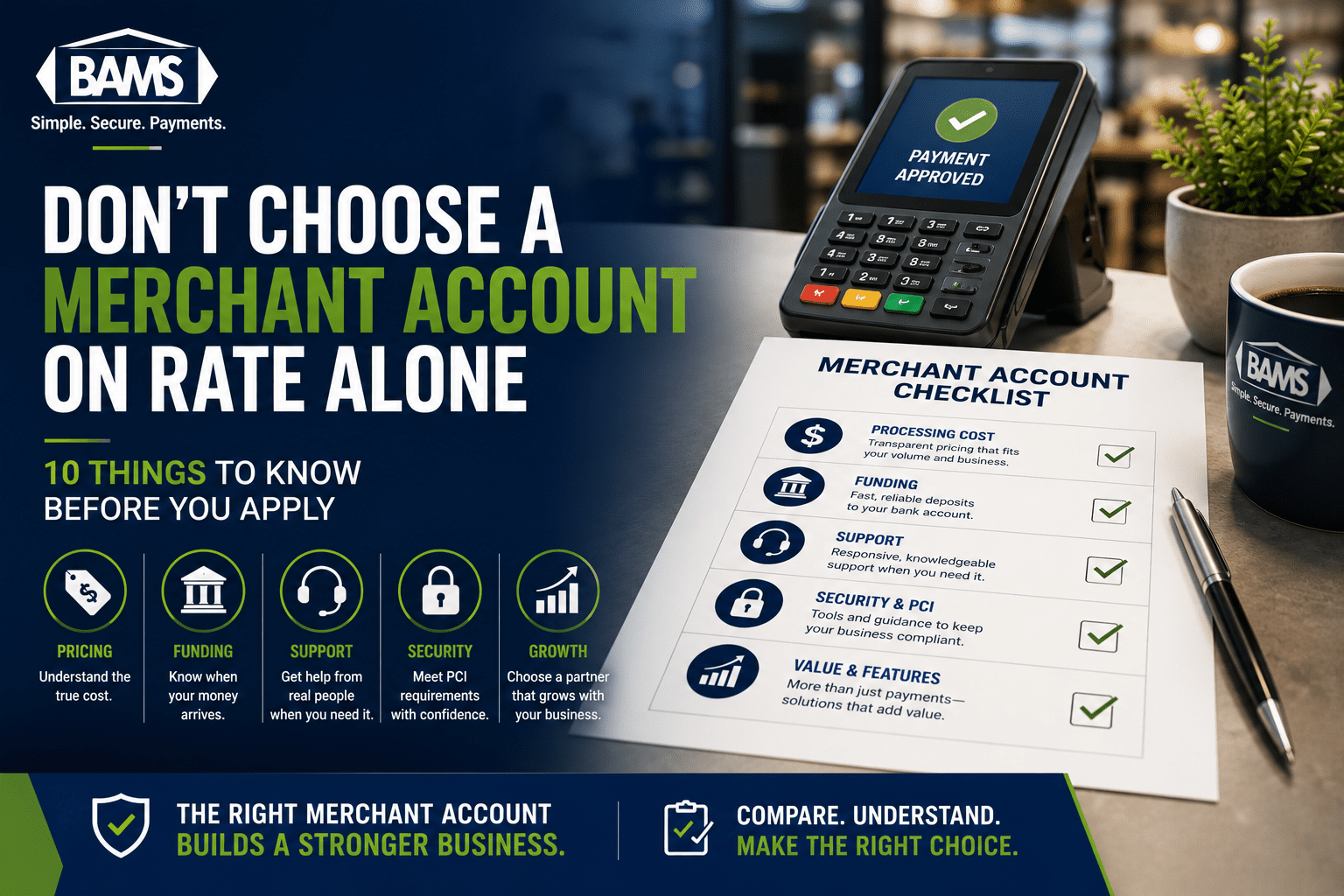
10 Things to Know When Opening a New Merchant Account
Last Updated on October 13, 2026 by Dimitri Akhrin
Choosing a Merchant Account Is About More Than the Processing Rate
A merchant account is a mission-critical piece of the payments puzzle for many full-time business owners doing significant card volume. But for new and experienced merchants alike, getting set up with a new account can seem opaque.
Independent sales organizations, commonly called ISOs, work with payment processors and acquiring partners to help businesses access merchant services. Some businesses work through an ISO while others apply more directly through a merchant-services provider.
Either way, the goal should be the same: understand what you are signing up for before the first transaction runs.
Pricing matters, but it is only one part of the decision. Underwriting, funding speed, payment technology, support, security and the services included with the account can all affect how well the relationship works once your business is processing every day.
Here are ten things to keep in mind when shopping for a merchant account in 2026.
TL;DR
- Do not choose a merchant account based on the advertised processing rate alone – Compare the complete cost of the account, including processor markup, transaction fees, gateway charges, PCI-related costs, chargeback fees and any funding fees.
- Underwriting is a normal part of opening a traditional merchant account – Providers may review your business type, expected volume, average transaction size, processing history and fulfillment model. Providing complete and consistent documentation can help keep the approval process moving.
- Support, technology and integrations matter after the account goes live – Confirm who handles funding questions, gateway or terminal issues, chargebacks and statements, and make sure the provider works with the POS, gateway and software your business already depends on.
- Funding terms can affect cash flow just as much as pricing – Ask about standard settlement timing, daily batch cutoffs and faster funding options before switching. BAMS currently offers qualifying merchants next-day funding with eligible batches submitted before 9 PM ET reaching the bank by 7 AM the following business day.
- Security and long-term fit should be part of the decision from the beginning – Merchants still have PCI DSS responsibilities even when payment processing is outsourced, and the right provider should be able to support your pricing, reporting, chargeback management and payment needs as the business grows.
1) Not All Merchant Accounts Charge the Same Fees

Traditional merchant accounts and payment service providers offer different approaches to setup, pricing and payment management.
It’s easy to assume that payment processing is fungible and processors act like your local gas stations, all charging more or less the same fees to stay competitive with each other. But that couldn’t be further from the truth. The fee structures attached to various merchant accounts can vary significantly.
Payment service providers such as PayPal and Square can make getting started relatively simple because payments, account setup and other tools are bundled into one platform. That convenience can be useful, particularly for businesses that are just beginning to accept cards.
A traditional merchant account takes a different approach. Pricing may be structured around the merchant’s transaction volume, risk profile and payment environment rather than one standardized rate.
Visa’s current small-business guidance notes that payment service providers can simplify setup, while traditional merchant accounts can provide greater control and may offer lower effective transaction costs as payment volume grows.
Merchant accounts also use different pricing models. Some use tiered pricing, which groups transactions into pricing categories. Others use interchange-plus pricing, which separates the underlying interchange cost from the processor’s markup.
BAMS currently offers interchange-plus and volume-based merchant account pricing for businesses that want clearer visibility into processing costs.
Compare the Effective Cost, Not One Advertised Number
A quoted transaction percentage does not necessarily tell you what processing will cost over the course of a month.
Look at:
- Processor markup
- Transaction fees
- Monthly account costs
- Gateway charges
- PCI-related fees
- Chargeback fees
- Funding fees, if applicable
Then compare the complete cost against the services included.
2) Every Business Represents a Potential Risk
A bad or fraudulent merchant impacts everyone involved in the payment chain, from the customer to the processor, acquiring bank and card networks.
Whenever a payment provider approves a merchant account, it takes on financial risk. That is why traditional merchant accounts normally go through underwriting before approval.
The underwriter may evaluate factors such as the type of business, expected transaction volume, average ticket size, processing history, creditworthiness and how the business delivers its products or services.
A new eCommerce merchant shipping expensive products internationally may present a different risk profile from an established neighborhood retailer accepting mostly card-present transactions.
That does not mean one cannot qualify. It means the processor needs enough information to understand the account it is approving.
3) The Underwriting Process Doesn’t Have to Be Slow
The downside of processors doing due diligence is that merchant-account approval can take longer than signing up for some payment-service-provider accounts.
But underwriting does not necessarily mean waiting weeks.
Visa currently notes that merchant-account approval can be immediate or take one to five business days or longer depending on the business, industry, credit history and responsiveness of the applicant.
The merchant has some control over that last factor.
Submit a complete application. Provide the requested documentation. Make sure information is consistent across the application, website, bank records and other supporting materials.
Nothing slows underwriting faster than having the processor repeatedly ask for information that could have been provided at the beginning.
Prepare Before You Apply
The exact documentation varies by provider and business, but merchants may be asked for information about:
- The business and its ownership
- Banking information
- Expected processing volume
- Average transaction size
- Products or services sold
- Processing history
- Refund and fulfillment practices
Established merchants may also be asked for recent processing statements.
4) Merchant Accounts Come With Underwriting Standards
The original version of this article described merchant accounts as requiring a “real” legally registered business and business bank account at an absolute minimum.
The better way to put it is that the provider needs to verify who the merchant is, what business is being conducted and where settlement funds should go.
Visa’s current guidance says merchant-account underwriting can consider the merchant’s industry, processing history, personal credit and business creditworthiness.
Sole proprietors can also qualify for merchant services, so incorporation as an LLC or corporation is not universally required.
The requirements depend on the provider, business structure and payment environment.
Be prepared to show that the business is legitimate and that the information supplied during the application accurately reflects how you plan to process transactions.
5) Dedicated Support Is a Big Deal
Once you’re officially looking for a new payment processing partner, there are factors to consider beyond price, and support is an important one.
Payments sit directly in the revenue path. When something goes wrong, a generic answer several days later may not be particularly useful.
Before signing up, find out how support actually works.
Ask:
- Is phone support available?
- Will I have a dedicated account contact?
- Who handles terminal or gateway problems?
- Who helps with funding questions?
- What happens if I receive a chargeback?
- Can someone help explain my monthly statement?
Problems inevitably arise in business. When the issue involves the system responsible for accepting customer payments, knowing exactly who to contact matters.
6) Your Payment Processor May Offer Payment Gateways Too
A merchant account enables the business to receive the proceeds from card transactions, but an online business will usually need payment technology that securely connects checkout with processing.
That is where the payment gateway comes in.
Visa describes a payment gateway as the front-end technology used by websites and applications to collect and protect payment information before passing it into the processing environment.
Merchants can sometimes source a gateway separately. In other cases, the merchant-services provider can offer or integrate the gateway as part of the payment setup.
BAMS currently supports gateway environments including NMI, Authorize.Net, PayTrace, USAePay and other compatible solutions.
Using one provider for both merchant services and gateway support can simplify billing and troubleshooting, but convenience should not be the only consideration.
Confirm that the gateway supports your shopping cart, payment methods, recurring billing requirements and any other technology the business depends on.
7) Not All Processors Offer Next-Day Funding
When a business accepts a card payment, approval at the terminal does not mean the money is immediately sitting in the merchant’s bank account.
The transactions still need to move through batching and settlement.
Funding schedules vary by processor, bank, account type, batch time and merchant eligibility.
Some processors offer faster funding options.
BAMS currently offers qualifying merchants next-day funding. Eligible deposits submitted before the 9 PM ET cutoff can reach the merchant’s bank account by 7 AM the following business day, making funds available in as little as ten hours.
That can make a meaningful difference for businesses with tight operating cycles.
Ask About Funding Before You Switch
Do not wait until after approval to find out when your money will arrive.
Ask:
- What is the standard funding schedule?
- What is the daily batch cutoff?
- Is next-day or same-day funding available?
- Are faster deposits subject to eligibility requirements?
- Are additional fees charged for faster funding?
- How are weekends and bank holidays handled?
A slightly lower processing rate may not feel like much of a bargain if the funding schedule creates cash-flow pressure.
8) Value-Added Features Matter
Many payment processors offer features that go beyond basic transaction authorization.
Those services can include fraud tools, chargeback defense, reporting, loyalty programs, faster funding and other payment-management tools.
BAMS currently provides Dispute Assistant Manager for chargebacks along with merchant reporting, payment analytics, gift and loyalty programs and other payment solutions.
Do not choose a processor simply because its feature list is longer.
Look for features that solve actual business problems.
A merchant processing thousands of eCommerce orders may care heavily about chargeback management and fraud controls. A multi-location restaurant group may place more value on centralized reporting and funding visibility.
The right value-added tools depend on how the business operates.
9) You Will Be Required to Take Payment Security Seriously
The payment processing industry takes payment security seriously, and merchants accepting payment cards have responsibilities under the Payment Card Industry Data Security Standard, or PCI DSS.
The original article described PCI DSS as 12 requirements that every merchant must meet in exactly the same way. PCI DSS does contain 12 principal requirements, but the requirements and validation method that apply to a particular merchant depend on the payment environment and compliance program.
A small business that fully outsources payment collection may have a different PCI scope from a merchant whose own systems store or process cardholder data.
Outsourcing payments does not eliminate responsibility either.
The PCI Security Standards Council states that merchants using third-party providers remain responsible for confirming provider compliance, understanding shared responsibilities and completing the applicable merchant validation.
BAMS provides PCI compliance support to help merchants work through the requirements that apply to their account.
PCI Compliance Is Ongoing
Compliance is not something to complete once and forget.
Technology changes. Websites change. Employees gain or lose access. Plugins and payment integrations get updated.
Merchants should understand which systems affect their payment environment and keep the required controls current.
10) Getting a New Merchant Account Doesn’t Have to Be Difficult
The biggest reason established merchants stay in unhappy processor relationships and some new businesses avoid traditional merchant accounts altogether is the assumption that changing providers will be difficult.
There is paperwork and underwriting involved, but the process does not need to become a major operational project.
A strong provider should explain what information it needs, identify compatible payment equipment or integrations, clarify pricing and help manage the transition.
If you are already processing payments, the transition should start with understanding the system you have today.
Before switching, document:
- Your current monthly processing volume
- Transaction channels
- Existing POS or gateway
- Current pricing structure
- Funding schedule
- Recurring billing requirements
- Important software integrations
That makes it much easier to compare one merchant-services setup with another without accidentally losing something the business relies on.
What to Compare Before Choosing a Merchant Account
A merchant account should be evaluated on more than its advertised processing rate. Pricing, funding, support, technology and security all affect the long-term fit.
| Area | What to Ask |
|---|---|
| Pricing | What will my total effective processing cost be? |
| Underwriting | What documents and information will you need? |
| Support | Who do I contact when something goes wrong? |
| Gateway | Will it work with my existing website and checkout? |
| POS compatibility | Can I continue using my existing equipment or software? |
| Funding | When will processed revenue reach my bank? |
| Chargebacks | What alerts and dispute-management tools are included? |
| Reporting | Can I easily review transactions, deposits and statements? |
| PCI compliance | What validation and security responsibilities apply to my setup? |
Frequently Asked Questions
What is a merchant account?
A merchant account is part of the payment infrastructure businesses use to accept card payments and receive settlement proceeds. The exact account structure depends on the provider and payment model.
What is the difference between a merchant account and a payment service provider?
A traditional merchant account is generally underwritten for a specific business. Payment service providers can bundle payment acceptance, gateway services, fraud tools and other functions into a simpler platform. Each model has different advantages depending on the merchant’s size and needs.
Is a merchant account always cheaper than PayPal or Square?
No. Cost depends on transaction volume, card mix, account pricing and additional services. Traditional merchant accounts may become more economical as payment volume increases, but businesses should compare the complete effective cost rather than assume one model is always cheaper.
How long does merchant-account approval take?
It varies. Visa states that merchant-account approval can be immediate or take one to five business days or longer depending on the industry, credit history, application and other underwriting factors.
Does every merchant account require underwriting?
Traditional merchant accounts generally involve underwriting because the provider and acquiring side need to evaluate the business and transaction risk before approval.
Does a sole proprietor qualify for a merchant account?
Sole proprietors can qualify for merchant services. The exact documentation and banking requirements depend on the provider and business structure.
What is interchange-plus pricing?
Interchange-plus pricing separates underlying interchange costs from the processor’s markup. This can make it easier for merchants to see how their processing price is constructed.
What is next-day funding?
Next-day funding allows qualifying transactions to reach the merchant’s bank account on the following business day instead of following a longer standard settlement schedule.
Do merchants need PCI compliance?
Businesses accepting payment cards have PCI DSS responsibilities. The exact requirements and validation method depend on how the merchant stores, processes or transmits payment data and which third-party providers are involved.
What should I compare before switching processors?
Compare total processing cost, funding speed, support, payment gateway and POS compatibility, reporting, chargeback tools, PCI support and any integrations your business currently relies on.
Getting the Right Merchant Account
BAMS is focused on making merchant-account pricing, application and ongoing payment management easier to understand.
Its current merchant-services offering includes interchange-plus and volume-based pricing, next-day funding for qualifying merchants, chargeback management, reporting and analytics, PCI compliance support and other payment tools.
Established merchants can also compare their current processing structure line by line instead of evaluating a new provider based on one advertised rate.
If you’re ready to see how a BAMS merchant account compares with your existing setup, request your comprehensive five-point price comparison today.


