
Rolling Reserves: A Guide to Forecasting and Reducing Held Funds
Last Updated on October 6, 2026 by Dimitri Akhrin
Turn payout holds from a cash flow surprise into a plannable variable you can negotiate down over time
Learn how rolling reserves work, why processors impose them, and how to forecast held funds into your cash flow cycle. This guide gives eCommerce managers a concrete framework for negotiating lower reserve rates as their processing history matures.
TL;DR
- Rolling reserves can significantly affect working capital — A processor may withhold a portion of your sales as a reserve against future exposure. The percentage and release terms depend on your merchant agreement, so they need to be built into your cash flow forecast..
- Your fraud and dispute performance is a major lever — A sustained record of stable or declining risk metrics gives you stronger evidence when requesting lower reserve terms.
- Processors don’t reduce reserves automatically — You need to initiate the review, present your performance data, and make specific requests for percentage or duration reductions in writing.
- Communicate volume changes before they happen — A quick heads-up to your processor before a big sale or product launch can prevent automated reserve increases and payout holds.
- Forecast reserves like any other cash flow variable — Build a simple tracker that models funds held and funds released each month so reserves never catch you off guard during critical spending periods.
Guide Orientation: What This Covers and Who It’s For
This guide explains how rolling reserves work, why processors impose them, and how growing eCommerce businesses can systematically reduce reserve requirements over time. If you’ve been surprised by payout holds that tie up working capital at the worst possible moment, this is for you.
The intended reader is an eCommerce manager at an established online business (roughly 10 to 50 employees) who has moved past startup mode but still encounters delayed deposits, unexpected reserve percentages, or a reserve release schedule that feels opaque. By the end, you’ll understand the mechanics behind held funds, know how to forecast reserves into your cash flow cycle, and have a concrete framework for negotiating lower reserve rates as your processing history matures.
This guide does not cover high-risk industry classification (gambling, adult, crypto) or processor selection from scratch. It assumes you already have a merchant account and want to improve the terms you’re operating under.
Why Reducing Rolling Reserves Matters for Growing Merchants
Most eCommerce owners discover rolling reserves at the worst possible moment. You’ve just had your best sales month, you’re ready to reinvest in inventory or advertising, and then you notice your deposit is short. A percentage of every transaction has been held back, and the processor’s support team offers little clarity on when you’ll see it.
This isn’t a niche problem. OCC guidance recognizes merchant reserve and holdback accounts as tools acquirers use to manage exposure from chargebacks and other merchant risks. Depending on your merchant agreement, even a modest reserve can tie up significant working capital as processing volume grows.
The cost of inaction is compounding. As your sales volume grows, so does the absolute dollar amount trapped in reserves. Merchants who never model held funds into their working capital cycle end up borrowing against revenue they’ve already earned, paying interest on money that’s technically theirs. Meanwhile, merchants who treat reserves as a forecastable variable (rather than a fixed penalty) build processor relationships that unlock lower percentages, shorter hold periods, and faster access to cash.
The difference between these two outcomes isn’t luck. It’s planning.

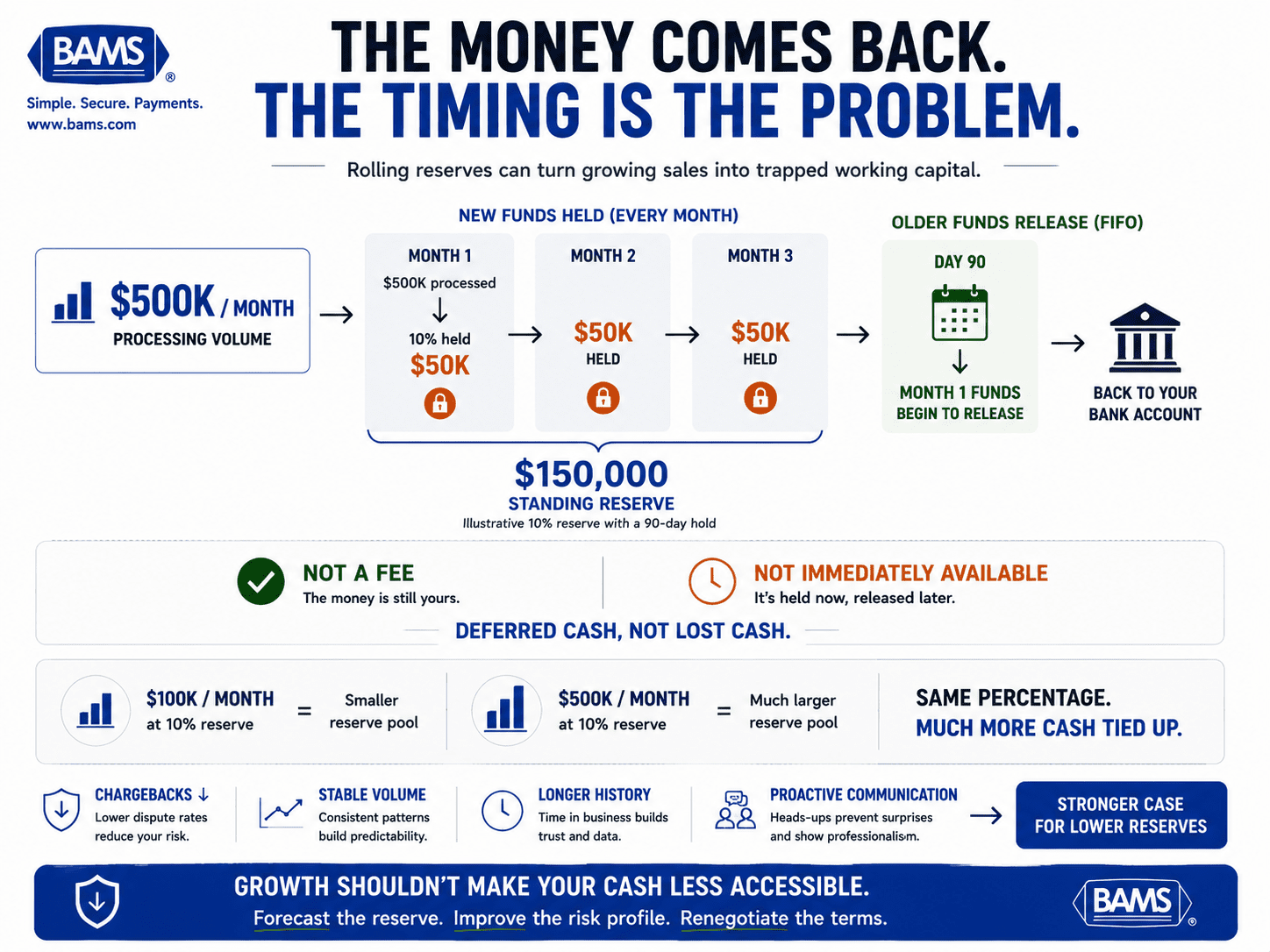
Rolling reserves are not lost revenue. The challenge is timing: new funds are withheld every day while older funds release later, creating a standing balance that grows with your sales volume.
Core Concepts: How Rolling Reserves Actually Work
What a Rolling Reserve Is (and Isn’t)
A rolling reserve is a percentage of your gross sales that your payment processor withholds as a financial buffer against chargebacks, refunds, and fraud losses. It is not a fee. The money is returned to you after the hold period expires. Think of it as a security deposit on your processing relationship.
The exact way reserved funds accumulate and release depends on the structure defined in your merchant agreement. Some arrangements withhold a portion of ongoing proceeds while others maintain a specified reserve balance. Review the percentage, release schedule and conditions in your agreement rather than assuming every processor uses the same reserve mechanics.
Reserves vs. Payout Holds vs. Account Freezes
These three terms get confused constantly, and the confusion costs merchants money because each requires a different response. A rolling reserve is a percentage-based hold applied systematically to every transaction. Payout holds are temporary delays on specific batches, often triggered by unusual activity. Account freezes stop all payouts entirely, usually due to compliance concerns or sudden risk spikes.
Understanding which one you’re dealing with determines whether you need to negotiate terms, provide documentation, or escalate urgently. If your processor has frozen your account entirely, the playbook is different from reducing a steady-state reserve percentage.
Why Processors Set Reserves in the First Place
Processors aren’t being punitive. They’re managing financial exposure. When a customer disputes a charge 60 days after purchase, the processor (not you) fronts the refund to the card network. If your business can’t cover that liability, the processor absorbs the loss. Reserves exist so processors don’t have to make that bet on faith alone.
The factors that drive reserve levels include your chargeback ratio, average transaction size, delivery timelines, industry category, and processing history length. Each of these is a variable you can influence, which is exactly what this guide teaches you to do.
The Reserve Reduction Framework: Four Phases
Reducing reserve requirements isn’t a single conversation with your processor. It’s a sustained effort across four phases that build on each other:
- Phase 1: Baseline — Understand your current reserve terms and map them to your cash flow cycle.
- Phase 2: Risk Signal Improvement — Systematically lower the metrics your processor uses to justify higher reserves.
- Phase 3: Documentation and Negotiation — Present your improved profile and request specific term changes.
- Phase 4: Ongoing Maintenance — Monitor, report, and prevent the backsliding that triggers reserve increases.
Each phase has clear success indicators. You don’t need to complete all four before seeing results. Even Phase 1 alone often reveals reserve terms that are outdated or misaligned with your current risk profile.
Step-by-Step: How to Reduce Your Rolling Reserves
Step 1: Audit Your Current Reserve Terms
Objective: Know exactly what percentage is being held, for how long, and under what conditions the terms can change.
Start by pulling your merchant agreement and finding the reserve clause. Look for three numbers: the reserve percentage (commonly 5% to 10% of each sale), the hold duration (typically 90 to 180 days), and any threshold triggers that could increase either number. Many merchants operate for months without knowing their exact terms because the reserve was set at onboarding and never revisited.
Next, calculate the actual dollar impact. Multiply your average monthly processing volume by the reserve percentage, then multiply by the number of hold-period months. This is your standing reserve balance, the cash perpetually unavailable to your business. For a merchant processing $300,000 monthly with a 10% reserve held for 90 days, that’s $90,000 locked up at any given time.
Cross-reference this with your cash flow forecast. Map when reserves are withheld against when major expenses hit (inventory purchases, payroll, ad spend). If your reserve release schedule doesn’t align with your cash needs, you’ve identified the first negotiation target.
Anti-patterns: Don’t assume your current terms are permanent. Don’t ignore the reserve clause because the percentage “seems small.” Five percent of a growing revenue base becomes significant fast.
Success indicators: You can state your reserve percentage, hold duration, and standing balance from memory. You’ve mapped reserve timing against your cash flow calendar.
Step 2: Lower Your Chargeback Ratio
Objective: Build a sustained record of stable or declining fraud and dispute activity so your performance data supports a request for lower reserve terms.
Fraud and dispute activity are important risk signals for processors and acquirers. Visa’s current Visa Acquirer Monitoring Program evaluates fraud and disputes together and monitors performance at both the merchant and acquirer levels. For reserve negotiations, the stronger case is a sustained record of improving risk performance rather than a single universal chargeback percentage.
Start with the basics: clear product descriptions, accurate delivery estimates, and responsive customer service. Most chargebacks in eCommerce stem from “item not as described” or “transaction not recognized” disputes, both of which are preventable. Add order confirmation emails that include your business name as it appears on card statements. This alone reduces “friendly fraud” disputes where customers don’t recognize the charge.
Invest in proactive chargeback defense tools: alerts that notify you of disputes before they become formal chargebacks, and rapid-response refund workflows that resolve issues at the inquiry stage. Every chargeback you prevent improves your ratio and strengthens your case for reserve reduction.
Anti-patterns: Don’t fight every chargeback on principle. Some disputes are cheaper to refund than to contest, and losing disputes still counts against your ratio. Don’t ignore “friendly fraud” as a cost of doing business.
Success indicators: Your chargeback ratio has trended downward for three consecutive months. You have documentation showing the specific steps you’ve taken to reduce disputes.
Step 3: Stabilize Your Transaction Patterns
Objective: Eliminate the volume spikes, average-ticket jumps, and geographic anomalies that trigger automated risk flags at your processor.
Processors use dynamic risk scoring to monitor merchant accounts continuously. A sudden 300% increase in monthly volume, a jump in average transaction size, or a surge in international orders can all trigger reserve increases or payout holds, even if the activity is entirely legitimate.
The fix is proactive communication. Before a major sale, product launch, or seasonal spike, notify your processor in writing. Provide the expected volume increase, the duration, and the reason. This converts a “risk anomaly” into a “planned event” in their system. Most processors have a formal process for this, but they won’t tell you about it unless you ask.
Review your merchant account configuration to ensure your declared volume limits, average ticket size, and transaction types match your actual sales patterns. Misalignment between declared and actual activity is one of the most common triggers for reserve increases. If you declared $100,000 monthly volume at onboarding but now process $400,000, your account settings are working against you.
Anti-patterns: Don’t assume your processor will notice growth positively. Automated systems flag deviations from baseline, regardless of direction. Don’t wait for a hold to happen before communicating volume changes.
Success indicators: Your monthly processing volume stays within 20% of your declared limits (or you’ve updated those limits). You have a documented communication trail with your processor about planned volume changes.
Step 4: Build a Processor Track Record
Objective: Accumulate 6 to 12 months of clean processing history that demonstrates low risk and justifies reduced reserve terms.
Reserve terms set at onboarding reflect your processor’s best guess about your risk profile, usually based on limited data. After six months of processing, you have actual performance data that should replace those initial assumptions. The problem is that most processors won’t revisit your terms automatically. You need to trigger the review.
Compile a simple performance summary: monthly volume trends, chargeback ratios, refund rates, and average transaction values. Present this as a one-page document (or email) to your account manager. Frame it as a business review, not a complaint. The tone matters: you’re demonstrating that your account has matured, not arguing that the original terms were unfair.
If your processor doesn’t assign a dedicated account manager, this step is harder but not impossible. Use whatever support channel exists to request a formal account review. Reference your processing history and ask specifically whether your reserve percentage or hold duration can be adjusted based on performance.
Partners like BAMS assign dedicated account managers who conduct these reviews proactively, which removes the burden of initiating the conversation yourself. This kind of human-first support makes a material difference when you’re trying to move from default terms to performance-based terms.
Anti-patterns: Don’t expect automatic improvement. Processors have no incentive to lower reserves unless you ask. Don’t wait for a “perfect” track record; six months of good-enough data is better than twelve months of silence.
Success indicators: You’ve submitted a formal review request with supporting data. Your processor has acknowledged the request and provided a timeline for response.
Step 5: Negotiate Specific Term Changes
Objective: Secure a concrete reduction in reserve percentage, hold duration, or both, documented in an amended agreement.
Armed with your performance data, you’re ready to negotiate. But “lower my reserve” is too vague. Make specific asks based on your audit from Step 1:
- If your reserve percentage has remained unchanged despite several months of improving fraud and dispute performance, request a specific reduction and support it with your processing history.
- If your hold duration no longer reflects your current risk profile, request a shorter release schedule and document the performance improvements that support the change.
- If your volume has grown significantly, request that the reserve percentage decrease as volume increases (a tiered structure).
Get any changes in writing. A verbal agreement from a support agent has no enforcement value. Request an addendum to your merchant agreement or at minimum a written confirmation from your account manager specifying the new terms and their effective date.
If your current processor won’t negotiate, this is valuable information. It tells you that your account is being managed by default settings rather than relationship, and it may be time to explore processors that offer performance-based reserve structures. Ensure you’ve reviewed a thorough merchant services checklist before making any switch.
Anti-patterns: Don’t threaten to leave as a negotiation tactic unless you’re genuinely prepared to switch. Don’t accept vague promises like “we’ll review it in a few months.” Get dates and numbers.
Success indicators: You have a written confirmation of reduced reserve terms. The new terms are reflected in your next statement or payout cycle.
Step 6: Forecast Reserves Into Your Working Capital Cycle
Rolling reserve cash flow tracker showing monthly funds held, reserve releases and net working capital impact for an eCommerce merchant.
Objective: Treat reserves as a predictable line item in your cash flow model, not a surprise deduction.
Even after negotiating better terms, reserves don’t disappear. They become smaller and shorter, but they’re still a feature of your processing relationship. The merchants who handle this best are the ones who forecast reserves the same way they forecast inventory costs or payroll.
Build a simple reserve tracker. For each month, calculate: (monthly volume × reserve percentage) = new funds held. Then calculate the funds scheduled for release under your merchant agreement. The difference between these amounts shows the net cash flow impact of reserves for the period. NetSuite Cash 360 similarly incorporates planned expenditures, receivables, payables and other expected cash movements when forecasting near-term liquidity. During growth periods, increasing reserve balances can therefore be modeled alongside the rest of your expected cash inflows and outflows.
This forecast becomes especially important during seasonal peaks. If you process $800,000 in November but $200,000 in February, your reserve releases in February (from November’s holds) will be much larger than the new holds. Understanding this timing lets you plan inventory purchases, negotiate supplier terms, and avoid unnecessary borrowing.
Anti-patterns: Don’t treat reserves as “lost” money. They come back. Don’t ignore the timing mismatch between when reserves are held and when they release, especially during growth phases.
Success indicators: You have a rolling 6-month reserve forecast integrated into your cash flow model. You can predict your standing reserve balance within 10% accuracy.
Practical Examples: Reserve Reduction in Action
Scenario A: The Post-Launch Squeeze
An eCommerce brand processing $150,000/month launches a new product line and volume jumps to $450,000 in a single month. The processor’s automated system flags the spike and increases the reserve from 5% to 10%, while also extending the hold period from 90 to 180 days. The merchant now has $90,000 held per month instead of $7,500, and the release timeline has doubled.
The fix: the merchant should have notified the processor before the launch, providing sales projections and marketing plans. After the fact, the merchant compiles 60 days of post-launch data showing that the chargeback ratio remained below 0.4% despite the volume increase, then requests a formal review. The processor agrees to return the reserve to 5% but keeps the 180-day hold for 90 more days as a precaution. Net result: the merchant recovers $45,000/month in cash flow within 60 days instead of waiting indefinitely.
Scenario B: The Gradual Grower
A mid-size retailer processes $250,000/month with a 10% reserve held for 180 days (standing balance: $150,000). Over 12 months, they reduce their chargeback ratio from 0.8% to 0.25%, update their declared volume to match actual processing, and submit quarterly performance summaries to their account manager. At the 12-month review, the processor reduces the reserve to 5% and the hold period to 90 days. The standing balance drops from $150,000 to $37,500, freeing $112,500 in working capital.
This didn’t happen because the merchant complained. It happened because the merchant systematically reduced every risk signal the processor was measuring and then asked for a specific outcome backed by data.
Common Mistakes and Pitfalls
- Ignoring reserve terms at onboarding. The time to negotiate is before you sign, not after your first short deposit. Read the reserve clause, ask questions, and understand the conditions that trigger increases.
- Treating reserves as a fee. Reserves are returned. Confusing them with fees leads to misguided anger at your processor instead of strategic action to reduce them.
- Failing to communicate volume changes. Processors penalize surprises. A five-minute email before a big sale can prevent weeks of payout holds.
- Waiting for the processor to initiate a review. They won’t. Reserve reductions are merchant-initiated in almost every case.
- Neglecting chargeback management. Your chargeback ratio is the lever with the most influence on reserve terms. Ignoring it makes every other effort less effective.
These mistakes aren’t moral failures. They’re the natural result of processors not explaining reserve mechanics clearly. Now that you understand the system, you can work within it.
What to Do Next
Start with Step 1. Pull your merchant agreement today and find your reserve percentage, hold duration, and any escalation triggers. Calculate your standing reserve balance. This single action takes 30 minutes and gives you the baseline for everything else in this guide.
If you discover that your terms haven’t been reviewed since onboarding, that’s your signal to begin building the performance case outlined in Steps 2 through 5. You don’t need to do everything at once. Even reducing your chargeback ratio by a few tenths of a percent over the next quarter strengthens your position for a formal review request.
Treat this guide as a reference, not a checklist. Revisit it before seasonal peaks, after major volume changes, or whenever your processor adjusts your terms. Reserve management isn’t a one-time project. It’s an ongoing practice that compounds in your favor the longer you maintain it.
Frequently Asked Questions
What is reserve and hold management in merchant services?
Reserve and hold management refers to the practice of monitoring, forecasting, and negotiating the funds your payment processor withholds from your payouts. This includes rolling reserves (a percentage of every transaction held for a set period), payout holds (temporary delays on specific batches), and understanding the conditions that trigger changes to either. Effective management means treating these holds as a predictable variable in your cash flow model rather than an unpredictable penalty.
Why do payment processors withhold reserves from merchants?
Processors withhold reserves to protect themselves against financial losses from chargebacks, refunds, and fraud. When a customer disputes a charge, the processor fronts the refund to the card network immediately. If your business can’t cover that liability, the processor absorbs the loss. Reserves act as a financial buffer, ensuring the processor has funds available to cover these potential losses. The reserve amount reflects the processor’s assessment of your risk profile based on factors like chargeback history, transaction size, and industry category.
How do rolling reserves work in payment processing?
A rolling reserve withholds a set percentage of each transaction (commonly 5% to 10%) and holds it for a defined period (typically 90 to 180 days). Funds release on a FIFO (first in, first out) basis, meaning each day’s held funds have their own countdown timer. After the initial ramp-up period, reserves flow in and out continuously. For example, with a 10% reserve and 90-day hold, the funds withheld from today’s sales will release 90 days from now, while today you’ll also receive the release of funds held 90 days ago.
When can a merchant expect to have their reserves released?
Reserve release timing depends on your specific merchant agreement. Most rolling reserves release between 30 and 180 days after each transaction. There’s no single release date because each day’s held amount has its own release date. Some processors also impose minimum balance reserves that aren’t released until the account is closed or terms are renegotiated. Check your merchant agreement for the exact hold duration and any conditions that could extend it.
Which factors influence the percentage of reserves withheld by payment processors?
The primary factors can include fraud and dispute activity, average transaction size, monthly processing volume relative to your declared limits, delivery timelines, industry category, processing history and refund patterns. The weight assigned to each factor depends on the processor’s own underwriting and risk policies, so merchants should ask which metrics specifically affect their reserve terms.
How can merchants reduce their reserve requirements over time?
Build a sustained record of stable fraud and dispute performance, keep your transaction profile aligned with declared account expectations, communicate planned volume changes to your processor in advance and document your processing history. Then request a formal account review with specific proposed changes to the reserve percentage, structure or release schedule.


