How to Build a Payment Alerts Service for Your Team
Last Updated on September 23, 2026 by Dimitri Akhrin
Catch false declines in near real-time and protect revenue without a dedicated finance department
Learn how false declines silently drain eCommerce revenue and how to build a practical payment alerts service workflow that catches them fast. This step-by-step guide helps lean teams improve cash flow management with the right merchant services partner.
TL;DR
- False declines can outweigh actual fraud – PwC reports that false declines are typically 5 to 10 times more common than actual fraud, while Visa estimates that 30% to 65% of rejected online orders are legitimate.
- You don’t need enterprise tools to fix this – A payment alerts service from your merchant services partner, a named team member reviewing alerts within four hours, and a simple outreach template can recover meaningful revenue without a dedicated finance team.
- Faster deposits compound into growth – Next-day funding puts tens of thousands of dollars back into your available cash flow. Combined with lower chargeback ratios (which unlock better funding terms), faster deposits let you reinvest in inventory, marketing, and supplier discounts sooner.
- Speed of response matters – PwC reports that 40% of shoppers abandon a purchase after rejection, while Visa reports that 33% of customers will not return to a merchant after a false decline.
- Start with a 90-day decline audit this week – Pull your decline data, calculate your baseline rate, identify your top five decline reason codes, and set up one alert for returning customer declines. That single action reveals revenue you didn’t know you were losing.
Guide Orientation: What This Covers and Who It’s For
This guide shows eCommerce managers at growing online businesses (10 to 50 employees) how to turn faster deposits and proactive decline monitoring into a measurable growth lever. If you run operations without a dedicated finance team, this is built for you.
By the end, you’ll understand how false declines quietly drain your revenue, how to build a practical payment alerts service workflow that catches them in near real-time, and how faster deposit cycles compound into better cash flow management. You’ll walk away with a step-by-step system you can implement this week.
This guide does not cover enterprise-grade fraud orchestration platforms, machine learning model tuning, or PCI compliance audits. It focuses on what a lean team can actually execute with the right merchant services partner and a handful of operational habits.
Why Faster Deposits and Decline Visibility Matter Now
False declines are not a niche problem. Visa estimates that 30% to 65% of rejected online orders are actually legitimate transactions. For a growing eCommerce brand processing thousands of transactions monthly, incorrectly blocked orders can translate into meaningful revenue losses that never appear as a traditional expense.
The damage goes beyond the immediate sale. Visa also reports that 33% of customers say they will not return to a merchant after experiencing a false decline. That’s not a temporary inconvenience. It’s customer attrition that can erode lifetime value while your acquisition costs stay fixed.
Meanwhile, deposit timing shapes every downstream decision you make. When funds land in your account two or three days late, you delay supplier payments, miss early-payment discounts, and carry unnecessary short-term debt. The cost of inaction is not dramatic. It’s incremental, persistent, and invisible until you measure it.
The businesses pulling ahead right now are the ones treating payment speed and decline visibility as operational infrastructure, not back-office afterthoughts. If you’re still reviewing declines in a weekly spreadsheet or waiting 48 hours for deposits, you’re leaving growth on the table that competitors with better cash flow management are already capturing.
Core Concepts: False Declines, Deposit Velocity, and the Visibility Gap
False Declines vs. Fraud Blocks
A false decline occurs when a legitimate customer’s transaction is rejected by your payment processor’s fraud filters, your bank, or the issuing bank. The customer intended to buy. Their card was valid. But something in the risk scoring (mismatched billing address, unusual purchase amount, new device) triggered an automatic block.
This is fundamentally different from a successful fraud block, where a stolen card or suspicious pattern is correctly identified and stopped. The problem is that false declines are typically 5 to 10 times higher than actual fraud. Most fraud filters are calibrated to protect processors, not to protect your revenue.
Deposit Velocity
Deposit velocity is the time between a customer completing a transaction and those funds becoming available in your bank account. The exact funding schedule depends on your processor and merchant agreement. Nacha notes that ACH payments can be processed within hours on the same banking day or scheduled for the following banking day, while weekends and federal holidays can affect settlement availability.
The Visibility Gap
The visibility gap is the space between when a decline happens and when you find out about it. Enterprise merchants close this gap with dedicated fraud analysts and automated orchestration layers. For a 10 to 50 person operation, that gap often stretches to days or weeks, if the decline is noticed at all. Closing it doesn’t require enterprise tools. It requires the right alerts, the right partner, and a simple response workflow.
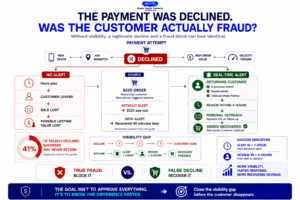
False decline infographic showing how real-time payment alerts can identify legitimate declined customers and recover eCommerce revenue before they leave.
A Key Misconception
Many eCommerce managers assume their payment processor handles decline recovery automatically. It doesn’t. Processors optimize for risk mitigation, not revenue recovery. The responsibility for identifying and recovering false declines sits with you, or with a merchant services partner who proactively surfaces them.
The Framework: Monitor, Respond, Accelerate
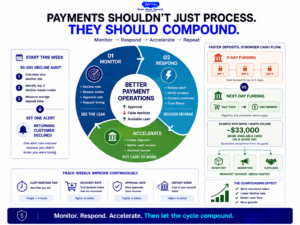
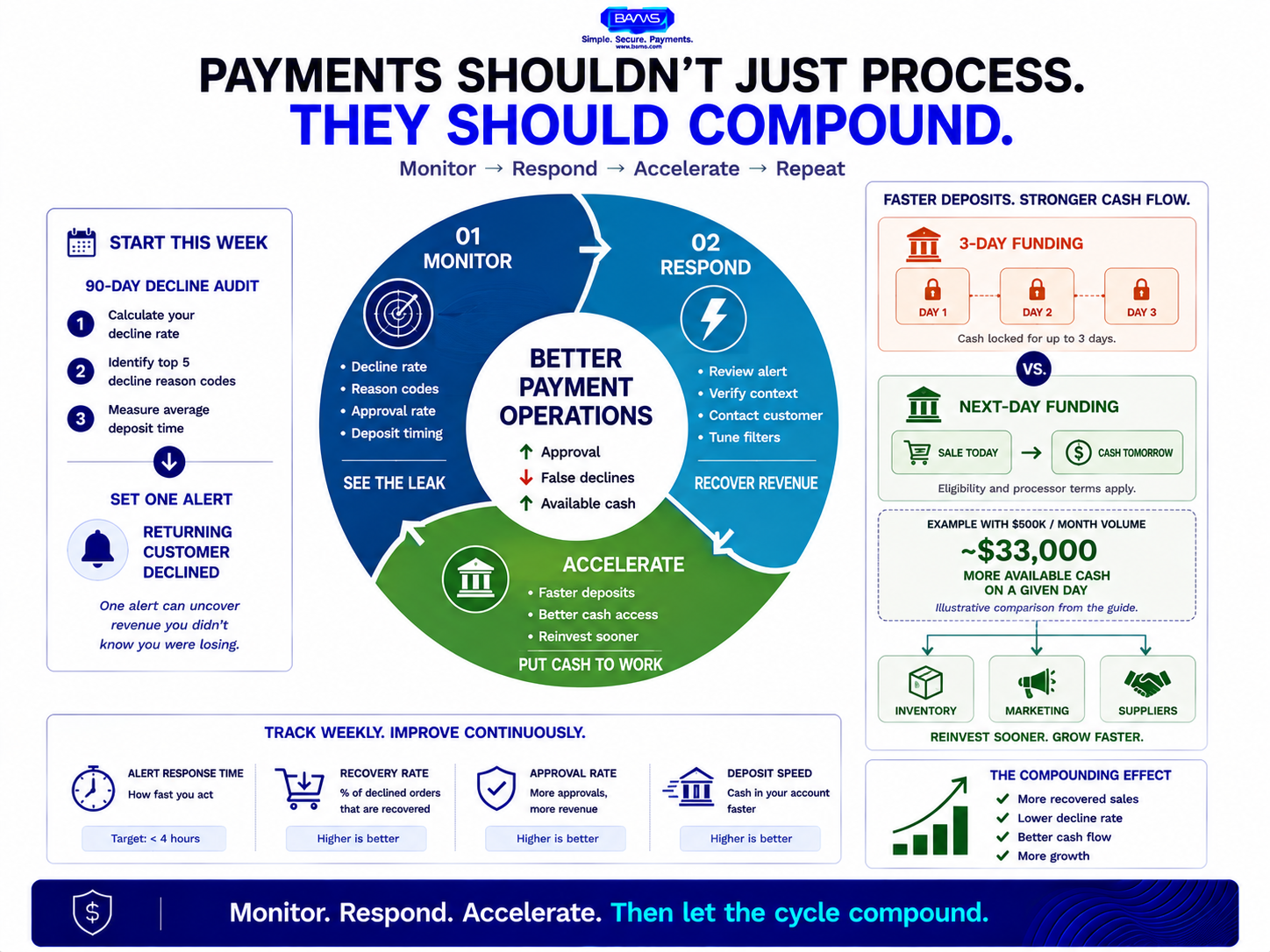
Better payment operations compound. Monitoring reveals recoverable transactions, faster response improves revenue recovery and faster funding puts that cash back to work sooner.
This guide follows a three-phase framework designed for lean teams without dedicated finance staff. Each phase builds on the previous one, and all three work together to turn payment operations into a growth lever.
- Monitor: Build real-time visibility into declines, approval rates, and deposit timing so problems surface before customers complain (or leave).
- Respond: Establish a lightweight but consistent process for triaging false declines, recovering legitimate orders, and adjusting fraud filter thresholds.
- Accelerate: Compress deposit timelines and reinvest the freed-up cash flow into inventory, marketing, and operations that drive top-line growth.
These phases are not sequential projects you complete once. They form a continuous cycle. Better monitoring reveals response opportunities. Faster responses improve approval rates. Higher approval rates combined with faster deposits generate the cash flow that funds further growth. The system compounds.
Step-by-Step: Building Your Decline Recovery and Faster Deposit System
Step 1: Audit Your Current Decline Rate and Deposit Timeline
Objective: Establish a factual baseline so you can measure improvement and identify the highest-impact problems first.
Start by pulling your transaction data from the last 90 days. You need three numbers: your total decline rate (all declined transactions divided by total attempted transactions), your estimated false decline rate within that, and your average deposit settlement time in business days.
Visa estimates that 30% to 65% of rejected online orders are actually legitimate. That makes it important to distinguish likely false declines from genuine fraud blocks instead of treating every rejected transaction as correctly declined. If you can’t separate the two, that’s your first problem to solve.
Check your processor dashboard for decline reason codes. Common false-decline signals include “do not honor” responses from issuing banks, AVS mismatches on otherwise valid cards, and velocity triggers on repeat customers. Group your declines by reason code and sort by frequency.
Anti-patterns: Don’t average your decline rate across all transaction types. Break it out by card brand, transaction size, and customer type (new vs. returning). A 3% overall rate can hide a 12% decline rate on high-value orders, which is where the real revenue loss sits.
Success indicators: You have a documented baseline decline rate, a list of your top five decline reason codes by volume, and you know your current average deposit settlement time to the day.
Step 2: Set Up a Payment Alerts Service That Surfaces Declines in Real Time
Objective: Close the visibility gap so you learn about false declines within hours, not days.
The core shift here is moving from periodic review (checking a dashboard weekly) to push-based alerts (getting notified when something goes wrong). You need a system that flags declined transactions matching false-decline patterns and routes those alerts to someone who can act on them.
For most 10 to 50 person operations, the practical path is a merchant services partner that provides proactive alerts and a dedicated account manager, not a six-figure fraud platform. Your payment alerts service should notify you when: a returning customer’s transaction is declined, a high-value order is blocked, your hourly or daily decline rate spikes above your baseline, or a specific decline reason code surges unexpectedly.
Configure alerts to go to a specific person (or a shared Slack channel or email alias), not to a generic inbox. Assign ownership. If nobody is responsible for reviewing alerts within four hours, the system doesn’t work.
Anti-patterns: Don’t set alerts for every single declined transaction. You’ll create noise that gets ignored. Filter for the patterns that indicate false declines specifically: returning customers, orders above your average order value, and “soft” decline codes that suggest issuer-side caution rather than confirmed fraud.
Success indicators: You receive actionable decline alerts within one hour of occurrence, a named team member reviews them within four hours, and you can distinguish false-decline alerts from legitimate fraud blocks at a glance.
Step 3: Build a Lightweight Response Workflow for Recovered Orders
Objective: Convert flagged false declines into recovered revenue through a repeatable, low-effort process.
When an alert flags a likely false decline, you need a defined next step. For most eCommerce teams, this means reaching out to the customer within 24 hours with an alternative way to complete their purchase. This can be a direct email with a fresh checkout link, a phone call from your support team, or an SMS with a one-click retry option.
The key insight is speed. 40% of shoppers abandon a purchase after a rejection, and that percentage climbs with every hour of delay. A customer contacted within a few hours of a false decline is far more likely to complete the purchase than one contacted two days later.
Create a simple template for outreach. Something like: “We noticed your recent order didn’t go through. This sometimes happens with bank security checks and isn’t a reflection of any issue on your end. Here’s a direct link to complete your purchase, or reply and we’ll help you finish the order.” Keep it human, not automated-sounding.
Track every recovery attempt and its outcome. You want to know your recovery rate (recovered orders divided by total false-decline outreach attempts) and the average time from alert to outreach. These two numbers tell you whether your system is working.
Anti-patterns: Don’t automate outreach before you’ve validated your false-decline identification is accurate. Contacting a customer whose card was legitimately flagged for fraud creates a worse experience than no contact at all. Start manual, build confidence in your filters, then consider automation.
Success indicators: You have a documented outreach template, a target response time under four hours, and you’re tracking recovery rate weekly. Even a 20% recovery rate on identified false declines can represent significant monthly revenue.
Step 4: Optimize Your Fraud Filter Thresholds
Objective: Reduce false declines at the source by adjusting the rules that cause them, without increasing actual fraud exposure.
Your decline audit from Step 1 should have revealed which fraud filter rules are triggering the most false declines. Common culprits include overly strict AVS (Address Verification System) matching, low velocity thresholds that flag repeat customers, and device fingerprinting rules that block mobile shoppers switching between apps and browsers.
Work with your processor or merchant services partner to adjust these thresholds incrementally. The goal is not to disable fraud protection. It’s to calibrate it so the filters match your actual risk profile rather than a generic one-size-fits-all setting.
For example, if your data shows that AVS mismatches on returning customers almost never correlate with actual fraud, you can relax AVS requirements for customers with a verified purchase history while keeping them strict for first-time buyers. This kind of segmented approach is where chargeback prevention and faster deposits intersect: fewer false declines mean fewer frustrated customers, fewer disputes, and a cleaner transaction history that processors reward with better terms.
Anti-patterns: Don’t make multiple filter changes simultaneously. Adjust one variable at a time, measure the impact over two to four weeks, then move to the next. Batch changes make it impossible to identify which adjustment helped (or hurt).
Success indicators: Your false decline rate decreases measurably over 30 to 60 days without a corresponding increase in chargebacks or confirmed fraud. Your overall approval rate improves.
Step 5: Accelerate Deposit Timing to Unlock Cash Flow
Objective: Compress the time between transaction and available funds so you can reinvest revenue faster.
Every day your funds sit in processing limbo is a day you can’t use that money. For a business doing $500,000 in monthly card revenue, the difference between three-day settlement and next-day funding means having roughly $33,000 more available on any given day. That’s inventory you can restock, a marketing campaign you can launch, or a supplier discount you can capture.
To qualify for faster deposit timelines, processors typically look at your chargeback ratio, processing history, and business stability. This is where Steps 1 through 4 pay a compounding dividend: lower false declines lead to fewer chargebacks, which improves your risk profile, which unlocks faster funding terms.
Batch submission timing also matters. If your platform submits transactions for settlement at 11 PM instead of 5 PM, you may be adding an extra day to your deposit cycle unnecessarily. Check with your processor about optimal batch cutoff times and adjust your system accordingly.
A merchant services partner like BAMS offers next-day funding as a standard feature alongside dedicated account management, which means you get both the speed and the human support to maintain the transaction quality that keeps fast funding available.
Anti-patterns: Don’t assume faster deposits are purely a processor feature you “turn on.” Your eligibility depends on your transaction health. Merchants with high chargeback ratios or inconsistent processing volumes often get slower settlement as a risk control. Fix the inputs first.
Success indicators: Your average deposit settlement time decreases by at least one business day. You can quantify the cash flow improvement in dollars available per day. Your chargeback ratio stays below 0.5%.
Step 6: Connect Decline Data to Customer Retention Metrics
Objective: Link payment operations data to customer lifetime value so you can see the full revenue impact of false declines.
56% of U.S. shoppers reported having a valid payment wrongly declined in the prior three months. That’s not a rare edge case. It’s a common experience that shapes how customers perceive your brand. When you connect your decline data to your CRM or customer database, you can start answering critical questions: How many of your falsely declined customers came back? How many churned? What was their average order value?
Map declined transactions to customer records. If you use Shopify, WooCommerce, or a similar platform, you can cross-reference declined order attempts with customer email addresses. Look for patterns: Are high-LTV customers being declined more often? Are first-time buyers from paid acquisition channels hitting fraud filters at higher rates (which means your CAC is being wasted)?
This data transforms the conversation from “we had X declines this month” to “false declines cost us Y dollars in lost lifetime value this quarter.” That’s the number that justifies investing time and resources in the monitoring and response system you’ve built.
Anti-patterns: Don’t treat decline data and customer data as separate systems indefinitely. The longer they stay disconnected, the longer you’re flying blind on the actual business impact. Even a manual monthly reconciliation in a spreadsheet is better than no connection at all.
Success indicators: You can report the estimated revenue impact of false declines in customer lifetime value terms. You can identify which customer segments are most affected. Your retention team has visibility into payment-related churn.
Practical Examples: What This Looks Like in Action
Scenario A: The Repeat Customer Blocked by a Device Change
A customer who has purchased from your store eight times over the past year tries to place a $220 order from a new phone. Your fraud filter flags the new device fingerprint and declines the transaction. Without an alert system, this decline sits unnoticed in your dashboard. The customer, frustrated, buys from a competitor. You’ve lost not just $220, but a customer with a $1,760 annual value.
With a payment alerts service in place, your team gets notified within the hour. A quick CRM check confirms the customer’s history. Your support team sends a personal email with a direct checkout link. The customer completes the order 40 minutes later and mentions they appreciate the follow-up. Relationship preserved, revenue recovered.
Scenario B: The Batch Timing Mistake
An eCommerce brand processing $400,000 monthly discovers their platform submits settlement batches at 11:30 PM ET, missing their processor’s 10 PM cutoff. Every transaction processed after the cutoff rolls to the next business day’s settlement. By adjusting batch timing to 9 PM, they effectively gain one full business day of deposit speed on roughly 30% of their daily transactions. Over a month, that’s an additional $40,000 in available working capital on any given day, with zero cost and a five-minute configuration change.
Scenario C: The Chargeback-to-Funding Connection
A merchant with a 1.2% chargeback ratio is stuck on three-day deposit holds. After implementing proactive chargeback notifications and transparent merchant services, they reduce their ratio to 0.4% over 90 days. Their processor upgrades them to next-day funding. The faster deposits allow them to take advantage of a supplier’s 2% early-payment discount, saving $8,000 annually on a $400,000 inventory spend.
Common Mistakes and Pitfalls
Treating all declines as fraud. The most expensive assumption in eCommerce payments is that every declined transaction was correctly declined. PwC reports that false declines are typically 5 to 10 times more common than actual fraud. If you’re not investigating declines, you may be turning away legitimate customers as a cost of doing business.
Over-engineering the solution. You don’t need a $50,000 fraud orchestration platform. You need alerts, a response process, and a merchant services partner who picks up the phone. Start simple. Scale when the data justifies it.
Ignoring deposit timing as a growth variable. Cash flow management is not just about revenue. It’s about when revenue becomes usable. Two days of deposit delay on a $30,000 daily volume means $60,000 perpetually unavailable. That’s real money with real opportunity cost.
Changing everything at once. Adjusting fraud filters, switching processors, and restructuring batch timing simultaneously makes it impossible to attribute results. Change one variable, measure, then move to the next.
What to Do Next
Start with Step 1 this week. Pull your last 90 days of decline data and calculate your baseline. That single action will likely reveal revenue you didn’t know you were losing, and it takes less than an hour.
From there, set up one alert: a notification when a returning customer’s transaction is declined. Just one. See how often it fires. Respond to the first few manually. You’ll build intuition for your false decline patterns faster than any dashboard can teach you.
This isn’t a system you build once and forget. It’s a set of habits that improve with repetition. Each month, your filters get smarter, your response gets faster, and your deposits get more predictable. Revisit this guide as a reference point when you’re ready to move to the next step, not as a checklist to rush through.
The businesses that treat payments as a growth lever, not a back-office chore, are the ones that compound small advantages into meaningful separation from competitors. You don’t need a finance team to start. You need visibility, a process, and the discipline to follow through.
Frequently Asked Questions
What are false declines and how do they differ from legitimate fraud blocks?
False declines occur when a payment processor or issuing bank incorrectly rejects a legitimate customer’s transaction. Unlike fraud blocks (which correctly stop stolen cards or suspicious activity), false declines turn away real customers with valid payment methods. Common triggers include address verification mismatches, new device fingerprints, and unusual purchase amounts that trip overly cautious fraud filters.
How can small eCommerce teams detect false declines without a dedicated finance department?
The most practical approach is setting up a payment alerts service through your merchant services partner that pushes notifications when specific decline patterns occur (returning customers blocked, high-value orders rejected, or decline rate spikes). Assign a single team member to review these alerts within four hours. You don’t need enterprise software. You need targeted alerts and a consistent response habit.
How does next-day funding actually improve cash flow management?
Standard payment processing holds funds for two to three business days. Next-day funding compresses that to one business day, meaning more of your revenue is available for inventory purchases, payroll, supplier payments, and marketing spend on any given day. For a business processing $500,000 monthly, the difference can mean $33,000 more in available working capital at all times.
When should merchants conduct a payment processing audit?
At minimum, review your decline rates, reason codes, and deposit timing quarterly. If you’re experiencing a decline rate above 6%, noticing customer complaints about blocked payments, or carrying short-term debt to cover cash flow gaps between deposits, audit immediately. The baseline data from a 90-day audit is the foundation for every improvement in this guide.
How do false declines impact customer relationships long-term?
The impact is severe and often permanent. Research shows that 41% of shoppers who experience a false decline never return to that merchant. Beyond the lost immediate sale, you lose the customer’s entire future lifetime value and may generate negative word-of-mouth. For eCommerce brands investing heavily in customer acquisition, false declines effectively waste a portion of your marketing spend.
Which factors affect the speed of payment deposits for eCommerce businesses?
The main factors are your chargeback ratio (lower is better), your processing history and volume consistency, your batch submission timing relative to your processor’s cutoff, and your merchant services agreement terms. Maintaining a chargeback ratio below 0.5%, submitting batches before your processor’s daily cutoff, and working with a provider that offers next-day funding are the most impactful levers.