7 Processing Statement Signals You’re Being Overcharged
Last Updated on October 7, 2026 by Dimitri Akhrin
A diagnostic guide to merchant account optimization that turns hidden fees into actionable savings
Learn to identify seven specific line items on your processing statement that signal overcharges. This diagnostic framework contrasts opaque provider tactics with transparent partner practices, helping eCommerce operators unlock meaningful business cost savings.
TL;DR
- Calculate your effective rate – Divide total fees by total volume. If it’s more than 0.3% above your quoted rate, hidden charges are inflating your costs.
- Demand interchange-plus pricing – Bundled or tiered pricing models obscure what your processor charges versus what card networks require, making overcharges invisible.
- Audit fixed monthly fees and PCI charges – Statement fees, account fees, and PCI non-compliance penalties are frequently duplicated or left in place after they should have been removed.
- Review chargeback costs beyond the per-incident fee – The real expense is lost disputes. A partner who actively helps you respond to chargebacks saves more than a processor who just charges the fee.
- Treat optimization as a relationship, not a rate – The signals on this list are easy to catch when someone walks you through them. They’re nearly impossible to spot when your only support option is a ticket queue.
Your Processing Statement Is Talking. Are You Listening?
Credit card processing optimization starts with a skill most eCommerce operators never develop: reading your own statement. Not skimming the total at the bottom, but understanding what each line item actually represents and whether the number next to it is reasonable.
The problem is structural. Nilson Report found that U.S.-issued credit, debit and prepaid cards generated $11.903 trillion in purchase volume in 2024, with credit cards accounting for 54.3% of that volume. At that scale, even small differences in processing costs can compound into meaningful annual expenses. For eCommerce merchants, understanding exactly what appears on the processing statement is especially important because card-not-present transactions can qualify differently from card-present transactions.
Yet most operators never question the statement because no one has shown them what to look for. This guide changes that.
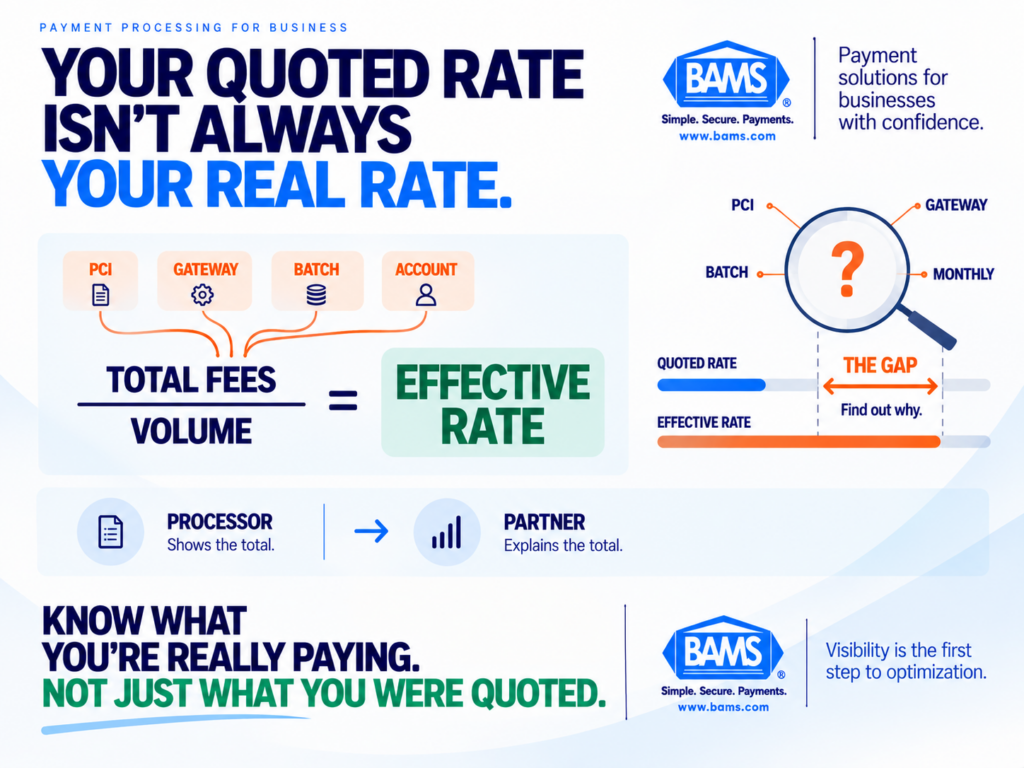
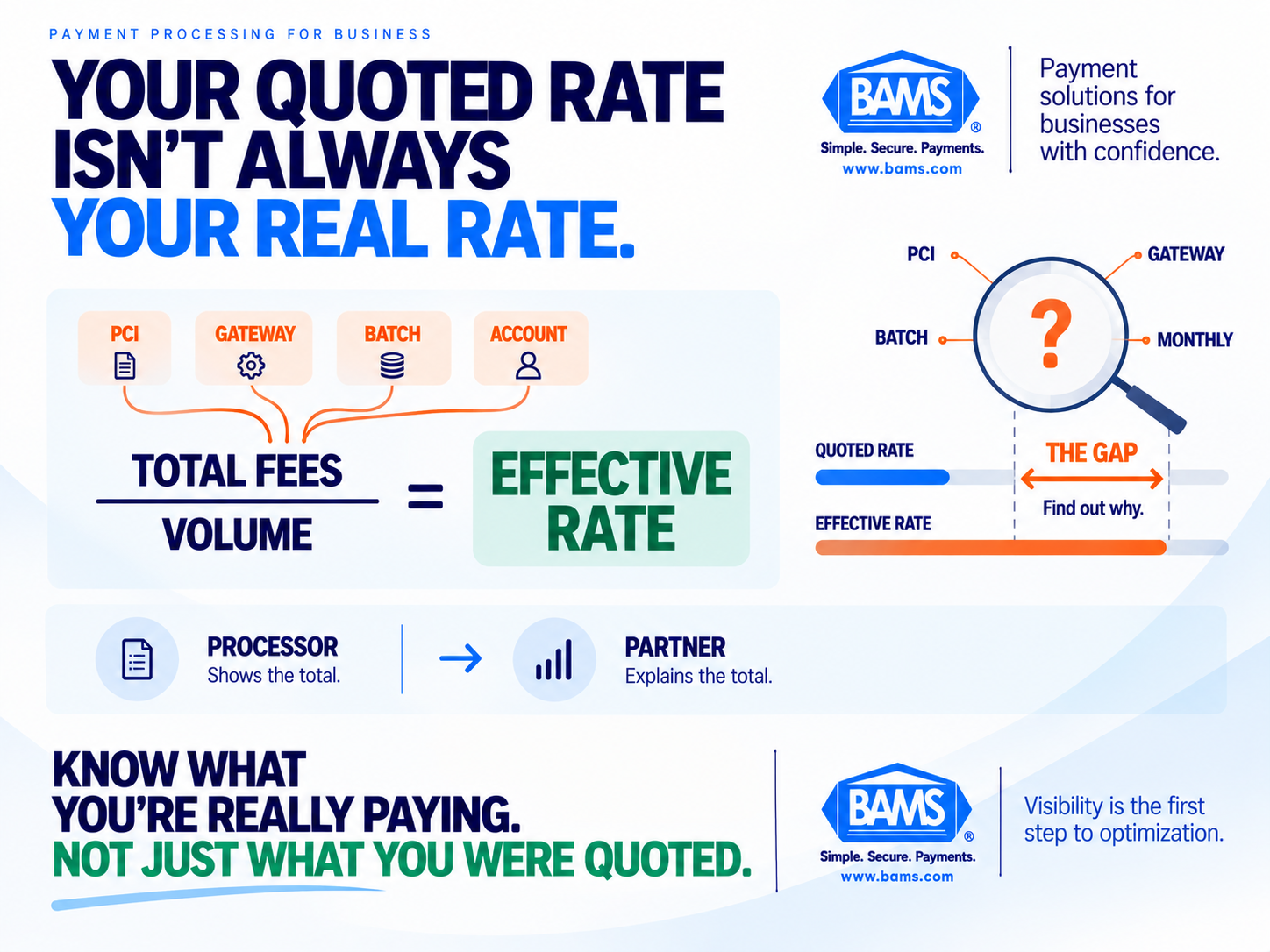
The rate you were quoted is not necessarily the rate you’re paying. Your effective rate reveals what processing actually costs after additional fees are included.
What This Guide Covers (and What It Doesn’t)
This is for eCommerce managers at established online businesses processing enough volume that a few basis points actually matter. If you’re running a team of 10 to 50 people, your processing costs are a real line item on your P&L, not a rounding error.
This is not a “switch to provider X” pitch. It’s a diagnostic framework. We’ll walk through seven specific line items on your statement that frequently signal overcharges, and for each one, we’ll contrast what an opaque provider does versus what a transparent, accountable partner does differently. The goal is merchant account optimization through understanding, not just vendor comparison.
How We Selected These Seven Signals
Each line item below meets three criteria: it appears on the majority of eCommerce processing statements, it is frequently inflated or obscured by providers who benefit from your inattention, and it is something a transparent partner handles in a verifiably different way. We prioritized signals that compound over time, because those are the ones that quietly erode your margins month after month.
7 Statement Line Items That Signal You’re Being Overcharged
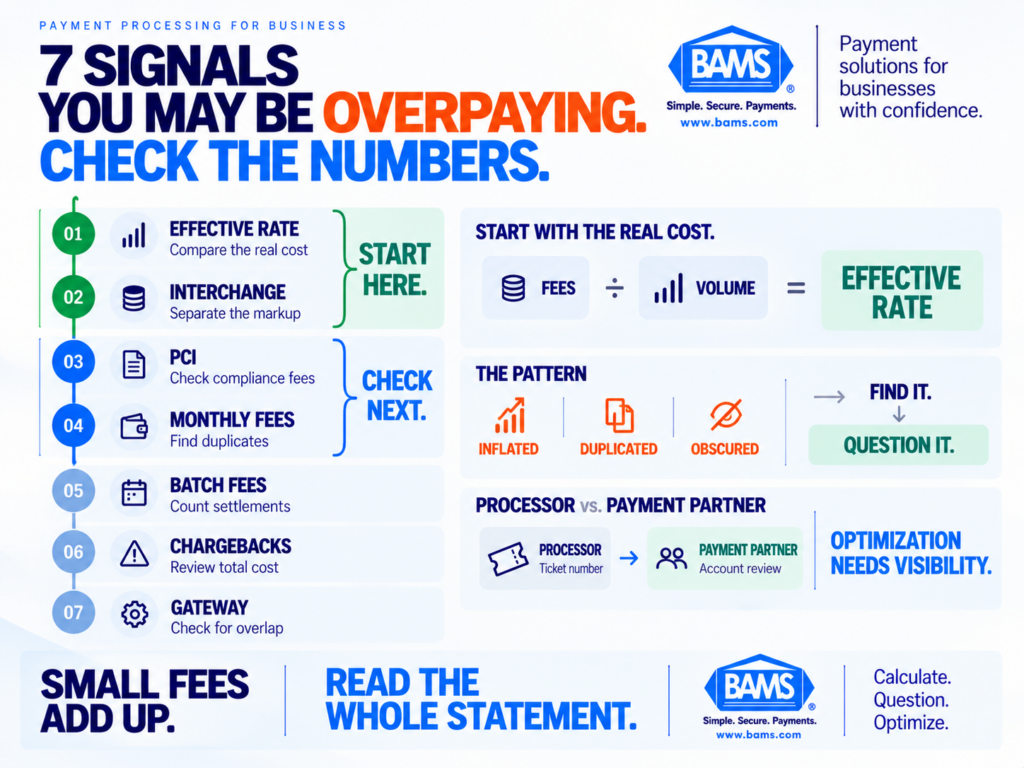
Small processing charges can compound into meaningful annual costs. These seven statement signals help merchants identify where fees may be inflated, duplicated or difficult to verify.
1. The Effective Rate vs. the Advertised Rate
Why it matters: Your provider quoted you a rate. Maybe 2.6% plus $0.10. But your effective rate (total fees divided by total volume) tells a different story. As payments industry leader Chris Brunner has noted, merchants should focus on the full effective rate because added gateway, statement, and compliance charges often determine the real cost of acceptance. If your effective rate is 50 or more basis points above your quoted rate, something is buried in the statement.
What it looks like today: Providers may advertise a simple headline rate while additional processing and service charges affect the amount you actually pay. Nilson Report found that U.S. merchants paid $187.20 billion in processing fees on approximately $11.9 trillion in card purchase volume in 2024. Your own effective rate can differ substantially depending on your card mix, transaction profile and pricing structure, which is why the total statement cost matters more than the advertised rate alone.
How to apply it: Pull your last three statements. Divide total fees by total processing volume. Compare that number to your quoted rate. If the gap exceeds 0.3%, ask your provider to itemize every charge contributing to the difference. A transparent partner calculates this for you proactively and walks you through the breakdown during regular account reviews.
2. Interchange Markup Bundling
Why it matters: Interchange is an underlying component of card acceptance costs, while your processor’s pricing determines what you pay on top of those underlying costs. Mastercard explains that interchange is one component of the merchant discount rate and that the applicable rate can depend on factors including merchant category, authorization-to-clearing timing, enhanced transaction data and transaction volume. When these underlying costs and the processor’s markup are bundled together, it becomes much harder to determine what is actually driving your effective rate.
What it looks like today: Tiered pricing models (qualified, mid-qualified, non-qualified) are the most common way providers obscure interchange. A transaction that should cost interchange plus a small markup gets reclassified as “non-qualified” and charged at a significantly higher rate.
How to apply it: Ask your provider if you’re on interchange-plus pricing. If they can’t clearly separate network costs from their markup on your statement, that’s a signal. An accountable partner uses interchange-plus by default and shows you the network cost and the margin side by side, so you can verify both. For a deeper look at how merchant account optimization works as an ongoing relationship, not a one-time rate negotiation, this matters more than any introductory offer.
3. PCI Compliance and Non-Compliance Fees
Why it matters: PCI compliance is a legitimate requirement, but you should understand exactly what any PCI-related charge on your statement represents. The PCI Security Standards Council states that it does not impose penalties for PCI DSS non-compliance itself and that individual payment brands or compliance programs may establish their own financial or operational consequences. If your processor charges a PCI compliance or non-compliance fee, ask who assesses it, what it covers and what action removes it.
What it looks like today: Look for line items labeled “PCI Fee,” “PCI Non-Compliance Fee,” or “Security Fee.” If you see more than one PCI-related charge, or if you’re being charged a monthly non-compliance fee despite having completed your annual certification, you’re overpaying.
How to apply it: Confirm your PCI compliance status directly with your provider. Ask for written confirmation that the non-compliance charge will stop once you certify. A transparent partner helps you complete the SAQ, removes the penalty immediately upon completion, and charges a single, clearly labeled annual compliance fee.
4. Monthly Statement and Account Fees
Why it matters: These are fixed costs that exist regardless of your processing volume. They’re easy to overlook because each charge may appear small in isolation. Statement fees, account maintenance charges, regulatory fees and technology fees can accumulate across the year, so they should be evaluated together rather than one line at a time.
What it looks like today: Some providers stack multiple fixed monthly fees under different labels: statement fee, account fee, regulatory fee, technology fee. Each one looks minor in isolation. Together, they represent a meaningful drag on your business cost savings goals.
How to apply it: List every fixed monthly charge on your statement. Total them annually. Then ask your provider what service each fee covers and whether any can be eliminated. An accountable partner consolidates these into a single, transparent monthly charge (or eliminates them entirely) and explains what you’re paying for.
5. Batch Processing Fees
Why it matters: Chargebacks cost more than the disputed transaction alone. Mastercard reports that merchants incur an average of $128 per chargeback in internal and third-party costs, excluding the potential loss of the merchandise or service itself. For eCommerce businesses with recurring disputes, those operational costs can become a meaningful expense category.
What it looks like today: Batch fees are often buried deep in the statement, sometimes labeled as “settlement fees” or “batch header fees.” Most eCommerce operators don’t realize they can control their batch frequency or that some providers don’t charge this fee at all.
How to apply it: Count how many batch fees appear on your statement each month. If you’re settling more than once per day, ask whether consolidating to a single daily settlement would reduce costs without affecting your cash flow. A transparent provider explains your settlement schedule during onboarding and helps you configure it for efficiency.
6. Chargeback Fees and Dispute Handling Costs
Why it matters: Chargebacks cost you twice: once in the lost sale and again in the fee your processor charges for handling the dispute. Those fees commonly range from $15 to $50 per incident. For eCommerce businesses with elevated dispute rates, this becomes a significant and often invisible expense category.
What it looks like today: Most providers charge the fee and leave you to manage the dispute on your own. You get a notification, a deadline, and a portal. What you don’t get is someone who knows your business, reviews the dispute details, and helps you build a response that actually has a chance of winning.
How to apply it: Review your chargeback fee total for the last six months. Then assess your win rate on disputes. If you’re losing most of them, the fee is only part of the problem. A partner like BAMS provides proactive chargeback defense with dedicated account managers who help you respond to disputes before the deadline, reducing both the fee volume and the revenue loss. That combination of next-day funding and active dispute support is what separates a partner from a processor.
7. Gateway and Technology Fees
Why it matters: Your payment gateway is the infrastructure that connects your checkout to the processing network. Many providers charge a separate monthly gateway fee ($10 to $25) plus a per-transaction gateway fee ($0.05 to $0.10). If your processor also owns the gateway, you may be paying twice for the same service under different labels.
What it looks like today: Look for line items like “gateway access fee,” “technology fee,” “platform fee,” or “API access fee.” Some providers bundle gateway costs into the processing rate (which is cleaner), while others itemize them separately (which can be transparent or deceptive, depending on whether the processing rate was adjusted accordingly).
How to apply it: Ask your provider whether your gateway fee is included in your processing rate or charged separately. If it’s separate, confirm that your processing rate reflects that separation. A transparent partner either includes gateway costs in a single rate or clearly labels them and explains why they’re itemized. Either approach works, as long as you’re not paying for the same function twice.
The Pattern Behind These Seven Signals
Every item on this list shares a common structure: a legitimate cost that has been inflated, duplicated, or obscured by a provider who benefits from your inattention. The overcharges aren’t dramatic. They’re designed to be small enough that you don’t question them individually, but large enough to matter when totaled annually.
The deeper pattern is about access. Each of these signals is easy to identify when someone walks you through the statement line by line. They’re nearly invisible when your only option is a support ticket or a 1-800 number. With U.S. noncash payments reaching trillions of dollars in total value, the scale of fee leakage across merchants is enormous. Your individual share of that leakage depends almost entirely on whether you have a partner who makes the numbers visible and explains what they mean.
This is why credit card processing optimization is fundamentally a relationship function, not a spreadsheet exercise.
Where to Start: Constraints and Priorities
You don’t need to audit all seven line items this week. Start with two: your effective rate (signal 1) and your interchange markup structure (signal 2). These two numbers reveal more about your provider’s transparency than any sales pitch ever will.
If those checks reveal gaps, move to the fixed monthly fees (signal 4) and PCI charges (signal 3), which are the easiest to negotiate or eliminate. Save the transaction-level fees (batches, chargebacks, gateway) for a deeper review once you’ve established whether your current provider is willing to explain the numbers or deflect. That willingness, or lack of it, tells you everything you need to know about choosing a merchant service provider you can actually hold accountable.
Frequently Asked Questions
What is an effective rate, and how do I calculate it?
Your effective rate is the total processing fees you paid in a given month divided by your total processing volume. For example, if you processed $100,000 and paid $2,800 in total fees, your effective rate is 2.8%. Compare this to your quoted rate. A gap of more than 0.3% typically means hidden fees are inflating your costs.
What is interchange-plus pricing, and why does it matter for eCommerce?
Interchange-plus pricing separates the non-negotiable card network fee (interchange) from your processor’s markup. This gives you visibility into exactly what your provider charges versus what Visa or Mastercard requires. For eCommerce merchants processing high volumes, this transparency is essential for identifying whether your markup is competitive.
When should a business consider using merchant account optimization services?
Consider it when your effective rate is significantly higher than your quoted rate, when you can’t identify what specific fees on your statement cover, or when your provider can’t (or won’t) explain the numbers during a direct conversation. These are signs that your current setup has room for meaningful cost reduction.
How do PCI non-compliance fees work, and can I avoid them?
PCI non-compliance fees are monthly penalties (typically $25 to $100) charged when you haven’t completed your annual PCI Self-Assessment Questionnaire. You can avoid them by completing the SAQ and confirming with your provider that the penalty has been removed. A good partner helps you through the process and stops the charge immediately upon certification.
Why do eCommerce transactions cost more to process than in-store transactions?
Card-not-present transactions carry higher fraud risk, which means card networks set higher interchange rates for them. Online processing rates commonly fall between 2.9% and 3.5% plus $0.30 per transaction, compared to lower rates for card-present (in-store) transactions. This higher baseline makes it even more important to minimize unnecessary fees elsewhere on your statement.
What’s the difference between a payment processor and a payment partner?
A processor handles transactions. A partner reviews your statement with you, explains each line item, helps you fight chargebacks, and adjusts your setup as your business changes. The distinction shows up most clearly when something goes wrong: a processor gives you a ticket number, while a partner gives you a person who knows your account.