7 Signals That Separate Real Apple Pay Fraud From Confused Customers
Diagnostic clues hidden in your transaction evidence that most eCommerce operators overlook
Learn the transaction-level signals that distinguish genuine Apple Pay disputes from customers who simply don’t recognize a charge. This guide gives eCommerce operators without a fraud team actionable diagnostics to reduce unnecessary chargebacks.
TL;DR
- Most Apple Pay disputes are recognition problems, not fraud – Billing descriptor mismatches between the Wallet app and bank statements are the top driver of unnecessary chargebacks on mobile wallet transactions.
- Your transaction data already contains the evidence you need – Device Account Number (DAN) history, biometric authentication status, and dispute timing patterns are available through your processor if you ask for them.
- Three quick wins protect the most revenue – Fix your billing descriptor, email customers before accepting fraud-coded disputes, and request DAN match data from your processor for representment.
- Dispute timing reveals the dispute type – Disputes filed within days suggest genuine fraud; disputes filed 25-35 days post-transaction usually indicate friendly fraud or recognition failure, each requiring a different response.
- Ignoring the pattern compounds your costs – Every uncontested dispute raises your chargeback ratio, which increases processing fees and can trigger monitoring programs with your acquirer.
Mobile Wallets Are Growing. So Are the Disputes You Didn’t Expect.
Digital wallets have become a mainstream payment method, giving eCommerce merchants faster checkout experiences and stronger protection for payment credentials. As Apple Pay and other wallets become a larger part of the payment mix, merchants also need processes that distinguish genuine unauthorized use from recognition problems and friendly fraud.
Apple’s official Apple Pay documentation explains how device-based authentication and tokenized payment credentials work together to secure Apple Pay transactions.
The disconnect is not about the technology failing. It is about merchants lacking the diagnostic signals to tell the difference between genuine Apple Pay fraud and a customer who simply does not recognize a charge on their statement. Those two scenarios require completely different responses, and treating them the same costs you money every time.
What This Guide Covers (and What It Doesn’t)
This guide is for eCommerce operators running established online businesses without a dedicated fraud team. If you process Apple Pay or other NFC payments online and have noticed dispute volume creeping upward, this is built for you.
We are not covering the technical architecture of tokenization or how Device Account Numbers (DANs) work at the protocol level. Instead, we focus on the transaction-evidence signals you can evaluate yourself, the ones that separate a legitimate dispute from a recognition problem or a friendly fraud attempt. Each signal is something you can check in your existing transaction data.
How We Selected These Signals
Each signal below meets three criteria: it is observable in standard merchant transaction records (no enterprise fraud tools required), it reliably differentiates between dispute types, and it leads to a specific operational response. We prioritized signals that address the gap between “tokenization makes things safer” and “here is what you still need to do to protect your revenue.”

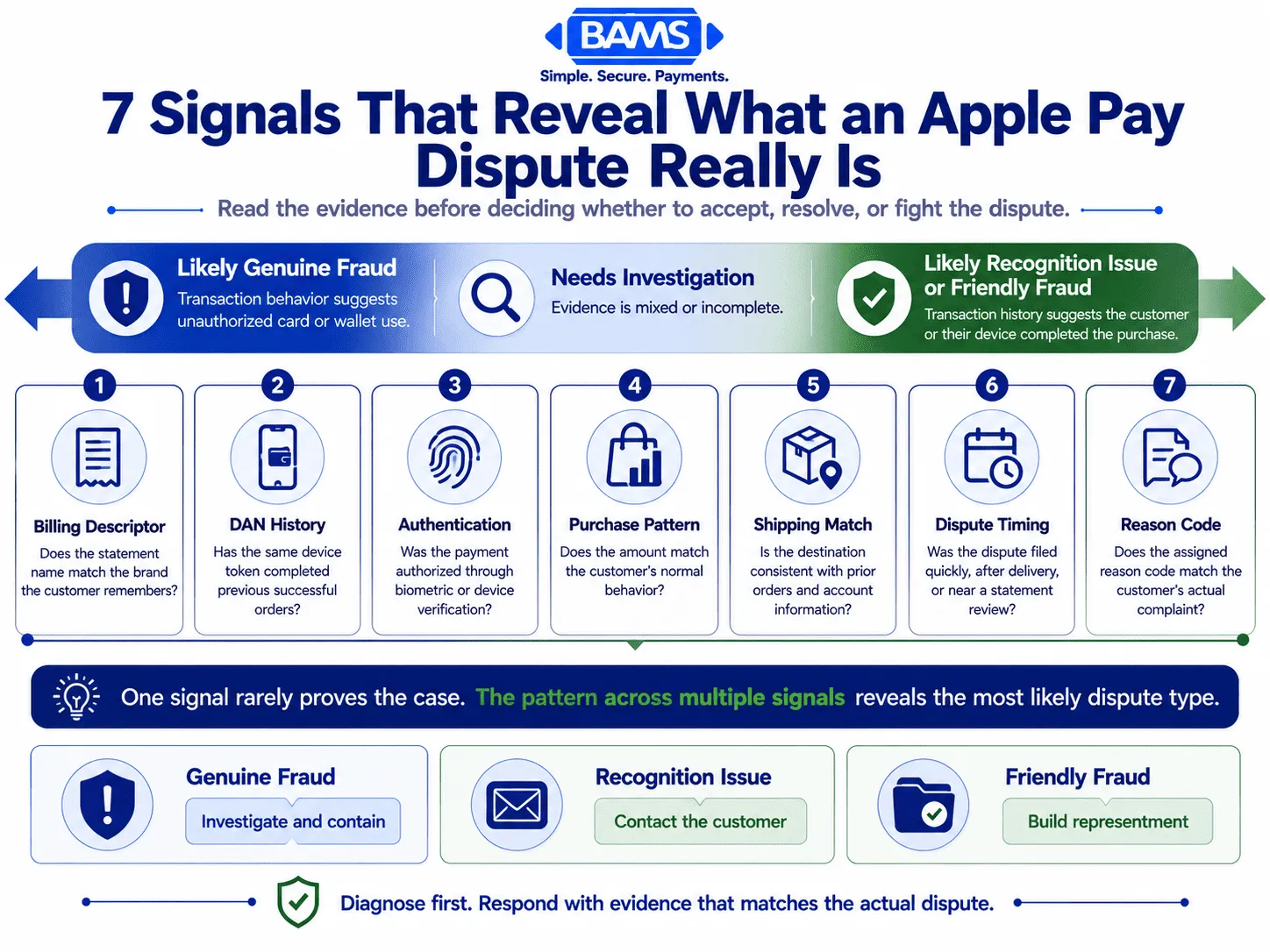
Apple Pay disputes do not all have the same cause. Billing descriptors, device history, authentication, order behavior, shipping details, timing, and reason codes reveal how each case should be handled.
7 Signals That Separate Genuine Apple Pay Disputes from Recognition Failures
1. The Billing Descriptor Does Not Match What the Customer Sees in Their Wallet
Why it matters: Apple Pay users see a clean transaction label inside their Wallet app, often pulled from the merchant’s registered name. But the billing descriptor on their bank statement may show a truncated corporate entity name, a DBA they have never heard of, or a payment facilitator’s name. This mismatch is the single largest driver of “I don’t recognize this charge” disputes for mobile wallet transactions.
What it looks like today: A customer pays via Apple Pay on your site. Their Wallet app shows “YourBrand.” Their credit card statement shows “PYMT*XYZLLC.” They file a dispute.
How to apply it: Pull your current billing descriptor from your processor’s dashboard and compare it to what appears in a test Apple Pay transaction. If they do not match, update your descriptor. This alone can reduce recognition-based disputes significantly.
2. The Device Account Number (DAN) Traces Back to a Consistent Device History
Why it matters: Apple Pay transactions use a tokenized Device Account Number rather than the customer’s underlying card number. When available through your processor, a consistent token history across previous successful orders can help connect the disputed payment to an established customer or device pattern. It should be treated as supporting evidence, not definitive proof of cardholder authorization.
What it looks like today: Your processor or gateway may retain token references that help connect the disputed transaction with earlier orders. However, the exact token metadata available to merchants varies by processor, gateway, card network, and reporting configuration.
How to apply it: Ask your processor which wallet-token references and transaction-history fields are available for dispute responses. Combine that information with customer history, order records, delivery evidence, and communications rather than relying on the token alone.
Mastercard Developers documents how network tokenization replaces sensitive payment credentials with tokenized account references during digital wallet transactions.
3. Biometric Authentication Was Successfully Completed
Why it matters: Apple Pay requires Face ID, Touch ID, or a passcode to authorize a transaction. If biometric authentication succeeded, it means the device owner (or someone with their biometric data) approved the payment. This is a powerful piece of evidence that the cardholder authorized the transaction, and it fundamentally changes the dispute narrative.
What it looks like today: The authentication indicator is embedded in the transaction’s cryptogram data. Your processor can confirm whether biometric verification was completed. Many merchants never ask for this detail during representment.
How to apply it: Include biometric authentication confirmation in every Apple Pay dispute response. Pair it with delivery confirmation to build a strong representment case. This combination addresses both “I didn’t authorize it” and “I didn’t receive it” reason codes.
4. The Transaction Amount Falls Outside the Customer’s Normal Purchase Pattern
Why it matters: Genuine fraud via compromised Apple Pay credentials (rare, but real) tends to show up as transactions that break the customer’s established spending pattern. A customer who typically orders $40-$60 worth of product suddenly placing a $400 order through Apple Pay warrants a closer look. Recognition disputes, by contrast, usually involve amounts consistent with the customer’s history.
What it looks like today: Your order management system likely stores purchase history by customer email or account. Cross-referencing the disputed transaction amount against prior orders takes minutes, not hours.
How to apply it: Flag Apple Pay transactions that exceed 3x the customer’s average order value for manual review before fulfillment. This is a low-effort filter that catches the most obvious genuine fraud signals without slowing down normal orders.
5. The Shipping Address Diverges from the Billing Profile
Why it matters: Apple Pay autofills billing information from the cardholder’s wallet, but shipping addresses are entered separately in most eCommerce flows. When a genuine fraudster uses a compromised Apple Pay account for an online purchase, they almost always change the shipping address. A mismatch between the Apple Pay billing address and a new or unusual shipping destination is a strong fraud signal.
What it looks like today: Many eCommerce platforms log both addresses but do not flag divergence automatically. The check is manual but straightforward.
How to apply it: Set up a simple rule in your order management system: if the Apple Pay billing address and the shipping address are in different states (or countries), hold the order for a 60-second manual review. Legitimate customers with gift orders will confirm quickly. Fraudsters will not.
6. The Dispute Timing Reveals the Pattern
Why it matters: Recognition disputes tend to cluster around statement dates, when customers review their credit card activity. Genuine fraud disputes tend to arrive faster, often within days of the transaction, because the real cardholder notices unauthorized activity through push notifications. Friendly fraud (buyer’s remorse disguised as a dispute) typically surfaces 15-30 days post-delivery.
What it looks like today: Your chargeback records include the dispute filing date relative to the transaction date. Plotting this gap across your Apple Pay disputes reveals which category dominates your losses.
How to apply it: Segment your disputes by the number of days between transaction and dispute filing. If most fall in the 25-35 day window, your primary problem is likely friendly fraud or recognition failure, not genuine theft. Adjust your response strategy accordingly.
7. The Reason Code Does Not Match the Customer’s Actual Complaint
Why it matters: Banks assign reason codes based on what the cardholder tells them, but customers often describe their issue imprecisely. A customer who says “I don’t recognize this” gets coded as potential fraud (e.g., Visa reason code 10.4), even when the real issue is a confusing billing descriptor. This misclassification inflates your apparent fraud rate and can trigger monitoring programs with your acquirer.
What it looks like today: You receive the reason code from your processor. But if you also have the customer’s email or phone, a quick outreach often reveals the actual issue is recognition, not fraud. If your processing fees are already under pressure, inflated fraud metrics compound the cost.
How to apply it: Before accepting any fraud-coded Apple Pay dispute, send a brief email to the customer with your logo, the product purchased, and the transaction date. A significant percentage of customers will withdraw the dispute once they recognize the charge. This single step can recover revenue that would otherwise be lost by default.
The Pattern Behind These Signals

The same fraud reason code can hide three very different situations. Comparing transaction history, authentication, delivery, timing, and customer behavior helps merchants choose the correct response.
Three themes connect every signal on this list. First, most Apple Pay disputes are not fraud problems. They are communication problems. The technology is doing its job (tokenization, biometric authentication), but the merchant’s post-transaction communication is not keeping pace. Billing descriptors, order confirmations, and statement clarity are where revenue leaks.
Second, the evidence you need to fight disputes already exists in your transaction data. You do not need a fraud detection platform. You need a habit of pulling DAN history, authentication status, and timing data before responding to chargebacks.
Third, there is a compounding cost to inaction. Every uncontested dispute raises your chargeback ratio, which raises your processing costs, which erodes the margin that contactless payment adoption was supposed to improve. A merchant services partner like BAMS can help with proactive chargeback defense and dedicated account management, turning these signals into a structured response workflow rather than a reactive scramble.
Where to Start Without Overwhelming Your Team
You do not need to implement all seven signals at once. Start with three that require the least operational lift: fix your billing descriptor (Signal 1), add customer outreach before accepting fraud-coded disputes (Signal 7), and begin requesting DAN match history from your processor (Signal 2).
These three actions address the most common dispute scenario (the customer who does not recognize the charge) and build the evidence foundation for stronger representment when genuine fraud does occur. As mobile wallet adoption continues to grow, with The majority of in-person transactions worldwide are already conducted contactlessly., the merchants who protect their revenue will be the ones who learned to read the signals in their own data first.
Frequently Asked Questions
How does Apple Pay tokenization affect the chargeback process?
Apple Pay replaces your customer’s real card number with a Device Account Number (DAN) for each transaction. This means the dispute process involves matching tokens rather than card numbers. The practical impact for merchants is that you need to request DAN-specific data from your processor to build effective representment cases. Without it, you are missing a key piece of evidence that proves the cardholder’s own device authorized the purchase.
Why am I seeing more chargebacks on Apple Pay transactions if tokenization is more secure?
The security of Apple Pay reduces actual fraud, but it does not prevent recognition disputes or friendly fraud. Customers who do not recognize a billing descriptor on their statement will file a dispute regardless of how the payment was authenticated. The gap between what Apple Pay shows in the Wallet app and what appears on a bank statement is the most common trigger for these unnecessary chargebacks.
Can biometric authentication data be used as evidence in a chargeback dispute?
Yes. If Face ID or Touch ID was successfully used to authorize the transaction, that data is recorded in the transaction’s cryptogram. Your payment processor can confirm whether biometric authentication occurred. This is strong evidence that the device owner approved the payment, and it should be included in every representment response for Apple Pay disputes coded as unauthorized transactions.
What is the difference between friendly fraud and a recognition dispute?
A recognition dispute happens when a customer genuinely does not recognize a charge and files a dispute in good faith. Friendly fraud occurs when the customer received the product or service but files a dispute anyway, often due to buyer’s remorse or an attempt to get a refund without returning the item. The distinction matters because recognition disputes can often be resolved with a simple email, while friendly fraud requires a formal representment case with delivery and authentication evidence.
Do I need a dedicated fraud team to manage Apple Pay disputes?
No. The signals outlined in transaction analysis for Apple Pay disputes are observable in standard merchant transaction records and order management systems. A small eCommerce team can implement billing descriptor corrections, customer outreach workflows, and basic order-amount flagging without specialized fraud tools. For more complex dispute patterns, working with a processor that offers proactive chargeback defense can fill the gap.
How do contactless payment trends affect my merchant chargeback ratio?
As contactless payments grow, the volume of mobile wallet transactions in your mix increases. If those transactions generate recognition disputes at a higher rate due to descriptor mismatches or unfamiliar payment flows, your overall chargeback ratio rises even if actual fraud stays flat. Monitoring your chargeback ratio by payment method helps you identify whether mobile wallets are disproportionately contributing to the problem.


