Apple Pay Fraud: A Merchant Liability Guide
Last Updated on October 6, 2026 by Dimitri Akhrin
How tokenized payment disputes create hidden chargeback risk for SMB eCommerce operations
Learn where merchant liability actually sits in Apple Pay and mobile wallet transactions. This guide covers how tokenized chargebacks differ from traditional disputes and outlines fraud prevention strategies you can implement this quarter.
TL;DR
- Tokenization protects card data, not your revenue — Apple Pay’s security architecture reduces unauthorized fraud by roughly 60%, but merchants still bear full liability for chargebacks on online transactions, especially friendly fraud.
- Merchant liability doesn’t shift for eCommerce Apple Pay transactions — Unlike in-store contactless payments, card-not-present Apple Pay purchases leave the merchant responsible for disputes. Biometric authentication doesn’t change this.
- Evidence architecture is your best defense — Collect delivery confirmations, session data, customer communications, and policy acknowledgments automatically at the point of transaction, not after a dispute arrives.
- Match your dispute response to the reason code — Fraud claims, product-not-received claims, and not-as-described claims each require different evidence packages. Generic responses lose.
- Treat chargeback defense as an ongoing operational process — Segment mobile wallet disputes in your reporting, track your chargeback ratio weekly, identify repeat fraud patterns, and optimize your checkout experience to prevent disputes at the source.
Guide Orientation: What This Covers and Who It’s For
This guide is for eCommerce managers at small-to-midsize businesses who already accept (or plan to accept) Apple Pay and other mobile wallets, and who need a clear operational plan for protecting revenue when tokenized payment disputes hit their accounts. It covers the specific gap between “tokenization makes payments safer” and “here’s what you still need to do about chargebacks.”
By the end, you’ll understand exactly where merchant liability sits in tokenized transactions, how Apple Pay fraud differs from traditional card fraud in practice, and what fraud prevention strategies you can implement this quarter without overhauling your payment stack. This is not a technical deep-dive into Device Account Numbers or Secure Element architecture. It’s a cash flow protection playbook.
Why Protecting Revenue from Mobile Wallet Disputes Matters Now
Mobile wallet adoption is no longer an early-adopter trend. Mobile wallets have become a mainstream payment method for eCommerce, making fraud prevention and dispute management increasingly important operational priorities for merchants. While digital wallets improve payment security, they do not eliminate merchant responsibility for chargebacks on online transactions.
The security narrative around Apple Pay is real.
Tokenization and biometric authentication significantly reduce exposure to stolen card credentials by replacing sensitive payment data with secure tokens during transactions. PCI Security Standards Council guidance explains how tokenization helps protect payment credentials while supporting secure digital wallet transactions.
Tokenization and biometric authentication genuinely reduce unauthorized transaction fraud. But here’s the problem most merchants miss: the fraud that remains disproportionately shifts toward friendly fraud and first-party misuse, the exact categories where the merchant bears the burden of proof.
When a cardholder uses Face ID to authorize a purchase and later disputes it, the biometric authentication actually works against you. The issuing bank sees a verified transaction and may still side with the cardholder, leaving you to fight the dispute with evidence you may not have collected. The cost of inaction isn’t a data breach. It’s a slow bleed of revenue through disputes you didn’t see coming and aren’t prepared to contest.
Core Concepts: Tokenization, Liability, and the Friendly Fraud Gap

Apple Pay protects card data—not merchant revenue. Understanding where liability remains helps ecommerce businesses build stronger fraud prevention and chargeback strategies.
What Tokenization Actually Changes for You
When a customer pays with Apple Pay, their actual card number never reaches your systems. Instead, a Device Account Number (DAN) and a one-time dynamic security code are used. This is payment tokenization in action, and it’s genuinely valuable: it eliminates the surface area for breach-driven card-data theft because there’s no card data to steal from your environment.
But tokenization solves a data security problem, not a dispute problem. When a customer claims they didn’t receive an order, didn’t authorize a family member’s purchase, or simply doesn’t recognize your business name on their statement, the tokenized architecture provides zero protection to you as the merchant. The chargeback still hits your account. The funds still leave your bank.
The Friendly Fraud Gap
Friendly fraud (also called first-party fraud) occurs when a legitimate cardholder makes a real purchase and then disputes it. This isn’t a stolen card scenario. The customer authenticated with their fingerprint or face. They received the product. And they filed a chargeback anyway. Industry data consistently shows that friendly fraud accounts for the majority of eCommerce chargebacks, and mobile wallet transactions are not exempt.
Merchant Liability in Tokenized Transactions
Here’s the misconception that costs merchants money: many assume that because Apple Pay is “more secure,” the liability for disputes shifts away from them. It doesn’t. For card-not-present (CNP) eCommerce transactions, the merchant remains liable for chargebacks regardless of whether the payment was tokenized. The liability shift that exists for in-store contactless (NFC) payments does not extend to online Apple Pay transactions in the same way. If you sell online, you carry the risk.
The Revenue Protection Framework for Mobile Wallet Disputes
Protecting revenue from Apple Pay and mobile wallet chargebacks requires a four-phase operational process, not a single technology solution. The phases are:
- Phase 1: Transaction Visibility — Ensure you can identify, match, and analyze mobile wallet transactions distinctly from traditional card payments.
- Phase 2: Evidence Architecture — Build the documentation habits and system integrations that create a defensible record before a dispute occurs.
- Phase 3: Dispute Response — Execute a structured, time-sensitive process for contesting chargebacks with the right evidence for the specific reason code.
- Phase 4: Pattern Detection and Prevention — Use dispute data to identify repeat offenders, operational gaps, and fraud patterns unique to your business.
These phases are cyclical. What you learn in Phase 4 feeds directly back into how you configure Phase 1. Let’s break each one down.
Step-by-Step Breakdown: Fraud Prevention Strategies for Mobile Wallet Revenue
Step 1: Separate Mobile Wallet Transactions in Your Reporting
Objective: Gain clear visibility into which transactions originated from Apple Pay, Google Pay, or other digital wallets so you can track dispute rates by payment method.
Most eCommerce platforms and payment gateways tag transactions by payment method, but many merchants never filter or segment by this data. Start by confirming that your gateway or processor distinguishes between traditional card-on-file payments and tokenized wallet payments in your transaction reports. If it doesn’t, that’s a conversation to have with your processor immediately.
Once you can segment, track three metrics monthly: mobile wallet transaction volume as a percentage of total sales, mobile wallet chargeback rate compared to your overall chargeback rate, and average dispute amount for wallet transactions versus card transactions. These numbers tell you whether your Apple Pay fraud exposure is growing faster than your Apple Pay revenue, which is the earliest warning sign of a problem.
Anti-patterns: Don’t lump all digital payments together. A chargeback on a saved-card transaction and a chargeback on an Apple Pay transaction may require different evidence and follow different dispute flows. Treating them identically means you’re likely submitting incomplete responses to at least one category.
Success indicators: You can pull a report showing mobile wallet dispute rates independently within five minutes. You know whether your wallet chargeback rate is above or below your overall rate.
Step 2: Build Your Evidence Architecture Before Disputes Happen
Objective: Ensure every transaction generates the documentation needed to win a dispute, automatically and before any customer files a claim.
For Apple Pay eCommerce transactions, the evidence that matters most in a chargeback response includes: proof of delivery (carrier tracking with delivery confirmation), customer communication records (order confirmation emails, shipping notifications), device and session data (IP address, device fingerprint, account login history), and a clear refund policy presented during checkout.
The critical mistake most SMB merchants make is treating evidence collection as a reactive process. They scramble for tracking numbers and email logs after a dispute notification arrives. By then, the 20-to-30-day response window is already ticking, and critical evidence may be harder to locate or may have been purged from systems. Instead, configure your eCommerce platform to automatically archive delivery confirmations, customer-facing policy acknowledgments, and session metadata at the point of transaction.
If you’re running on WooCommerce or BigCommerce, verify that your Apple Pay integration is capturing and storing these data points alongside the order record. A clean integration doesn’t just reduce cart abandonment; it creates the documentation trail that protects your revenue after the sale.
Anti-patterns: Don’t rely solely on the payment gateway’s transaction record as your evidence. Issuers want to see proof that the customer received value (delivery confirmation, login activity, digital access logs), not just proof that a charge was processed.
Success indicators: For any transaction in the last 90 days, you can assemble a complete evidence package (delivery proof, communication trail, policy acknowledgment, session data) within 15 minutes.
Step 3: Execute a Structured Dispute Response Process
Objective: Respond to every contestable chargeback within the response window with evidence matched to the specific reason code.
Chargebacks arrive with reason codes that tell you exactly what the cardholder (or issuer) is claiming. The most common reason codes for Apple Pay disputes fall into three buckets: “fraud” (the cardholder says they didn’t authorize the transaction), “product not received” (they claim the order never arrived), and “not as described” (the product didn’t match expectations). Each requires a fundamentally different evidence package.
For fraud claims on Apple Pay transactions, your strongest evidence is that the transaction was authenticated via biometric verification on the cardholder’s personal device. Combine this with proof that the order shipped to the billing address or a previously used address, and evidence of prior successful transactions from the same account. For product-not-received claims, carrier tracking with a delivery signature or photo confirmation is your primary defense. For not-as-described claims, product page screenshots, return policy documentation, and any customer service interactions become central.
A merchant services partner with proactive chargeback defense can make a material difference here. BAMS, for example, provides dedicated account management that helps merchants structure dispute responses and identify which chargebacks are worth contesting versus accepting, a decision that directly affects your chargeback ratio and long-term processing costs.
Anti-patterns: Don’t submit the same generic evidence package for every dispute. Issuers evaluate responses against the specific reason code. A delivery confirmation doesn’t help you win a “not as described” dispute, and a product page screenshot doesn’t help with a “product not received” claim.
Success indicators: Your dispute response rate (percentage of chargebacks you contest) is above 80%, and your win rate on contested disputes is improving quarter over quarter.
Step 4: Identify and Act on Apple Pay Fraud Patterns
Objective: Use your dispute data to detect recurring fraud patterns, repeat offenders, and operational weaknesses specific to mobile wallet transactions.
Once you’ve been tracking mobile wallet disputes separately (Step 1) and responding to them systematically (Step 3), you’ll start seeing patterns. Common ones include: a cluster of disputes from the same geographic region, repeat disputes from the same customer account (a hallmark of serial friendly fraud), disputes concentrated on a specific product category or price range, and disputes that spike after a particular marketing campaign or promotion.
Build a simple monthly review process. Pull your mobile wallet dispute data, sort by reason code, customer, product, and date. Look for concentrations. If you see the same customer filing multiple disputes across different orders, that’s a serial abuser who should be flagged in your system and potentially blocked from future purchases. If you see disputes clustering around a specific product, investigate whether there’s a fulfillment issue, a misleading product description, or a quality problem creating legitimate dissatisfaction that customers resolve through chargebacks instead of your return process.
This is also where fraud detection tools earn their value. Address Verification Service (AVS), velocity checks (flagging multiple orders from the same device in a short window), and 3D Secure authentication for higher-risk transactions all reduce your exposure. The key is applying these tools selectively based on your actual dispute data, not blanket-applying friction that kills conversion rates.
Anti-patterns: Don’t add aggressive fraud filters without analyzing your false-positive rate. Blocking legitimate customers costs you more revenue than the chargebacks you’re trying to prevent. Start with the patterns your data reveals, then calibrate.
Success indicators: You can name your top three dispute patterns by reason code and payment method. You have at least one automated rule in place that flags or blocks transactions matching your highest-risk pattern.
Step 5: Optimize Your Checkout and Post-Purchase Experience to Prevent Disputes at the Source
Objective: Reduce the number of chargebacks that originate from confusion, poor communication, or unnecessary friction rather than actual fraud.
A significant percentage of chargebacks aren’t malicious. They happen because the customer didn’t recognize the charge on their statement (your billing descriptor doesn’t match your brand name), couldn’t find a way to request a refund (your return process is buried or confusing), or never received a shipping update (and assumed the order was lost). These are operational chargebacks, and they’re entirely preventable.
Start with your billing descriptor. Check what your customers actually see on their bank statement when they pay via Apple Pay. If it says something like “PYMNT*ABCMERCH” instead of your recognizable brand name, you’re generating confusion-driven disputes. Contact your payment processor to update this. Next, make your return and refund policy visible at checkout, not just linked in your footer. When customers see a clear path to a refund, they’re less likely to skip straight to their bank.
Post-purchase communication matters enormously. Send order confirmation immediately, shipping notification with tracking within 24 hours, and delivery confirmation when the carrier marks it delivered. Each of these touchpoints reduces the likelihood that a customer “forgets” the purchase or assumes it was fraudulent. For merchants on platforms like BigCommerce, most of these notifications can be automated with minimal configuration.
Anti-patterns: Don’t hide your customer service contact information. If a dissatisfied customer can’t reach you easily, their next step is calling their bank. Every customer service interaction you handle directly is a chargeback you likely prevented.
Success indicators: Your billing descriptor matches your customer-facing brand name. Your post-purchase email sequence includes at least three automated touchpoints (confirmation, shipping, delivery). Your customer service response time is under 24 hours.
Step 6: Monitor Your Chargeback Ratio and Protect Your Processing Relationship
Objective: Keep your chargeback ratio below card network thresholds to avoid monitoring programs, increased fees, or account termination.
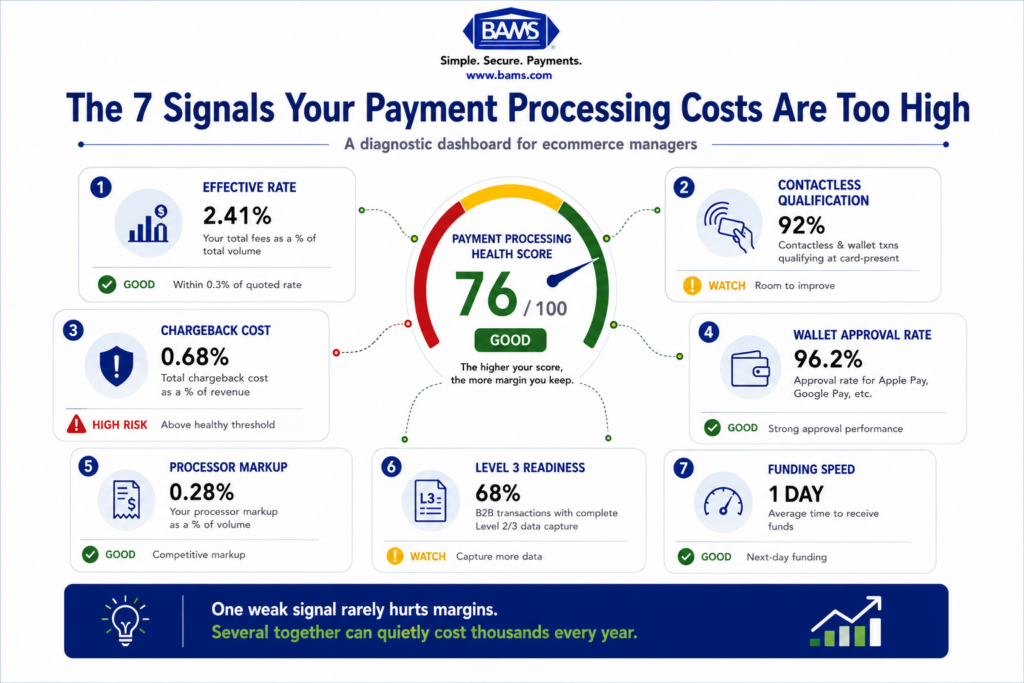
Visa and Mastercard both enforce chargeback ratio thresholds (generally 0.9% to 1% of transactions). Exceeding these thresholds places you in a monitoring program that comes with additional fees, mandatory remediation plans, and in severe cases, loss of your ability to accept card payments entirely. As mobile wallet volume grows as a share of your total transactions, wallet-related disputes have an increasingly outsized impact on this ratio.
Track your chargeback ratio weekly, not monthly. A sudden spike from a promotional campaign, a fulfillment delay, or a batch of friendly fraud can push you over the threshold before a monthly review catches it. Your payment processor should provide this data, and if they don’t, that’s a red flag about the level of support you’re receiving.
This is where the relationship between your fraud prevention strategies and your processing partner becomes critical. A processor that offers proactive chargeback alerts (notifications when a dispute is filed but before it becomes a formal chargeback) gives you a window to issue a refund and avoid the chargeback entirely. This costs you the sale amount but protects your ratio, which protects your ability to process payments at all.
Anti-patterns: Don’t ignore chargeback ratio warnings from your processor. The escalation from “warning” to “monitoring program” to “account termination” happens faster than most merchants expect, often within 60 to 90 days.
Success indicators: You know your current chargeback ratio to two decimal places. You have a process for issuing preemptive refunds on disputes you can’t win. Your ratio has remained below 0.65% for the trailing three months.
Practical Examples: How This Plays Out in Real Scenarios

Winning more chargeback disputes starts long before a dispute is filed. A structured defense framework protects both revenue and merchant processing relationships.
Scenario A: The Unrecognized Charge
An online retailer selling home goods notices a spike in “fraud” reason code chargebacks on Apple Pay transactions. Investigation reveals that their billing descriptor reads “HG DISTRIB LLC” instead of their consumer brand name. Customers see the charge, don’t recognize it, and file a dispute with their bank claiming unauthorized use. The fix takes one call to their processor and two business days to propagate. Chargebacks from this reason code drop by 40% within the next billing cycle.
Scenario B: The Serial Friendly Fraudster
A mid-size eCommerce brand selling electronics identifies one customer who has placed 11 orders over six months and filed chargebacks on four of them, all via Apple Pay, all with “product not received” as the reason code. Carrier tracking shows delivery confirmation for every order. The merchant flags the account, submits compelling evidence for the open disputes (winning three of four), and blocks the customer from future purchases. Estimated annual revenue saved: $3,200 in reversed chargebacks plus avoided chargeback fees.
Scenario C: The Post-Promotion Spike
After a flash sale drives a 300% increase in Apple Pay transaction volume, a fashion retailer sees their chargeback ratio jump from 0.4% to 1.1% within three weeks. The cause: fulfillment delays pushed shipping times from 3 days to 12 days, and customers who didn’t receive tracking updates assumed orders were lost. The retailer implements automated shipping delay notifications, extends their estimated delivery window on the product page, and adds a self-service order status page. Their ratio returns to 0.5% within 45 days.
Common Mistakes and Pitfalls
Assuming tokenization equals chargeback protection. This is the most expensive misconception in mobile wallet payments. Tokenization protects card data. It does not protect your revenue from disputes. Apple Pay’s fraud rate reflects unauthorized fraud prevention, not friendly fraud prevention.
Treating all chargebacks as a cost of doing business. Many SMB merchants accept chargebacks without contesting them, either because they don’t know they can or because the process seems too complex. Every uncontested chargeback is revenue you surrendered without a fight and a data point you lost for pattern detection.
Over-filtering legitimate transactions. In response to fraud concerns, some merchants implement aggressive fraud filters that block legitimate Apple Pay transactions. This creates invisible revenue loss (customers who are declined and never return) that often exceeds the chargebacks it prevents.
Ignoring the operational challenges of accepting digital wallets until disputes force attention. Proactive setup and integration work prevents reactive firefighting.
What to Do Next
Start with Step 1. Pull your transaction reports this week and segment mobile wallet payments from traditional card payments. If your processor can’t provide this segmentation, that’s your first actionable insight: you may need a processing partner that gives you the visibility required to protect your revenue.
Then pick the one step in this guide that addresses your most immediate pain point. If you’re already seeing Apple Pay chargebacks, jump to Step 3 and build your dispute response process. If your chargeback rate is low but your wallet volume is growing fast, focus on Step 2 and get your evidence architecture in place before you need it.
This isn’t a checklist to complete in a weekend. It’s a reference framework you’ll return to as your mobile wallet transaction mix evolves. Revisit your metrics quarterly, adjust your fraud detection rules based on what your dispute data tells you, and treat chargeback defense as an ongoing operational process, not a one-time configuration.
Frequently Asked Questions
What is Apple Pay and how does it work for eCommerce transactions?
Apple Pay is a digital wallet that lets customers pay using tokenized card credentials stored on their Apple device. For eCommerce, the customer authenticates with Face ID or Touch ID, and a Device Account Number (DAN) with a one-time security code is transmitted instead of their actual card number. The merchant never receives or stores the real card data. Mastercard Developers provides technical documentation describing tokenized payment credentials and secure digital payment implementations used throughout modern payment ecosystems. For a practical overview of setup and benefits, see our guide on Apple Pay for merchants.
Does Apple Pay eliminate chargebacks for merchants?
No. Apple Pay’s tokenization and biometric authentication significantly reduce unauthorized fraud, but they do not prevent chargebacks. Customers can still dispute Apple Pay transactions for reasons like “product not received,” “not as described,” or even “unauthorized” claims. For card-not-present eCommerce transactions, the merchant remains liable for these disputes regardless of the payment method used. Visa’s payment processing guidance explains the roles of merchants, issuers, acquirers, and payment networks throughout the transaction lifecycle, highlighting why merchants must still manage dispute risk for eCommerce transactions.
Which fraud patterns are commonly associated with Apple Pay transactions?
The most common pattern is friendly fraud (first-party misuse), where a legitimate cardholder makes a real purchase, authenticates with biometrics, and later disputes the charge. Other patterns include family fraud (a household member uses the device owner’s Apple Pay without explicit permission) and confusion-driven disputes (customers don’t recognize the billing descriptor on their statement). Traditional stolen-card fraud is significantly less common with Apple Pay due to the biometric requirement.
How does merchant liability work differently for Apple Pay versus traditional card payments?
For in-store contactless (NFC) payments, the liability shift that applies to chip transactions generally protects the merchant. For online (card-not-present) Apple Pay transactions, the merchant bears the same liability as any other CNP transaction. Tokenization does not change who is responsible for the chargeback. If a customer disputes an online Apple Pay purchase, the merchant must provide evidence to contest it or absorb the loss.
What evidence do I need to win an Apple Pay chargeback dispute?
The evidence depends on the reason code.
- For “fraud” claims, you need proof the transaction was authenticated on the cardholder’s device, shipped to a known address, and ideally linked to prior successful orders.
- For “product not received” claims, carrier tracking with delivery confirmation is essential.
- For “not as described” claims, product page screenshots, return policy documentation, and customer service interaction logs are your primary defense.
Collecting this evidence proactively (before a dispute occurs) dramatically improves your win rate.
When should merchants consider enabling Apple Pay as a payment option?
If your customer base includes mobile shoppers (which, for most eCommerce businesses, it does), enabling Apple Pay reduces checkout friction and can improve conversion rates. The key is to enable it with the right operational infrastructure in place: clear billing descriptors, automated post-purchase communications, evidence archival processes, and a structured dispute response plan. Accepting Apple Pay without these safeguards increases your revenue but also increases your unprotected exposure to chargebacks.