
Apple Pay Transaction Fees: The Hidden Cost Beyond the Rate
Last Updated on October 7, 2026 by Dimitri Akhrin
Why digital wallet economics require system-level analysis of fees, settlement lag, and working capital drag
Learn why Apple Pay transaction fees cost more than the per-transaction rate suggests. This analysis covers how settlement timing and working capital drag quietly erode eCommerce margins when digital wallets are treated as a checkout feature instead of a cash flow variable.
TL;DR
- Apple Pay fees aren’t the problem – Apple charges merchants nothing extra. Your real cost is interchange, processor markup, and gateway fees, the same as any card sale.
- Settlement lag is the hidden margin killer – Many processors hold digital wallet funds for 2-3 business days, creating a working capital drag that costs more than a few basis points on rate ever could.
- Model the full system, not just the rate – Evaluate Apple Pay cost as per-transaction fee plus settlement speed plus working capital impact. That’s the complete picture.
- Time-to-cash is the metric that matters – Next-day funding turns Apple Pay from a cash flow liability into a competitive advantage. Ask your processor when you get paid, not just how much it costs.
The Checkout Button Nobody Audits
Every eCommerce team celebrates the moment a customer taps “Pay with Apple Pay.” Conversion up. Friction down. But almost nobody follows the money after that tap. Where does it go? When does it land? And what does the delay between sale and deposit actually cost your business?
Apple Pay transaction fees don’t show up as a scary line item. That’s exactly why they’re dangerous. The real cost hides in the days between a completed sale and cash you can actually use.
Why Everyone Treats Digital Wallets Like a Free Upgrade
The prevailing wisdom in eCommerce is simple: enable Apple Pay, watch conversions climb, move on. Most content about accepting digital wallets focuses on setup guides, device compatibility, and the security benefits of tokenization. And that advice isn’t wrong. Contactless payments do reduce cart abandonment. Customers do prefer them.
But here’s what that narrative leaves out: Apple Pay doesn’t bypass card economics. Apple itself charges no fees for purchases made through the wallet. The cost comes from your processor, your gateway, and the card networks underneath. That means Apple Pay inherits every inefficiency already baked into your payment stack.
The industry has conditioned merchants to evaluate Apple Pay at the surface level: “Does it cost more per transaction than a regular card swipe?” The answer is usually no. So the conversation ends there. It shouldn’t.
The Real Variable Isn’t the Rate. It’s the Calendar.
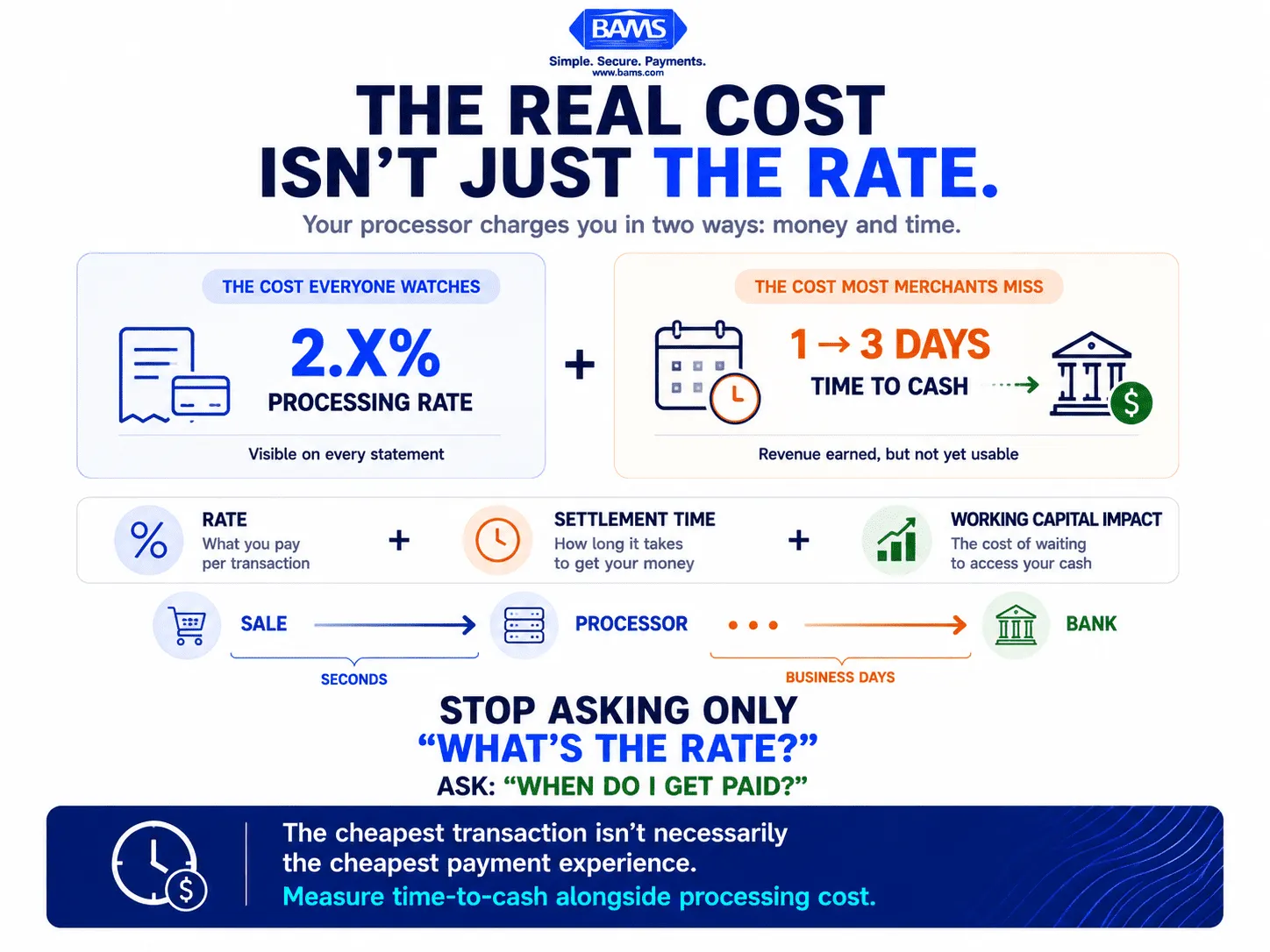
We believe the biggest cost of mobile wallet transactions isn’t the processing fee. It’s the settlement lag that most processors impose on digital wallet sales, quietly turning your revenue into someone else’s float. That’s the thesis, and the math backs it up.

Processing rates tell you what a transaction costs. Settlement timing tells you how long you have to wait before that revenue becomes usable.
Apple Pay Transaction Fees Are Only Half the Equation
Let’s break down what actually happens after a customer pays with Apple Pay on your site.
The transaction flows through your payment gateway, hits your processor, travels the card network, and eventually settles into your merchant account. Visa’s payment processing guidance shows how gateways, processors, networks, and other parts of the payment infrastructure work together to move digital transactions. Your actual processing cost depends on the underlying card and your processor’s pricing arrangement. So far, no surprise.
But settlement timing varies wildly by processor. Some batch Apple Pay transactions differently than standard card-present sales. Some hold funds for 48 to 72 hours. A few impose rolling reserves on digital wallet volume. And if your processor treats Apple Pay as a card-not-present transaction (which many do for eCommerce), you may be sitting in a longer settlement window than you realize.
The Working Capital Drag Nobody Calculates
Consider a mid-size eCommerce operation doing $300,000 per month in revenue, with 35% of transactions coming through Apple Pay or other NFC payments. That’s $105,000 flowing through digital wallets monthly.
If your processor settles those funds in three business days instead of one, you’re carrying roughly $15,000 in inaccessible revenue at any given time. That’s cash you can’t reinvest in inventory, can’t use for ad spend, can’t deploy for payroll. Over a year, the opportunity cost compounds in ways that dwarf the difference between a 2.6% and a 2.4% processing rate.
This is the blind spot. eCommerce managers obsess over basis points on interchange while ignoring the calendar. Federal Reserve data shows how interchange fees vary across debit card networks and transaction categories, reinforcing why the underlying payment mix matters when evaluating processing costs. Merchants negotiate hard on rate and never ask: “When do I actually get my money?”
For a business processing significant digital wallet volume, a few extra days between sale and deposit can leave meaningful working capital in transit.
The System-Level View
A proper cost analysis of Apple Pay for business requires three inputs, not one:
- Per-transaction cost: Interchange + processor markup + gateway fee. This is table stakes. Apple confirms no additional merchant fees beyond standard card processing.
- Settlement speed: How many business days until funds are depositable? Does your processor treat wallet transactions differently from standard card sales?
- Working capital impact: What’s the cost of delayed access to revenue? Factor in missed early-payment vendor discounts, higher credit line utilization, and slower reinvestment cycles.
When you model all three together, the “free” checkout enhancement starts looking like a meaningful cash flow variable. Tools like BAMS, which offers next-day funding on merchant deposits, can compress that settlement window from days to hours, turning Apple Pay from a cash flow drag into a genuine advantage. The difference isn’t theoretical. It shows up in your bank balance every morning.
What Changes If You Start Measuring Settlement, Not Just Rates
If this framing is right, several things shift for eCommerce operators. First, processor selection becomes a cash flow decision, not just a rate negotiation. The cheapest per-transaction cost means nothing if your funds are locked up for three days while your competitors reinvest theirs overnight.
Second, your Apple Pay integration strategy changes. Instead of treating it as a mobile commerce checkbox, you start modeling it as a working capital lever. What percentage of your volume flows through digital wallets? What’s the settlement delta versus standard card payments? What would next-day access to those funds unlock?
Third, you stop benchmarking against published rates and start benchmarking against time-to-cash. That’s the metric that actually moves your margin.
A Better Way to Think About Payment Speed
Here’s the reframe we keep coming back to: your payment processor isn’t a cost center. It’s a lending relationship you never agreed to.
Every day your processor holds your settled funds is a day they’re earning interest on your revenue. That’s not a conspiracy. It’s just how the economics work. The question is whether you’ve consciously agreed to that arrangement or stumbled into it because nobody told you to ask about settlement timing when you enabled Apple Pay for your business.
Once you see it this way, the conversation with your processor changes entirely. You stop asking “What’s your rate?” and start asking “When do I get paid?”
The Tap Is Just the Beginning
Digital wallet adoption will keep climbing. Contactless payments are not a trend to evaluate. They’re infrastructure to optimize. The merchants who win won’t be the ones who enabled Apple Pay first. They’ll be the ones who understood what happened after the tap, and refused to let their revenue sit in someone else’s account a single day longer than necessary.
Frequently Asked Questions
Does Apple charge merchants extra fees for Apple Pay transactions?
No. Apple collects a small fee from the issuing bank, not from merchants. Your costs come from your payment processor, gateway, and the card networks, the same stack that handles any card transaction.
Why do Apple Pay deposits sometimes take longer than regular card sales?
Many processors batch digital wallet transactions separately or classify them as card-not-present, which can trigger longer settlement windows. The delay depends on your processor’s policies, not on Apple Pay itself.
How can I get faster access to funds from mobile wallet sales?
Choose a merchant services provider that offers next-day funding on all transaction types, including digital wallets. Then confirm in writing that Apple Pay sales settle on the same timeline as standard card payments.


