Chargeback Fees vs Interchange Fees: Which Costs More?
Last Updated on April 28, 2026 by Dimitri Akhrin
A side-by-side comparison to help eCommerce owners decide where to focus their cost-reduction efforts first
Learn which payment fee deserves your attention first. This comparison breaks down the true costs of chargeback and interchange fees, with a decision framework for businesses processing $500K or more annually.
TL;DR
- Chargeback fees hurt more per incident – Each dispute costs an average of $190 total when you factor in lost product, labor, and bank fees, not just the $10-50 processor fee.
- Interchange fees add up at volume – At 1.30%-2.90% per transaction, these predictable costs become significant for high-volume merchants processing thin margins.
- Prioritize chargebacks if your rate exceeds 0.5% – You’re approaching monitoring program territory where penalties escalate quickly and threaten your ability to accept cards.
- Chargebacks offer more reduction opportunity – Prevention strategies can cut dispute rates 30-50%, while interchange rates are largely set by card networks.
- Address both systematically – Start with chargeback prevention for the higher ROI, then optimize interchange rates once disputes are under control.
The Real Cost Battle: Chargeback Fees vs. Interchange Fees
You check your monthly statement and see two line items eating into your margins: interchange fees on every transaction and chargeback fees from disputed purchases. Both hurt, but which one deserves your immediate attention?
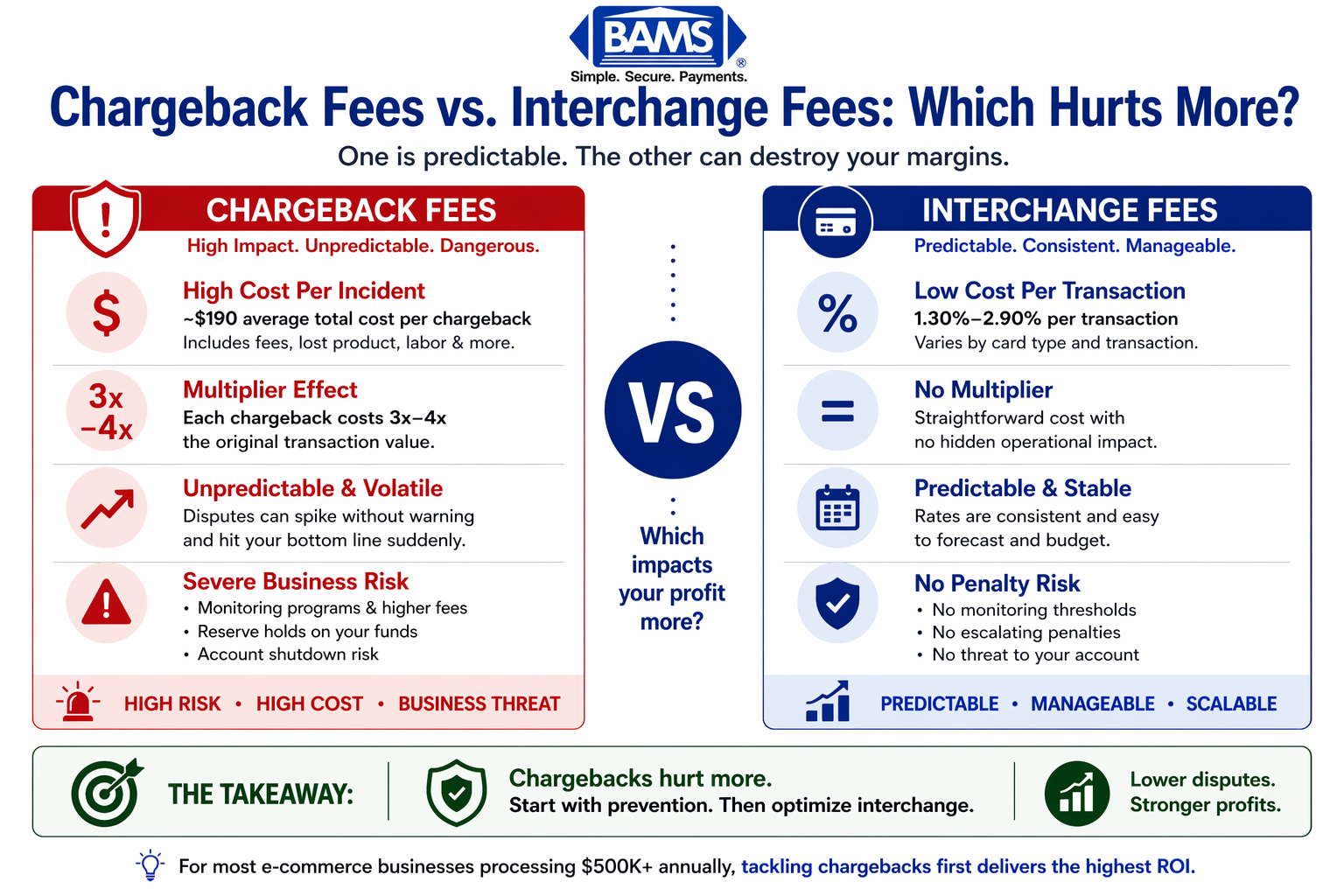
A side-by-side comparison showing why chargeback fees create higher financial risk and impact than interchange fees.
This comparison helps you identify where your money actually goes. We’ll break down the true cost of each fee type, show you which scenarios make one worse than the other, and give you a clear path to reduce both. If you’re managing payments for an established eCommerce operation, this decision framework will help you prioritize your next move.
Quick Verdict: Where to Focus First
Choose to tackle chargeback fees first if your dispute rate exceeds 0.5% or you’ve noticed an uptick in friendly fraud. The multiplier effect makes each chargeback cost 3-4 times the original transaction value.
Choose to prioritize interchange fees if your chargeback rate stays below 0.3% and you process high volumes of credit card transactions. Small percentage reductions compound into significant annual savings.
For most eCommerce businesses processing $500K or more annually, chargebacks represent the bigger threat to profitability, even if interchange fees look larger on your statement.
|
Criterion |
Chargeback Fees |
Interchange Fees |
Winner (Lower Impact) |
|---|---|---|---|
|
Cost Per Incident |
$190 average total cost |
1.30%-2.90% per transaction |
Interchange (predictable) |
|
Controllability |
Moderate (prevention possible) |
Low (set by card networks) |
Chargeback fees |
|
Hidden Costs |
Extreme (labor, lost product, reputation) |
Minimal beyond stated rate |
Interchange fees |
|
Scalability Risk |
Compounds with growth |
Linear with volume |
Interchange fees |
|
Threshold Penalties |
Yes (monitoring programs) |
No |
Interchange fees |
How We’re Comparing These Fees
Not all payment costs deserve equal attention. Here’s how we’ll evaluate chargeback fees against interchange fees across dimensions that matter to your bottom line.
Direct Cost Per Transaction
The actual dollars leaving your account for each fee type. This baseline comparison reveals the surface-level impact before hidden costs enter the picture.
Total Cost of Ownership
Beyond the fee itself, what does each cost you in labor, lost inventory, and operational disruption? This multiplier effect often determines which fee truly hurts more.
Predictability and Control
Can you forecast this cost accurately? Can you reduce it through operational changes? Fees you can control deserve different strategic treatment than fixed costs. Modern payment systems emphasize transparency and cost visibility, helping businesses better understand and manage transaction-level expenses according to Modern Treasury.
Threshold and Penalty Risk
Some fees trigger escalating consequences when they exceed certain levels. Understanding these cliffs helps you avoid catastrophic outcomes.
Reduction Difficulty
How much effort, technology, or negotiation does it take to meaningfully lower each fee type? Your resources are limited, so ROI on reduction efforts matters.
Head-to-Head Breakdown
Direct Cost Per Transaction
Chargeback fees hit you with a flat penalty ranging from $10 to $50 per dispute depending on your payment processor. You pay this fee regardless of whether you win or lose the dispute. It’s a guaranteed loss the moment a customer files.
Interchange fees take a percentage of each transaction, typically 1.30% to 2.90% depending on card type and transaction method. On a $100 sale, you’ll pay $1.30 to $2.90. These fees are predictable and apply uniformly across your transaction volume. Interchange fees are set by card networks and issuing banks, forming the largest component of card acceptance costs, as outlined by the Federal Reserve.
Verdict: Interchange fees cost less per incident but occur on every transaction. Chargeback fees hit harder individually but (hopefully) happen less frequently. If your chargeback rate stays low, interchange represents your larger total expense.
Total Cost of Ownership
Chargeback fees carry a devastating multiplier. The average chargeback costs merchants $190 per dispute when you factor in the transaction value, shipping costs, bank fees, and labor to fight it.
Interchange fees have minimal hidden costs. The rate you see is essentially the rate you pay. Assessment fees from card networks add a small percentage on top, but there’s no labor cost or lost inventory to account for.
Verdict: Chargebacks win this category decisively for worst impact. A single chargeback can wipe out the profit from 10-20 successful transactions. Interchange fees, while constant, don’t carry this multiplier effect.
Predictability and Control
Chargeback fees offer moderate control through prevention strategies. Better fraud detection, clearer billing descriptors, and proactive customer service can reduce dispute rates. However, friendly fraud (customers disputing legitimate purchases) remains difficult to prevent entirely.
Interchange fees give you limited control. Card networks set these rates, and while you can influence them slightly through card-present vs. card-not-present processing or encouraging debit over credit, the core rates are non-negotiable.
Verdict: Chargeback fees offer more reduction opportunity. Your operational choices directly impact dispute rates, while interchange fees remain largely fixed by external parties.
Threshold and Penalty Risk
Chargeback fees carry severe threshold penalties. Visa and Mastercard place merchants in monitoring programs when dispute rates exceed 0.9-1%. These programs bring additional fees, mandatory action plans, and potential account termination. Chargebacks often stem from customer disputes over unrecognized or unclear transactions, making them a critical risk factor for merchants as outlined by Visa.
Interchange fees have no threshold penalties. Whether you process $10,000 or $10 million monthly, the percentage stays consistent. High volume might qualify you for better rates, but there’s no cliff where costs suddenly spike.
Verdict: Chargeback fees pose existential risk. Crossing monitoring thresholds can threaten your ability to accept cards at all. Interchange fees never carry this danger.
Reduction Difficulty
Chargeback fees require investment in prevention tools, customer service improvements, and dispute management processes. The effort pays off: proactive chargeback defense can cut dispute rates by 30-50%. Partners who specialize in chargeback prevention can handle much of this work for you. Investing in proactive chargeback defense solutions can significantly reduce dispute rates and prevent costly penalties before they escalate.
Interchange fees require negotiation with your merchant services provider or switching processors entirely. You might save 0.1-0.3% through better pricing structures, but the card networks control the base rates. Transparent pricing models help you understand exactly what you’re paying.
Verdict: Both require effort, but chargeback reduction offers higher ROI. Cutting your dispute rate in half could save thousands monthly. Shaving 0.2% off interchange helps, but the impact is smaller per dollar of effort.
Use Case Mapping: Which Fee to Prioritize
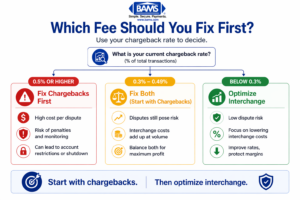
A simple decision framework to help eCommerce businesses determine whether to prioritize reducing chargebacks or optimizing interchange fees.
If You Sell High-Ticket Items ($200+)
Prioritize chargeback prevention. A single disputed $500 order costs you roughly $950 in total losses. That same order only generated $7-15 in interchange fees. The math is clear: one prevented chargeback saves you more than months of interchange optimization.
If You Process High Volume, Low Margin
Focus on interchange fees first. When you’re processing thousands of $20 transactions with thin margins, the cumulative interchange cost exceeds your chargeback exposure. Every 0.1% reduction matters at scale.
If Your Chargeback Rate Exceeds 0.5%
Drop everything and address chargebacks immediately. You’re approaching monitoring program territory, and the consequences escalate quickly.
If You’re Growing Rapidly
Build chargeback prevention infrastructure now. Dispute rates often climb with growth as fraud attempts increase and customer service gets stretched. The systems you implement today prevent crisis management tomorrow.
If Neither Fee Seems Urgent
Review your complete fee structure including assessment fees, PCI compliance fees, and monthly minimums. Sometimes the biggest savings hide in overlooked line items rather than the obvious categories.
What Both Fee Types Get Wrong
Neither chargeback fees nor interchange fees align merchant interests with customer experience. Interchange fees punish you for accepting the payment methods customers prefer. Chargeback fees penalize you even when you’ve done nothing wrong.
The payment industry has built a system where merchants absorb risk from all directions. Card networks profit regardless of outcomes. Until fundamental reform happens, your job is to minimize exposure on both fronts while maintaining the payment flexibility your customers expect.
Switching Costs and Lock-In Factors
Changing your approach to either fee type involves transition costs worth considering.
For Chargeback Management
Implementing prevention tools requires integration time (typically 1-2 weeks) and staff training. If you’re switching chargeback management partners, expect a 30-60 day overlap period to ensure continuity. The good news: your transaction history travels with you, and prevention strategies compound over time.
For Interchange Optimization
Switching payment processors involves more friction. You’ll need to update payment integrations, potentially re-enter customer payment methods, and manage a transition period where both systems run simultaneously. Most merchants find this worthwhile only when savings exceed 0.3-0.5% on interchange, enough to justify 2-4 weeks of implementation effort.
Understanding interchange costs becomes easier with transparent interchange plus pricing, which clearly separates network fees from processor markup and eliminates hidden pricing structures.
Consider working with a merchant services provider who offers both competitive interchange rates and proactive chargeback defense. Consolidating these relationships simplifies your payment operations and often unlocks better pricing.
Final Recommendation
For most established eCommerce businesses, chargeback fees deserve priority attention. The multiplier effect, threshold risks, and controllability make them the higher-impact target. A 0.2% reduction in dispute rate often saves more than a 0.2% reduction in interchange fees.
That said, don’t ignore interchange entirely. Once your chargeback rate sits comfortably below 0.5%, turn your attention to payment processing costs. Transparent pricing from your merchant services provider helps you identify exactly where those dollars go.
The businesses that win at payment optimization address both fee types systematically. Start with chargebacks because the downside risk is higher. Then optimize interchange because the savings compound over time. Your payment costs should be predictable, not a monthly surprise.
Frequently Asked Questions
What are credit card processing fees and how are they calculated?
Credit card processing fees include interchange fees (paid to the card-issuing bank), assessment fees (paid to card networks like Visa and Mastercard), and processor markup (your payment processor’s profit). Interchange makes up the largest portion, typically 1.30% to 2.90% depending on card type, transaction method, and merchant category. These rates are set by card networks and adjusted twice yearly.
Why do merchants have to pay processing fees for credit card transactions?
Processing fees compensate the parties that make card acceptance possible. The issuing bank takes on fraud risk and extends credit to cardholders. The card network maintains the payment infrastructure. Your processor handles the technical connection and customer service. Each party takes a cut for their role in moving money from customer to merchant.
How can businesses minimize their credit card processing fees?
Start by negotiating with your merchant services provider for interchange-plus pricing, which shows exactly what you pay. Encourage debit card use when possible (lower interchange rates). Ensure transactions qualify for the best rates by including all required data fields. For chargeback fees specifically, invest in fraud prevention tools and clear billing descriptors to reduce disputes before they happen.
Which types of transactions incur higher processing fees?
Card-not-present transactions (online and phone orders) cost more than card-present (in-store) because of higher fraud risk. Rewards cards and corporate cards carry higher interchange than basic cards. International transactions add cross-border fees. Keyed-in transactions cost more than swiped or chip-read transactions. eCommerce merchants typically pay the highest rates due to these risk factors.
What happens if my chargeback rate gets too high?
Card networks place high-chargeback merchants into monitoring programs when dispute rates exceed 0.9-1%. These programs bring additional monthly fees ($10,000-$25,000), mandatory remediation plans, and increased scrutiny. Continued high rates can result in account termination, placement on the MATCH list (making it difficult to get a new merchant account), and potential fines up to $100,000 per month.
Can I pass credit card processing fees to customers?
Many states allow surcharging (adding a fee for credit card payments), though rules vary. You must disclose the surcharge clearly and cannot charge more than your actual processing cost. Debit cards typically cannot be surcharged. An alternative is offering a cash discount, which frames the same price difference more positively. Check your state regulations and card network rules before implementing either approach.
Sources