Credit Card Surcharging: Infrastructure, Not a Shortcut
The Compliance Trap Hiding in Plain Sight
Credit card surcharging looks simple on the surface. Add a small fee at checkout, recover your processing costs, protect your margins. Thousands of merchants are doing it right now. But a growing number of them are doing it wrong. The consequences range from card-brand fines to state-level legal action to something harder to quantify: lost customers who never come back.
The gap between “we added a surcharge” and “we built a legal compliance program” is where reputations fracture. And most merchants don’t realize they’re standing in that gap until it’s too late.
TL;DR
- Surcharging is a compliance program, not a billing shortcut – State laws, card-brand rules and disclosure requirements create a regulatory patchwork that no single POS toggle can handle.
- Non-compliance carries real costs – J.D. Power found 41% of credit card users decided not to pay by card because of a surcharge. A surcharge customers weren’t warned about adds card-brand and state-law risk on top of lost sales.
- Legal rigor is a competitive advantage – Merchants who verify state-by-state legality, give the required 30-day notice, exclude debit and prepaid cards and disclose transparently protect both margins and customer trust.
- Think of fee recovery as a disclosure system – The right question isn’t “can we add a fee?” but “have we built the infrastructure to do it legally and transparently across every jurisdiction?”
Why Everyone Thinks Credit Card Surcharging Is Just a Pricing Decision
The conventional wisdom is straightforward. Processing fees eat into margins, so you pass them along. It’s math. In the Federal Reserve’s 2024 Report on Payments, fees topped the list of payment challenges small firms face. Owners feel every basis point. When card-brand settlements opened the door to surcharging, merchants understandably rushed through it.
The problem is that most merchants treated this as a billing adjustment, not a regulatory event. They saw a toggle in their POS system, flipped it on and moved on. Some copied what a competitor down the street was doing without checking whether that competitor was even compliant. The assumption was that if surcharging is legal, then the details don’t matter much.
That assumption is quietly expensive.
Surcharging Isn’t a Tactic. It’s Infrastructure.
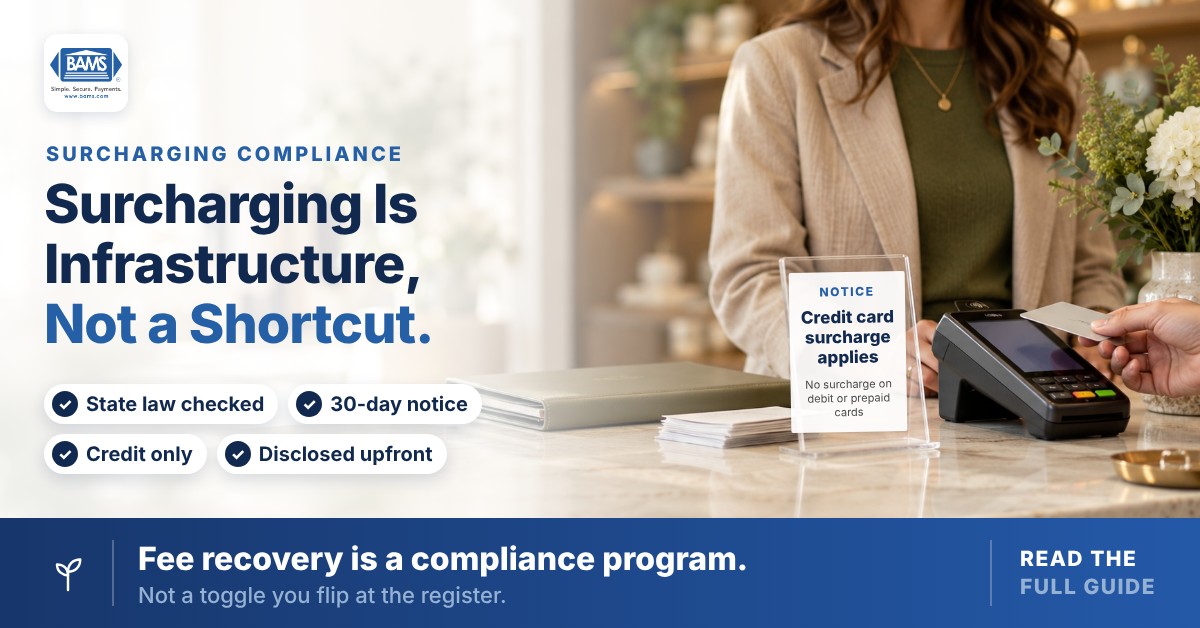
Here’s what we actually believe: fee recovery done right is a compliance program, not a billing hack. Merchants who treat it as infrastructure, with state-by-state legal awareness, card-brand notice, proper disclosure protocols and debit and prepaid exclusions, protect both their margins and their brand. Those who treat it as a shortcut are building on sand.
The State-by-State Minefield That Most Merchants Ignore
Credit card surcharging is not uniformly legal across the United States. According to the NFIB Legal Center 2025 surcharge guide, Connecticut and Massachusetts prohibit credit card surcharges, Maine bars private businesses from adding them and California does not allow adding one at the register. The status in Texas and Oklahoma is unclear. Others impose caps or disclosure rules: Colorado caps surcharges at 2% and New York requires merchants to post the total price for paying by credit card. A merchant operating in multiple states, or selling online to customers across state lines, faces a patchwork of obligations that no single POS setting can handle.
And the card brands add their own layer. Visa requires merchants to notify their acquirer at least 30 days before they start surcharging and caps the surcharge at the merchant’s cost of acceptance (no more than 3%). Customers must be told at the point of entry and the point of sale and the surcharge must appear separately on the receipt. Mastercard requires 30 days’ notice to both Mastercard and the acquirer and caps surcharges at 4% or the merchant’s average effective discount rate, whichever is lower. Neither brand allows a surcharge on debit or prepaid cards, even when a debit card is run as credit.
So a surcharge the customer never saw coming is not just a customer experience failure. It breaks card-brand disclosure rules and, in some states, state law.
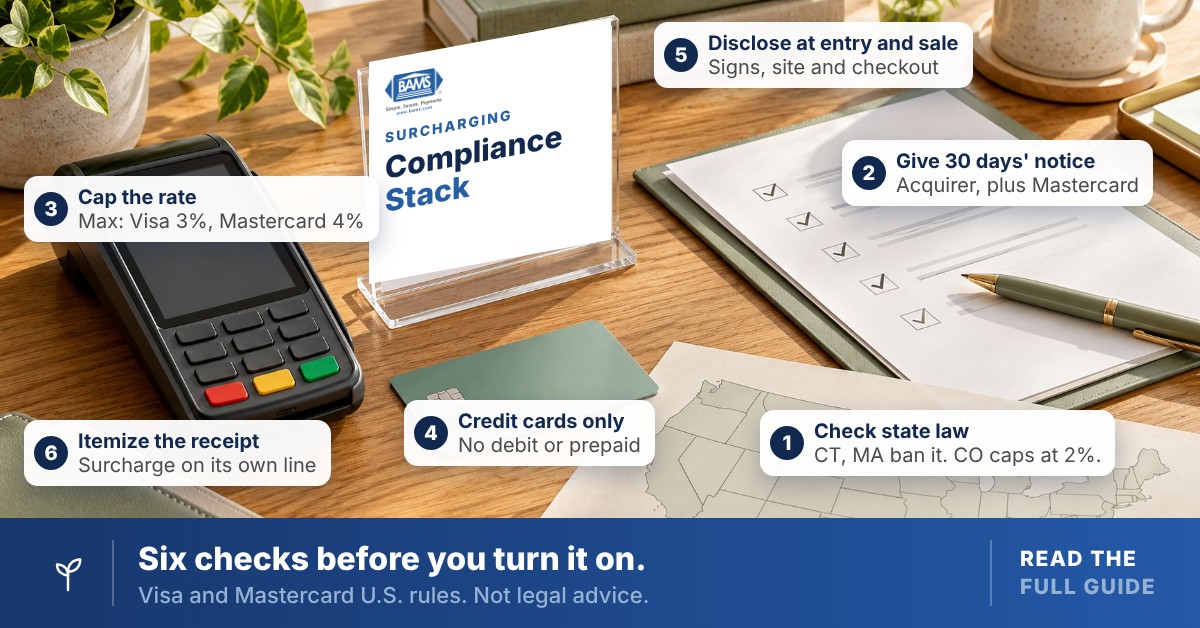
Six checks before you turn on a credit card surcharge. Not legal advice.
The Customer Cost No One Calculates
The financial risk of non-compliance is real, but the reputational cost may be larger. In J.D. Power research released in January 2025, 41% of credit card users said they decided not to use a card because of a surcharge. Some of those customers pay another way. Others take their business somewhere else.
For a small business, losing even a few regular customers can cost more than the processing fees the surcharge was meant to recover.
The lesson isn’t “don’t surcharge.” The lesson is that surcharging without proper disclosure, without state-level legal compliance and without customer communication design is a net-negative decision disguised as a cost-saving one.
What Rigorous Business Protection Actually Looks Like
Merchants who get this right tend to share a few characteristics. They verify legality in every state where they transact, not just their home state. They give the card brands and their acquirer the required notice before activating surcharges. Their POS and eCommerce systems separate credit from debit and prepaid transactions cleanly. Clear signage (physical and digital) meets both state and card-brand disclosure requirements. And they monitor for regulatory changes, because this landscape shifts.
This is where working with a knowledgeable payment processor matters. At BAMS, a dedicated account representative can help you confirm terminal, receipt and card-type settings before you turn a surcharge on. Our guide to eCommerce interchange fees versus surcharges walks through the decision itself. A partner that understands the regulatory layer, not just the transaction layer, helps turn fee recovery from a liability into a legitimate margin strategy.
Roughly four in five small employer firms reported at least one payments-related challenge, with fees topping the list. The demand for cost relief is real. But relief without rigor is just risk with a different name.
If This Is Right, the Stakes Are Higher Than You Think
If fee recovery is truly a compliance program, then every merchant currently surcharging without state-level verification, without card-brand notice or without proper disclosure is carrying unpriced risk on their books. That risk shows up as fines passed through by the acquirer, disputes, customer attrition or all three at once.
It also means that the merchants who do invest in legal compliance gain a quiet competitive advantage. Their surcharges hold up to scrutiny. Customers feel informed rather than ambushed and processor relationships stay clean. In a market where four in ten card users will change how they pay over a surcharge, “doing it right” isn’t overhead. It’s brand investment.
The cost of compliance is visible. The cost of non-compliance is invisible until it isn’t.
A Better Way to Think About Fee Recovery
Stop thinking of credit card surcharging as a line item and start thinking of it as a disclosure system. The question isn’t “can we add a fee?” The question is “have we built the infrastructure to add a fee legally, transparently and in a way that preserves customer trust across every state and channel where we operate?”
That reframe changes everything. It moves the conversation from finance to operations, from a quick fix to a durable program. It forces the right questions: Did we give notice? Are we compliant in every jurisdiction? Do we exclude debit and prepaid properly? Are we disclosing before the transaction, not after?
Compliance isn’t the cost of doing surcharging. Compliance is what makes surcharging worth doing.
The Merchants Who Win This Game
The merchants who recover processing costs successfully over the long term are not the ones who moved fastest. They’re the ones who moved most carefully. They treated fee recovery as a system, not a switch. They understood that legal compliance and customer experience are not separate concerns but two sides of the same decision.
In a landscape where the rules vary by state, the card brands enforce their own standards and about four in ten card users will change their behavior when they see a surcharge, precision is the only sustainable strategy.
Frequently Asked Questions
Is credit card surcharging legal in every U.S. state?
No. Connecticut and Massachusetts prohibit credit card surcharges, Maine and California restrict them and Texas and Oklahoma are unclear. Merchants must verify legality in every state where they transact, including for online sales across state lines.
Can I apply a surcharge to debit card transactions?
No. Visa and Mastercard rules prohibit surcharges on debit and prepaid cards, even when a debit card is processed as a credit transaction. Your POS system must distinguish between card types to remain compliant.
What happens if I surcharge without notifying the card brands?
Visa requires merchants to notify their acquirer at least 30 days before surcharging and Mastercard requires 30 days’ notice to both Mastercard and the acquirer. Skipping notice or breaking the rules can lead to non-compliance fines that acquirers may pass on to you. It can also trigger a review of your merchant account.
Sources
- Visa: Merchant Surcharging Considerations and Requirements
- Mastercard: Merchant Surcharge Rules (U.S.)
- NFIB Legal Center: Credit Card Surcharge and Cash Discount Laws Guide, 2025
- J.D. Power: Many Small Businesses Add Card Payment Surcharges to Customer Purchases (2025 U.S. Merchant Services Satisfaction Study)
- Federal Reserve Banks: 2024 Report on Payments, Findings from the 2023 Small Business Credit Survey