
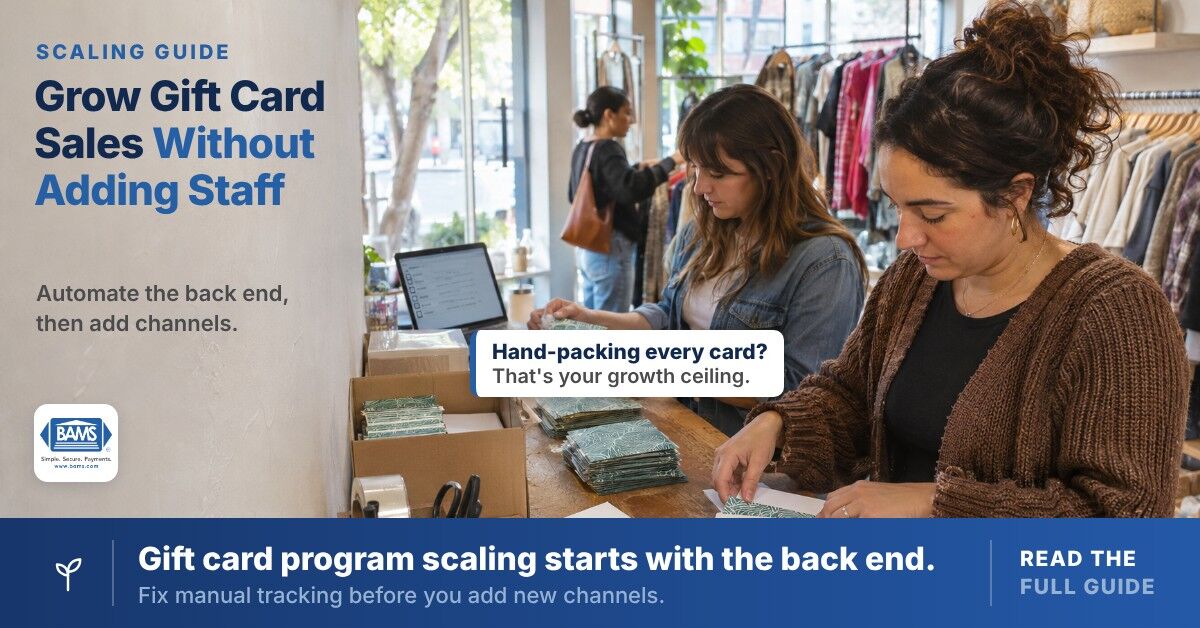
Gift Card Program Scaling: A Guide for Small Businesses
Guide Orientation: What This Covers and Who It’s For
This guide is about gift card program scaling for small businesses that already sell gift cards but have hit a revenue ceiling. If you run a restaurant, retail shop, salon, or service business and your gift card sales have plateaued, this is built for you.
By the end, you’ll understand why most small gift card programs stall, how to expand your gift card sales channels without hiring more staff and how to build a system that grows revenue on its own. You’ll walk away with a repeatable framework for removing the manual bottlenecks that keep your program small.
This guide does not cover launching a gift card program from scratch, enterprise platform migrations, or open-loop (Visa/Mastercard branded) gift card strategies. It assumes you already have a closed-loop gift card program in place and want to make it produce more revenue without producing more work.
TL;DR
- Gift card plateaus are a systems problem, not a demand problem – Shoppers still want gift cards, so channel execution and denomination strategy usually matter more than raw customer demand.
- Automate before you expand – Manual balance tracking and reconciliation are the hidden ceiling that prevents multi-channel growth. Fix the back end first, then add digital sales and B2B channels.
- Digital gift cards are your highest-leverage next channel – They need no physical inventory or fulfillment labor and sell around the clock without staff involvement.
- Connect gift cards to your marketing calendar and loyalty program – Promotions that tie gift card purchases to loyalty rewards can drive dramatic short-term revenue spikes with minimal operational effort.
- Use redemption data to optimize continuously – Track which denominations drive the most overspend, how quickly cards are redeemed and which channels produce the highest-value sales. Let data guide your next move, not assumptions.
Why Gift Card Revenue Growth Is a Systems Problem
Most small business owners assume their gift card sales have plateaued because customer demand has leveled off. Yet demand is still there. The National Retail Federation expected holiday gift card spending to reach $29 billion in 2025 and gift cards ranked as the second-most popular holiday gift. So the businesses growing their gift card revenue aren’t necessarily finding new demand. They’re selling smarter: through better denomination mixes, digital availability and expanded channel execution.
Meanwhile, the cost of ignoring this is clear. Every month your program depends on a single point of sale and a staff member remembering to mention gift cards, you’re leaving revenue on the table. You’re also missing the compounding benefit of gift cards as a foot-traffic tool. After all, gift card holders come back. They often spend above the card’s value. And they frequently bring someone with them.
The real constraint isn’t demand. It’s that your program was designed for a single channel, managed by a person and never rebuilt for scale. Gift card program scaling is not a staffing problem. It’s a systems problem. And systems problems respond to better architecture, not more labor.
In fact, small operators don’t need enterprise platforms. They need smarter workflows, automated reconciliation and the ability to sell across multiple touchpoints without multiplying the hours spent managing the program. This guide shows you how to build that.
Core Concepts: What Drives Gift Card Program Growth
Closed-Loop vs. Open-Loop: Why It Matters for Scaling
Closed-loop gift cards are redeemable only at your business. However, open-loop cards (branded Visa, Mastercard) work anywhere. For small businesses focused on driving repeat visits and building loyalty, closed-loop cards are the growth lever. They bring customers back to you, not to a competitor. Every scaling decision in this guide assumes you’re working with closed-loop cards. For a deeper margin comparison, see our guide to closed-loop vs open-loop gift cards.
Channels vs. Volume
Most operators think about gift card program scaling as “sell more cards.” The more useful frame is “sell cards in more places.” For example, a single register is one channel. Your website is another. Email campaigns, social media storefronts, third-party marketplaces and in-app purchasing are all additional channels. Each new channel creates incremental revenue without requiring you to convince more people at the counter.
Manual Reconciliation: The Hidden Ceiling
When gift card balances, sales data and redemption records live in separate systems (or worse, in spreadsheets), every new channel you add multiplies your administrative burden. Therefore, most small programs stall at one or two channels. The operational cost of adding a third becomes prohibitive. Automated gift card reconciliation is the prerequisite for multi-channel growth.
Denomination Strategy
Many buyers reach for a familiar amount like $25. But that doesn’t mean you should only offer $25 cards. Instead, offering a range of denominations (including custom amounts) lets buyers match the card to the occasion, which increases average order value and reduces purchase friction.
The Gift Card Program Scaling Framework: Four Phases of Growth
Gift card program scaling without growing overhead follows a four-phase process. Each phase builds on the previous one and skipping phases creates the exact kind of operational chaos this guide helps you avoid.
- Phase 1: Audit – Identify where your current program leaks time, revenue and data.
- Phase 2: Automate – Remove manual steps from balance tracking, reporting and fulfillment.
- Phase 3: Expand – Add new gift card sales channels that run without daily oversight.
- Phase 4: Optimize – Use redemption and sales data to refine denomination mix, timing and promotion strategy.
These phases are sequential for a reason. For example, expanding channels before automating your back-end creates more work. Optimizing before you have multi-channel data gives you an incomplete picture. Follow the order.
Step-by-Step Breakdown: Scaling Gift Card Sales Without Adding Overhead
Step 1: Audit Your Current Program for Manual Bottlenecks
Objective: Identify every point where a human being is required to keep your gift card program running.
Start by mapping the full lifecycle of a gift card in your business. From the moment a customer buys one to the moment the balance hits zero, trace every step. Who activates the card and tracks the balance? Who reconciles gift card revenue against your books at month-end? And who reorders physical card stock?
For most small businesses, this audit reveals several manual steps that could be automated or eliminated. Common findings include: staff manually entering gift card sales into a separate tracking system, no automated low-stock alerts for physical cards and no visibility into redemption patterns (when cards are used, how much is spent, whether cardholders spend above the card value).
If you’re unsure where to start with this diagnostic, the seven operational gaps that stall gift card growth provide a data-first checklist for identifying what’s broken before you try to scale.
Anti-patterns: Don’t skip this step because your program “feels fine.” Programs that feel fine at one channel collapse at three. Don’t audit only the sales side. Redemption tracking and reconciliation are where most overhead hides.
Success indicators: You have a written list of every manual step in your gift card lifecycle, with a time estimate for each. You can identify which steps would break or become unsustainable if you doubled your gift card sales volume.
Step 2: Automate Balance Tracking, Reporting and Fulfillment
Objective: Eliminate manual reconciliation so that adding new sales channels doesn’t add administrative hours.
This is the most important step in gift card program scaling. Without automation, every new channel you add becomes a new source of manual work. However, with automation, every new channel becomes a new source of revenue with near-zero marginal cost.
Focus on three automation priorities. First, balance synchronization: when a gift card is purchased in one channel and redeemed in another, the balance should update in real time across all systems. Second, reporting: gift card sales, redemptions, outstanding liabilities and breakage (unredeemed balances) should be available in a single dashboard without manual data pulls. Third, digital fulfillment: when someone buys a digital gift card online, delivery should be instant and automatic.
Your payment processor plays a central role here. A processor that connects gift cards to your point-of-sale and eCommerce systems reduces the need for a separate gift card platform. As a Payment Processing Company, BAMS offers gift and loyalty card programs with branded cards in professional or custom designs. In addition, a dedicated account representative can help you set up the program alongside your payment processing.
Anti-patterns: Don’t invest in a standalone gift card platform that doesn’t talk to your POS. You’ll create a second data silo. Don’t automate reporting without first cleaning your existing data. Garbage in, garbage out.
Success indicators: You can check outstanding gift card balances, sales volume and redemption rates from a single screen. Digital gift card purchases are fulfilled without staff intervention. Month-end reconciliation takes minutes, not hours.
Step 3: Add Digital Sales as Your Second (or Third) Channel
Objective: Make gift cards purchasable online without requiring staff to process, package, or ship anything.
If you’re currently selling gift cards only at the register, digital is your highest-leverage next channel. That’s because a digital card can be bought, delivered and recorded without anyone on your team touching it.
Above all, digital cards require zero physical inventory and zero fulfillment labor. A customer buys a card on your website at 11 PM on a Sunday, the recipient gets an email or text immediately and your system records the sale and liability automatically.
To add digital sales effectively, you need three things: a purchase page on your website (or a hosted page from your processor), automated email/SMS delivery of card codes and real-time balance sync with your in-store POS so the card works seamlessly when the recipient walks in.
Consider your gift card program strategy holistically here.They shift revenue forward (you get paid before the customer visits), extend your geographic reach (anyone can buy, not just people standing in your store) and reduce seasonal dependency by making gift cards available year-round without seasonal displays.
Anti-patterns: Don’t launch digital sales without testing the redemption experience in-store. If a customer shows up with a digital card code and your staff doesn’t know how to process it, you’ve created a worse experience than not offering digital at all. Don’t bury the purchase link three clicks deep on your website. Treat it like a product, not an afterthought.
Success indicators: Digital gift card purchases are happening outside business hours. Redemption of digital cards in-store is seamless (staff can process them in under 30 seconds). Digital cards represent a growing percentage of total gift card sales month over month.
Step 4: Integrate Gift Cards Into Your Loyalty and Promotion Calendar
Objective: Turn gift cards from a passive product into an active revenue driver by connecting them to your existing marketing rhythms.
Gift cards sitting on a rack by the register are a passive product. However, gift cards promoted through email campaigns, social media and loyalty program tie-ins are an active revenue channel. The difference is significant, because a promotion gives buyers a reason to act now instead of someday.
You don’t need aggressive promotions to see results. Start with three integration points. First, add gift cards to your loyalty program as both a reward tier and a purchase trigger (e.g., “Buy a $50 gift card, earn double points”). Second, build gift card promotions into your existing seasonal calendar. Mother’s Day, graduation season and the winter holidays are obvious, but don’t ignore slower periods where a gift card push can bridge revenue gaps. Third, use email and social media to remind existing customers that gift cards exist, especially during the two weeks before major gifting occasions.
Still, none of this should require a dedicated person. If your automation from Step 2 is working, promotional gift card sales flow through the same system as regular sales. You’re adding a marketing message, not a workflow.
Anti-patterns: Don’t discount gift cards below face value. It trains customers to wait for deals and creates accounting headaches. Don’t run promotions without tracking redemption windows. You need to know whether promotional cards drive visits within 30 days or sit unused for six months.
Success indicators: Gift card sales spike measurably during promotional periods. You can trace a direct line from a specific campaign to a specific increase in gift card revenue. Loyalty program members are purchasing gift cards at a higher rate than non-members.
Step 5: Expand to Third-Party and B2B Channels
Objective: Reach buyers who would never walk into your store by making your gift cards available through external distribution points.
Once your in-store and digital channels are running smoothly, the next growth layer is third-party and B2B distribution. This includes local corporate gifting (companies buying your gift cards for employee rewards or client gifts), community partnerships (cross-promotions with complementary local businesses) and local gift card marketplaces or chamber of commerce programs.
B2B sales are particularly valuable because they tend to involve higher denominations and bulk purchases. A local company buying 50 gift cards at $50 each for holiday bonuses represents $2,500 in prepaid revenue and the operational cost of fulfilling that order (especially with digital cards) is near zero.
To make B2B accessible without adding overhead, create a simple bulk-order process. This can be as straightforward as a form on your website or a dedicated email address. The key is that the fulfillment side is automated: bulk digital card generation, automatic balance activation and a single invoice.
Anti-patterns: Don’t pursue B2B sales without a bulk-order workflow. Processing 50 individual gift card transactions manually defeats the purpose. Don’t offer volume discounts so steep that they erode your margins. Keep any bulk discount modest and run the margin math before you offer it.
Success indicators: You have at least two recurring B2B customers purchasing gift cards quarterly or seasonally. Bulk orders are fulfilled digitally without manual card activation. B2B revenue represents a measurable and growing segment of total gift card sales.
Step 6: Use Redemption Data to Optimize Denomination Mix and Timing
Objective: Let your sales and redemption data guide decisions about what to sell, when to promote and where to invest.
By this point, you have multiple channels generating gift card sales data. Now use it. The two most actionable data points for small businesses are denomination performance and redemption timing.
On denominations: while $25 is a common choice, your business may tell a different story. If your average transaction is $40, a $25 card leaves the customer paying $15 out of pocket, which is fine. But a $50 card might drive a higher-value visit where the customer adds items they wouldn’t normally buy. Test different denomination mixes and track which values drive the highest overspend (the amount cardholders pay above the card balance).
On timing: track how long it takes for gift cards to be redeemed after purchase. If most cards are redeemed within two weeks, your program is functioning as a short-term foot-traffic driver. If cards sit unused for months, add balance reminder emails to convert outstanding balances into visits. The FTC advises consumers to use gift cards soon because they’re easy to lose or forget, so a reminder helps both sides. Understanding your redemption tracking patterns helps you forecast cash flow and plan staffing around expected redemption surges.
Anti-patterns: Don’t optimize based on gut feeling. Use actual sales data. Don’t change your denomination mix without running it for at least 60 to 90 days. Short test windows produce noisy data.
Success indicators: You can identify your top-performing denomination by revenue (not just units sold). You know your average redemption window. You’ve made at least one data-driven change to your denomination mix or promotional timing and measured the result.
Practical Examples: What This Looks Like in Action
The scenarios below are hypothetical. They show how the framework plays out in three common business types.
Scenario A: A Neighborhood Restaurant
A family-owned restaurant sells gift cards only at the host stand. Monthly gift card revenue has been flat at around $800 for two years. The owner adds a digital gift card purchase page to the restaurant’s website and promotes it in the weekly email newsletter. Within 90 days, digital sales contribute an additional $400/month and total gift card revenue rises to $1,200 without any change in staffing. The owner then approaches three local offices about bulk holiday orders and closes two, adding $3,000 in Q4 revenue.
Scenario B: A Boutique Retail Shop
A clothing boutique sells physical gift cards at the register and tracks balances in a spreadsheet. The owner switches to a payment processor that handles gift card balance tracking within the POS system, eliminating the spreadsheet entirely. She then adds a $75 denomination (her average transaction value) alongside the existing $25 and $50 options. The $75 card becomes her second-best seller within two months and her average gift card transaction value rises.
Scenario C: A Day Spa
A day spa runs a Mother’s Day gift card promotion via social media and email, offering double loyalty points on gift card purchases over $100. The promotion runs for five days and generates $4,200 in gift card sales (compared to $1,100 during the same period the previous year). Because the cards are digital, fulfillment is automatic. The spa owner spends roughly 45 minutes total on the campaign: 30 minutes writing the email and social posts, 15 minutes reviewing the results.
Common Mistakes and Pitfalls
Treating gift cards as a seasonal product. Yet many businesses only push gift cards in November and December. Gift cards are a year-round revenue tool. Birthdays, thank-you gifts and corporate rewards happen in every month.
Adding channels before fixing the back end. If your balance tracking is manual and your reconciliation is messy, adding a digital sales channel will make things worse before it makes them better. Automate first, expand second.
Ignoring breakage data. Unredeemed gift card balances represent revenue you’ve collected but visits you haven’t generated. High breakage rates mean your cards aren’t driving foot traffic. Under federal gift card rules, which the Federal Reserve finalized in 2010, store gift card funds can’t expire for at least five years from issue or last load. So those balances can sit on your books for a long time. Low breakage with high overspend is the ideal outcome.
Over-engineering the solution. In fact, you don’t need an enterprise gift card platform. You need your payment processor, your POS and your website working together. Complexity is the enemy of sustainability for lean teams.
Neglecting fraud exposure. As you add channels, your attack surface for chargebacks and gift card fraud grows. Scammers favor gift cards: the FTC Consumer Sentinel Data Book 2024 logged 41,120 fraud reports where a gift or reload card was the payment method. Make sure your system includes basic fraud controls: purchase velocity limits, balance inquiry authentication and real-time transaction alerts.

Automate first, expand second.
What to Do Next
Gift card program scaling starts with Step 1. Map your current gift card lifecycle on a single sheet of paper. Circle every step that requires a person. That’s your list of automation priorities.
Still, you don’t need to execute all six steps this month. The framework is designed to be sequential and incremental. Audit this week. Automate over the next 30 days. Add digital sales in the following 30. As a result, each phase compounds on the one before it.
Revisit this guide as your program evolves. The optimization phase (Step 6) is ongoing. As your data grows, your decisions get sharper. Treat this as a reference document, not a one-time checklist. The businesses that sustain gift card revenue growth are the ones that build the system once and refine it continuously.
Frequently Asked Questions
What is gift card processing and how does it work?
Gift card processing is the system that handles activation, balance tracking and redemption of gift cards at the point of sale or online. When a customer buys a gift card, the processor activates it and assigns a balance. When the recipient uses it, the processor deducts the purchase amount in real time. For small businesses, this processing is typically handled by your payment processor or POS system and choosing one that integrates both functions eliminates the need for separate gift card software.
Why does the choice between closed-loop and open-loop gift cards matter for scaling?
Closed-loop cards are redeemable only at your business, which makes them a direct driver of repeat visits and foot traffic. Open-loop cards (branded Visa or Mastercard) can be used anywhere, meaning the revenue benefit goes to whichever merchant the cardholder chooses. For small businesses focused on building loyalty and driving customers back through the door, closed-loop cards are the scaling lever because every redemption happens at your location.
How can a small business scale gift card sales without enterprise software?
First, automate the operational back end (balance tracking, reconciliation, digital fulfillment) through your existing payment processor and POS. Then add channels incrementally. Start with digital sales on your website, then layer in email promotions and B2B bulk orders. Each channel should run with minimal manual intervention. You don’t need a dedicated platform; you need your current tools working together.
When should a business consider a unified gift card processing system?
The clearest signal is when reconciliation becomes a recurring time drain. If you’re spending more than 30 minutes per week manually tracking gift card balances, matching sales to redemptions, or resolving discrepancies between your POS and a separate tracking system, it’s time to consolidate. A unified system becomes essential once you’re selling through more than one channel.
What features should small businesses prioritize in a gift card processing platform?
Focus on three things: real-time balance synchronization across all sales channels, automated digital card fulfillment (instant delivery via email or SMS) and integrated reporting that shows sales, redemptions and outstanding balances in one dashboard. Everything else is secondary. Avoid platforms that require separate logins, manual data exports, or additional monthly fees per channel.
How do gift cards drive foot traffic and repeat visits?
Gift cards function as prepaid invitations to visit your business. The recipient has a financial incentive to come in and gift card holders often spend above the card’s balance. They also tend to bring companions. When combined with a loyalty program, gift card redemption visits become opportunities to enroll new loyalty members, creating a cycle of repeat business that extends well beyond the original card purchase.
Sources
- National Retail Federation: Gift Cards Gain Popularity as Top Choice for Holiday Shoppers in 2025
- FTC: FTC Has Gift Card Tips for Holiday Buying
- FTC: Consumer Sentinel Network Data Book 2024
- Federal Reserve: Final Rules to Restrict Fees and Expiration Dates on Gift Cards, March 2010
- eCFR: 12 CFR 1005.20, Requirements for Gift Cards and Gift Certificates


