
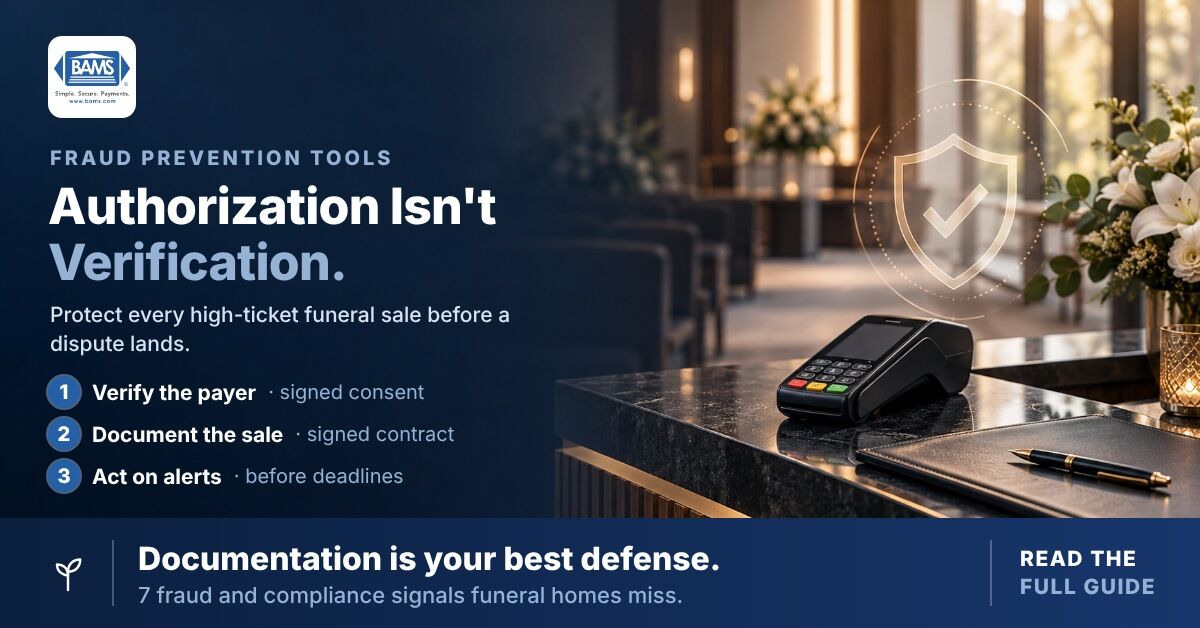
7 Fraud Prevention Tools Funeral Homes Need Now
The Compliance and Fraud Signals Funeral Homes Miss Until It’s Too Late
A family walks in during the worst week of their lives. They authorize a $12,000 prepaid funeral arrangement on a credit card. The authorization goes through. You deliver the service with care and professionalism. Then, 47 days later, a chargeback notice arrives. Suddenly, your merchant account is at risk. (The scenario is illustrative, but the pattern is common.)
For funeral home operators, fraud prevention tools and PCI compliance aren’t abstract IT concerns. They’re the difference between a stable business and a frozen merchant account. High-ticket service industries absorb disproportionate damage per dispute because a single reversed transaction can represent weeks of revenue.
Most guidance on PCI compliance and fraud defense is written for volume-driven retail or SaaS subscriptions. Funeral homes operate differently: low transaction volume, high per-ticket value, emotionally complex customer relationships and limited staff bandwidth for dispute management. Generic advice doesn’t account for any of that.
TL;DR
- Authorization isn’t verification – A successful card swipe confirms available credit, not cardholder identity or intent. High-ticket funeral transactions need signed contracts, a verified cardholder and documented authorization to defend against disputes.
- Friendly fraud is a major chargeback risk – Visa calls it first-party misuse. In funeral services it often starts with a family disagreement and your defense is documentation, not fraud filters.
- Default processor settings don’t fit your business – Generic fraud thresholds are built for high-volume retail. Funeral homes need custom velocity limits and ticket-size parameters to avoid false declines and missed fraud signals.
- Three quick wins protect you now – Fix your statement descriptor, add a signed refund policy to every contract and turn on real-time dispute alerts.
- PCI compliance is ongoing, not one-time – Validate with the right Self-Assessment Questionnaire, usually yearly. Keep terminal firmware current and block staff access to full card numbers.
What This Guide Covers (and What It Doesn’t)
This guide is for family-owned funeral service operators with one to ten locations. It’s for owners who process high-value card transactions and want to protect their merchant accounts without hiring a compliance team. If you run a funeral home, memorial chapel, or cremation service, these signals apply directly to your operation.
We’re not covering enterprise-level PCI audits, multi-currency processing or eCommerce platform selection. Instead, you’ll get a diagnostic framework for identifying the compliance gaps and fraud exposures that put high-ticket service businesses at risk before a dispute ever lands.
How We Selected These Signals
Each item below meets three criteria. It shows up often in service-industry disputes, it can affect merchant account standing and operators on generic payment processors commonly overlook it. We prioritized signals that funeral home staff can act on without specialized technical training.
7 PCI Compliance and Fraud Signals That Put Funeral Home Merchant Accounts at Risk
1. You Treat a Successful Card Authorization as Proof of a Legitimate Transaction
Why it matters: An authorization confirms available credit. It does not confirm the cardholder’s identity, intent, or awareness. In funeral services, a grieving family member may use a parent’s card, a sibling’s card, or a card belonging to someone who later disputes the charge. Yet many funeral homes skip any further verification because the authorization “went through.”
What it looks like today: Modern transaction monitoring tools flag mismatches between the cardholder name and the contract signer, unusual billing addresses, or cards that have been used in recent disputes elsewhere. These checks happen at the point of sale, not after a chargeback arrives.
How to apply it: Before processing any transaction above $5,000, verify that the cardholder is present or has provided written authorization. Capture a signed service agreement that includes the cardholder’s name, the last four digits of the card and a clear description of services purchased. If someone pays with another person’s card, get that cardholder’s signed authorization. Store these records digitally for at least 18 months.
2. Your PCI Compliance Self-Assessment Is Outdated or Incomplete
Why it matters: PCI DSS compliance isn’t a one-time checkbox. It’s an annual requirement and the standards evolve. Funeral homes that completed a Self-Assessment Questionnaire (SAQ) years ago and never revisited it are technically non-compliant. Non-compliance doesn’t just invite data breaches; it can lead to fines or higher fees from your acquiring bank and leaves you exposed if card data is compromised.
What it looks like today: PCI compliance for merchants includes requirements around protecting stored card data (or not storing it at all) and restricting who can access it. If your front-desk staff can see full card numbers on screen, you have a compliance gap.
How to apply it: Complete the appropriate SAQ on the schedule your acquirer sets, usually once a year. SAQ B covers merchants using only standalone dial-out terminals and SAQ B-IP covers standalone, PCI-approved terminals connected over IP, which fits most terminal-based funeral homes. Confirm with your processor that your terminal firmware is current. Remove any paper records containing full card numbers and replace them with tokenized references.
3. You Don’t Distinguish Between True Fraud and Friendly Fraud
Why it matters: Visa defines first-party misuse as cardholders reporting fraud on transactions they actually authorized. Its Compelling Evidence 3.0 rules aim to shift more of that cost back to issuers when merchants can prove it. In funeral services, friendly fraud often looks like this: a family member authorizes a charge and the service is delivered. Weeks later, someone in the family disputes the charge because they disagreed with the arrangement or didn’t know the card was used.
What it looks like today: Effective fraud prevention tools separate true fraud (stolen cards, identity theft) from first-party misuse (authorized users who later dispute). The defense strategy for each is different. True fraud requires pre-transaction screening. Friendly fraud requires post-transaction documentation.
How to apply it: For every high-value transaction, collect three forms of evidence. You need a signed service contract, the cardholder’s written authorization if they weren’t present and an itemized receipt the customer acknowledged. This documentation becomes your primary defense in representment.
4. Customers Bypass You Entirely When Disputing a Charge
Why it matters: Many cardholders go straight to their bank instead of calling the merchant. For funeral homes, this is especially damaging. You likely could have resolved the issue directly, perhaps by explaining the charges to another family member or offering a partial adjustment. Once a dispute goes to the bank, you lose that opportunity and enter a formal process with tight deadlines.
What it looks like today: Proactive chargeback defense programs include alerts that notify you quickly when a dispute arrives, so you can act within the deadline. Mastercard notes that acquirer response windows average 10 to 35 days and the whole chargeback process can take up to 120 days. BAMS Dispute Responder sends immediate chargeback notifications with a clear action plan and online management. That speed matters when a single $10,000+ reversal can spike your chargeback ratio.
How to apply it: Ensure your processor provides real-time dispute alerts. When an alert arrives, contact the cardholder within 24 hours. Some disputes filed by family members can be resolved with a phone call and a copy of the signed agreement.
5. Your Descriptor Doesn’t Match What Customers Expect to See
Why it matters: Some chargebacks start with simple confusion. Visa’s chargeback guidelines note that an unclear or confusing merchant name can make a cardholder think a transaction is fraudulent. Visa advises checking your Doing Business As (DBA) name with your acquirer. If your legal business name is “Greenfield Holdings LLC” but families know you as “Riverside Memorial Chapel,” you’re generating unnecessary disputes.
What it looks like today: Payment processors allow you to set a “soft descriptor” that appears on cardholder statements. Modern transaction monitoring tools can also append service details (for example, “Riverside Memorial Funeral Svcs”) to reduce confusion.
How to apply it: Check your current statement descriptor by running a test transaction on your own card. If the name doesn’t clearly identify your funeral home, contact your processor to update it. Where your processor allows it, include a phone number so cardholders can call you directly before disputing.
6. You Lack a Documented Refund and Cancellation Policy Tied to Card Transactions
Why it matters: Visa’s chargeback guidelines support your return and refund policies only if they were clearly disclosed at the time of purchase. Mastercard lists the refund policy the customer agreed to among the evidence to provide in a dispute. Funeral homes often operate on verbal agreements or assume that the sensitive nature of the service makes refunds unnecessary. Without a written policy presented at the time of sale, you lose a critical piece of evidence during representment. Even the strongest dispute response fails without that baseline documentation.
What it looks like today: Compliant funeral homes present a printed or digital refund/cancellation policy alongside the service agreement. The customer signs or acknowledges both. This policy is stored alongside the transaction record in a merchant services platform that supports document retrieval during disputes.
How to apply it: Draft a one-page refund and cancellation policy specific to your services. Include it on every service contract and require a separate signature or checkbox acknowledgment. Store it digitally where it can be retrieved within minutes if a dispute arises.
7. You’re Relying on Your Processor’s Default Fraud Settings Instead of Configuring Thresholds
Why it matters: Generic processors set fraud thresholds for average merchants: high-volume, low-ticket retail. A funeral home processing 30 transactions per month at an average of $8,000 looks anomalous to default fraud filters. This can result in legitimate transactions being declined (frustrating grieving families at the worst possible moment) or, conversely, genuinely suspicious patterns slipping through because the filters aren’t calibrated for your business profile.
What it looks like today: AI-powered fraud prevention tools allow merchants to set custom velocity limits, ticket-size thresholds and geographic parameters. For funeral homes, this means configuring your system to expect high-ticket, low-frequency transactions rather than flagging them as outliers.
How to apply it: Request a fraud threshold review with your processor or account manager. Specify your average transaction size, monthly volume and typical cardholder geography. If your processor can’t customize these parameters, that’s a sign your payment partner isn’t built for your business model.

Check these before a $12,000 dispute lands. Start with the green three.
The Pattern Across These Signals
Every signal above shares a common thread: the gap between authorization and verification. In high-ticket service industries, a successful card swipe is the beginning of your compliance obligation, not the end. Volume-driven retailers can absorb a $40 chargeback as a cost of doing business. A funeral home cannot absorb a $12,000 reversal without material impact on cash flow, merchant account standing and operational stability. Disputes also tie up cash while they’re open, as our guide to chargeback risk management explains.
The second pattern is documentation as defense. Funeral homes already create detailed service records for regulatory and family purposes. Extending that documentation discipline to payment records (signed authorizations, cardholder verification, refund policies) converts existing operational habits into chargeback protection. The operators who treat payment compliance as an extension of their service quality, rather than a separate IT task, are the ones who avoid account reviews and frozen funds.
Where to Start: Prioritizing Without Overwhelming Your Team
You don’t need to overhaul your entire payment operation this week. Start with three actions that deliver the highest protection per hour invested:
- Update your statement descriptor (Signal 5). This takes one call to your processor and eliminates confusion-based disputes immediately.
- Create a signed refund policy (Signal 6). Draft it once, attach it to every contract going forward and store copies digitally.
- Activate dispute alerts (Signal 4). Confirm with your processor that you receive real-time notification of any filed dispute so you can respond within the resolution window.
Once those three are in place, move to annual SAQ completion (Signal 2) and a fraud threshold review (Signal 7). Each step builds on the last and none requires specialized technical staff. The goal is a payment environment where compliance and fraud prevention tools are built into your existing workflow, not bolted on after a loss.
Frequently Asked Questions
What is PCI compliance and does my funeral home need it?
PCI DSS (Payment Card Industry Data Security Standard) compliance is required for any business that accepts credit or debit card payments. If your funeral home processes card transactions, you validate compliance (usually with a yearly Self-Assessment Questionnaire) and maintain security controls like restricted access to cardholder data. Non-compliance can result in fines, increased processing fees and, in serious cases, loss of your merchant account.
How does friendly fraud differ from true fraud in funeral services?
True fraud involves stolen cards or identity theft, where the actual cardholder never authorized the purchase. Friendly fraud occurs when someone who did authorize the transaction (or a family member with access to the card) later disputes it through their bank. In funeral homes, friendly fraud often involves family disagreements about charges or a relative who didn’t realize their card was used for the arrangement.
What documentation should I collect to defend against chargebacks on high-value transactions?
Collect a signed service contract with the cardholder’s name and the card’s last four digits. Add written authorization if the cardholder wasn’t present, an itemized receipt the customer acknowledged and a signed refund and cancellation policy. Store all documents digitally for at least 18 months so they can be retrieved quickly during a dispute.
How can I ensure PCI compliance when using a payment processor like BAMS?
Work with your processor to confirm your terminal firmware is current, complete the appropriate SAQ on your acquirer’s schedule and ensure no staff member can view full card numbers on screen. A processor like BAMS, with dedicated account representatives and PCI compliance support, can help you work through the requirements for your business. You can also review practical steps for securing transactions as a starting point.
Why do legitimate funeral home transactions get flagged or declined by fraud filters?
Default fraud filters are calibrated for high-volume, low-ticket retail. A funeral home processing a small number of transactions at $5,000 to $15,000 each looks unusual to these systems. The solution is to work with your processor to customize velocity limits and ticket-size thresholds so your legitimate transactions aren’t treated as outliers.
What is a chargeback defense program and how does it help funeral homes?
A chargeback defense program provides early dispute alerts, documentation support and representment assistance. For funeral homes, a single disputed transaction can represent thousands of dollars. These fraud prevention tools warn you early and help you respond within card network deadlines. Timely, well-documented responses give you the best chance of winning a dispute.
Sources
- Visa: Chargeback Management Guidelines for Visa Merchants
- PCI Security Standards Council: PCI DSS v4.0 Self-Assessment Questionnaire B
- Mastercard: Disputing Chargebacks, Practical Guidance for Merchants
- PCI Security Standards Council: PCI DSS v4.0 Self-Assessment Questionnaire B-IP
- Visa: Evolution of Compelling Evidence, Acquirer FAQ


