Dynamic Risk Scoring: What Processors See That You Don’t
Why your growing eCommerce business can be quietly reclassified as a liability without warning
Learn how processors use dynamic risk scoring to reassess your account in real time—even as you celebrate growth. Discover the hidden triggers that inflate reserves and threaten cash flow, and why visibility into these signals is essential protection.
TL;DR
- Your risk score is live, even if you can’t see it – Processors update your risk classification in real time based on chargeback ratios, refund patterns, and volume changes. Most merchants have zero visibility into these shifts until reserves increase.
- Growth can quietly raise your risk profile – Scaling revenue often widens your customer base and dispute exposure. A chargeback ratio that was safe at $50K/month can trigger reserve increases at $200K/month, even with the same operational quality.
- Reserves are negotiable, not fixed – Merchants who track the same metrics processors use (chargeback ratio, refund velocity, dispute trends) can proactively negotiate lower reserves and shorter hold periods.
- Transparency is the lever – Ask your processor for your risk score, the thresholds that trigger reserve changes, and a documented release schedule. The conversation you’re not having is costing you thousands per month in locked cash.
Your Processor Already Changed Your Risk Score. You Just Don’t Know It Yet.
Revenue growth can look healthy from the merchant side while a processor’s risk model is telling a different story. Understanding the signals behind that assessment can help merchants protect cash flow and avoid unexpected reserve changes.
Here’s something most eCommerce managers never see coming: your business is growing, your revenue is climbing, and then one morning your deposit is short. Not by a little. By tens of thousands of dollars. Your processor just increased your rolling reserve, and nobody told you why.
The uncomfortable truth about dynamic risk scoring is that it operates in real time on the processor’s side, while you’re still looking at last month’s dashboard wondering what changed.
The “Just Keep Growing” Assumption
The prevailing wisdom in ecommerce is straightforward: grow your volume, build your track record, and your processor will reward you with better terms. Lower fees. Faster funding. Reduced reserves. It sounds logical. And for a long time, it was roughly how things worked.
But that mental model assumes your risk profile is a static snapshot taken at merchant account approval and revisited annually, maybe quarterly if you’re lucky. Most merchants treat their reserve requirements like a fixed tax. Pay it, forget it, focus on sales.
The problem is that your processor doesn’t see it that way. Not even close.
Processors Don’t Grade on a Curve. They Grade in Real Time.
We believe the single biggest cash flow leak in growing ecommerce businesses isn’t fees, isn’t slow funding, and isn’t even chargebacks themselves. It’s the invisible reclassification of a healthy business into a liability, triggered by risk assessment tools the merchant never sees and scoring thresholds nobody explained.
How Dynamic Risk Scoring Actually Works Against Growing Merchants
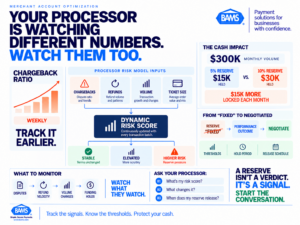
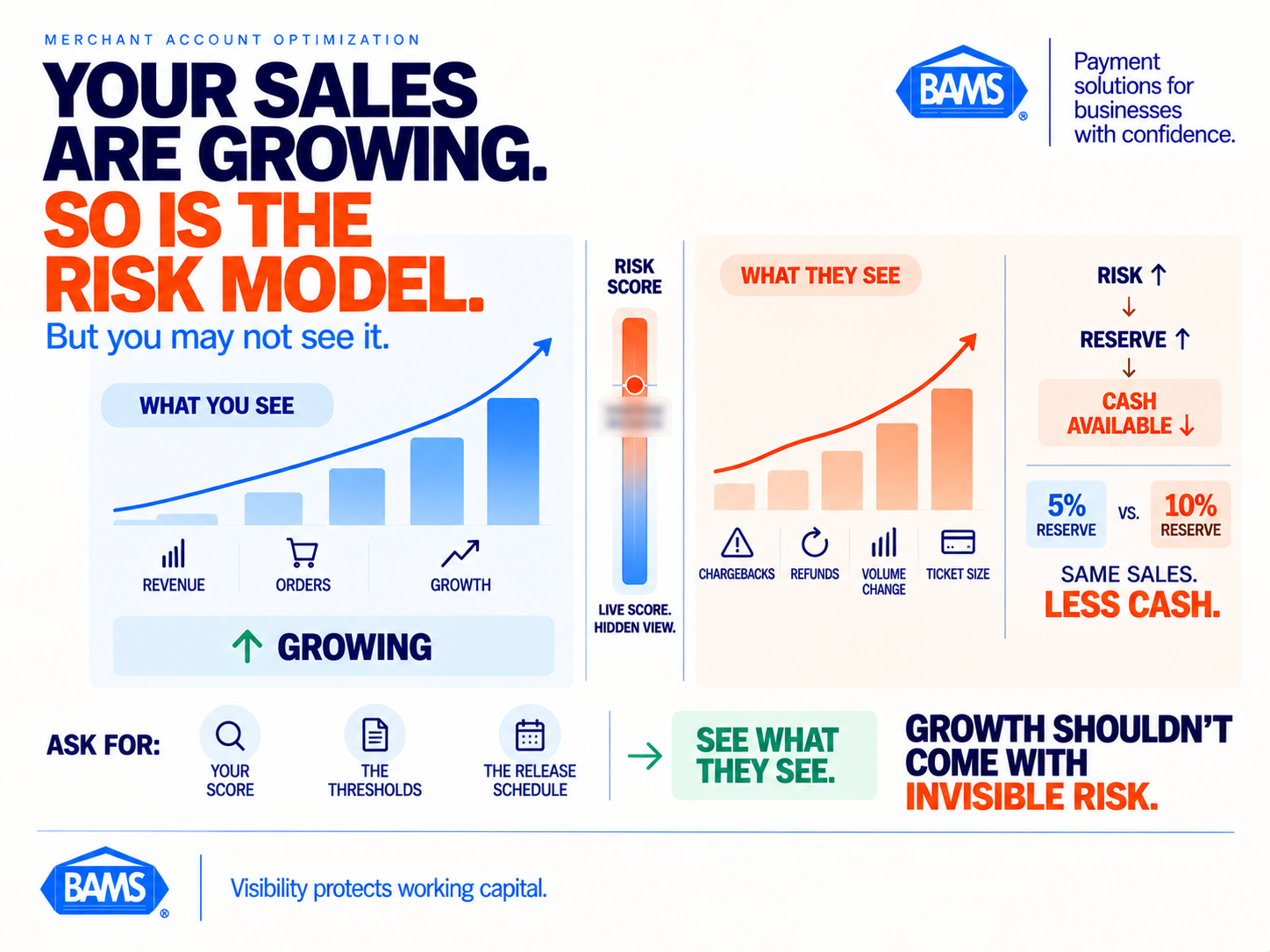
Processors continuously reassess merchant risk using transaction and dispute signals. Understanding those inputs gives ecommerce operators a better opportunity to anticipate reserve changes and protect working capital.
Let’s walk through what happens beneath the surface. Acquirers and processors can continuously monitor merchant activity against risk parameters established for the account. OCC guidance describes merchant monitoring based on factors such as daily sales volume, average ticket size, transaction patterns and chargeback activity and notes that some acquirers use systems that compare transactions against a merchant’s prior sales patterns.
There is no universal industry formula that assigns chargebacks a fixed 25% weight in every merchant risk score. The variables and thresholds differ by acquirer, processor, merchant category and agreement. The practical point is that meaningful changes in volume, ticket size, disputes or transaction patterns can trigger additional review even when the underlying business remains healthy.
And here’s where growth becomes paradoxical. When you’re processing $50,000 a month, five chargebacks put you at a 0.10% ratio. Comfortable. But scale to $200,000 a month and your customer base widens. Maybe you enter a new product category. Maybe you run a promotion that attracts a different buyer profile. Suddenly those five chargebacks become fifteen, and your ratio creeps toward 0.75%.
You haven’t done anything wrong. Your fulfillment is the same.
Your product quality hasn’t dropped. But the scoring system doesn’t care about intent. It cares about ratios.
Dispute pressure remains significant across eCommerce. The Merchant Risk Council’s 2026 Global eCommerce Payments and Fraud Report found that 64% of surveyed merchants reported a meaningful increase in first-party misuse over the prior year. That does not create a universal processor risk threshold, but it reinforces why merchants and acquirers closely monitor changing dispute patterns.
There is no universal 0.5% or 1% dispute threshold that determines how every processor will classify a merchant. Card networks maintain their own monitoring frameworks and processors may apply additional account-specific controls. Visa’s current Visa Acquirer Monitoring Program evaluates fraud and dispute activity at both the acquirer and merchant level using defined program metrics and thresholds. Merchants should therefore ask their processor which network thresholds and account-level risk parameters apply to their specific business rather than relying on generic industry percentages.
The consequence can be tighter risk controls, including higher reserve requirements or delayed access to settlement funds where permitted by the merchant agreement. The OCC notes that acquirers may establish merchant reserve or holdback accounts to address higher risk or chargeback exposure and may fund those reserves by withholding a portion of daily proceeds. The percentage withheld and the length of the hold are account-specific rather than universal industry standards.
The Visibility Gap Is the Real Problem
What makes this especially frustrating is that the information exists. Your processor has a dashboard showing exactly where your risk score sits, what’s moving it, and what thresholds trigger reserve changes. You just don’t have access to it.
Most merchant agreements don’t require processors to notify you before adjusting reserves. They reserve the right (pun intended) to modify hold percentages based on “risk factors at their discretion.” That’s boilerplate language hiding a cash flow trap.
This is where the relationship between merchant and processor matters more than the contract. Working with a partner like BAMS, which provides dedicated account management and proactive chargeback risk management, gives you visibility into the scoring triggers before they result in higher reserves. That transparency turns an abstract compliance concern into a concrete cash flow planning tool.
What Changes If You Start Watching What They’re Watching
If this thesis is right, the implication is clear: reserve requirements aren’t fixed costs to accept. They’re negotiable outcomes that respond to specific, trackable inputs. And the merchants who reduce their reserves over time aren’t just “low risk” by nature. They’re actively managing the metrics that processors weight most heavily.
That means tracking your chargeback ratio weekly, not monthly. It means monitoring refund velocity as a leading indicator of disputes. It means understanding that a spike in funding holds isn’t random. It’s a signal your risk score moved, and you need to know why before the next reserve adjustment lands.
The cost of ignoring this? Tens of thousands of dollars locked in reserves that could be funding inventory, marketing, or hiring. For a business processing $300,000 a month, the difference between a 5% reserve and a 10% reserve is $15,000 per month sitting in someone else’s account.
Reserves Aren’t a Penalty. They’re a Conversation You’re Not Having.
Here’s the reframe: stop thinking of reserves as something your processor does to you. Start thinking of them as a reflection of what your processor sees but hasn’t told you.
The merchants who successfully reduce reserves over time treat their processor relationship like a credit relationship. They ask for their risk score, they request documentation of the thresholds that trigger changes, they present quarterly reviews of their dispute ratios and refund patterns and they negotiate reserve release schedules tied to specific performance benchmarks.
A reserve isn’t a verdict. It’s a conversation you haven’t started yet.
The Money Is Already Yours. Go Get It Back.
Your processor will never volunteer to lower your reserves. That conversation starts with you, armed with the same data they’re already using to score you. Track what they track. Ask for the thresholds. Build the case.
The businesses that grow without bleeding cash to invisible reserve increases aren’t luckier. They’re just paying attention to the right numbers.
Frequently Asked Questions
Why do payment processors withhold reserves from merchants?
Processors hold reserves as financial protection against chargebacks, refunds, and fraud losses. The reserve acts as a buffer so the processor isn’t left covering costs if a merchant can’t fulfill obligations to cardholders.
How can merchants reduce their reserve requirements over time?
Actively manage your chargeback ratio below 0.5%, request regular risk score reviews from your processor, and negotiate reserve release schedules tied to specific performance benchmarks. Consistent low-dispute processing history over 6 to 12 months gives you the strongest negotiating position.
Which factors influence the percentage of reserves withheld by payment processors?
Risk inputs vary by processor and acquiring bank. OCC guidance identifies monitoring factors that can include daily sales volume, average ticket size, transaction patterns and chargeback activity. Industry type, delivery model, refund behavior and other account characteristics may also affect risk decisions, but there is no universal 25% weighting that applies across processors.