Payment Processing Freezes: An Information Problem
Last Updated on June 4, 2026 by Dimitri Akhrin
Why processors default to suspicion — and how upfront transparency converts new accounts into fast-funded ones
Learn why payment processing holds aren’t about compliance caution — they’re about information gaps. Discover how providing the right documentation upfront eliminates funding delays and reserve requirements.
TL;DR
- Processor freezes are an information problem, not a compliance problem – Merchants who arrive at onboarding without complete documentation get punished with conservative defaults, slower funding, and higher effective costs.
- Hidden fees live in configuration, not contracts – Batch timing, risk reserves, interchange misqualification, and funding delays are structural costs baked into setup defaults that most merchants never question.
- Transparency is a pricing strategy – Providing complete transaction history, chargeback data, and gateway requirements upfront removes the processor’s justification for conservative settings and unlocks better terms from day one.
- Ask the right first question – Instead of “what’s your rate,” ask your processor “what do you need from me to give me the fastest funding and lowest effective cost immediately?”
Your Processor Isn’t Cautious. It’s Uninformed.
Every eCommerce manager knows the feeling. You sign with a new payment processing provider, expect smooth sailing, and instead get a funding hold on day three. Your deposits vanish into a 48-hour black hole. A reserve gets slapped on your account with zero explanation. You didn’t do anything wrong. You just didn’t give the processor enough reason to trust you before it defaulted to suspicion.
The “Standard Setup” Myth in Merchant Services
The conventional wisdom in merchant services goes like this: processors freeze new accounts because they’re being careful. Compliance is complex. Fraud is real. So new merchants get conservative defaults, slow funding windows, and rolling reserves “just in case.” It sounds reasonable.
And for years, it was. When processors couldn’t verify a business quickly, caution made sense. The problem is that this caution became permanent architecture. Today, the same conservative defaults get applied to a 15-year-old eCommerce brand doing $2M annually and a brand-new dropshipper with no transaction history. Same batch timing, same risk thresholds and same funding delays. The defaults weren’t designed to protect you. They were designed to protect the processor from having to learn anything about you.
The Real Problem Is Information, Not Risk
Here’s what we actually believe: processors don’t freeze new merchant accounts out of caution. They freeze them because merchants arrive without the documentation and risk context that would have made approval automatic. The onboarding freeze is an information asymmetry problem, not a compliance failure. NACHA ACH Network resources continue to emphasize how settlement timing, ACH submission windows, and processing configuration directly impact how quickly merchants gain access to cleared funds.
When you understand that distinction, everything about your merchant account setup changes.
Processors rarely freeze accounts because they are cautious. They freeze accounts because they are missing information.
How Hidden Merchant Processing Fees Get Baked Into the Defaults
Let’s trace how this plays out in practice. You sign a merchant services agreement. You’re told you’re on “competitive rates.” The application asks for basic business info, a voided check, maybe a processing statement. You provide it. You go live.
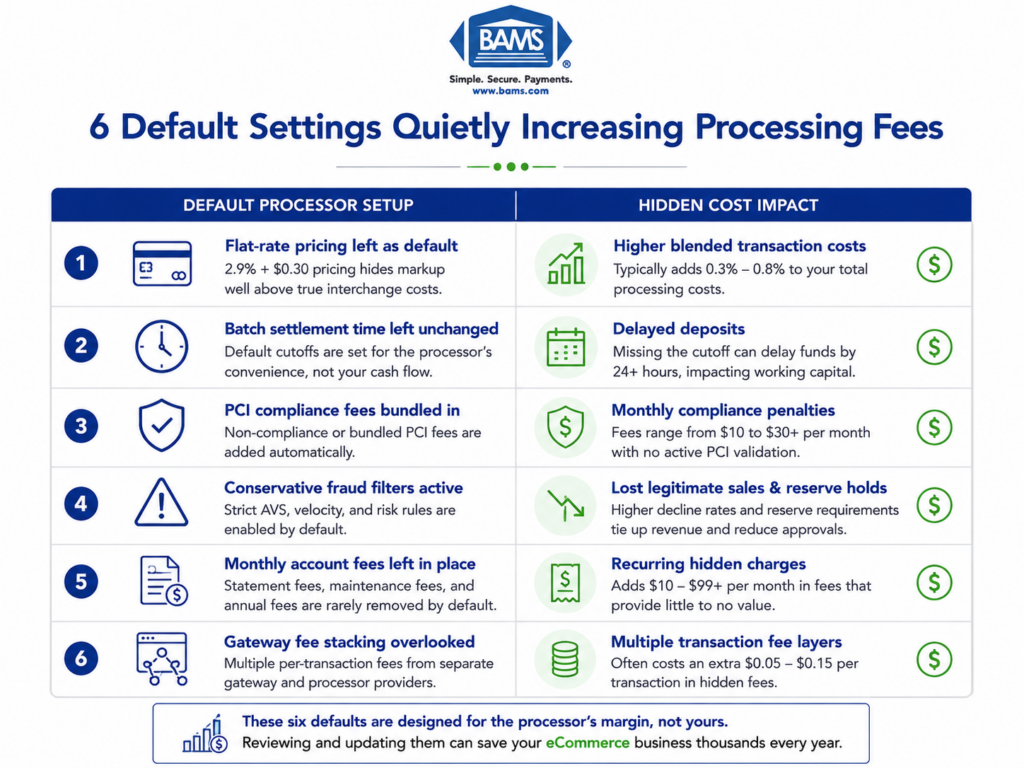
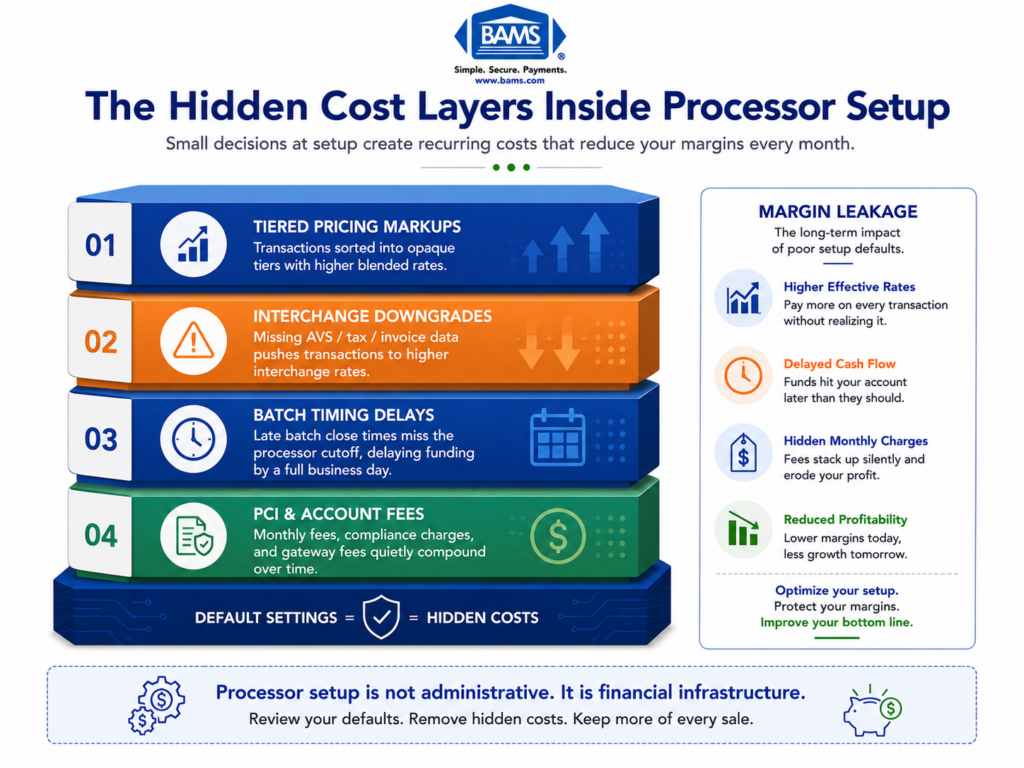
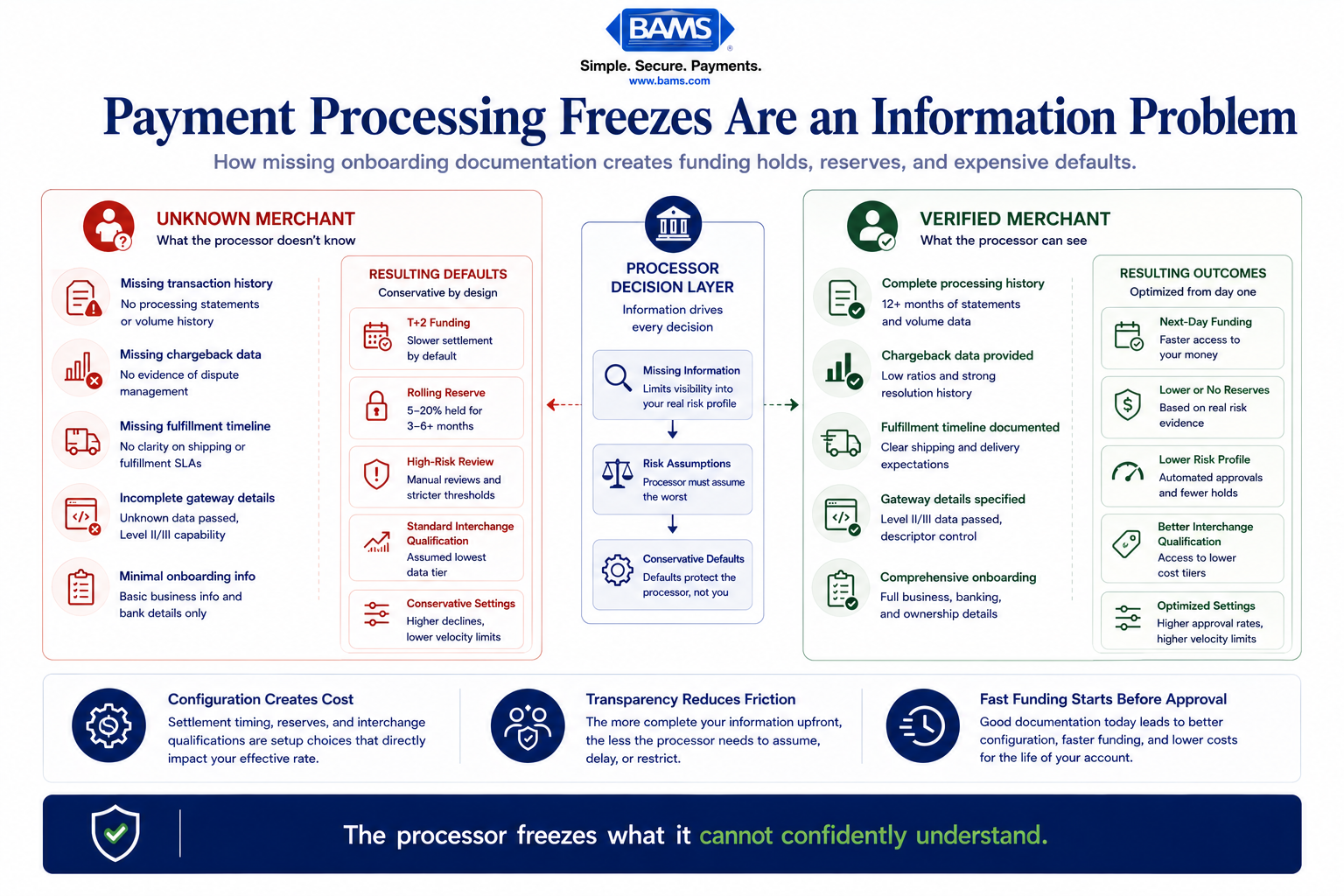
What you don’t realize is that the processor just made a dozen decisions about your account based on what you didn’t provide. Your batch settlement window? Set to T+2 instead of next-day because nobody verified your chargeback ratio was low. Your interchange qualification? Defaulting to the most expensive tier because your gateway isn’t passing Level II data. Your risk reserve? 10% of volume, held for six months, because the underwriter couldn’t confirm your fulfillment timeline.
None of these are “fees” on your statement. They’re structural costs buried in your processor setup defaults. And they add up fast.
Consider the math. U.S. credit and debit card swipe fees hit $187.2 billion in 2024, with average Visa and Mastercard credit card swipe fee rates reaching 2.35% per transaction. Most merchants pay between 2.0% and 3.2% in total processing costs. Federal Reserve interchange fee data continues to demonstrate how qualification differences and interchange structure materially affect merchant processing costs over time. The difference between the low end and the high end of that range, for a business processing $100K per month, is $12,000 a year. That gap isn’t explained by interchange. It’s explained by configuration.
We’ve seen this pattern repeatedly: an eCommerce business switches processors expecting lower rates, only to discover their PCI compliance fees tripled, their funding speed actually got worse, and their effective rate barely moved. The new processor’s “low rate” was real, but the setup defaults clawed back the savings through slower settlement, higher reserves, and miscategorized transactions.
The fix isn’t finding a cheaper processor.
It’s arriving at onboarding with enough information to override the defaults.
That means providing your last 3-6 months of processing statements upfront. It means documenting your average ticket size, chargeback ratio, and fulfillment timeline before anyone asks. It means specifying your gateway configuration requirements (batch timing, Level II/III data fields, tokenization preferences) in writing during setup, not after your first delayed deposit.
When you hand a processor a complete risk profile on day one, you’re not being overly thorough. You’re removing the processor’s justification for conservative defaults. You’re converting yourself from an unknown risk into a known, fundable merchant. That’s the difference between waiting 48 hours for your money and getting it next business day.
This is where working with a transparent partner matters. BAMS, for example, structures onboarding around this exact principle: gathering the documentation and transaction context upfront so that merchants qualify for next-day funding and interchange-plus pricing from the start, rather than fighting to unlock those terms months later.

Most funding delays are configuration outcomes created during onboarding, not after transactions begin processing.
What This Means for Your Next Processor Switch
If this framing is right, it changes how you evaluate every processor conversation. Stop asking “what’s your rate?” first. Start asking “what do you need from me to give me the fastest funding and lowest effective cost on day one?”
A processor that can’t answer that question clearly is telling you something. They’re going to default you into the most conservative (and most profitable, for them) configuration, then make you prove your way out of it. That’s not a partnership. That’s a toll booth.
The cost of ignoring this is real. Delayed funding means delayed inventory purchases, missed supplier discounts, and cash flow gaps that force you into short-term borrowing. Opaque billing practices compound month after month, turning a “competitive” rate into an expensive relationship. And every day your account sits in a conservative default, you’re paying a hidden tax for a risk profile that doesn’t belong to you.
A Better Way to Think About Merchant Processing Fees
Here’s the reframe: your merchant processing fees aren’t set when you sign the contract. They’re set when your account gets configured. The contract defines the floor. The configuration defines what you actually pay.
Think of onboarding not as paperwork, but as a negotiation over defaults. Every document you provide, every data point you surface, every question you ask about batch timing and risk thresholds is you actively lowering your cost of processing. The merchants who get the best terms aren’t the ones with the most volume. They’re the ones who eliminate ambiguity before the processor has to guess.
That’s the mental model: transparency is a pricing strategy.
The Merchants Who Get Paid Fastest Already Know This
The best eCommerce operators we’ve worked with don’t treat processor setup as an administrative task. They treat it as a financial decision with compounding consequences and they show up with data. They ask specific questions about settlement windows and they verify that deposits actually arrive on time during the first week, not the first quarter.
Your processor doesn’t owe you trust. But you can make trust the only rational conclusion. Give them no reason to guess, and they’ll have no reason to hold.
Frequently Asked Questions
What documents should I gather before switching merchant service providers?
At minimum, bring 3-6 months of processing statements, your current chargeback ratio, average ticket size, and fulfillment timelines. The more risk context you provide upfront, the faster your new processor can configure your account for optimal funding speed and rates.
Why should I keep my old merchant account open during the transition?
Open chargebacks and refund obligations can follow you after you close an account, and any pending settlements need somewhere to land. Keep the old account active until all transactions have fully settled and your chargeback window has closed.
Which pricing model is best for my business when setting up merchant services?
Interchange-plus pricing gives you the most transparency because you see the actual card network cost plus a fixed markup. Tiered and flat-rate models obscure where your money goes, making it harder to identify whether your processor’s defaults are costing you more than they should.