Faster Deposits for eCommerce: Payment Optimization Guide
Last Updated on May 18, 2026 by Dimitri Akhrin
Practical strategies to accelerate settlement times and build predictable cash flow for established online businesses
Learn how to eliminate delayed deposits and optimize your payment processes for speed. This guide covers specific strategies to accelerate settlements, reduce costs, and improve cash flow for eCommerce businesses with existing payment infrastructure.
TL;DR
- Audit your settlement timeline first – Map exactly where funds spend time between customer payment and your bank account to identify specific delay sources and calculate the working capital cost of current performance.
- Authorization rate improvements compound – Payment orchestration can improve authorization rates by 2-3%, and one optimization solution recovered 20% of originally unsuccessful payments across its merchant base.
- Negotiate settlement terms actively – Businesses processing over $50,000 monthly often qualify for next-day funding at no additional cost, but you typically need to ask for it.
- One-click checkout delivers outsized returns – Customers using streamlined checkout increase spending by 28.5% and purchase frequency by 43%, making this often the highest-ROI payment optimization.
- AI-driven fraud detection reduces costs by 30% – Modern fraud tools eliminate manual review bottlenecks and reduce false positives, accelerating legitimate transactions while maintaining security.
What This Guide Covers
This guide shows eCommerce managers at established online businesses how to eliminate delayed deposits and build payment processes that deliver funds faster. You’ll learn specific strategies to accelerate settlement times, reduce processing costs, and create predictable cash flow.
By the end, you’ll understand exactly why deposits get delayed, which optimization levers matter most, and how to implement faster deposit strategies that directly impact your bottom line. We focus on practical execution for businesses processing meaningful transaction volume, not theoretical concepts for startups still finding product-market fit.
This guide excludes payment gateway setup basics and general eCommerce platform selection. We assume you already have functioning payment infrastructure and want to make it work harder for your business.
Why Payment Speed Matters Now
Delayed deposits create a hidden tax on your operations. Every day funds sit in limbo represents inventory you can’t restock, marketing you can’t deploy, and opportunities you can’t capture. For eCommerce businesses running on thin margins, this delay compounds quickly.
The payment landscape continues to evolve. According to Visa, modern payment systems are designed to process transactions securely while maintaining speed and efficiency.
Your customers experience instant everything in their personal lives. They expect the same from businesses they buy from. More critically, your competitors who optimize payment processes gain working capital advantages that compound over time.
The cost of inaction is measurable. Each failed transaction represents both lost revenue and potential customer churn. Payment optimization isn’t a nice-to-have; it’s a competitive necessity.
Core Concepts You Need to Understand
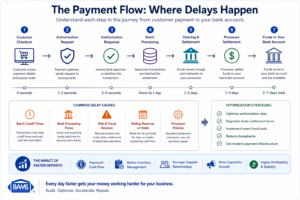
Understanding each stage of the payment flow reveals where delays occur and how faster settlement improves cash flow and operations.
Settlement vs. Authorization
Authorization confirms a customer has available funds. Settlement moves those funds to your account. The gap between these two events is where deposit delays live. Understanding this distinction helps you identify which part of your process needs attention.
Interchange and Processing Layers
Your payment costs stack in layers: interchange fees (paid to card-issuing banks), assessment fees (paid to card networks), and processor markup. Each layer affects both cost and speed. Cost-effective payment processing requires optimizing across all three.
According to the Federal Reserve, interchange fees significantly impact total processing costs, reinforcing the need for transparent pricing structures when optimizing payments.
Funding Windows
Standard funding typically takes 2-3 business days. Guaranteed next-day funding accelerates this to one business day. Same-day funding provides funds within hours. Each option carries different cost and qualification requirements.
Authorization Rate
This percentage measures successful transaction approvals. Higher rates mean more completed sales and fewer customer service issues.
The Deposit Acceleration Framework

A structured optimization framework helps businesses reduce delays, improve approval rates, and accelerate access to funds.
Faster deposits result from optimizing four interconnected systems: transaction approval, settlement timing, cost structure, and failure recovery. Each system feeds the others.
- When authorization rates improve, fewer transactions require manual review or retry, which accelerates settlement.
- When settlement timing improves, you have more capital to invest in fraud protection, which improves authorization rates.
- When costs decrease, you can afford premium settlement options.
This framework operates as a flywheel. Initial improvements in any area create momentum that makes subsequent improvements easier. The goal is building a self-reinforcing system where each optimization compounds previous gains.
Step 1: Audit Your Current Settlement Timeline
Objective
Map exactly where your funds spend time between customer payment and bank account availability.
What to Do
Pull three months of transaction data and track the actual time between authorization and deposit for each transaction. Segment by payment method, transaction amount, and day of week. Look for patterns in delays.
Document your current processor’s stated settlement terms versus actual performance. Many businesses discover their real settlement times exceed contractual promises by 12-24 hours on average.
Calculate the working capital cost of your current delays. If you process $500,000 monthly with a 3-day average settlement and 8% cost of capital, you’re paying roughly $3,300 annually just for the delay.
What to Avoid
- Don’t assume your processor’s marketing materials reflect your actual experience.
- Don’t ignore weekend and holiday impacts on settlement timing.
- Don’t overlook partial settlements that split single orders across multiple deposits.
Success Indicators
- You have a documented baseline of current settlement performance.
- You can identify your slowest payment methods and highest-delay transaction types.
- You know the specific dollar cost of your current delays.
Step 2: Optimize Your Authorization Rate
Objective
Increase the percentage of transactions that approve on first attempt, reducing delays from retries and manual reviews.
What to Do
Review declined transaction codes to identify patterns. Common culprits include outdated card information, insufficient funds, and fraud false positives. Each category requires different intervention.
Implement card account updater services to automatically refresh expired or replaced card details. This single change can recover 2-5% of recurring transaction failures.
AI-driven payment routing analyzes transaction characteristics and routes each payment through the processor most likely to approve it. This technology, once available only to enterprise merchants, now exists for mid-market businesses.
What to Avoid
- Don’t set fraud thresholds so tight that legitimate transactions get declined.
- Don’t ignore soft declines that might succeed on retry.
- Don’t treat all declined transactions as lost causes.
Success Indicators
Authorization rates increase by at least 1-2 percentage points. Declined transaction volume decreases. Customer complaints about payment failures drop.
Step 3: Negotiate Better Settlement Terms
Objective
Secure faster funding windows and more favorable processing agreements from your payment partners.
What to Do
Gather your transaction data: monthly volume, average ticket size, chargeback rate, and industry category. This information determines your negotiating leverage.
Request next-day funding as a standard feature rather than a premium add-on. Businesses processing over $50,000 monthly often qualify for expedited settlement at no additional cost. Same-day funding options exist for businesses with strong processing histories.
Evaluate cost-plus pricing structures that separate interchange from processor markup. This transparency often reveals opportunities for savings that offset faster settlement costs.
What to Avoid
- Don’t accept the first offer without negotiation.
- Don’t sign long-term contracts without settlement guarantees.
- Don’t overlook early termination fees that lock you into underperforming arrangements.
Success Indicators
You have written confirmation of settlement timing commitments. Your effective processing rate decreases or holds steady while settlement accelerates. Contract terms include performance guarantees.
Step 4: Reduce Transaction Friction
Objective
Streamline the checkout experience to increase completion rates and reduce payment-related cart abandonment.
What to Do
Implement one-click checkout for returning customers. This single change often delivers the highest ROI of any payment optimization.
Add digital wallet payment options (Apple Pay, Google Pay, Shop Pay) that store customer credentials securely. These methods typically show higher authorization rates than manually entered card details.
Optimize your payment page load speed. Each second of delay reduces conversion rates. Ensure your payment forms work flawlessly on mobile devices where most eCommerce traffic now originates.
What to Avoid
- Don’t require account creation before checkout.
- Don’t add unnecessary form fields that slow completion.
- Don’t hide total costs until the final step.
Success Indicators
Cart abandonment rate decreases. Checkout completion time shortens. Mobile conversion rates approach desktop performance.
Step 5: Implement Proactive Fraud Protection
Objective
Balance fraud prevention with transaction approval to minimize false positives while protecting revenue.
What to Do
Deploy layered fraud detection that combines multiple signals: device fingerprinting, behavioral analysis, and transaction velocity monitoring.The PCI Security Standards Council highlights that strong fraud prevention and compliance controls are essential to maintain secure and efficient payment processing.
Set fraud rules based on your actual risk profile, not generic industry settings. A business selling $50 items has different risk tolerance than one selling $5,000 items.
What to Avoid
- Don’t block entire countries or regions without data supporting the decision.
- Don’t apply the same fraud rules to new and returning customers.
- Don’t ignore the revenue cost of false positives.
Success Indicators
Chargeback rates remain low while authorization rates improve. Manual review queue shrinks. Fraud losses stay within acceptable thresholds.
Step 6: Build Payment Recovery Systems
Objective
Capture revenue from initially failed transactions through systematic retry and recovery processes.
What to Do
Implement intelligent retry logic for soft declines. Not all failures are permanent; many succeed on second attempt, especially with different routing or timing.
Create automated dunning sequences for subscription and recurring payments. Notify customers of payment failures before canceling services. Offer easy card update options.
Analyze recovery data to identify patterns. If certain card types fail more often at specific times, adjust your retry timing accordingly.
What to Avoid
- Don’t retry hard declines that will never succeed.
- Don’t send aggressive dunning messages that damage customer relationships.
- Don’t give up after a single retry attempt.
Success Indicators
Failed transaction recovery rate exceeds 15%. Involuntary churn from payment failures decreases. Customer satisfaction with payment recovery communications remains positive.
Step 7: Monitor and Iterate
Objective
Create ongoing visibility into payment performance and systematic improvement processes.
What to Do
Build a payment dashboard tracking authorization rates, settlement times, processing costs, and failure recovery. Review weekly, not monthly.
Set alerts for performance degradation. A sudden drop in authorization rates might indicate processor issues, fraud attacks, or technical problems requiring immediate attention.
Schedule quarterly reviews of processor performance against contractual commitments. Use data to renegotiate terms or evaluate alternatives.
What to Avoid
- Don’t assume set-and-forget optimization.
- Don’t ignore small performance changes that might indicate larger problems.
- Don’t wait for annual reviews to address underperformance.
Success Indicators
You have real-time visibility into payment performance. Issues get identified and resolved quickly. Continuous improvement becomes part of operations rather than occasional projects.
Practical Application: Before and After
Scenario: Mid-Size eCommerce Brand
A home goods retailer processing $400,000 monthly experienced 3-day average settlement, 4.2% authorization failures, and 2.8% effective processing rate.
After implementing this framework: settlement dropped to next-day, authorization failures fell to 2.1%, and processing costs decreased to 2.4% through better interchange qualification. The combined impact freed approximately $15,000 in monthly working capital and recovered $8,400 in previously lost transactions.
Scenario: Subscription Business
A specialty food subscription service struggled with 8% involuntary churn from payment failures. Implementing card account updater and intelligent retry logic reduced this to 3.2%. For a business with 5,000 subscribers at $45 monthly, this recovered nearly $130,000 in annual revenue.
Common Mistakes That Slow Your Deposits
Accepting default processor settings. Most processors configure accounts for their convenience, not yours. Default settlement timing, fraud thresholds, and routing rules rarely optimize for merchant benefit.
Ignoring interchange qualification. Transactions that qualify for lower interchange categories save money and often process faster. Many businesses leave money on the table by not providing required data fields. Level 3 processing for B2B transactions can significantly reduce costs.
Treating all payment methods equally. Different payment methods have different cost, speed, and reliability profiles. Steering customers toward preferred methods (without restricting choice) improves overall performance.
Underinvesting in chargeback prevention. Chargebacks don’t just cost money directly; they increase processor risk assessments, which can slow settlement and increase fees.
What to Do Next
Start with the audit. Before changing anything, understand your current baseline. Pull your settlement data, calculate your actual costs, and identify your biggest delay sources.
Pick one optimization area where you expect the highest impact relative to effort. For most businesses, this is either authorization rate improvement or settlement term negotiation.
Implement changes incrementally and measure results before moving to the next optimization. Payment systems are interconnected; rushing changes can create new problems while solving old ones.
Return to this guide as your business evolves. Optimization strategies that work at $200,000 monthly volume differ from those at $2 million. Your payment infrastructure should grow with your business.
Frequently Asked Questions
What are faster deposit strategies in merchant services?
Faster deposit strategies include negotiating next-day or same-day funding with your processor, improving authorization rates to reduce retry delays, and optimizing transaction data to qualify for expedited settlement. The most effective approach combines multiple strategies: better processor terms, reduced payment failures, and streamlined checkout processes that minimize manual review requirements.
Why is payment optimization important for businesses?
Payment optimization directly impacts cash flow, revenue, and customer experience. Delayed deposits tie up working capital you could use for inventory, marketing, or operations. Failed transactions represent lost sales. High processing costs reduce margins on every order. Businesses that optimize payments gain competitive advantages through better capital efficiency and higher conversion rates.
How can I improve my payment authorization rates?
Start by analyzing decline codes to identify patterns in failed transactions. Implement card account updater services to keep stored payment methods current. Consider payment orchestration tools that route transactions to the processor most likely to approve them. Reduce fraud false positives by tuning detection rules to your actual risk profile rather than generic settings.
When should I consider expanding my payment options?
Add new payment methods when data shows customer demand or when specific options offer better authorization rates and lower costs. Digital wallets often outperform manually entered cards on both metrics. Evaluate new options based on your customer demographics, average order value, and the payment method’s performance characteristics in your industry.
Which payment processing fees can I reduce to optimize costs?
Focus on interchange qualification first, as this represents the largest fee component. Ensure transactions include all data fields required for the lowest applicable interchange category. Negotiate processor markup separately from interchange. Consider cost-plus pricing for transparency. Review your contract for hidden fees like batch processing charges, PCI compliance fees, and statement fees.
What role does fraud protection play in payment optimization?
Effective fraud protection balances security with approval rates. Overly aggressive fraud rules create false positives that decline legitimate customers, hurting revenue and experience. Underly protective rules increase chargebacks, which raise costs and can trigger processor penalties. Modern AI-driven fraud detection reduces false positives while maintaining security, directly improving both authorization rates and settlement speed.