7 Fee-Recovery Program Audit Signals and 3 Red Flags
Why Fee-Recovery Program Audit Signals Matter More Than You Think
Running a credit card surcharge or dual-pricing program without checking your fee-recovery program audit signals is like filing taxes without verifying your business entity is in good standing. You might get away with it for a quarter or two. Then an audit, a customer complaint, or a card-brand inquiry surfaces and the program shuts down overnight.
The challenge is real: 51% of small businesses say licensing, certification and permit requirements make it harder to grow. Meanwhile, surcharge regulations shift state by state. Card-brand rules also update without fanfare and many merchants never receive a clear “you’re out of compliance” warning until enforcement arrives.
This guide does not replace legal counsel. Instead, it gives you a fast, observable diagnostic. You’ll get seven signals that your fee-recovery program is built to last. You’ll also get three red flags that suggest you are one audit away from losing it entirely.
TL;DR
- Verify your business entity status. Your surcharge program is only as legitimate as the entity behind it. Confirm good standing in every state where you collect surcharges.
- Confirm card-brand registration in writing. Verbal assurance from your processor is not enough. Get and file documented proof that Visa and Mastercard were notified at least 30 days before you collect any surcharge.
- Test debit-card exclusion regularly. Surcharging debit or prepaid cards violates card-brand rules. Run test transactions after every system update and document the results.
- Maintain a state-by-state eligibility matrix. Surcharge laws vary and change. Review your matrix quarterly and suppress surcharges for transactions in restricted states.
- Assign compliance ownership to a named person. When no one specifically owns surcharge compliance, it falls through the cracks. Designate one individual, build a compliance calendar and review it monthly.
Who This Is For and What It Covers
These fee-recovery program audit signals are for small to midsize business owners, finance directors and managers who are already running (or actively considering) a surcharge, dual-pricing, or cash-discount program to offset credit card processing costs. If you operate in multiple states or plan to expand, the stakes are higher.
We are not covering the legal theory behind surcharging, the full text of every state statute, or a comparison of every payment processor on the market. Instead, we focus on fee-recovery program audit signals you can verify yourself, today, without a law degree. The value proposition is simple: know where you stand before someone else tells you.
How These Signals Were Selected
We chose each of these fee-recovery program audit signals using three criteria. First, the business owner can observe it directly. Second, it maps to a known audit trigger or enforcement pattern from card brands or state regulators. Third, you can verify or correct it within a reasonable timeframe. We ordered the signals from foundational (entity and notice) to operational (disclosure, monitoring, documentation).
Seven Fee-Recovery Program Audit Signals That Your Program Is Built to Last
1. Your Business Entity Is Registered and in Good Standing in Every State Where You Surcharge
Why it matters: A surcharge program is only as legitimate as the entity behind it. If your LLC or corporation has lapsed, been administratively dissolved, or is not registered in a state where you collect surcharges, the entire program sits on unstable ground. Business entity good standing is also one of the first things an acquirer or regulator can check.
What it looks like today: Most states offer online entity-status lookups through their Secretary of State website. “Good standing” means your annual reports are filed, your registered agent is current and you have no pending administrative actions.
How to apply it: Run a status check for every state where you operate or ship to customers who pay surcharges. Then set a calendar reminder 60 days before each annual report deadline. If you use a registered agent service, confirm they are still active.
2. You Have Written Confirmation of Card-Brand Notice
Why it matters: Visa and Mastercard both require notice at least 30 days before you start surcharging. Mastercard requires notice to Mastercard and your acquirer, while Visa requires notice to your acquirer. Skipping this step is a frequent compliance failure. It also gives the card brand grounds to fine your acquirer, who may then pass the fine on or end your account. Many merchants assume their processor handled registration. Many processors did not.
What it looks like today: Registration typically happens through your payment processor or acquirer, who notifies the card network on your behalf. The confirmation is a document, email, or portal record showing your merchant ID, the date of registration and the networks covered.
How to apply it: First, contact your processor and request written proof that notice went out. If they cannot produce it, escalate immediately. Do not rely on verbal assurance. File the confirmation in your audit-readiness documentation.
3. You Know Exactly Which States Prohibit or Restrict Surcharging
Why it matters: Surcharging is not legal everywhere. Visa lists Connecticut, Maine, Massachusetts and Oklahoma as states that prohibit or limit surcharging. Other states have recently changed their laws. Colorado, for example, now allows surcharges but caps them at 2% or the merchant’s actual cost. Applying a surcharge where it is prohibited is not a gray area. It’s a violation that can trigger fines, lawsuits and program termination.
What it looks like today: The list of restricted states changes. Lawmakers introduce new bills regularly and court decisions can alter the landscape mid-year. There is no single federal registry of surcharge-eligible states.
How to apply it: Maintain a state-by-state eligibility matrix. Review it quarterly. If you sell online and ship to restricted states, your payment system must suppress surcharges for those transactions. For ongoing monitoring guidance, see this resource on tracking surcharge regulations without legal staff.
4. Your Surcharge Never Applies to Debit Card Transactions
Why it matters: Card-brand rules prohibit surcharging debit and prepaid cards. This is a hard rule, not a best practice. Merchants who surcharge debit transactions, even accidentally because of a misconfigured terminal, face fines and program shutdown. It is also one of the easiest things for an auditor to test.
What it looks like today: Modern POS systems and payment gateways can distinguish between credit and debit at the point of sale using BIN (Bank Identification Number) data. But not every system arrives configured correctly. Dual-network debit cards (cards that can route as either Visa debit or PIN debit) add complexity.
How to apply it: Run test transactions with a debit card and verify the terminal adds no surcharge. Repeat this test after any terminal update or software change. Document each test with a date, result and the name of the person who ran it. A detailed walkthrough of this testing process is available in this surcharge configuration audit guide.
5. Your Customer-Facing Disclosures Are Visible Before the Point of Sale
Why it matters: Both Visa and Mastercard require that customers learn about a surcharge before they commit to a transaction. In stores, that means disclosure at the point of entry and the point of sale, plus a separate line on the receipt. Online, it means clear disclosure on the checkout page. Missing or buried disclosures lead to customer complaints and complaints can trigger audits.
What it looks like today: Compliant signage explains the surcharge, says it applies only to credit card transactions and appears at every customer-facing entry point. Some states set their own wording. New York, for instance, requires the total credit card price rather than only a percentage. Online, the disclosure must appear before the customer enters payment information, not buried in terms and conditions.
How to apply it: Next, walk through your own customer experience, both in-store and online. Photograph your signage. Screenshot your checkout flow. If a reasonable customer could reach the payment step without seeing the surcharge notice, your disclosure is insufficient. Update it and document the change.
6. Your Surcharge Percentage Does Not Exceed the Cap
Why it matters: Visa caps surcharges at the lower of your cost of acceptance or 3%, down from 4% before 2023. Mastercard caps them at 4% and some states impose their own lower caps. Exceeding the cap, even by a fraction of a percent, is a violation. It is also a common mistake when processors set a flat fee instead of a percentage, or when a merchant copies a competitor’s rate without verifying the current rules.
What it looks like today: Your effective surcharge rate should reflect your actual cost of acceptance, not exceed it and never breach the network cap. Some states also tie the surcharge to your processing cost. Colorado, for example, caps it at 2% or your actual cost, which may be well below 3%.
How to apply it: First, pull your most recent processing statement. Calculate your effective rate (total fees divided by total credit volume). Compare it to the surcharge you are charging customers. If your surcharge exceeds your cost or the network cap, adjust immediately. A Payment Processing Company like BAMS offers interchange-plus pricing transparency. That makes it easier to align surcharge rates with your actual costs.
7. You Have a Surcharge Compliance Calendar with Assigned Ownership
Why it matters: Compliance is not an event. It is a recurring process. In a broader compliance survey, 38% of organizations had a compliance report rejected by a vendor or prospect. Another 34% lost business opportunities because of a missing certification. For fee-recovery programs, the equivalent risk is a lapsed registration, an outdated state matrix, or a disclosure that was never updated after a rule change.
What it looks like today: A surcharge compliance calendar is a simple document (spreadsheet, project management tool, or shared calendar) that lists every recurring compliance task, its due date and the person responsible. Tasks include entity renewal, card-brand registration verification, state-law review, debit-card testing, signage audits and surcharge-rate reconciliation.
How to apply it: So build the calendar now. Assign each task to a named individual, not a department. Set reminders 30 and 60 days before each deadline. Review the calendar monthly. For a deeper framework, this guide on monthly compliance habits for small businesses offers a practical 30-minute routine.
Three Surcharge Audit Red Flags That Signal You’re One Audit Away From Shutdown
Red Flag 1: You Cannot Produce Your Card-Brand Notice Documentation Within 24 Hours
If someone from your acquirer, a card brand, or a state regulator asks for proof of registration and you cannot locate it within a business day, your program has a structural weakness. “We registered a while back” is not evidence. In an audit, missing documentation can look the same as missing notice.
Red Flag 2: Your POS System Has Never Been Tested for Debit-Card Surcharge Exclusion
If no one on your team has ever run a debit card through your terminal specifically to verify that no surcharge is applied, you are operating on assumption. Terminal software updates, processor migrations and hardware swaps can all reset configurations. So untested systems are ticking violations.
Red Flag 3: No One in Your Organization Owns Compliance as a Named Responsibility
In one Creditsafe survey, 59% of surveyed professionals said they “always” compromise on compliance because of business pressure. When compliance is “everyone’s job,” it is no one’s job. So if you cannot name the person responsible for your surcharge program’s compliance, the program is at risk. This is true whether you have five employees or fifty.
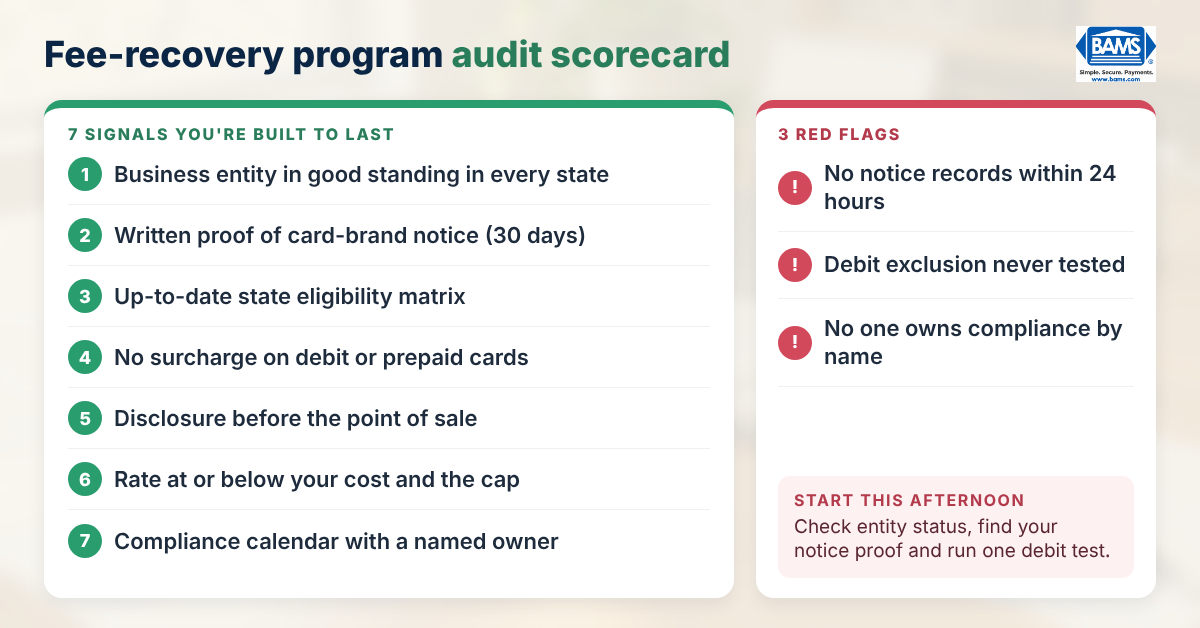
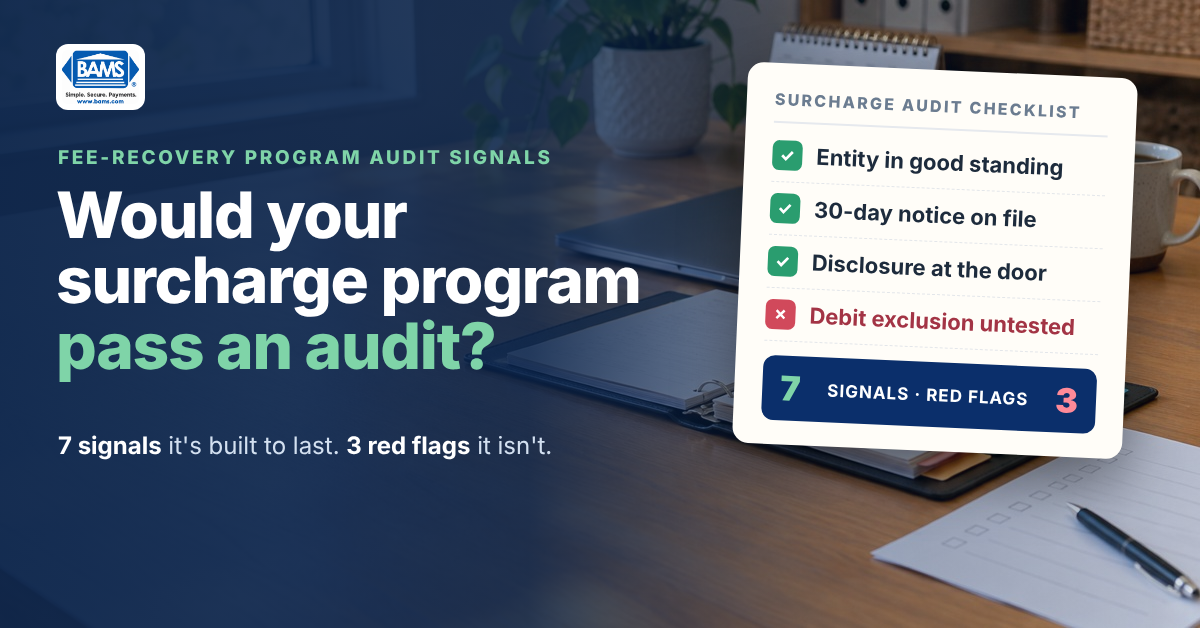
Score your surcharge program: 7 signals and 3 red flags.
Pattern Recognition: What These Signals Share
Every durable compliance signal shares three properties. First, someone documents it instead of assuming it. Second, a specific person owns it, not a general intention. Third, the team tests it on a recurring schedule instead of setting it once and forgetting it.
By contrast, the surcharge audit red flags are mirror images: undocumented, unowned, untested. The pattern reveals that surcharge compliance is less about knowing the law and more about building operational habits that produce evidence. 69% of small businesses already report spending more per employee on regulatory compliance than larger competitors. The goal is not to spend more, but to spend more effectively by focusing on the signals that actually prevent shutdowns.
Also notice the tradeoff: thoroughness versus speed. A merchant who checks every signal quarterly will catch problems early but invest more time. A merchant who checks annually saves time but increases exposure. The right cadence depends on how many states you operate in and how frequently your payment setup changes.
Where to Start: Constraints and Prioritization
You do not need to check all seven fee-recovery program audit signals and three red flags this week. Start with three: verify your business entity status, confirm your card-brand registration documentation exists and run one debit-card test transaction. These three actions cover several common audit triggers and you can finish them in a single afternoon.
Then, if you operate in multiple states, add the state eligibility matrix as your fourth priority. If you sell online, add disclosure verification for your checkout flow. 44% of small businesses outsource compliance tasks and that is a reasonable approach for ongoing monitoring. But the initial diagnostic, knowing where you stand right now, is something only you can do.
Frequently Asked Questions
Is credit card surcharging legal in every state?
No. Several states, including Connecticut and Massachusetts, prohibit or limit surcharging. Other states allow it with specific conditions, such as caps on the surcharge amount or mandatory disclosure formats. The list changes as new legislation is introduced, so merchants must maintain and review a current state-by-state eligibility matrix at least quarterly.
Do I need to notify Visa and Mastercard before surcharging?
Yes. Both card brands require notice at least 30 days before you start. Mastercard requires notice to Mastercard and your acquirer and Visa requires notice to your acquirer. Your processor typically handles the notification, but you should request and retain written confirmation as part of your compliance file.
Can I apply a surcharge to debit card transactions?
No. Card-brand rules prohibit surcharging debit cards and prepaid cards. Set up your POS system to distinguish between credit and debit transactions and suppress surcharges on debit. Test this regularly, especially after any system update.
What is the maximum surcharge percentage I can charge?
Visa caps surcharges at the lower of your cost of acceptance or 3% and Mastercard caps them at 4%. Some states impose their own lower caps. Merchants should calculate their effective processing rate and ensure the surcharge stays at or below both the network cap and their actual cost.
What happens if my surcharge program fails an audit?
Consequences range from fines imposed on your acquirer (which are typically passed to you) to mandatory program suspension or termination. In some cases, state attorneys general may pursue enforcement actions that include penalties and injunctions. Frequent audit failures include missing notice documentation, surcharges applied to debit cards and inadequate customer-facing disclosures.
How often should I review my surcharge compliance?
At minimum, conduct a quarterly review of your state eligibility matrix, surcharge rate and disclosure signage. Debit-card exclusion testing should occur after every terminal update or processor change. Verify business entity good standing and card-brand notice records annually. Assigning these tasks to a named individual with calendar reminders is the most reliable approach for small businesses.
Sources
- U.S. Chamber of Commerce: Small Business Index, Q4 2024 Quarterly Spotlight
- Visa: Merchant Surcharging Considerations and Requirements
- Mastercard: Merchant Surcharge Rules
- Arnall Golden Gregory: Colorado Opens the Door to Surcharging, Five Key Takeaways
- Vanta: 2024 Compliance Benchmark Report (A-LIGN data)
- Corporate Compliance Insights: News Roundup, November 1, 2024 (Creditsafe survey)
- U.S. Chamber of Commerce: Small Businesses Are Spending More Time and Money on Regulatory Compliance