
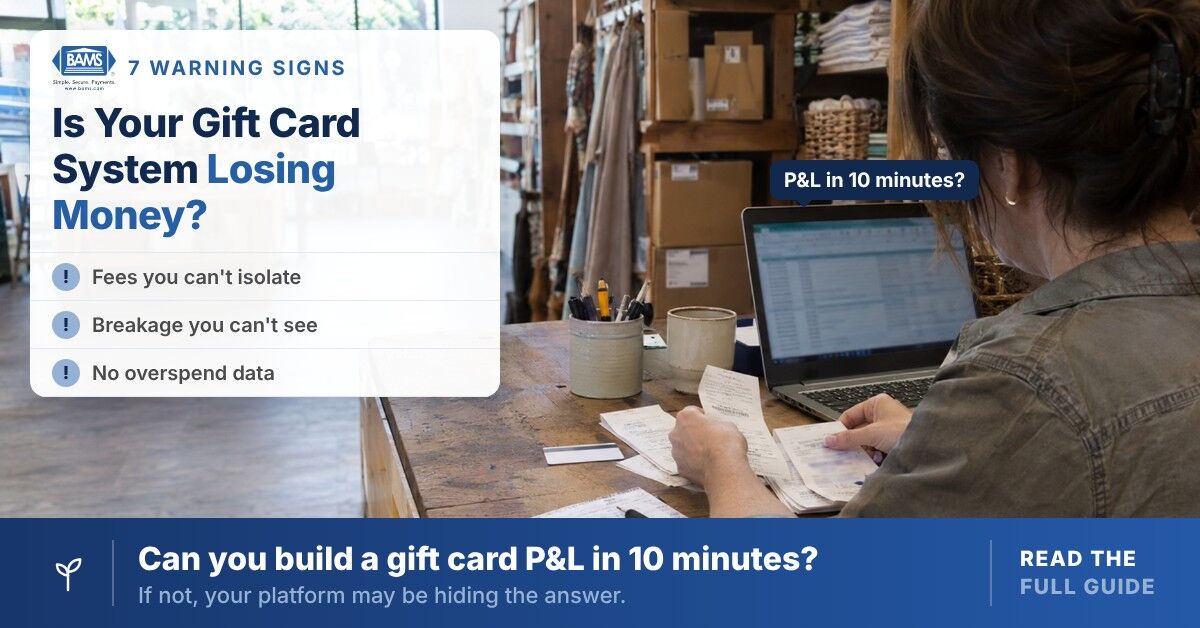
7 Signs Your Gift Card Management System Is Losing Money
The Gift Card Problem Nobody Warns Independent Businesses About
Gift card programs look straightforward on the surface: sell a card, collect revenue upfront and benefit when the recipient walks through your door. But for independent businesses operating without enterprise-level analytics teams, the gap between what a gift card management system promises and what it actually reveals can be expensive. In its Consumer Sentinel Network Data Book 2024, the FTC logged 41,120 fraud reports where a gift card or reload card was the payment method. That risk touches merchants too, especially those who lack visibility into how their programs actually perform.
The real cost isn’t always fraud in the traditional sense. It’s the slow bleed of hidden fees, unreported breakage and opaque redemption data. Many platforms are also designed for scale and treat small-business economics as an afterthought. Most content on this topic treats gift cards as a product feature. Instead, this piece treats them as a financial instrument that deserves the same scrutiny you’d give any revenue line.
TL;DR
- Channel-blind redemption data hides real patterns – Digital and physical gift cards often come back on different timelines. If your platform reports a single blended rate, your cash flow forecasts and staffing decisions are based on distorted data.
- Breakage and overspend are your program’s real ROI drivers – Many redeemers spend above the card’s face value and some balances go unused. If your gift card management system can’t surface these numbers, you can’t prove the program’s value.
- Fee structures designed for high volume penalize small businesses – Calculate your all-in cost per card and compare it with your average card value. If fees eat a large share, the economics need reevaluation.
- No card-level fraud alerting means preventable losses go undetected – Basic velocity checks are table stakes, such as flagging multiple redemptions within hours. Yet many small-business platforms don’t offer them.
- If you can’t produce a gift card P&L in 10 minutes, the platform isn’t built for you – Start by attempting this exercise. In fact, how hard it is tells you whether your system serves your business or hides its performance.
Who This Is For and What It Covers
This guide is for independent retail, dining and service owners who run (or are considering) a gift card program. You don’t need a primer on what gift cards are. You need a diagnostic framework for evaluating whether your current platform is working for you or quietly working against you.
This is not a product comparison or a procurement checklist. It excludes enterprise-grade solutions designed for multi-location chains. Instead, it focuses on seven signals that your gift card platform may be costing more than it earns. It pays particular attention to gift card analytics, redemption tracking and fee structures that matter at small-business transaction volumes.
How These Signals Were Selected
Each signal meets three criteria. It represents a measurable financial risk and it’s commonly overlooked in standard platform evaluations. Also, an owner can act on it without specialized technical resources. The emphasis is on gaps in visibility rather than features. After all, a feature you can’t measure is a feature you can’t manage.
Seven Signals Your Gift Card Management System Costs More Than It Earns
1. Your Redemption Data Doesn’t Distinguish Channels
Why it matters: A single blended redemption rate hides critical differences in customer behavior. Cards bought online and delivered by email or text are easy to find and use. Physical cards are easy to misplace, which is why the FTC tells consumers to use gift cards as soon as possible. If your platform reports one number for both, you’re making inventory, staffing and cash flow decisions with distorted data.
What it looks like today: Many small-business gift card platforms report total cards sold and total cards redeemed. Period. No channel segmentation, no time-to-redemption curves, no distinction between digital and physical. Enterprise platforms offer this granularity. Budget platforms rarely do.
How to apply it: Ask your provider for a sample redemption report before renewing any contract. If the report can’t separate digital from in-store gift card redemption data, you’re operating with a blind spot that affects how you forecast revenue timing.
2. You Can’t Calculate Your Actual Breakage Revenue
Why it matters: Breakage (the value on gift cards that never gets redeemed) can become revenue for your business, but only if you can measure it and account for it correctly. Under federal gift card rules, which the Federal Reserve finalized in 2010, store gift card funds can’t expire for at least five years from issue or last load. State unclaimed property laws may also apply. For independent businesses, even modest breakage matters, yet many platforms don’t surface this data at all.
What it looks like today: Some platforms track card balances but don’t flag cards that have gone dormant. Others report breakage only once a year, if at all. Without clear breakage reporting, you can’t work with your accountant on when to recognize it or factor it into your program’s ROI.
How to apply it: Request a report showing cards with remaining balances that haven’t been used in 12+ months. If your platform can’t generate this, build a manual tracking sheet from your transaction records. Imperfect data beats invisible data.
3. Your Fee Structure Penalizes Low Volume
Why it matters: Many gift card platforms price their services around transaction volume tiers designed for businesses processing hundreds of cards monthly. An independent café or boutique selling 15 to 30 cards per month can end up paying per-card fees, monthly minimums or platform charges. Those costs erode margins on a program that should be pure upside.
What it looks like today: Fee structures vary widely. Some providers charge per activation, per redemption and a monthly platform fee. Others, however, bundle fees in ways that make it difficult to isolate the true cost per card. The result is that a $25 gift card can carry several dollars in combined fees before the customer even walks in.
How to apply it: Calculate your all-in cost per card (activation fee + monthly platform fee divided by cards sold + per-redemption fee). Compare that against your average card value. If fees consume a large share of card value at your volume level, the economics deserve a hard look. As a Payment Processing Company, BAMS offers gift and loyalty card programs. In addition, a dedicated account representative can help you review whether your costs fit your actual transaction patterns.
4. You Have No Fraud Alerting at the Card Level
Why it matters: Gift card fraud prevention for independent businesses isn’t about stopping organized crime rings. It’s about catching the small, repeatable exploits: duplicate activations, rapid-fire redemptions across locations, or balance checks that precede unauthorized use. Gift cards are a favorite payment method for scammers because value moves fast and is hard to recover. Basic card-level monitoring can flag many suspicious patterns.
What it looks like today: Enterprise platforms offer velocity checks, geolocation matching and anomaly detection. Most small-business platforms offer nothing beyond a transaction log you’d have to review manually. The gap between these two worlds is where independent businesses absorb preventable losses.
How to apply it: At minimum, your platform should alert you when a single card is redeemed multiple times within 24 hours. It should also flag a card redeemed for its full value within minutes of activation. If it can’t, set up manual alerts through your POS system’s reporting tools. For merchants looking at custom payment software solutions, integrating basic fraud logic into your card program is a practical investment.
5. Your Platform Doesn’t Track Overspend Behavior
Why it matters: The strongest financial argument for gift cards isn’t the card sale itself. It’s what happens at redemption. Many redeemers spend more than the card’s face value. If your gift card management system doesn’t capture this overspend data, you can’t build a real ROI model for your program.
What it looks like today: Most platforms track the card balance. However, few connect that balance to the total transaction amount at redemption. This means you know a $50 card was used, but you don’t know whether the customer’s total purchase was $50 or $75. That missing $25 is the entire business case for running a gift card program.
How to apply it: If your platform can’t link card redemptions to total ticket size, pull the data manually from your POS for one quarter. Calculate average overspend per redemption. This single metric can justify (or challenge) your entire gift card investment.
6. Digital and Physical Card Programs Run on Separate Systems
Why it matters: Digital gift cards are now a normal part of many programs. However, if your digital and physical card programs don’t share a single system of record, you double your admin work. You also create reconciliation gaps that hide both revenue and risk.
What it looks like today: It’s common for small businesses to use one vendor for physical cards and a separate e-gift card tool bolted onto their website. Disconnected systems create hidden labor costs. For independent businesses, that cost is usually the owner’s own time.
How to apply it: Audit how many systems touch your gift card lifecycle (sale, activation, balance check, redemption, reporting). If the answer is more than two, consolidation should be a priority. Unified gift card analytics across channels is the baseline for making informed decisions about your program.
7. You Can’t Generate a Gift Card P&L in Under 10 Minutes
Why it matters: Suppose a profit-and-loss view of your gift card program means exporting data from several systems and calculating fees by hand. In that case, the program’s true performance is effectively unknown. A revenue line you can’t evaluate quarterly is a revenue line you can’t optimize.
What it looks like today: Enterprise platforms offer dashboard views of card sales, redemptions, breakage, fees and net revenue. Independent businesses, by contrast, often piece this together from POS reports, bank statements and vendor invoices. The friction isn’t just inconvenient. It means the analysis rarely happens at all.
How to apply it: Set a benchmark: can you produce a one-page summary of gift card revenue, costs and net contribution in under 10 minutes? If not, the reporting gap is itself a cost. Next, evaluate whether your current provider offers a consolidated view, or whether switching to a merchant services partner with integrated gift card reporting would close the gap.

Start with Signals 3 and 7: cost per card and a 10-minute P&L.
What These Signals Have in Common
All seven signals point to the same problem. Platforms designed for high-volume operators often treat small-business users as a lower tier. The result is that independent businesses pay for infrastructure they don’t fully use while lacking the analytics they actually need. Visibility gaps compound over time. Picture fees you can’t isolate, redemption data you can’t segment and fraud patterns you can’t detect. Together, they create a program that feels like it’s working but can’t prove it.
The connective thread is that each gap makes the next one harder to identify. Without channel-level gift card redemption data, breakage calculations are unreliable. Without overspend tracking, ROI models are incomplete. And with no consolidated P&L, none of these issues surface until the program is either too entrenched to change or too neglected to matter. Ultimately, treating your gift card program as a financial instrument rather than a marketing tactic shifts the evaluation from “does it work?” to “can I prove it works?”
Where to Start
You don’t need to address all seven signals simultaneously. First, calculate your all-in cost per card (Signal 3). Then try to generate a gift card P&L (Signal 7). Together, these exercises show whether your platform gives you enough data to manage the program as a business function.
If either exercise takes more than an hour or produces inconclusive results, that’s your diagnostic answer. The platform isn’t necessarily bad. It’s just not built for your scale or your questions. Independent businesses operate with limited time and limited margin for invisible costs. The goal isn’t a perfect system. It’s a system transparent enough to tell you whether your gift card program is earning its place in your operations.
Frequently Asked Questions
What is gift card processing and how does it work?
Gift card processing starts by activating a physical or digital card at the point of sale. Then the system stores the balance securely and deducts value when the cardholder redeems it. For closed-loop cards (usable only at your business), the processing typically runs through your POS system or a dedicated gift card platform. Each activation and redemption generates a transaction that may carry separate fees depending on your provider.
How do closed-loop and open-loop gift card systems differ?
Closed-loop gift cards can only be redeemed at the issuing business. As a result, they’re simpler to manage and carry lower processing costs, making them the standard choice for independent businesses. By contrast, open-loop cards (like Visa or Mastercard gift cards) work anywhere those networks are accepted. However, they involve higher fees and more complex compliance requirements. For most small businesses, closed-loop cards offer better economics and tighter control over the customer experience.
How can gift cards help increase customer spending and loyalty?
The primary mechanism is overspend at redemption. Many redeemers spend more than the card’s face value. Gift cards also drive new customer acquisition, since the buyer and the recipient are often different people. In addition, they create a reason to visit that doesn’t depend on a promotion.
Which features should I look for in a gift card management platform?
First, prioritize channel-level redemption tracking (digital vs. physical) and breakage reporting. Also look for card-level fraud alerting and the ability to link card redemptions to total transaction amounts. Fee transparency is equally important: you should be able to calculate your all-in cost per card without cross-referencing multiple invoices. A platform that can generate a gift card profit-and-loss summary in minutes, not hours, is a strong indicator of small-business readiness.
When is the best time to launch a gift card program?
The highest-volume gift card sales periods align with major holidays. However, launching well before peak season gives you time to test your systems, train staff and establish baseline data. So if you’re evaluating a new platform, start in a quieter period. That way you can spot reporting gaps and fee surprises before your busiest months.
What is gift card breakage and why does it matter for small businesses?
Breakage is the dollar value on gift cards that is never redeemed. For small businesses, breakage can become revenue, but it often goes unmeasured because platforms don’t report it clearly. Understanding your breakage rate helps you forecast cash flow more accurately and build a more honest picture of your gift card program’s total return. Federal rules keep store gift card funds from expiring for at least five years. Because state laws vary, ask your accountant when unredeemed balances can be recognized.


