
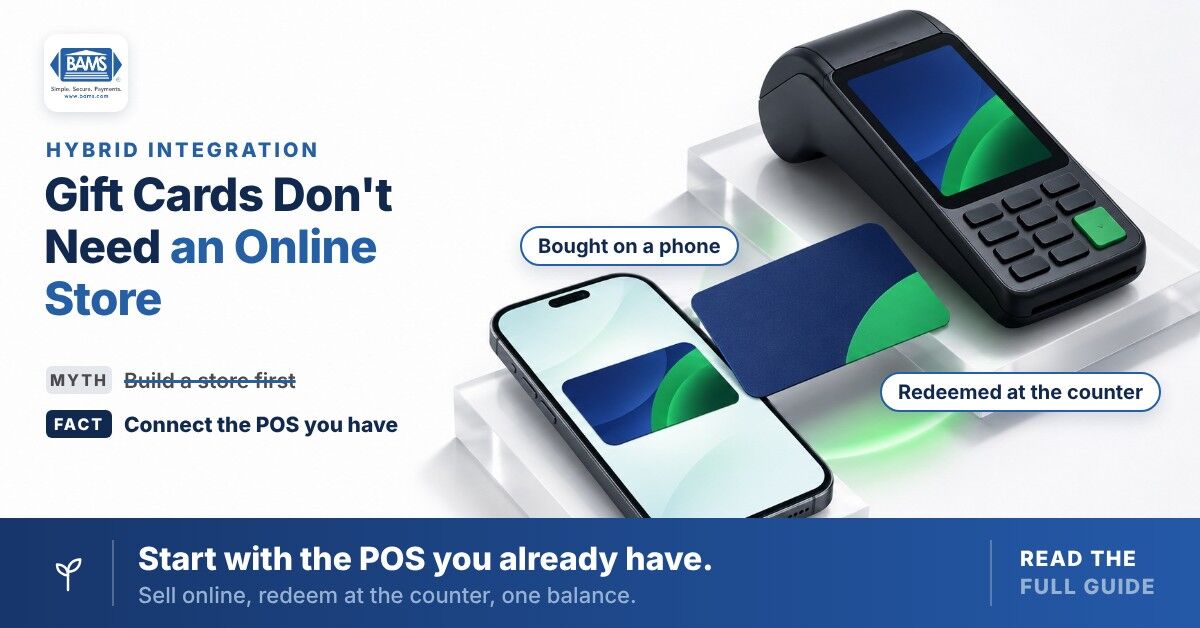
Hybrid Integration: Why Gift Cards Don’t Need an Online Store
The Myth That’s Keeping Your Gift Cards Off the Market
Somewhere along the way, small business owners got sold a lie: that launching a branded gift card program requires building an online store first. That you need a full eCommerce stack, a digital storefront and weeks of setup before a single card changes hands. Meanwhile, customers are walking into your shop, your restaurant, your salon, ready to buy a gift for someone they love. And you’re sending them to Amazon instead.
TL;DR
- You don’t need an online store to sell gift cards – Start with your existing POS and payment processor, then use hybrid integration to add a digital purchase channel.
- Gift cards are a payment product, not an eCommerce feature – Treating them as a payment integration project instead of a digital storefront project cuts costs dramatically and speeds up launch.
- PCI compliance testing is a launch workstream, not an afterthought – Digital gift card sales can change your PCI scope. Build it into the plan from day one.
- The revenue is already there – Customers already want to send gift cards from their phones. Your job is to make that easy.
Why Everyone Thinks You Need an Online Store First
The “build an online store” advice isn’t malicious. It comes from a world where enterprise retailers launched gift card programs as extensions of massive eCommerce platforms. For Target or Starbucks, the digital storefront came first and the gift card was a feature bolted on top.
That playbook trickled down to small business advice columns, SaaS landing pages and even payment processor marketing. The message became: step one, get online. Step two, add gift cards. Step three, profit. It sounds logical. It also ignores reality. Most independent retailers already have a working point-of-sale system and customers who walk through a physical door. They don’t need a Shopify subscription just to sell a $50 gift card.
This advice used to make sense when digital-only was the growth story. It doesn’t anymore.
The Real Starting Point Isn’t a Storefront
Here’s what we actually believe: the fastest, cheapest way for a physical retailer to launch a branded gift card program is to start with what they already have. That means their POS, their payment processor and their counter, with digital capability layered in through hybrid integration rather than rebuilt from scratch. You don’t need a new store. You need a smarter connection between the systems you’re already paying for.
How Hybrid Integration Changes the Gift Card Math
Consider what a typical small business owner faces when told to “go digital” with gift cards. They’re looking at a monthly eCommerce platform subscription, custom card design through a third-party vendor, a separate payment gateway and the headache of reconciling online gift card sales with in-store redemptions. For a coffee shop doing $400,000 in annual revenue, that’s a serious bet on infrastructure before selling a single card.
Now consider the alternative.
Most modern POS systems already support gift card functionality. The gap isn’t capability. It’s connection. A hybrid integration approach links your existing POS to a lightweight digital sales channel (think a simple landing page or even a text-to-buy flow) without requiring a full eCommerce build. The card sold online redeems at the register. The balance updates in real time. No second platform. No reconciliation nightmare.
Digital gift cards are still gift cards. Under federal gift card rules, a store gift card can be “a card, code, or other device,” so an emailed code carries the same protections as plastic. The rules, which the Federal Reserve finalized in 2010, keep funds from expiring for at least five years. Your POS gift card module already tracks those balances. The question isn’t whether your customers want to buy gift cards digitally. It’s whether you rebuild your infrastructure or simply connect what you have.
This is where the choice of payment processing partner matters far more than most owners realize. A processor that offers integration consulting alongside merchant services can help you connect your POS gift card module to a digital purchasing flow, often using tools you already have access to. As a Payment Processing Company, BAMS offers gift and loyalty card programs, PCI compliance support and a dedicated account representative to help plan the connection.
The PCI Question Nobody Asks Early Enough
And then there’s the compliance question nobody talks about until it’s too late.
The moment you accept a digital payment for a gift card, you’re handling card-not-present transactions. That changes your PCI scope. Say customers pay on a page your provider hosts, through a redirect or an emailed payment link. In that case, the PCI Security Standards Council explains you may be able to use SAQ A, the shortest questionnaire. If the payment form is embedded on your own site, since April 2025 you must also confirm your site is protected from script attacks. For a small business owner juggling payroll, inventory and Saturday morning rushes, that isn’t a weekend project. It’s a workstream that needs to be baked into the launch plan from day one.
Small businesses that fall behind on PCI compliance usually don’t lack technology. They lack guidance. When your payment partner treats compliance as a checkbox rather than an implementation step, you end up exposed. When they treat it as part of integration consulting, you end up protected and live faster.
What You’re Actually Losing by Waiting
If this framing is right, then every month a small business delays its gift card program isn’t just a missed marketing opportunity. It’s lost revenue. Gift card sales flow to businesses that make it easy to buy, not to the ones that built the fanciest digital storefront.
The cost of inaction compounds in ways that aren’t obvious. A customer who can’t buy a gift card from you doesn’t just skip the purchase. They buy one from a competitor, or from a marketplace that takes a cut you’ll never see. They form a habit of gifting somewhere else. And the person who would have received that card, your potential new customer, never walks through your door.
The businesses capturing this growth aren’t the ones with the biggest tech budgets. They’re the ones whose payment processing partner helped them connect what they already had to what their customers already wanted.

Gift cards are a payment product. Treat launch as a payment integration project.
A Better Way to Think About Gift Card Programs
Stop thinking of a gift card program as a “digital project.” Start thinking of it as a payment integration project. The mental shift matters because it changes who you call for help, how much you spend and how fast you launch.
A digital project means platforms, subscriptions, design agencies and weeks or months of setup. A payment integration project means connecting your existing POS to a digital purchase flow, ensuring PCI compliance testing covers the new transaction type and going live. One can cost thousands. The other usually costs far less, plus a few focused conversations with the right partner.
Gift cards aren’t an eCommerce feature. They’re a payment product. Treat them that way and the budget problem shrinks.
The Revenue Is Already Waiting
Your customers don’t care whether you have a beautiful online store. They care whether they can text a gift card to their mom on her birthday. They care whether the card works when she walks into your shop on Saturday.
The businesses winning at gift cards right now aren’t the ones who spent the most. They’re the ones who started with what they had and connected it to what people actually wanted to buy. That’s not a technology problem. It’s a decision.
Frequently Asked Questions
Do I need an online store to sell gift cards digitally?
No. Most POS systems already support gift card functionality. A hybrid integration approach can connect your existing system to a simple digital purchase flow without requiring a full eCommerce platform.
How does PCI compliance change when adding digital gift card sales?
It depends on how customers pay. A page hosted by your payment provider usually keeps your scope small and the PCI Security Standards Council says SAQ A may apply. Confirm the right questionnaire with your acquirer and plan the time into your launch rather than treating it as an afterthought.
What does integration consulting mean for a small business launching gift cards?
Integration consulting helps you connect the systems you already use (POS, payment processor, customer database) to new capabilities like digital gift card sales. It replaces the need to buy and manage entirely new platforms.


