Gift Card Program Strategy: A Revenue Timing Tool
Last Updated on November 3, 2026 by Dimitri Akhrin
Your Gift Card Program Isn’t a Perk. It’s a Timing Problem.
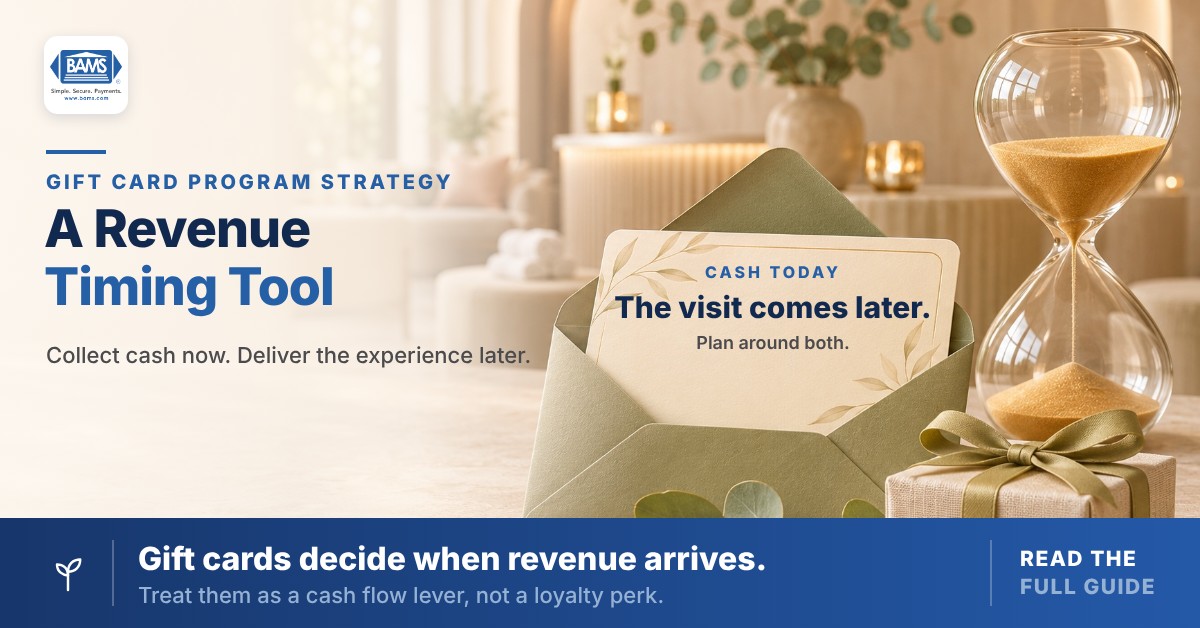
Many small business owners think of gift cards as a nice feature, a loyalty add-on, something to display near the register during the holidays. But the businesses actually winning with gift card program strategy aren’t treating cards as a product. They’re treating them as a lever. It controls when revenue arrives, when customers walk in and how much they spend.
The distinction matters more than it sounds.
TL;DR
- Gift cards are a revenue timing tool, not a loyalty perk – They let you collect cash now and deliver the experience later, bridging seasonal cash flow gaps.
- The overspend effect is real – Many customers spend more than the card’s balance, which can turn a redemption into a higher-value visit.
- B2B is the overlooked channel – Corporate rewards and client appreciation gifts mean bulk orders with minimal marketing cost.
- Digital cards speed up the cycle – A card delivered to a phone is easier to find and use, so purchases can turn into foot traffic sooner.
The “Loyalty Feature” Pitch That Misses the Point
For years, the prevailing advice has been straightforward: offer gift cards because customers like them. The pitch usually sounds like this: gift cards build brand awareness, they make great last-minute presents, they introduce new customers to your business. All true. None of it strategic.
This framing worked when gift cards were a novelty. When the market was growing simply because more businesses were adopting programs. Today, nearly every competitor offers gift cards too. The advantage now comes from smarter programs, not from simply having cards. The “just offer them” era is over.
Gift Cards Are a Revenue Timing Tool, Not a Checkout Accessory
Here’s what we actually believe: a gift card is not a product you sell. It’s a mechanism that lets you collect revenue now and deliver the experience later. The terms favor your cash flow, foot traffic and average ticket. The businesses that understand this build programs around timing. Everyone else just prints plastic.
The Gift Card Revenue Case Nobody Makes for Small Business
Consider what actually happens when someone buys a $50 gift card from your restaurant in December. You receive $50 in cash immediately. Your food cost at that moment is zero. Your labor cost is zero. On your books the $50 is a liability until the card is redeemed. But the cash is in your account today and costs don’t arrive until the card comes back, often weeks or months later.
This is not a minor accounting detail. Holiday shoppers buy a large share of gift cards in November and December, right before the cash-thin months of January and February. That means a well-designed holiday gift card push can function as a cash flow bridge, pulling future-period revenue into the present when you need it most.
Then comes redemption and the math gets even more interesting.
Many customers spend more than the balance on their gift card. That $50 card can turn into a $60 or $70 visit, with the overage paid in cash or card. The gift card didn’t just bring a customer in. It anchored a higher-value transaction.
And some cards never get redeemed at all. Plan for this “breakage” carefully rather than counting on it. Under federal gift card rules, which the Federal Reserve finalized in 2010, store gift card funds generally can’t expire for at least five years from purchase or last load. State unclaimed property laws may also apply, so ask your accountant when and how unredeemed balances can be recognized.
Digital Changes the Timing Equation
The shift to digital gift cards can speed up every part of this cycle. A physical card is easy to misplace and the FTC advises consumers to use gift cards as soon as possible because it’s common to lose or forget about them. A digital card lives in an inbox or a phone wallet, where it’s easier to find and use.
Faster redemption can mean faster foot traffic. A customer who gets a birthday gift card on Tuesday may visit the next week. A forgotten plastic card might surface three months later in a drawer. For a small business owner thinking about gift card program strategy, digital delivery isn’t just convenient. It’s a faster path from someone else’s purchase to your register.
The B2B Channel Most Small Businesses Ignore
Business buyers are easy to overlook. Corporate incentives, employee rewards and client appreciation gifts represent bulk purchases at predictable intervals, often with little marketing cost to acquire.
A local spa selling ten $100 gift cards to a nearby accounting firm for tax-season employee rewards just brought in $1,000 with a single conversation. No ad spend, discount or coupon code. This is where gift card revenue stops being a consumer-gifting story and becomes a B2B sales channel.
To set up or refine a program alongside your payment processing, consider BAMS. As a Payment Processing Company, BAMS offers gift and loyalty card programs with branded gift cards in professional or custom designs. A dedicated account representative can help with setup, so owners can focus on the strategy rather than the infrastructure.
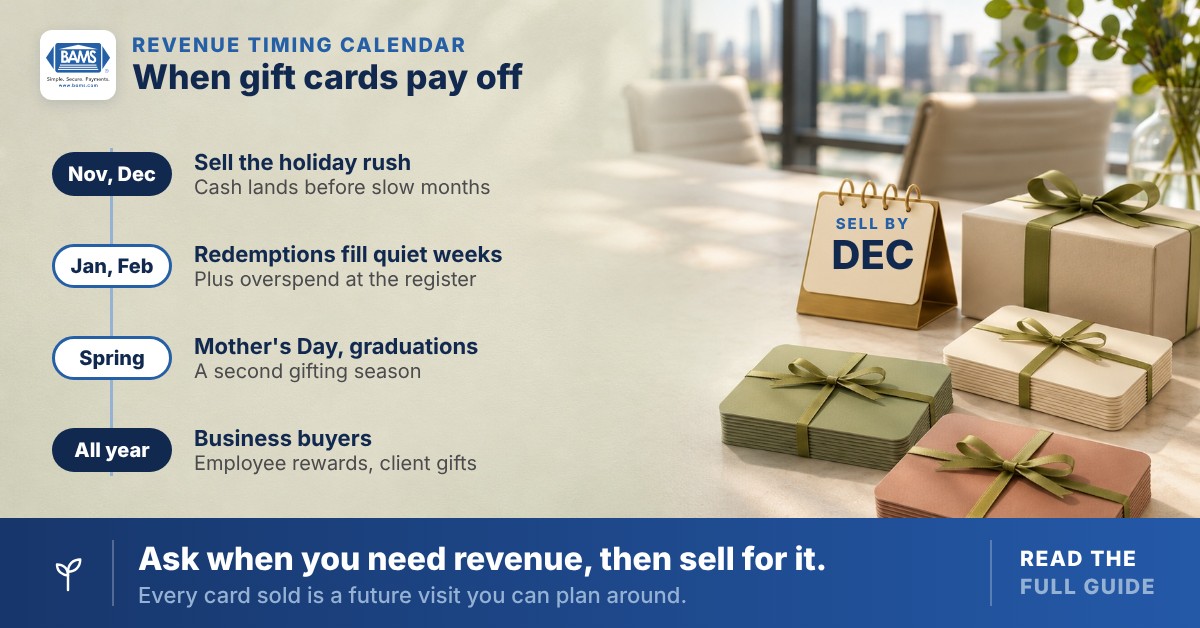
Ask when you need revenue, then sell for it.
What Changes If You See Gift Cards as Timing
If this framing is right, then several common decisions look different. Launching a gift card program “when you get around to it” becomes a missed quarter of cash flow. Treating gift cards as a holiday-only product ignores Mother’s Day, graduations, birthdays and corporate thank-yous the rest of the year. Choosing a provider based on card design templates instead of redemption analytics means you’re optimizing the wrong variable.
It also means your gift cards drive revenue in ways that compound over time. The customer who redeems a card and overspends becomes a candidate for your loyalty program. The data from redemption patterns tells you which promotions pull traffic into slow periods. Each card sold is a future visit you can plan around, not just hope for.
A Better Way to Think About It
Stop asking “should we offer gift cards?” and start asking “when do we need revenue and can gift cards move it there?”
This is the reframe: a gift card program is a time-shift tool for small business revenue, not a loyalty feature. It lets you borrow demand from a future period (or someone else’s wallet) and deposit it into the present. It converts a one-time gifting impulse into a two-visit minimum: one to buy, one to redeem. December generosity becomes January foot traffic.
When you see it this way, every decision about your program (digital vs. physical, promotional timing, B2B outreach, provider selection) becomes a question about cash flow architecture, not marketing decoration.
The Real Question Isn’t Whether. It’s When.
Every independent business already has seasonal gaps, slow weeks and months where cash flow tightens. Gift cards don’t fix that by magic. But a program built around your revenue timing needs turns a simple card into a tool that helps you control the clock. Now you can plan around it.
Frequently Asked Questions
How do closed-loop and open-loop gift card systems differ for small businesses?
Closed-loop cards are redeemable only at your business, which drives direct foot traffic and keeps revenue in-house. Open-loop cards (like Visa or Mastercard branded) work anywhere, making them less useful as a repeat-visit tool for independent businesses focused on gift card program strategy.
When is the best time to launch a gift card program?
Before your next high-traffic season, not during it. Launch well ahead of the holiday rush, Mother’s Day, graduation season or your industry’s peak. That gives you time to promote the program before gift-buying intent peaks.
What should I look for in a gift card management platform?
Prioritize redemption analytics, digital delivery options and integration with your existing payment processing. Card design is secondary to understanding when and how cards get redeemed, which is the data that actually informs your revenue timing decisions.