How Chargeback Defense Works
Last Updated on September 4, 2026 by Dimitri Akhrin
Chargeback Defense Starts Before the Response Deadline
Chargebacks are a reality of accepting card payments, which is why having a solid chargeback defense process matters. Some disputes are legitimate and should be accepted. Others involve transactions where the merchant fulfilled the order correctly and may have strong grounds to challenge the claim.
The difference often comes down to something very practical: did the merchant know about the dispute quickly enough, understand why it was filed and submit the right evidence within the required response window?
Unfortunately, plenty of merchants still lose disputes they might otherwise have challenged because they respond late, submit incomplete evidence or simply fail to notice the case in time.
And it isn’t just lost revenue. In many cases, merchandise has already been shipped or a service has already been delivered. That leaves the merchant potentially losing both the payment and the value of what was provided.
Consistently high dispute levels can create another problem. Chargebacks increase risk for processors, acquiring banks and card networks, and excessive dispute activity can eventually expose a merchant to additional monitoring, fees or account instability.
With that much at stake, chargeback defense should not be something a business thinks about only after money disappears. The BAMS Chargeback Defense program is designed to make the response process faster, more organized and easier to manage from the moment a dispute arrives.
TL;DR
- Chargeback defense starts with knowing about the dispute immediately – BAMS Dispute Assistant Manager sends day-zero email and SMS alerts when a new dispute appears, followed by reminders on days one and three when no action has been taken.
- The reason code should determine the evidence you submit – Dispute Assistant Manager automatically interprets the dispute reason code and provides a customized documentation checklist so merchants can focus on the records that are relevant to that specific case.
- Evidence submission and case tracking should happen in one workflow – Merchants can upload supporting documents online, receive confirmation that the response was submitted and monitor status changes through the dispute dashboard.
- Historical dispute data can help prevent future losses – Searchable and exportable dispute history can reveal patterns involving billing descriptors, products, fulfillment, sales channels or fraud that may be contributing to repeated chargebacks.
- The strongest chargeback strategy combines prevention with defense – Clear billing descriptors, fraud controls, accurate fulfillment and responsive customer service can reduce avoidable disputes, while a structured defense process helps merchants respond when a legitimate transaction is challenged.
Chargeback Defense with BAMS Dispute Assistant Manager
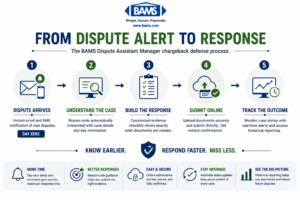
Effective chargeback defense gives merchants early notice, shows them what evidence to collect and keeps the case visible through resolution.
BAMS merchants get access to an advanced dispute management system called Dispute Assistant Manager. Prevention should still come first. Clear billing descriptors, fraud screening, accurate fulfillment and responsive customer service can help stop some disputes before they become chargebacks.
But prevention will never eliminate every case.
Dispute Assistant Manager focuses on what happens next: notification, reason-code interpretation, evidence collection, online submission and ongoing case tracking.
That workflow matters because chargeback management has become an operational problem as much as a payment problem.
Mastercard’s 2026 research found that consumers bypass the merchant and go directly to their card issuer in roughly 75% of disputes. Yet when consumers do contact merchants first, merchants frequently resolve the problem through an explanation, refund or replacement before it needs to escalate further.
Once the dispute has already reached the formal process, the merchant needs information quickly.
Chargeback Defense Method: Instant Dispute Notifications
You can’t respond to a chargeback you don’t know exists.
That sounds obvious, but dispute deadlines can move quickly. Waiting until someone notices a mailed notification or manually checks an account can waste part of the response window before anyone starts gathering evidence.
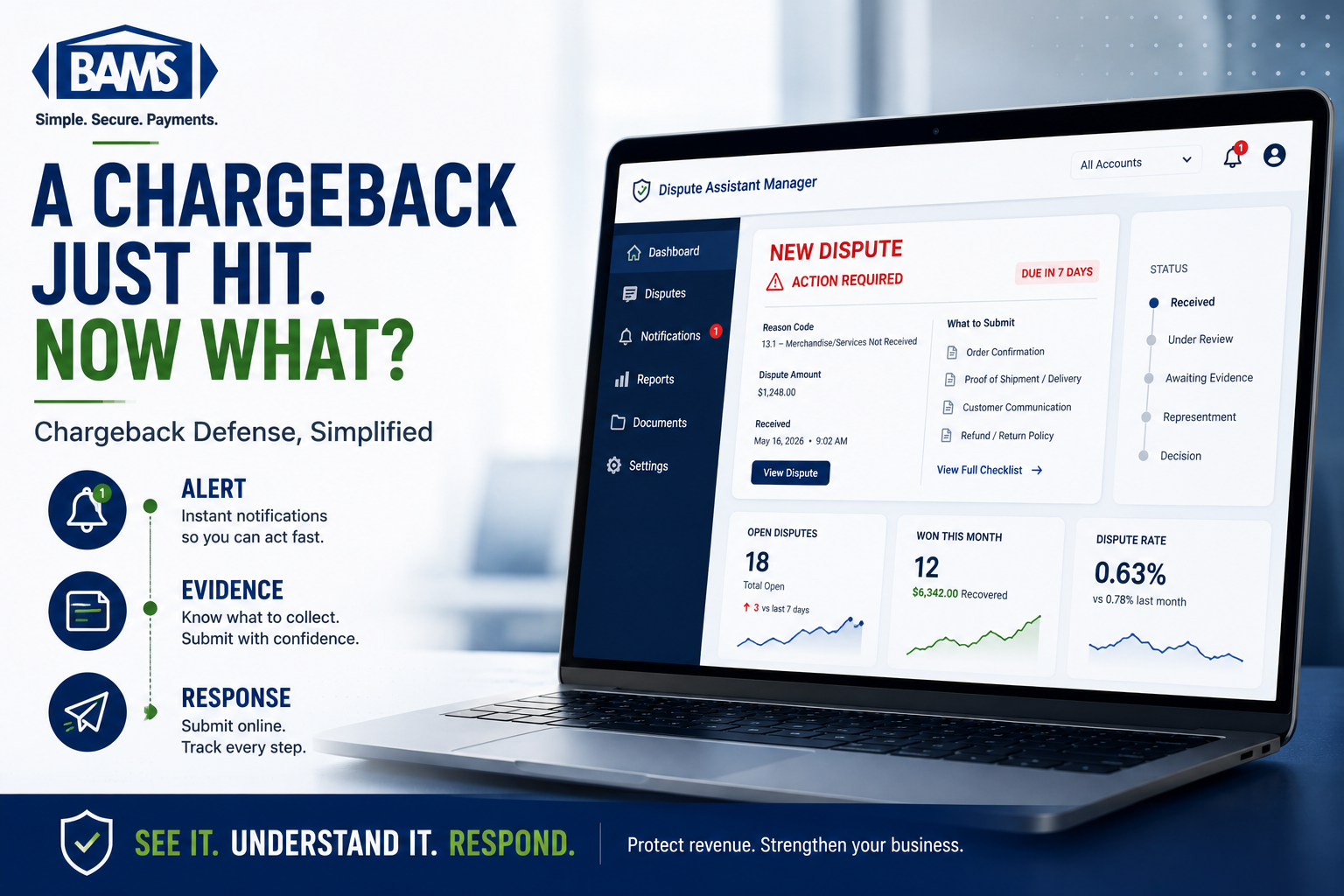
Dispute Assistant Manager provides immediate email and SMS notifications when a new dispute enters the system. BAMS describes these as day-zero notifications.
If no action is taken, automatic reminders follow on day one and day three.
That gives the merchant more time to locate the transaction, identify the dispute reason and decide whether challenging the case makes sense.
Visa similarly advises merchants to respond quickly when an acquirer contacts them about a dispute. If a merchant challenges the claim, it should provide a clear explanation along with the supporting transaction records.
Why Early Notification Matters
The first hours of a dispute should not be spent figuring out where the original transaction lives.
A useful chargeback workflow should let the merchant move immediately from notification to investigation:
- Which transaction is being disputed?
- Why did the cardholder dispute it?
- When is the response due?
- What evidence is required?
- Who inside the business has that evidence?
The earlier those questions are answered, the less likely the case becomes another deadline buried inside someone’s inbox.
Chargeback Defense Method: Automatic Reason-Code Interpretation
This is one of the most useful parts of the current BAMS system and deserves more attention than it received in the original article.
A dispute reason code tells the merchant why the transaction is being challenged. The evidence needed for one reason may be very different from what is useful for another.
Dispute Assistant Manager automatically interprets the reason code and generates a customized documentation checklist for the case.
That means the merchant does not need to start by digging through card-network tables trying to determine what a particular code means.
The system can point the response toward the evidence that actually matters.
Depending on the dispute, that might include:
- Order or transaction records
- Shipping and delivery confirmation
- Refund or cancellation policies
- Customer correspondence
- Signed receipts or service documentation
- Evidence showing that the customer previously used or recognized the account
There is no universal evidence package that guarantees a win. Strong representment means matching relevant evidence to the specific reason for the dispute.
Chargeback Defense Method: Online Dispute Response
The traditional dispute response process could be painfully manual. Merchants sometimes had to gather paper documents, send copies to the processor or even rely on fax-based workflows.
That description is increasingly dated in 2026, but the underlying problem has not disappeared. A fragmented process still wastes time when evidence lives across email, order-management systems, shipping platforms and merchant-account records.
Dispute Assistant Manager brings the response itself online.
The merchant can upload supporting documentation directly through the system and submit it to the processor’s chargeback department. BAMS currently states that submissions are delivered immediately and that the merchant receives confirmation that the evidence was successfully received.
That removes a surprisingly important uncertainty from the process.
You should not have to wonder whether the response made it to the right place.
Organize Evidence Before the Chargeback Arrives
The dispute dashboard can make submission easier, but the merchant still needs good records.
For eCommerce businesses, that means retaining useful information such as order confirmation, delivery information, customer communication and applicable refund or cancellation terms.
For card-present businesses, transaction receipts and relevant customer documentation may matter more.
Visa’s current dispute guidance emphasizes the same basic process: locate the transaction records, decide whether to accept or challenge the dispute and provide supporting evidence when contesting it.
Businesses that want to reduce the number of cases reaching this point can also review BAMS’ guide to chargeback prevention for eCommerce.
Chargeback Defense Method: Automatic Status Updates
Submitting a response does not necessarily close the case.
The processor or acquiring side may need additional documentation. The dispute can move through several statuses before reaching a final outcome.
That creates another opportunity for a case to slip through the cracks if the merchant treats submission as the end of the process.
Dispute Assistant Manager provides a centralized dashboard for monitoring current and historical cases. BAMS also sends email and SMS notifications when a dispute’s status changes.
If additional information is requested, the merchant can see that something needs attention instead of finding out after another response window has passed.
Your Historical Disputes Are Useful Data
A dispute is not only a case to close. Over time, it becomes part of a dataset that can tell you where problems are coming from.
BAMS currently allows merchants to export historical dispute information, including reason codes, so they can review patterns and trends.
That can reveal questions worth investigating:
- Are customers repeatedly disputing transactions because they do not recognize the billing descriptor?
- Is one product generating more dissatisfaction-related disputes?
- Are chargebacks concentrated in a particular sales channel?
- Are delivery-related claims increasing?
- Is one type of fraud appearing more often?
This is where merchant reporting and analytics can complement chargeback management. The goal is not simply to keep a record of what happened. It is to find patterns that may prevent the next dispute.
Chargeback Defense Method: ISO Intervention
Chargebacks do not affect only the merchant. They also create risk and administrative work for processors, acquiring banks and independent sales organizations.
The BAMS Dispute Assistant Manager framework has also been designed to give ISOs visibility into merchant disputes and, where appropriate, the ability to help manage cases on the merchant’s behalf.
That can be useful when a merchant is not consistently monitoring disputes or needs additional assistance keeping the response workflow moving.
The important point is not that the merchant should hand every dispute to someone else. It is that chargeback defense works better when the merchant and its processing partners can see the same problem before the deadline passes.
The Best Chargeback Defense Starts Before a Chargeback
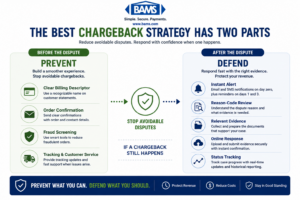
Chargeback prevention happens before a formal dispute, while chargeback defense helps merchants respond when a legitimate transaction is challenged.
Responding well is important. Preventing unnecessary disputes is better.
Visa currently divides dispute management into several stages, including preventing disputes, resolving pre-disputes and representing valid transactions when a formal chargeback does occur.
That is a better way to think about chargeback defense than treating it as a single response form.
Start with the customer experience.
Use a recognizable billing descriptor. Make return and cancellation terms clear. Send useful order confirmation and tracking information. Give customers an obvious way to reach your business when something looks wrong.
Then use fraud controls appropriate to the way the business accepts payments.
Mastercard’s 2026 research found that nearly half of consumers have disputed a transaction they later realized was legitimate. Transaction confusion is therefore not a small issue. A purchase that a customer recognizes does not need to become a chargeback in the first place.
Why the Cost of Chargeback Management Matters
Losing the original transaction is only part of the expense.
Mastercard and Javelin’s 2026 research found that merchants report an average of approximately $82 in internal costs and $46 in third-party costs for every chargeback handled. Those figures are separate from the value of the product or service involved in the disputed transaction.
The same research found that 35% of surveyed merchants considered chargeback management challenging or severely challenging.
That makes automation useful even when it does not change the final decision on every dispute.
If alerts reduce the chance of missing a deadline, reason-code interpretation reduces research time and centralized uploads reduce administrative work, the merchant can lower some of the operational burden surrounding each case.
What a Modern Chargeback Defense System Should Provide
| Capability | Why It Matters |
|---|---|
| Real-time dispute alerts | Gives the merchant as much of the response window as possible. |
| Reason-code interpretation | Helps identify why the dispute occurred and what documentation may be relevant. |
| Evidence checklist | Reduces guesswork when building the response. |
| Online document uploads | Keeps evidence submission inside one workflow. |
| Submission confirmation | Confirms that supporting documentation was received. |
| Status notifications | Helps prevent follow-up requests from going unanswered. |
| Historical reporting | Helps the business identify recurring dispute patterns. |
Not Every Chargeback Should Be Fought
A chargeback defense system should make it easier to respond. It should not encourage a merchant to challenge every dispute automatically.
If the customer genuinely did not receive what was promised, the transaction was fraudulent or the business made an error, accepting the dispute may be the appropriate outcome.
The purpose of better chargeback management is to help merchants make that decision with complete information.
When the transaction is legitimate and the merchant has relevant evidence, the system makes it easier to present that evidence. When the dispute is valid, the merchant can avoid wasting time on a response that is unlikely to change the outcome.
Frequently Asked Questions
What is chargeback defense?
Chargeback defense is the process of preventing unnecessary disputes and responding to chargebacks when a merchant has evidence that a transaction was legitimate. It can include alerts, fraud prevention, evidence collection, representment and case tracking.
What is BAMS Dispute Assistant Manager?
Dispute Assistant Manager is the chargeback-management system offered through BAMS. It provides real-time dispute alerts, automatic reason-code interpretation, document checklists, online evidence submission, status monitoring and historical dispute reporting.
How quickly does BAMS notify merchants about disputes?
BAMS currently sends email and SMS alerts on day zero when a new dispute enters the system. If the dispute has not been addressed, follow-up reminders can also be sent on days one and three.
Can merchants submit chargeback evidence online?
Yes. BAMS Dispute Assistant Manager allows merchants to upload dispute documentation online and submit it to the processor’s chargeback department. The system also provides confirmation of submission.
Does BAMS explain chargeback reason codes?
Yes. Dispute Assistant Manager automatically interprets the reason code associated with a case and creates a customized documentation checklist to help merchants understand what evidence may be needed.
Can merchants track chargeback status?
Yes. The system provides current case status through the dispute dashboard and sends email or SMS notifications when the status changes.
Can BAMS merchants review old disputes?
Yes. Historical dispute information can be searched and exported, including reason-code data that can help merchants identify recurring patterns.
Does responding to a chargeback guarantee the merchant will win?
No. A timely and well-documented response gives the merchant an opportunity to challenge a dispute, but the final outcome depends on the facts of the case, the evidence submitted and the applicable card-network rules.
Can chargebacks be prevented completely?
No. Some disputes involve genuine fraud or legitimate customer complaints. Merchants can reduce avoidable disputes through clear communication, recognizable billing descriptors, fraud controls and strong customer service, but no business can eliminate every chargeback.
Make Chargeback Defense Part of the Payment Setup
Chargeback management works best when it is part of the merchant account rather than something a business starts thinking about after disputes become a problem.
The current BAMS Chargeback Defense program combines alerts, reason-code interpretation, digital evidence submission, status tracking and historical analytics inside Dispute Assistant Manager. BAMS also states that access to the system is provided to its merchants and participating ISOs at no additional cost.
That gives merchants a practical system for handling the disputes they cannot prevent while providing data that can help reduce similar cases in the future.
To find out more about how a BAMS merchant account can help minimize dispute losses and reduce payment-processing costs, start your free five-point price comparison.