7 Hidden Credit Card Processing Fees That Surface After Signup
Last Updated on October 7, 2026 by Dimitri Akhrin
Diagnostic signals eCommerce operators miss until overcharges are already buried in monthly statements
Learn the specific fee structures and overcharge patterns that processors introduce after onboarding. This guide helps eCommerce operators audit statements for hidden markups and identify accountability gaps before the damage compounds.
TL;DR
- Demand interchange-plus pricing with visible passthrough – Bundled and tiered pricing models hide overcharges. If you can’t see interchange, network, and markup as separate line items, you can’t verify what you’re paying.
- Get a named account manager, not a ticket queue – The support model determines whether fee disputes get resolved or ignored. Ask for direct contact information before you sign.
- Audit statements regularly and insist your processor participates – Fees creep through rate reclassifications, new surcharges, and assessment increases. If no one at your processor reviews your statements with you, you’re the only one watching.
- Treat next-day funding and chargeback defense as baseline requirements – These aren’t premium add-ons. They’re operational necessities that directly impact your cash flow and revenue recovery.
- Start by calculating your effective rate across three months – Divide total fees by total volume. Compare that number to your contract. If they don’t match, you’ve found the accountability gap.
The Fee Transparency Problem Most eCommerce Operators Discover Too Late
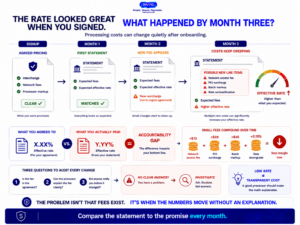
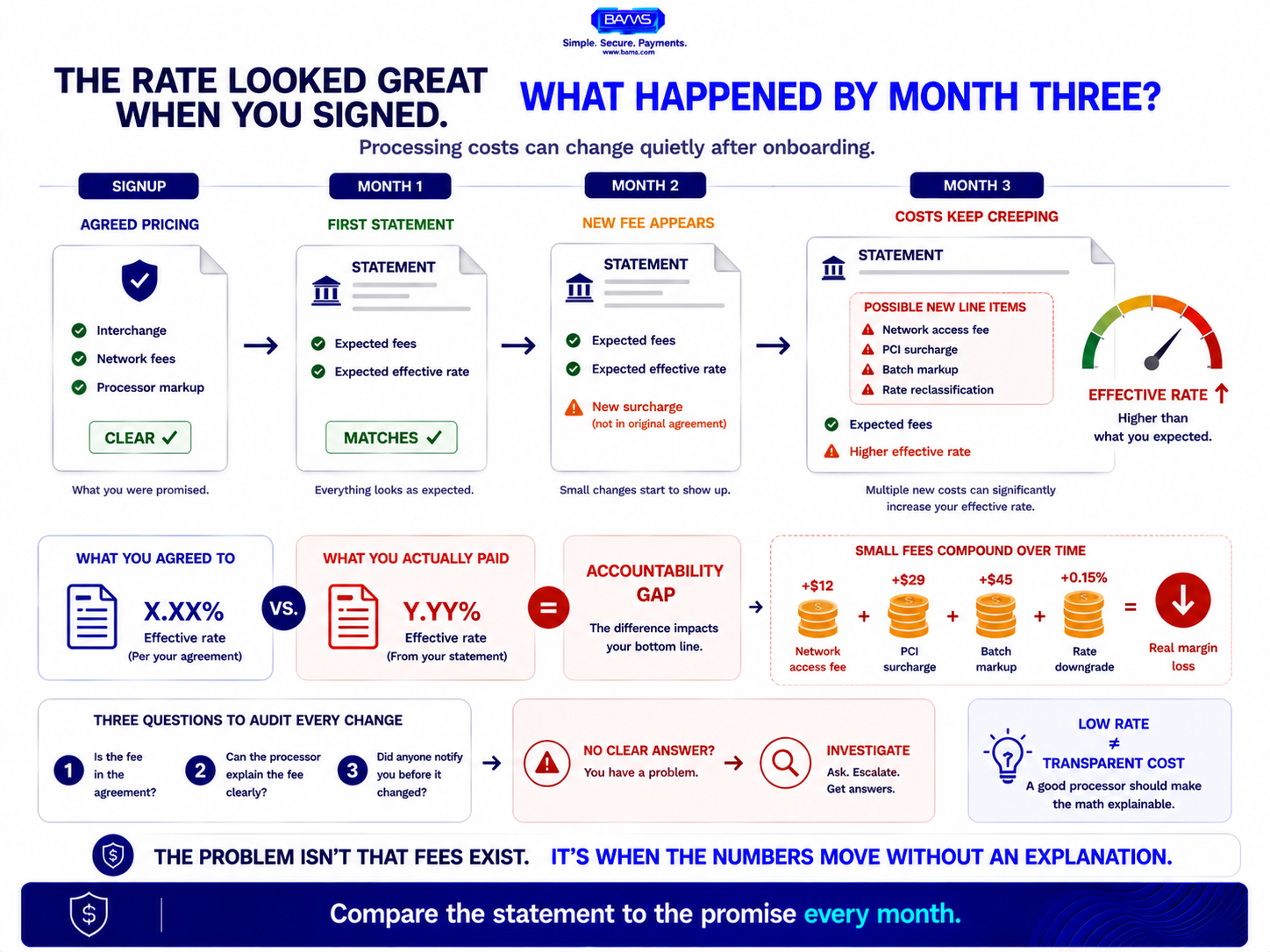
The headline rate is only useful if the statement continues to match it. Small new fees and reclassifications can gradually push the effective cost higher after onboarding.
Your credit card processing fees looked reasonable on the proposal. The rate sheet was clean, the sales call was smooth, and the first month’s statement matched expectations. Then month three arrived. New line items appeared: “network access fees,” “PCI non-compliance surcharges,” batch processing markups that weren’t in any document you signed.
This is the pattern. The Federal Reserve Bank of St. Louis reports that U.S. banks collected nearly $66 billion in interchange fees in 2025, up from $64 billion in 2024 and $52 billion in 2021. That cost environment makes fee transparency especially important for eCommerce operators running thin margins, and the problem gets worse when the fees you agreed to aren’t the fees you’re actually paying.
The challenge isn’t finding a cheap processor. It’s finding one you can hold accountable when the numbers shift beneath you.
What This List Covers (and What It Doesn’t)
This guide is for eCommerce managers at established online businesses who’ve already been through at least one processor relationship and know the gap between what’s promised and what shows up on a statement. If you’re evaluating a new payment partner or auditing your current one, these are the specific accountability signals to look for.
This is not a rate comparison chart. You won’t find a ranked list of processors or a “best of” roundup. Instead, these are diagnostic criteria: the structural and operational markers that separate a payment partner who stays accountable from one who disappears the moment you need answers.
How These Accountability Signals Were Selected
Each item below targets a specific moment where interchange overcharges, hidden fees, or service failures typically surface in eCommerce payment relationships. The selection favors signals you can verify before signing and patterns you can monitor after onboarding. If a factor only matters at the proposal stage but vanishes from the ongoing relationship, it didn’t make this list.
8 Accountability Signals for Choosing a Payment Partner
1. Interchange-Plus Pricing with Visible Passthrough Costs
Why it matters: Tiered and flat-rate pricing models bundle interchange, network assessments, and processor markup into a single number. That bundling is where overcharges hide. When interchange rates drop for certain card types or transaction categories, bundled pricing lets your processor pocket the difference without telling you.
What it looks like today: Interchange-plus (or “cost-plus”) pricing separates underlying payment costs from the processor’s markup. Visa explains that interchange reimbursement fees operate between acquiring and issuing banks while merchants negotiate a merchant discount with their financial institution that may include a variety of processing services. Separating these cost layers gives you greater visibility into what you’re actually paying instead of relying only on the headline rate.
How to apply it: Ask any prospective processor to show you a sample statement with interchange passthrough broken out line by line. If they can’t produce one, or if their statement lumps costs into “qualified” and “non-qualified” tiers, that’s your first red flag. Review how transaction fees impact eCommerce margins to understand what each line should look like.
2. A Named Account Manager (Not a Ticket Queue)
Why it matters: The moment you need to dispute a fee or resolve a funding delay, the support model determines whether you get resolution or runaround. Most processors route you to a general support queue where no one has context on your account history, pricing agreement, or transaction patterns.
What it looks like today: Some processors assign dedicated account managers who know your business, your rate structure, and your integration setup. Others give you a ticket number. The difference becomes measurable the first time a chargeback threatens your reserve hold or a batch fails to settle.
How to apply it: Before signing, ask for the name and direct contact information of the person who will manage your account. Ask what happens when that person is unavailable. If the answer involves a 1-800 number or a chat widget, you’re looking at a support model built for deflection, not resolution.
3. Statement-Level Fee Auditing on a Regular Schedule
Why it matters: Processors can adjust fees through rate increases, new surcharges, or reclassified transactions. These changes often appear as small line items that don’t trigger scrutiny individually but compound over months. Without regular auditing, you’re relying on your own team to catch discrepancies in a format designed to obscure them.
What it looks like today: The average U.S. credit card processing fee was 2.24% in 2024. But averages mask variance. Your effective rate can creep above that average through downgrades, misrouted transactions, and assessment increases that your processor never flags.
How to apply it: Ask your processor (or prospective partner) whether they conduct periodic statement reviews with you. Not a dashboard you log into alone, but a scheduled conversation where someone walks through your costs and explains any changes. If that service isn’t part of the relationship, you’re the only one watching the numbers.
4. Clear Contractual Language on Rate Increase Notifications
Why it matters: Many processing agreements include clauses allowing the processor to raise rates with minimal notice, sometimes buried in a terms-of-service update or a single line in a monthly statement. By the time you notice, the increase has been applied for one or more billing cycles, and disputing it retroactively is nearly impossible.
What it looks like today: Some contracts require 30-day written notice before any rate change. Others allow changes with “reasonable notice,” which can mean a PDF attachment to a statement you never opened. The difference in language directly determines your ability to respond.
How to apply it: Read the rate adjustment clause before you sign. Look for specific notification timelines, the method of notification (email vs. statement insert vs. portal update), and whether you have a window to cancel without penalty. If the clause is vague, negotiate specific terms in writing.
5. Transparent Early Termination and Equipment Lease Terms
Why it matters: Accountability works both directions. A processor confident in their service doesn’t need a punitive exit clause to retain your business. Long-term contracts with steep early termination fees (ETFs) create a power imbalance where disputing fees or demanding better service carries the implicit threat of a costly breakup.
What it looks like today: ETFs can range from a few hundred dollars to liquidated damages calculated on projected future revenue. Equipment leases sometimes auto-renew or contain separate termination penalties. These terms are often disclosed in ancillary documents, not the primary agreement.
How to apply it: Ask for the total cost of exiting the relationship at any point during the contract. Include equipment return policies, lease buyout amounts, and any residual obligations. A partner willing to earn your business monthly will offer month-to-month terms or minimal ETFs. For guidance on evaluating these terms, see tips for choosing a merchant service provider that won’t lock you in.
6. Proactive Chargeback Defense (Not Just Reporting)
Why it matters: Chargebacks cost more than the disputed transaction. They trigger reserve holds, increase your risk profile, and can push your effective processing rate higher. Most processors notify you after a chargeback is filed and leave you to manage the response. That’s reporting, not defense.
What it looks like today: Proactive chargeback defense includes alert systems that flag disputes before they become formal chargebacks, pre-built response templates, and direct communication with the account manager handling your case. The difference between a reactive and proactive approach often determines whether you recover the revenue or absorb the loss.
How to apply it: Ask how your processor handles chargebacks at each stage: alert, response, and representment. Ask for their win rate on representments and whether they provide any tools or staff to manage the process. BAMS, for example, includes proactive chargeback defense and a dedicated account manager as part of their merchant services model, which means someone is actively working your disputes rather than forwarding you a form.
7. Next-Day Funding as a Standard, Not an Upsell
Why it matters: Cash flow timing is a structural cost that rarely appears on a fee schedule. If your processor holds funds for two to three business days, you’re financing that gap with your own working capital. For eCommerce operators managing inventory, ad spend, and payroll on weekly cycles, delayed settlement creates real operational drag.
What it looks like today: Many processors offer next-day funding as a premium add-on with its own fee. Others include it as a standard feature. The distinction matters because a processor that charges extra for faster access to your own money is monetizing a problem they could solve for free.
How to apply it: Confirm whether next-day funding is included in your base pricing or carries an additional per-transaction or monthly fee. Understand the cutoff times and whether weekends or holidays create gaps. For a deeper look at why next-day funding matters for merchants, review how settlement timing impacts cash flow planning.
8. Interchange Optimization for Your Specific Transaction Profile
Why it matters: Interchange rates aren’t uniform. They vary by card type (rewards, corporate, debit), transaction method (card-present vs. card-not-present), and data level submitted. Ecommerce transactions default to higher interchange categories unless your processor actively optimizes the data passed with each transaction. Most don’t, because the higher rate doesn’t cost them anything.
What it looks like today: Level 2 and Level 3 data processing can qualify B2B and government card transactions for significantly lower interchange rates. But this requires your processor to capture and transmit additional transaction data (tax amounts, line-item details, shipping information) that many platforms skip by default.
How to apply it: Ask whether your processor supports Level 2 and Level 3 data capture, and whether they actively route transactions to qualify for the lowest applicable interchange category. If you process corporate or purchasing cards, this single factor can reduce your effective rate meaningfully. Learn more about Level 3 credit card processing and how it applies to your transaction mix.
The Pattern Across These Signals
Every item on this list shares a common thread: the gap between what’s disclosed at signing and what’s enforced during the relationship. Interchange-plus pricing means nothing if your statements aren’t audited. A named account manager means nothing if they can’t override a fee dispute. Next-day funding means nothing if it’s gated behind a surcharge that erodes the cash flow benefit.
Accountability in payment processing isn’t a feature you buy. It’s a structural condition created by transparency in pricing, accessibility in support, and contractual terms that don’t punish you for asking questions. The processors who resist these conditions are the ones profiting from your inattention. The ones who welcome them are betting they can retain you on merit.
Payment processing fees reduction doesn’t start with negotiating a lower rate. It starts with choosing a partner whose business model doesn’t depend on you missing what they charge.
Where to Start Without Overhauling Everything
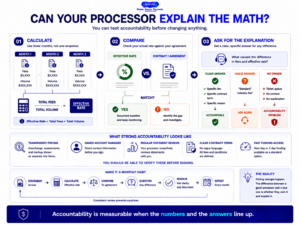
Processor accountability becomes measurable when you compare three months of actual costs with the agreement and ask someone to explain every meaningful difference.
You don’t need to switch processors tomorrow. Start with three steps: pull your last three statements and calculate your effective rate (total fees divided by total volume). Compare that rate to what your contract says it should be. Then call your processor and ask them to explain every line item you don’t recognize.
If that call goes to a hold queue, if no one can explain the charges, or if the explanation doesn’t match your agreement, you have your answer. The processor you can hold accountable is the one who picks up the phone and walks you through the math.
Frequently Asked Questions
How do I know if I’m being overcharged on interchange fees?
Calculate your effective processing rate by dividing your total monthly fees by your total monthly processing volume. If that number is significantly higher than your quoted rate (or higher than the 2.24% national average for credit card transactions), you likely have interchange downgrades, hidden surcharges, or misrouted transactions inflating your costs. Request an itemized statement showing interchange passthrough, network assessments, and processor markup separately.
What’s the difference between interchange-plus and tiered pricing?
Interchange-plus pricing shows you the actual interchange rate set by the card network plus a fixed processor markup. Tiered pricing bundles everything into categories like “qualified,” “mid-qualified,” and “non-qualified,” which obscure the real cost of each transaction. Tiered models give your processor room to reclassify transactions into higher-cost tiers without changing your quoted rate.
Can I negotiate early termination fees with a payment processor?
Yes. Early termination fees are contractual, not regulatory. Many processors will reduce or waive ETFs during negotiation, especially if you have competitive offers. Some partners offer month-to-month agreements with no ETF at all. Always ask for the total exit cost in writing before you sign, including equipment lease buyouts and residual obligations.
Why does next-day funding matter for eCommerce businesses?
eCommerce operators often manage inventory purchases, advertising spend, and payroll on tight weekly cycles. When your processor holds funds for two to three business days, you’re using your own working capital to cover that gap. Next-day funding gives you access to yesterday’s sales revenue the following business day, improving cash flow predictability and reducing reliance on credit lines.
What is Level 3 credit card processing, and does it apply to my business?
Level 3 processing involves submitting detailed transaction data (line-item details, tax amounts, shipping information) to qualify for lower interchange rates on corporate, purchasing, and government cards. It’s most relevant for B2B eCommerce businesses that accept these card types. If a meaningful portion of your transactions involve corporate cards, Level 3 data capture can reduce your interchange costs significantly.
How often should I audit my payment processing statements?
Review your statements monthly, and conduct a thorough audit quarterly. Look for new line items, changes in your effective rate, and any fees that weren’t in your original agreement. Ideally, your processor should conduct these reviews with you as part of the account management relationship. If you’re doing all the auditing yourself, your processor isn’t invested in keeping your costs accurate.