
Interchange Fees vs Merchant Discount Rate Explained
Last Updated on April 28, 2026 by Dimitri Akhrin
Why most merchants negotiate the wrong piece of their processing costs—and where you actually have leverage
Learn the difference between interchange fees and merchant discount rates, and discover which one you can actually negotiate. This breakdown helps eCommerce managers focus their energy where it saves real money.
TL;DR
- Interchange fees are fixed by card networks – You cannot negotiate them, but you can optimize which categories your transactions fall into through better data and faster settlement.
- Your processor markup is negotiable – This is where your leverage lives. Switch to interchange-plus pricing to see exactly what you are paying and negotiate the markup based on volume.
- Interchange is 70-80% of your costs – Understanding it explains why certain transactions cost more, but optimizing your merchant discount rate delivers faster savings.
- Flat-rate and tiered pricing hide the truth – You are likely overpaying on low-cost transactions. Interchange-plus pricing shows you exactly what networks charge versus what your processor adds.
- Focus on MDR for negotiation, interchange for optimization – Most eCommerce managers should start by getting transparent pricing, then work on transaction-level improvements.
The Real Cost Conversation Most Merchants Are Missing
You check your processing statement and see a percentage. Maybe 2.5%, maybe 2.9%. That number feels like the whole story. It is not.

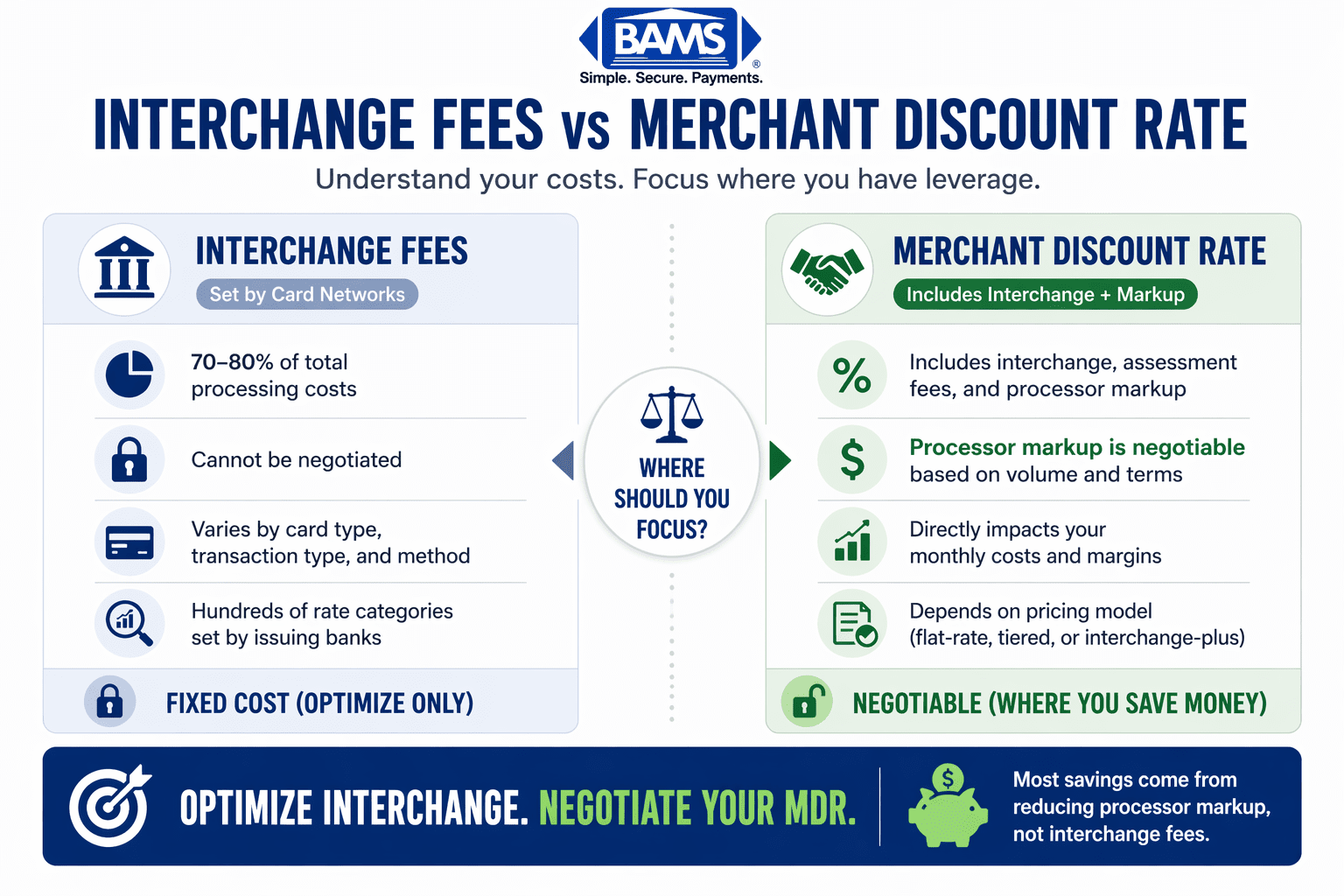
A clear comparison of interchange fees and merchant discount rate, showing which costs are fixed and where merchants have negotiating power.
Your merchant discount rate is actually three costs bundled together: interchange fees paid to card-issuing banks, assessment fees paid to card networks, and your processor’s markup. Most merchants negotiate the wrong piece.
This comparison breaks down interchange fees versus merchant discount rates so you can focus your energy where it actually saves money. For eCommerce managers processing significant volume, understanding this distinction can mean thousands in annual savings.
Quick Verdict: Where to Focus Your Negotiation Energy
Choose to focus on interchange fees if you want to understand why certain transactions cost more and optimize your checkout flow accordingly.
Choose to focus on merchant discount rate components if you want to negotiate better terms with your processor and reduce your actual monthly costs.
The bottom line: interchange fees explain your costs, but processor markups are where you have leverage. Smart merchants track both.
| Criterion | Interchange Fees | Merchant Discount Rate | Where to Focus |
|---|---|---|---|
| Negotiability | Fixed by card networks | Processor markup is negotiable | MDR |
| Transparency | Published rates available | Often bundled or hidden | Interchange |
| Optimization potential | Moderate (transaction type) | High (pricing model choice) | MDR |
| Direct cost impact | 70-80% of total fees | 100% of what you pay | Both |
| Complexity | Hundreds of rate categories | Varies by pricing model | MDR |
What We Are Comparing and Why It Matters
Before diving into specifics, let us define what is actually at stake in your processing costs.
Interchange fees are the wholesale cost of accepting cards. They flow from your processor to the card-issuing bank every time a customer pays. Interchange fees are set by card networks and issuing banks and represent the largest portion of card acceptance costs, as outlined by the Federal Reserve.
Merchant discount rate is your all-in cost, the total percentage and per-transaction fee you actually pay. It includes interchange, assessment fees, and your processor’s markup.
The evaluation criteria below reflect what eCommerce managers care about most: cost control, transparency, and operational simplicity.
Head-to-Head Breakdown
Cost Control: What Can You Actually Change?
Interchange fees are set by Visa, Mastercard, and other networks. They publish rate tables twice yearly. You cannot call Visa and negotiate a lower rate. Period.
However, you can influence which interchange category your transactions fall into. eCommerce transactions with AVS verification and CVV matching often qualify for lower rates than those without. Rewards cards cost more than standard cards. Corporate cards cost more than consumer cards.
Merchant discount rate includes your processor’s markup, and this piece is absolutely negotiable.
Verdict: Focus on merchant discount rate for negotiation. Focus on interchange for transaction optimization. The most effective way to understand your true merchant discount rate is through transparent interchange plus pricing, which separates network fees from processor markup and eliminates hidden pricing structures.
Transparency: Understanding What You Pay
Interchange fees offer surprising transparency if you know where to look. Card networks publish their rates. You can see exactly what Visa charges for a consumer credit card eCommerce transaction versus a business card keyed entry.
The challenge? There are hundreds of interchange categories. Tracking which category each transaction falls into requires detailed statement analysis.
Merchant discount rate transparency depends entirely on your pricing model. Flat-rate pricing (like 2.9% + $0.30) is simple but hides whether you are overpaying. Tiered pricing often buries transactions in “mid-qualified” or “non-qualified” buckets with unclear criteria.
Interchange-plus pricing shows you exactly what the network charged and what your processor added. This is the gold standard for transparency.
Verdict: Interchange fees are inherently transparent. Merchant discount rate transparency depends on your processor and pricing model.
Impact on Your Bottom Line
Interchange fees represent the largest chunk of your processing costs, typically 70-80% of your total merchant discount rate.
Because interchange is the biggest piece, even small optimizations matter. Moving transactions from a higher to lower interchange category can save 0.2-0.5% per transaction.
Merchant discount rate is what actually leaves your bank account. Your share of that depends on your rate, your volume, and your average ticket size.
For a business processing $500,000 annually, a 0.3% reduction in your merchant discount rate saves $1,500 per year. That is real money.
Verdict: Both matter. Interchange determines the floor. Your processor markup determines how much you pay above it.
Optimization Strategies Available
A side-by-side comparison of payment processing pricing models, highlighting why interchange-plus offers the most transparency and cost control.
Interchange optimization requires technical and operational changes.
- You can implement Address Verification Service (AVS) to qualify for lower card-not-present rates.
- You can settle transactions within 24 hours to avoid downgrades.
- You can pass Level 2 or Level 3 data for B2B transactions to access commercial card rates.
Optimizing transaction data, authentication, and processing methods can improve authorization rates and reduce payment friction, as outlined by Visa.
Some merchants implement a surcharge for credit card fees, passing interchange costs to customers who choose credit over debit. This is legal in most states but requires careful compliance with network rules.
Merchant discount rate optimization is more straightforward. Switch to interchange-plus pricing for transparency. Negotiate your processor markup based on volume. Eliminate unnecessary fees like PCI compliance fees or statement fees. Consider next-day funding options that improve cash flow without raising your rate.
Verdict: Interchange optimization is technical. MDR optimization is negotiation. Most merchants should start with MDR.
Implementing an integrated payment gateway helps ensure accurate data transmission, faster settlement, and improved transaction qualification for better interchange rates.
Complexity and Management Burden
Interchange fees are complex by design. Visa alone has over 150 interchange categories. Understanding why one transaction cost 1.65% and another cost 2.10% requires forensic statement analysis. Most eCommerce managers do not have time for this.
Merchant discount rate complexity depends on your pricing model. Flat-rate is simple but expensive. Tiered is confusing and often exploitative. Interchange-plus is transparent but requires you to understand the underlying interchange system.
The right merchant services provider simplifies this. They should explain your costs clearly, flag optimization opportunities, and handle the complexity so you can focus on running your business.
Verdict: Both can be complex. A good processor makes MDR simple while optimizing interchange on your behalf.
Use Case Mapping: Which Focus Fits Your Situation?
If you process mostly debit cards, focus on interchange. Ensure your processor passes these savings through.
If you have high average ticket sizes, focus on merchant discount rate. The percentage-based portion of your fees matters more than per-transaction fees. Negotiate that markup down.
If you sell to businesses (B2B), focus on interchange. Level 2 and Level 3 data can drop your rates by 0.5-1.0% on corporate and purchasing cards.
If you are on flat-rate pricing, focus on switching pricing models. You are likely overpaying on debit and standard credit cards to subsidize rewards card acceptance.
If you are growing rapidly, focus on merchant discount rate. Your increased volume is leverage. Use it to negotiate better processor markups every 6-12 months.
What Neither Approach Fully Solves
Understanding interchange and negotiating your merchant discount rate will not eliminate processing costs. Cards cost money to accept. That is the reality.
Neither approach addresses chargeback fees, which can run $15-100 per dispute regardless of outcome. Neither solves PCI compliance costs, though some processors bundle these more fairly than others.
The goal is not zero fees. The goal is paying fair fees with full transparency.
Switching Processors: When It Makes Sense
If your current processor uses tiered pricing, switching to an interchange-plus provider typically saves 0.3-0.5% immediately. For a business processing $50,000 monthly, that is $1,800-3,000 annually.
Switching costs are lower than most merchants expect. Modern processors handle the technical migration. Your main investment is time: comparing quotes, reviewing contracts, and testing the new integration.
Modern payment systems emphasize transparency and detailed cost visibility, helping businesses better understand the breakdown of interchange and processor fees according to Modern Treasury.
Watch for early termination fees in your current contract. Some processors charge hundreds or thousands to leave. Others, like BAMS, offer month-to-month agreements with no long-term commitment.
The best time to switch is when your current contract renews, when you hit a volume milestone that justifies renegotiation, or when you realize you cannot get a straight answer about what you are paying.
Final Recommendation
Stop treating your merchant discount rate as a single number to accept or reject. Break it apart. Understand that interchange fees are the foundation you cannot change but can optimize. Understand that processor markups are where your negotiating power lives.
For most eCommerce managers, the highest-impact move is switching to interchange-plus pricing with a transparent processor. You will see exactly what the networks charge and exactly what your processor adds. From there, you can make informed decisions about optimization, whether that means implementing surcharges, improving data quality, or simply negotiating a better markup.
Your processing costs should be predictable, transparent, and fair. If they are not, the problem is not interchange fees. The problem is your processor.
Frequently Asked Questions
What are credit card processing fees and how are they determined?
Credit card processing fees include three components: interchange fees (paid to card-issuing banks), assessment fees (paid to card networks like Visa and Mastercard), and processor markups. Interchange rates are set by card networks based on factors like card type, transaction method, and merchant category. Your total cost depends on which pricing model your processor uses.
Why do merchants have to pay processing fees for credit card transactions?
Processing fees compensate the parties that make card acceptance possible. The issuing bank takes fraud risk and extends credit to cardholders. The card network maintains the payment infrastructure. Your processor handles authorization, settlement, and customer support. Each takes a cut for their role in moving money from customer to merchant.
Which types of transactions incur higher processing fees?
Rewards cards cost more than standard cards because issuers fund those points and miles through higher interchange. Card-not-present transactions (eCommerce) cost more than card-present (in-store) due to higher fraud risk. Corporate and purchasing cards have higher rates than consumer cards. Keyed transactions cost more than swiped or chip-read transactions.
How can businesses minimize their credit card processing fees?
Start by switching to interchange-plus pricing for transparency. Negotiate your processor markup based on volume. Implement AVS and CVV verification to qualify for lower interchange categories. Settle transactions daily. For B2B sales, pass Level 2 and Level 3 data to access lower commercial card rates. Consider implementing a surcharge for credit card fees where legally permitted.
When do interchange fees change, and what factors influence them?
Visa and Mastercard update interchange rates twice yearly, typically in April and October. Changes reflect network competition, regulatory pressure, fraud trends, and economic conditions. Individual transaction rates also vary based on how the transaction is processed, what data is submitted, and how quickly it settles.
What is the difference between a convenience fee and a surcharge?
A surcharge is a fee added specifically when customers pay with credit cards, meant to offset processing costs. A convenience fee is charged for using an alternative payment channel (like paying online instead of in person) regardless of payment method. Surcharges are prohibited in some states and have strict network compliance rules. Convenience fees have different requirements and broader acceptance.
Sources


