Payment Processing Fees: Why Your Rate Is Higher Than You Think
Last Updated on April 28, 2026 by Dimitri Akhrin
Your Payment Processing Rate Is a Lie
Why the percentage in your head is wrong—and how a fee calculator reveals what you’re actually paying
Discover why most businesses underestimate their true processing costs by 30-40%. Learn how hidden assessment and PCI compliance fees inflate your rates beyond that comfortable ‘2.5%’ estimate.
TL;DR
- Your estimated processing rate is probably wrong – Hidden assessment fees, PCI compliance fees, and card-not-present premiums can push actual costs 20-40% higher than expected.
- Assessment fees add up silently – Card networks charge 0.13% to 0.15% on every transaction, separate from interchange, often missing from rate quotes.
- Use a payment processing fee calculator – Stop estimating and calculate your true effective rate by accounting for every fee category in your statements.
- Knowledge equals margin – Businesses that know their actual processing costs make better pricing and growth decisions than those working from comfortable guesses.
The Number You Think You Know Is Wrong
You have a number in your head right now. It’s the percentage you believe you pay to process credit cards. Maybe it’s 2.5%. Maybe it’s 2.9%. Whatever it is, I’m confident it’s wrong.
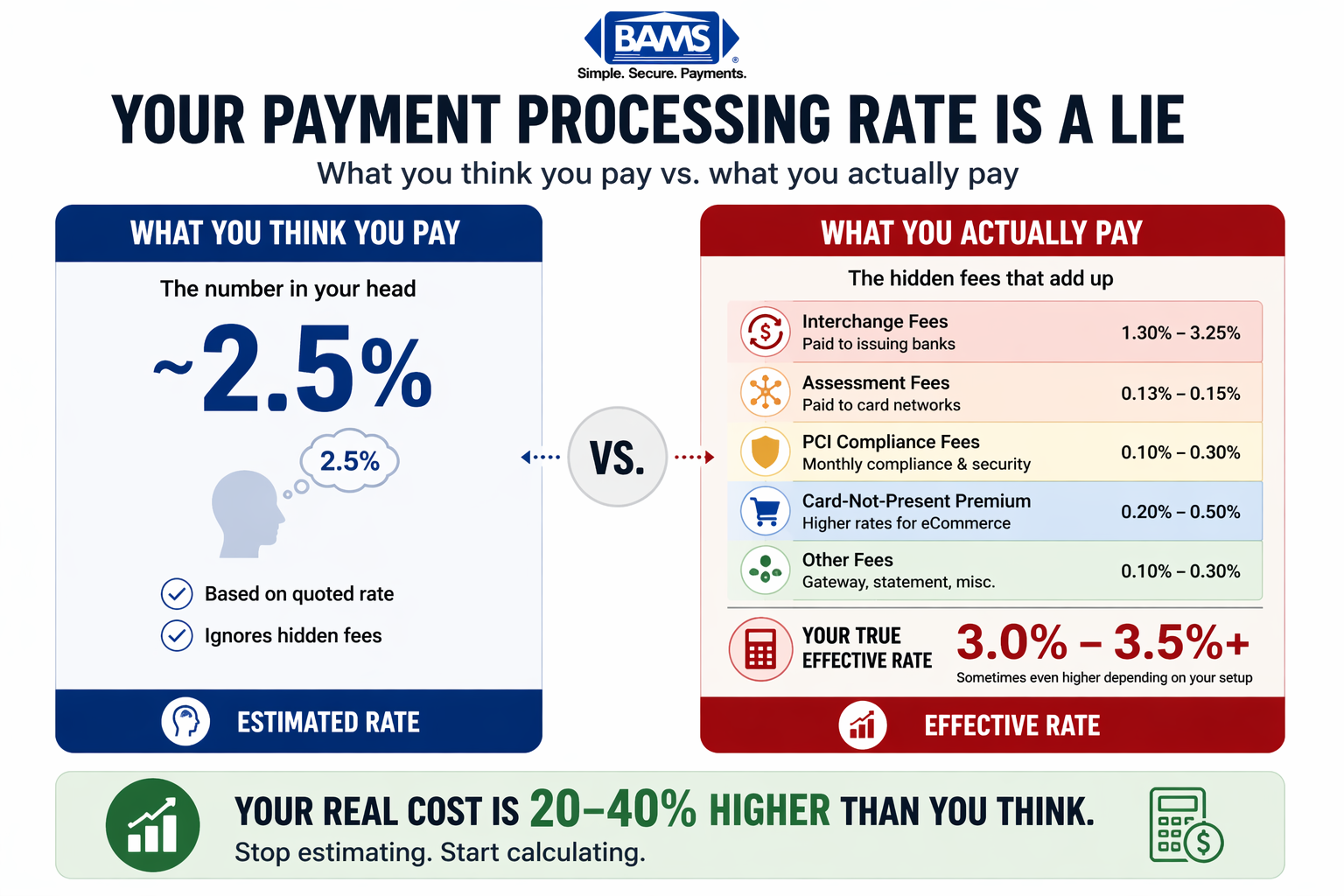
A comparison of estimated versus actual payment processing rates, revealing how hidden fees increase true costs by 20–40%.
Not because you’re bad at math. Because the payment processing industry has made it nearly impossible to know your true cost without doing serious forensic work on your statements.
Here’s what changed my thinking: watching eCommerce managers discover they were paying 30% to 40% more than they thought, not because of fraud or incompetence, but because of fees they didn’t know existed.
The Comfortable Myth of “Around 2.5%”
Ask most business owners what they pay for processing, and you’ll hear some version of “around 2.5%” or “roughly 3%.” This estimate usually comes from their processor’s initial pitch or a quick glance at their monthly statement.
The industry has trained us to think in simple percentages. It’s easier to sell, easier to compare, and easier to ignore. Your processor benefits from this vagueness. When fees are fuzzy, overcharges hide in plain sight. Card processing costs continue to grow as card usage expands, with interchange and related fees forming a significant share of merchant expenses, as outlined by the Federal Reserve.
This shorthand worked when payment processing was simpler. But today, with swipe fees hitting billions in 2024, the complexity has outpaced our mental shortcuts.
Your “Effective Rate” Is a Fiction
Here’s what I actually believe: until you run your numbers through a payment processing fee calculator that accounts for every fee category, you don’t know what you’re paying. Full stop.
The Anatomy of What You’re Missing
Let me show you where the money goes that most estimates miss entirely.
Interchange fees are the obvious ones. They range from 1.30% to 3.25% depending on the card network, and they’re what your processor quotes when they want to sound competitive. Visa sits around 1.30% to 2.60%. American Express runs higher at 1.80% to 3.25%.
But interchange is just the foundation. Payment processing involves multiple fee layers including interchange, assessments, and processing costs, all of which impact transaction outcomes and total cost, as outlined by Visa.
Assessment fees are the card networks’ cut, separate from interchange. Visa and Mastercard charge 0.13% to 0.15% on every transaction. It sounds small until you realize it’s applied to your entire volume, every month, forever. On $100,000 monthly volume, that’s $130 to $150 you probably didn’t factor in.
PCI compliance fees are where things get interesting. These charges, ostensibly for maintaining security standards, can run $10 to $30 monthly for compliance, plus $20 to $100 monthly for non-compliance penalties. Some processors bury these as “regulatory fees” or “security charges.”
Then there’s the gap between card-present and card-not-present rates. If you’re running eCommerce, you’re paying the premium.
A business processing $100,000 monthly in credit cards expects to pay $1,500 to $3,500. But hidden fees can push effective rates to 3.10% or higher. That’s potentially $3,100 monthly, or $37,200 annually, when you thought you were paying $30,000.
Many hidden costs originate from fragmented systems, which is why using an integrated payment gateway helps consolidate processing and improve fee visibility across transactions.
Why This Gap Keeps Growing
If your true processing cost is 20% higher than your estimate, you’re making decisions based on phantom margins. Your pricing strategy assumes profit that doesn’t exist. Your growth projections assume costs that are actually worse.
For eCommerce managers juggling delayed deposits and tight cash flow, this isn’t academic. Every unexpected fee is money that should have funded inventory, marketing, or payroll. When you’re waiting on funds and paying more than you realized, you’re financing your processor’s profit with your working capital.
The businesses that thrive aren’t necessarily the ones with the lowest rates. They’re the ones who know their actual rates and plan accordingly.
Stop Estimating, Start Calculating
The mental shift is simple: treat payment processing like you treat inventory costs. You wouldn’t estimate your cost of goods sold. You calculate it, line by line, because the margin matters.
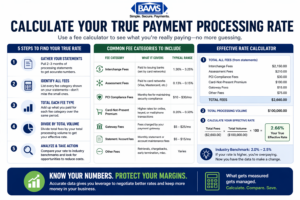
A step-by-step guide to calculating your true payment processing rate using real fee data instead of estimates.
A payment processing fee calculator forces you to account for interchange by card type, assessment fees by network, PCI compliance fees, batch fees, statement fees, and every other charge hiding in your statement’s fine print. The output isn’t a comfortable round number. It’s the truth.
Modern payment infrastructure emphasizes full cost transparency, enabling businesses to accurately calculate and manage their effective processing rates according to Modern Treasury. Transparent pricing isn’t a feature. It’s the baseline for making real business decisions.
The most effective way to calculate your true cost is by using transparent interchange plus pricing, which clearly separates network fees, assessments, and processor markup.
The Cost of Comfortable Ignorance
You can keep using the estimate in your head. It’s easier, and nobody will call you out on it. But every month, the gap between what you think you pay and what you actually pay widens. Swipe fees have more than doubled over the past decade. They’re not getting simpler.
The businesses that win the next five years will be the ones that stopped guessing and started knowing.
Frequently Asked Questions
What are assessment fees in payment processing?
Assessment fees are charges from card networks like Visa and Mastercard, separate from interchange fees. They typically run 0.13% to 0.15% of your total transaction volume and are often overlooked in rate estimates.
Why are my actual processing costs higher than quoted rates?
Quoted rates usually cover only interchange fees. Your true cost includes assessment fees, PCI compliance fees, batch fees, and card-not-present premiums that add up quickly, especially for eCommerce businesses.
How can I find my real effective processing rate?
Use a payment processing fee calculator that breaks down every fee category from your statements. Divide your total monthly fees by total volume processed to get your actual effective rate.
Sources