Merchant Account Optimization: A Chargeback Defense Guide
Last Updated on October 1, 2026 by Dimitri Akhrin
How to shift from reactive dispute filing to a prevention-first strategy that protects your account standing
Learn how to audit your payment processor relationship against a concrete accountability framework. This guide helps eCommerce managers identify template-and-disappear support models and build a prevention-first chargeback defense strategy.
TL;DR
- Chargebacks are an account health issue, not an admin task — eCommerce chargeback rates surged 222% between Q1 2023 and Q1 2024. Treating each dispute as a one-off instead of a systemic risk puts your merchant account standing in jeopardy.
- Most processors default to a template-and-disappear model — They provide generic response forms and rotating support agents. Prevention-first defense requires a partner who monitors your account, provides reason-code-specific guidance, and reviews trends with you regularly.
- Fee transparency is a direct measure of accountability — If you can’t trace every dollar of your processing costs to interchange, assessments, and processor markup, you’re likely overpaying. Interchange-plus pricing is the baseline for visibility.
- Test your processor with a real escalation — Call support during your next chargeback and ask for specific, account-aware guidance. The quality of that response tells you more than any sales pitch.
- Build accountability into your contract — Negotiate quarterly account reviews, defined support SLAs, transparent rate-change notifications, and reasonable termination terms before you sign.
Guide Orientation: What This Covers and Who It’s For
This guide helps eCommerce managers evaluate payment partners based on one overlooked criterion: accountability. Specifically, it covers how to assess whether your current (or next) processor will actively defend your merchant account health or simply hand you a template when disputes arrive.
If you manage payments for an established online business with 10 to 50 employees, and you’ve ever waited on hold during a chargeback deadline, this is for you. Merchant account optimization isn’t just about shaving basis points off your credit card processing fees. It’s about knowing someone picks up the phone when your revenue is on the line.
By the end, you’ll be able to audit your current processor relationship against a concrete accountability framework, identify the warning signs of a “template-and-disappear” support model, and build a prevention-first dispute strategy that protects your account standing over time. This guide does not cover PCI compliance setup, gateway integrations, or payment processor changes at the enterprise level.
Why Merchant Account Optimization Starts with Accountability
The dispute landscape for online merchants has shifted dramatically. Chargebacks remain one of the biggest operational risks for eCommerce merchants and require ongoing monitoring to protect merchant account health. Certain verticals, like travel, saw rates spike by 816% in the same period. For mid-size eCommerce operators, each dispute isn’t just a lost sale. It’s a data point that card networks use to evaluate your account risk.
Most processors respond to this reality with automation: templated evidence submissions, generic fraud filters, and a support queue that routes you to a different agent every time. The result is a reactive cycle where you’re always filing responses after the damage is done, never preventing the dispute from occurring.
The cost of this model compounds. Mastercard reports that global eCommerce fraud losses exceeded $48 billion in 2023, a 17% year-over-year increase. Merchants absorb a disproportionate share of that cost through chargebacks, fee increases, and in the worst cases, account termination. The processors who profit from your transaction volume have little structural incentive to invest in your dispute outcomes unless accountability is built into the relationship from the start.
This is why choosing a payment partner you can hold accountable isn’t a nice-to-have. It’s the foundation of sustainable merchant account health.
Core Concepts: What Separates a Partner from a Processor
Merchant Account Health vs. Transaction Volume
Your merchant account health is determined by your chargeback ratio, authorization rates, and compliance standing with card networks (Visa, Mastercard). Most processors track your transaction volume because that’s how they earn. Fewer track your account health metrics proactively, because that requires work on their end with no direct revenue upside.
When your chargeback ratio crosses network thresholds (typically 0.9% to 1% of transactions), you enter monitoring programs that carry fines and can lead to account closure. A processor focused on volume won’t warn you when you’re trending toward that line. An accountable partner will.
Reactive Dispute Filing vs. Prevention-First Defense

Responding to each chargeback individually treats the symptom. Prevention-first defense identifies the recurring cause, improves operations, and protects the merchant account before dispute ratios escalate.
Reactive dispute filing means you receive a chargeback notification, fill out a response form (often a template your processor provides), and hope for the best. Prevention-first defense means your payment partner helps you implement system-level controls, such as fraud screening rules, compelling evidence workflows, and transaction-level data enrichment, that reduce dispute incidence before chargebacks are filed.
77% of merchants now use card networks’ updated compelling-evidence rules to block or reverse first-party misuse disputes. This statistic reveals a gap: the tools exist, but many processors don’t help merchants implement them.
The Template-and-Disappear Model
This is the default experience with most remote, high-volume processors. You get onboarded quickly, receive a generic dashboard, and are left to manage disputes with boilerplate response documents. There’s no strategic guidance, no account review cadence, and no single point of contact. When something goes wrong, you call a 1-800 number and start from scratch every time.
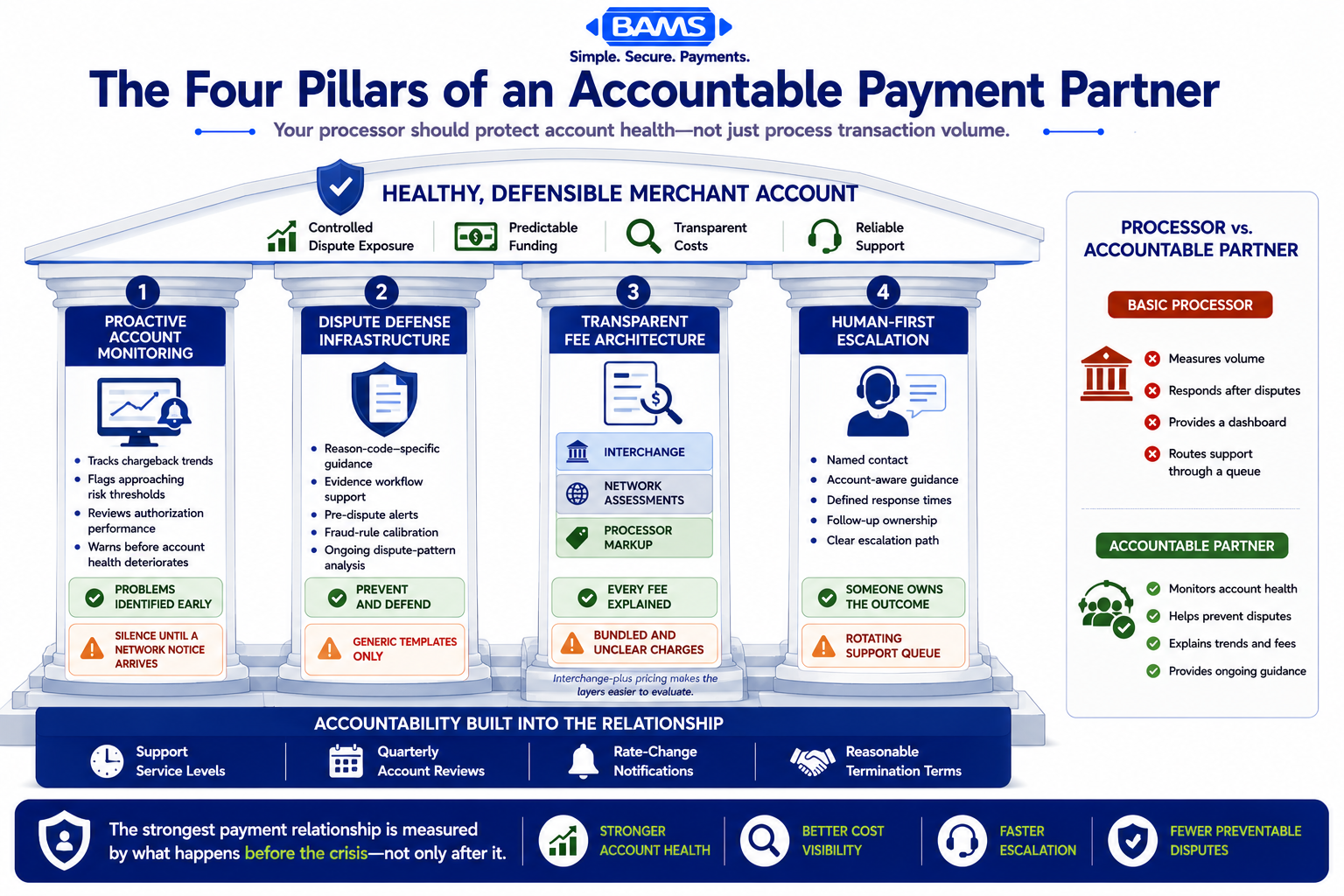
The Accountability Framework: Four Pillars of a Defensible Payment Partnership

The framework below gives you a structured way to evaluate any payment partner, whether you’re auditing your current processor or considering payment processor changes. Each pillar maps to a specific area where accountability either exists or breaks down.
- Pillar 1: Proactive Account Monitoring — Does your processor flag risk trends before you hit network thresholds?
- Pillar 2: Dispute Defense Infrastructure — Does your processor provide prevention tools, or just response templates?
- Pillar 3: Transparent Fee Architecture — Can you trace every dollar of your credit card processing fees to a specific cost component?
- Pillar 4: Human-First Escalation Paths — When a critical issue arises, do you reach a dedicated contact or a rotating support queue?
These four pillars form the spine of the step-by-step evaluation process below. Each step provides concrete actions you can take to test your processor against these standards.
Step-by-Step: How to Evaluate and Choose a Payment Partner You Can Hold Accountable
Step 1: Audit Your Current Chargeback Ratio and Dispute Outcomes
Objective: Establish a factual baseline of your dispute exposure and win rate so you can measure any partner’s impact.
Pull your chargeback data for the past 12 months. You need three numbers: total chargebacks filed, chargebacks won (reversed in your favor), and your chargeback-to-transaction ratio by month. If your processor doesn’t make this data easy to access, that’s your first red flag.
Compare your ratio against Visa’s and Mastercard’s monitoring thresholds. Visa’s Dispute Monitoring Program triggers at a 0.9% ratio with 100 disputes in a month. Mastercard’s Excessive Chargeback Program triggers at 1.5% with 100 disputes. If you’re within 0.3% of either threshold and your processor hasn’t mentioned it, you’re operating without a safety net.
Anti-patterns: Don’t rely on your processor’s summary dashboard alone. Export raw data and verify it against your order management system. Processors sometimes exclude certain dispute categories from their reporting, which can mask your true ratio.
Success indicators: You have a clear, month-by-month view of dispute trends, you know your win rate, and you can identify which dispute reason codes (friendly fraud, product not received, unauthorized transaction) drive the most volume.
Step 2: Test Your Processor’s Response to a Real Escalation
Objective: Determine whether your processor provides meaningful, personalized support when it matters, or routes you through a generic queue.
The most reliable way to evaluate accountability is to create a real test. The next time you receive a chargeback notification, contact your processor’s support line and ask three specific questions: What evidence should I submit for this specific reason code? Can you review my response before I submit it? What can I change operationally to prevent this type of dispute going forward?
Track the response. Did you reach a person who knows your account? Did they offer specific guidance, or read from a script? Did they follow up? Most remote processors fail this test. You’ll get a different agent each call, generic advice, and no follow-up. That’s the template-and-disappear model in action.
Anti-patterns: Don’t accept “we’ll escalate this” as a resolution. Escalation without a named contact and a timeline is a dead end. Also avoid conflating fast initial response times with quality support. A chatbot that replies in 30 seconds but can’t answer your question isn’t support.
Success indicators: You reach a dedicated or semi-dedicated contact who references your account history, provides reason-code-specific evidence guidance, and schedules a follow-up within 48 hours.
Step 3: Map Your Fee Structure to Identify Hidden Costs
Objective: Gain full visibility into your credit card processing fees so you can distinguish between legitimate costs and margin padding.
Request a complete fee breakdown from your processor. You’re looking for three layers: interchange fees (set by card networks, non-negotiable), assessment fees (also set by networks), and your processor’s markup. An interchange-plus pricing model separates these layers clearly. Tiered or flat-rate models bundle them together, making it nearly impossible to identify overcharges.
Look specifically for: PCI non-compliance fees charged without prior notification, batch processing fees that weren’t in your original agreement, and “miscellaneous” line items that lack descriptions Pricing pressure and regulatory scrutiny are reshaping payment-provider economics across the industry. That makes it especially important for merchants to review ancillary and miscellaneous fees carefully.
Anti-patterns: Don’t compare your effective rate (total fees divided by total volume) alone. Two processors can produce the same effective rate while one charges significantly more on high-ticket transactions and less on small ones. You need line-item visibility. Also, avoid choosing a payment processor based on advertised rates without reviewing a sample statement.
Success indicators: You can identify your processor’s markup to the basis point, you see no unexplained fees, and your processor can explain every line item on your statement in plain language.
Step 4: Evaluate Dispute Prevention Tools, Not Just Response Workflows
Objective: Determine whether your processor equips you to prevent disputes or merely helps you respond after they’re filed.
Ask your processor what prevention tools they offer or integrate with. The current best practice, according to CyberSource’s 2024 Global eCommerce Payments & Fraud Report, includes intelligent transaction routing, machine-learning-based fraud management, automated retry logic for failed authorizations, and use of updated compelling evidence rules (like Visa’s CE 3.0).
Visa recommends combining fraud prevention tools with proactive dispute management to reduce chargeback exposure and improve merchant performance, which demonstrates that prevention infrastructure produces measurable results. But automation alone isn’t enough. You need a partner who helps you configure these tools for your specific business model, product category, and customer behavior patterns.
This is where a partner like BAMS differentiates itself. Their proactive chargeback defense model pairs dedicated account managers with prevention tools, so you’re not left configuring fraud rules in a vacuum. The combination of human guidance and system-level controls is what moves you from reactive filing to genuine prevention.
Anti-patterns: Don’t confuse having a fraud filter with having a prevention strategy. Default fraud settings on most platforms are calibrated for the processor’s risk tolerance, not yours. This often means legitimate transactions get declined (costing you revenue) while sophisticated friendly fraud slips through.
Success indicators: Your processor provides or integrates with prevention tools, helps you customize fraud rules for your business, and reviews dispute trends with you on a regular cadence to adjust settings.
Step 5: Confirm Funding Speed and Reliability
Objective: Verify that your processor’s funding timeline matches your cash flow requirements and that delays are communicated proactively.
Funding speed is one of the most tangible accountability markers. Standard processing timelines range from two to five business days. For eCommerce operators managing inventory, payroll, and advertising spend, every day of delay has a direct cost. Next-day funding eliminates this gap and gives you predictable access to your revenue.
But speed alone isn’t the full picture. Ask your processor: What happens when funding is delayed? How will I be notified? Is there a dedicated contact for funding issues? Delays happen (holds for risk review, bank processing errors, holiday schedules). The question is whether your processor tells you proactively or whether you discover it when your bank balance doesn’t match your expectations.
Anti-patterns: Don’t assume advertised funding timelines apply to all transaction types. Some processors offer next-day funding for card-present transactions but default to three-day timelines for eCommerce. Verify the timeline for your specific transaction mix.
Success indicators: Your processor provides next-day or same-day funding for your transaction type, communicates delays before they impact your operations, and doesn’t charge hidden fees for faster access to your own money.
Step 6: Negotiate Accountability Into Your Contract
Objective: Ensure that the accountability standards you’ve identified are documented, not just promised verbally.
Most merchant services agreements are written to protect the processor. Your job is to negotiate terms that create mutual accountability. Focus on three areas: service-level commitments for support response times, defined escalation paths with named contacts, and clear termination terms (including early termination fees and data portability).
Ask for a quarterly account review clause. This is a scheduled meeting where your processor reviews your chargeback trends, fee changes, and account health metrics with you. Processors who resist this request are telling you something important about how they view the relationship.
Also review your contract’s rate-change notification terms. Some agreements allow processors to adjust markup rates with as little as 30 days’ notice buried in an email. Push for 90-day written notice with a right to terminate without penalty if rates increase beyond a defined threshold.
Anti-patterns: Don’t sign multi-year contracts with auto-renewal clauses unless the termination terms are genuinely favorable. Third-party processors often offer month-to-month flexibility, but that flexibility sometimes comes at the cost of higher per-transaction fees and weaker dispute support. Find the balance that matches your volume and risk profile.
Success indicators: Your contract includes defined support SLAs, a quarterly review cadence, transparent rate-change notification terms, and reasonable termination provisions.
Practical Examples: What Accountability Looks Like (and Doesn’t)
Scenario A: The Template Response
An eCommerce apparel brand receives 15 chargebacks in a single week, mostly coded as “product not as described.” The merchant contacts their processor’s support line, waits 40 minutes, and reaches an agent who has no context on the account. The agent emails a generic chargeback response template and suggests the merchant “include any relevant evidence.” No one follows up. The merchant submits responses using the template, wins two of the 15 disputes, and their chargeback ratio climbs to 0.85%.
Three weeks later, Visa sends a monitoring program notification. The processor forwards it without commentary. The merchant now faces monthly fines and a 90-day window to bring their ratio below threshold, with no guidance on how to do it.
Scenario B: The Accountable Partner
The same apparel brand, but with an accountable payment partner. When the 15 chargebacks arrive, their dedicated account manager calls them directly. The manager identifies that 12 of the 15 disputes share a common pattern: customers who received items but claimed they didn’t match the listing photos. The manager recommends three specific changes: updating product images to match actual color rendering, adding a size-comparison tool to product pages, and implementing a pre-dispute alert service that notifies the merchant before a chargeback is formally filed.
The merchant submits evidence packages tailored to each dispute with the manager’s review. They win nine of the 15. More importantly, the operational changes reduce “product not as described” disputes by 60% over the following quarter. Their chargeback ratio stabilizes at 0.4%, well below monitoring thresholds.
The difference between these scenarios isn’t the merchant’s product or customer base. It’s whether their payment partner treated dispute defense as a shared responsibility or an administrative task the merchant handles alone.
Common Mistakes and Pitfalls
- Treating chargebacks as isolated incidents. Each dispute is a data point. If you’re not analyzing patterns across reason codes, product categories, and customer segments, you’re solving symptoms instead of causes.
- Choosing a processor based on rate alone. The lowest per-transaction rate means nothing if you’re losing 1% of revenue to preventable chargebacks and paying hidden fees that inflate your actual cost.
- Assuming your processor monitors your account health. Most don’t, unless it’s in their contractual obligation. Ask explicitly what metrics they track and how they alert you to risk.
- Waiting for a crisis to evaluate your payment partner. By the time you’re in a Visa monitoring program, your leverage is gone. Audit your relationship quarterly, not after the damage is done.
- Confusing automation with strategy. Automated dispute responses are a tool, not a plan. Without human analysis of why disputes occur, automation just speeds up a broken process.
What to Do Next
Start with Step 1. Pull your chargeback data for the past 12 months and calculate your ratio by month. If your processor can’t provide this data in a clear, exportable format within 24 hours of your request, that tells you everything you need to know about the current relationship.
From there, work through the remaining steps at your own pace. This framework isn’t a one-time checklist. It’s a reference you can return to whenever your processing agreement comes up for renewal, when your dispute volume shifts, or when you’re evaluating whether a payment processor change makes sense for your business.
The goal isn’t to find a perfect processor. It’s to find a partner whose incentives align with your account health, not just your transaction volume. That alignment is what makes accountability possible, and accountability is what turns payments from a recurring headache into a predictable advantage.
Frequently Asked Questions
When should a business consider using merchant account optimization services?
Consider it when your chargeback ratio is trending upward, your effective processing rate has increased without explanation, or you can’t get a clear breakdown of your fees. Also evaluate optimization if you’re processing more than $50,000 per month, because at that volume, even small inefficiencies in routing, interchange qualification, and dispute management compound into significant annual costs.
How do I know if my payment processor is actually managing chargebacks proactively?
Ask three questions: Does your processor alert you when your chargeback ratio approaches network thresholds? Do they provide reason-code-specific evidence guidance (not templates)? Do they schedule regular reviews of your dispute trends? If the answer to any of these is no, you’re in a reactive model. A proactive partner monitors your metrics continuously and contacts you before problems escalate.
What’s the real cost of staying with a processor that uses the template-and-disappear model?
Beyond lost disputes, the costs include higher chargeback ratios that trigger network monitoring programs (with fines of $25 to $100 per chargeback), potential account termination, and placement on the MATCH list, which makes it difficult to open a new merchant account. There’s also the opportunity cost of time spent managing disputes without expert guidance, which pulls eCommerce managers away from growth activities.
What is interchange-plus pricing and why does it matter for fee transparency?
Interchange-plus pricing separates the three components of your processing cost: the interchange fee (set by card networks), the assessment fee (also set by networks), and the processor’s markup. This transparency lets you see exactly what your processor charges versus what the networks charge. Tiered and flat-rate models bundle these together, making it easy for processors to pad margins without your knowledge.
Can switching payment processors hurt my business in the short term?
There’s typically a transition period of one to four weeks where you’re running parallel systems, updating gateway integrations, and testing new configurations. The key risks are funding gaps during the switch and temporary declines if your new processor’s fraud filters aren’t calibrated to your customer base yet. A good partner will manage the migration with you and ensure continuity. The short-term disruption is almost always worth it if your current processor lacks accountability.
How often should I review my payment processing relationship?
At minimum, conduct a full review quarterly. This should include chargeback ratio trends, fee statement analysis, support quality assessment, and funding reliability. Additionally, trigger an ad-hoc review any time your processor changes rates, your dispute volume spikes, or your business model shifts (new product lines, new markets, subscription billing changes). Waiting for contract renewal to evaluate your processor is too late.
Sources
- https://www.mastercard.us/en-us/business/overview/safety-and-security/chargeback-guide.html
- https://www.mastercard.com/news/eemea/en/newsroom/press-releases/en/2026/may/checkout-com-and-mastercard-report-reveals-mena-emerges-as-one-of-the-fastest-growing-regions-to-adopt-tokenization-at-344-9/
- https://www.cybersource.com/content/dam/documents/campaign/fraud-report/global-fraud-report-2024.pdf
- https://www.visa.com/en-us/solutions/visa-protect/merchants