Merchant Services: Why Chargeback Advice Fails SMBs
Last Updated on October 7, 2026 by Dimitri Akhrin
Enterprise fraud playbooks don’t fit NYC eCommerce teams of 10–50, and that mismatch is eroding your margins
Learn why standard chargeback prevention advice fails growing eCommerce brands without dedicated fraud teams. This piece reframes dispute losses as a structural mismatch between enterprise tools and SMB operations.
TL;DR
- The advice gap is structural, not educational – Most chargeback prevention content assumes you have a dedicated fraud team. NYC eCommerce brands with 10 to 50 employees typically don’t, and that mismatch is where margins erode.
- False declines cost as much as fraud – Enterprise-tuned fraud filters reject roughly 6% of orders, and merchants win fewer than 20% of fraud-coded disputes. You’re losing revenue on both ends.
- Chargebacks are a staffing problem disguised as a fraud problem – The solution isn’t better tools. It’s choosing merchant services partners (like BAMS) who absorb the operational burden your team can’t carry.
- Faster deposits offset chargeback pressure – Next-day funding and transparent pricing turn payment processing from a cash flow liability into a growth lever.
The Chargeback Advice You’re Getting Wasn’t Built for You
Here’s something nobody in merchant services wants to say out loud: most chargeback prevention advice assumes you have a fraud team. A real one, with analysts, dashboards, and a playbook. If you’re running an eCommerce operation in New York City with 10 to 50 employees, you probably don’t have that. You have a warehouse manager who also handles disputes on Tuesday afternoons. And that gap between what the advice assumes and what your team actually looks like? That’s where your margins quietly disappear.
The Enterprise Playbook Everyone Keeps Handing You
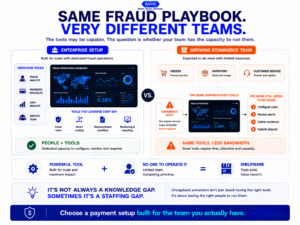
Enterprise fraud strategies can work well when dedicated people are available to manage them. The problem starts when the same playbook is handed to a growing eCommerce team without the staff to operate it.
The standard guidance sounds reasonable enough. Implement smart routing. Layer in tokenization. Build retry logic. Invest in a fraud orchestration platform. Audit your chargeback representment workflow quarterly.
This advice became dominant because it works at scale. If you’re processing millions of transactions a month with a dedicated fraud operations team, these tools earn their keep. The problem is that the same advice gets repackaged, diluted, and served to growing eCommerce brands as though operational context doesn’t matter.
It’s not bad advice. It’s mismatched advice. And mismatched advice is sometimes worse than no advice at all, because it makes you feel like the problem is your execution rather than the tools themselves.
The Real Problem Isn’t Knowledge. It’s Architecture.
We believe the chargeback vulnerability most NYC eCommerce operators face isn’t a knowledge gap or an effort gap. It’s a structural mismatch: enterprise-oriented tools sold to businesses that don’t operate like enterprises.
The result isn’t dramatic failure. It’s slow, invisible margin erosion that compounds month over month until cash flow management becomes a constant source of anxiety rather than a solved problem.
How Merchant Services Misalignment Erodes NYC eCommerce Margins
Let’s look at how this actually plays out.
A growing DTC brand in Brooklyn processes 800 orders a week. Their processor’s fraud filters are tuned for a much larger merchant profile. The filters are aggressive because that’s what works at enterprise volume. The brand doesn’t have the technical staff to customize thresholds. Visa estimates that 30% to 65% of rejected online orders are actually legitimate, and 33% of customers say they won’t return to a merchant after experiencing a false decline.
That’s not fraud prevention. That’s revenue prevention.
Meanwhile, the chargebacks that do come through get worse, not better. Nearly half of merchants surveyed by the Merchant Risk Council said friendly fraud accounted for 50% or more of their chargebacks. This isn’t card theft. It’s customers claiming they never received an order, or disputing a charge they recognize but want reversed. And merchants win fewer than 20% of fraud-coded disputes.
So the math is brutal: you lose good orders to overzealous filters, you lose revenue to friendly fraud you can’t fight effectively, and every dispute adds operational expense. Mastercard reports that merchants average $82 in internal costs and $46 in third-party fees per chargeback, excluding the value of lost goods or services. For a mid-size ecommerce brand, that means you’re absorbing costs well beyond the original transaction.
The pattern we’ve seen across NYC payment challenges is consistent.
Operators aren’t ignoring chargebacks. They’re just stuck between processors that offer self-serve dashboards designed for teams of 50 and the reality of needing someone to actually pick up the phone when a dispute needs attention this week.
This is where the structural mismatch hits hardest. Tools like payment optimization platforms can improve transaction approval rates and speed up deposits, but only if someone on your team has bandwidth to configure, monitor, and act on the data. When that person doesn’t exist, the tool becomes shelfware and the chargebacks keep compounding.
BAMS NYC merchant services approach this differently by pairing proactive chargeback defense with dedicated account managers who help handle dispute response on behalf of the merchant. It’s not a dashboard you need to learn. It’s a person who already knows your account and acts before the dispute window closes.
What Changes If You Stop Treating This as a Knowledge Problem
If this structural mismatch thesis is right, then the implications shift significantly. It means the answer for most growing eCommerce brands isn’t “learn more about chargebacks” or “invest in better fraud tooling” and it means the answer is choosing merchant services partners whose operational model matches your team’s actual capacity.
It means next-day funding isn’t a nice-to-have feature; it’s a cash flow management lever that directly offsets the margin pressure chargebacks create. When you’re waiting three days for deposits while disputes drain your account, the compounding effect is real.
It means transparent pricing (interchange-plus, not bundled) matters more than you think, because opaque fees hide the true cost of disputes and make it harder to measure whether your chargeback prevention efforts are actually working.
And it means the question isn’t “do we need a fraud team?” It’s “does our processor act like one on our behalf?”
A Better Way to Think About Chargeback Vulnerability
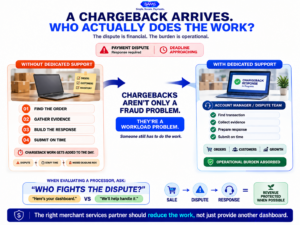
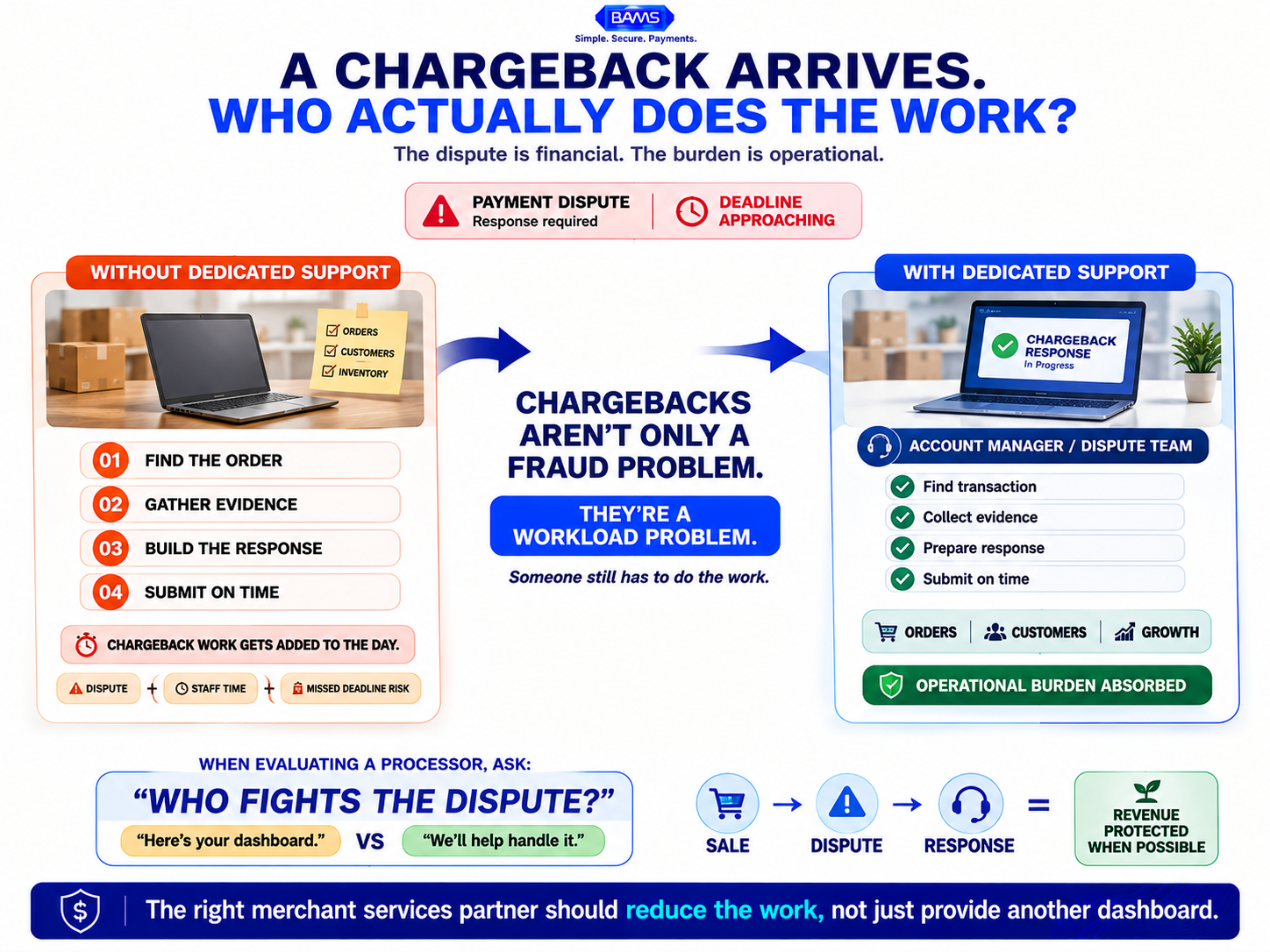
A chargeback creates work long before it becomes a loss. Someone has to investigate the order, collect evidence, meet the deadline and submit the response.
Here’s the reframe: chargebacks aren’t a fraud problem for most SMBs. They’re a staffing problem disguised as a fraud problem.
When you see it that way, the solution set changes completely. You stop evaluating tools by feature count and start evaluating partners by how much operational burden they absorb. You stop asking “what platform should we buy?” and start asking “who will actually fight this dispute at 2pm on a Thursday when my team is packing orders?”
The merchants who are getting faster access to their funds and preserving margins aren’t necessarily smarter or better resourced. They’ve just aligned their payment infrastructure to their operational reality instead of aspirational org charts.
The Margin Is in the Match
The best chargeback strategy for a 30-person eCommerce company will never look like the best strategy for a 3,000-person retailer. Stop borrowing their playbook. Find partners who are built for how your business actually runs today, not how it might run in three years. The margin you’re looking for isn’t hiding in a better fraud algorithm. It’s hiding in the gap between what your processor assumes about your team and what your team can actually do.
Frequently Asked Questions
What are the common payment challenges faced by NYC merchants?
NYC eCommerce merchants frequently deal with delayed deposits, aggressive fraud filters that reject legitimate orders, and rising friendly fraud disputes. These challenges compound when teams lack dedicated fraud staff to manage them proactively.
How do false declines impact customer relationships?
When legitimate orders get flagged and rejected, customers rarely try again. With roughly 6% of eCommerce orders rejected on fraud suspicion and false-positive rates running between 2% and 10%, the revenue lost to overzealous filters can rival actual chargeback losses.
When should merchants conduct a payment processing audit?
If chargeback costs are affecting your pricing, deposits are consistently delayed, or you’re unsure what percentage of declined transactions are false positives, it’s time. A quarterly review of dispute rates, approval rates, and effective processing costs reveals whether your current setup matches your operational capacity.
Sources
- https://merchantriskcouncil.org/learning/resource-center/member-news/news/2024/2024-chargeback-field-report-merchant-survey-reveals-latest-trends-impacts-of-friendly-fraud
- https://corporate.visa.com/content/VISA/visacorporate/global/en/home/sites/visa-perspectives/security-trust/how-tokens-protect-you-and-your-business.html
- https://www.mastercard.com/global/en/news-and-trends/Insights/2025/what-s-the-true-cost-of-a-chargeback-in-2025.html