Peak Season Planning: A Payment Processing Guide
Last Updated on October 7, 2026 by Dimitri Akhrin
How to build pre-season chargeback defenses before the sales spike erodes your margins
Learn how to treat peak season as a payment risk event, not just a revenue opportunity. This guide gives eCommerce managers a step-by-step framework for preventing chargebacks, processor holds, and hidden costs that hit 30-60 days after the rush.
TL;DR
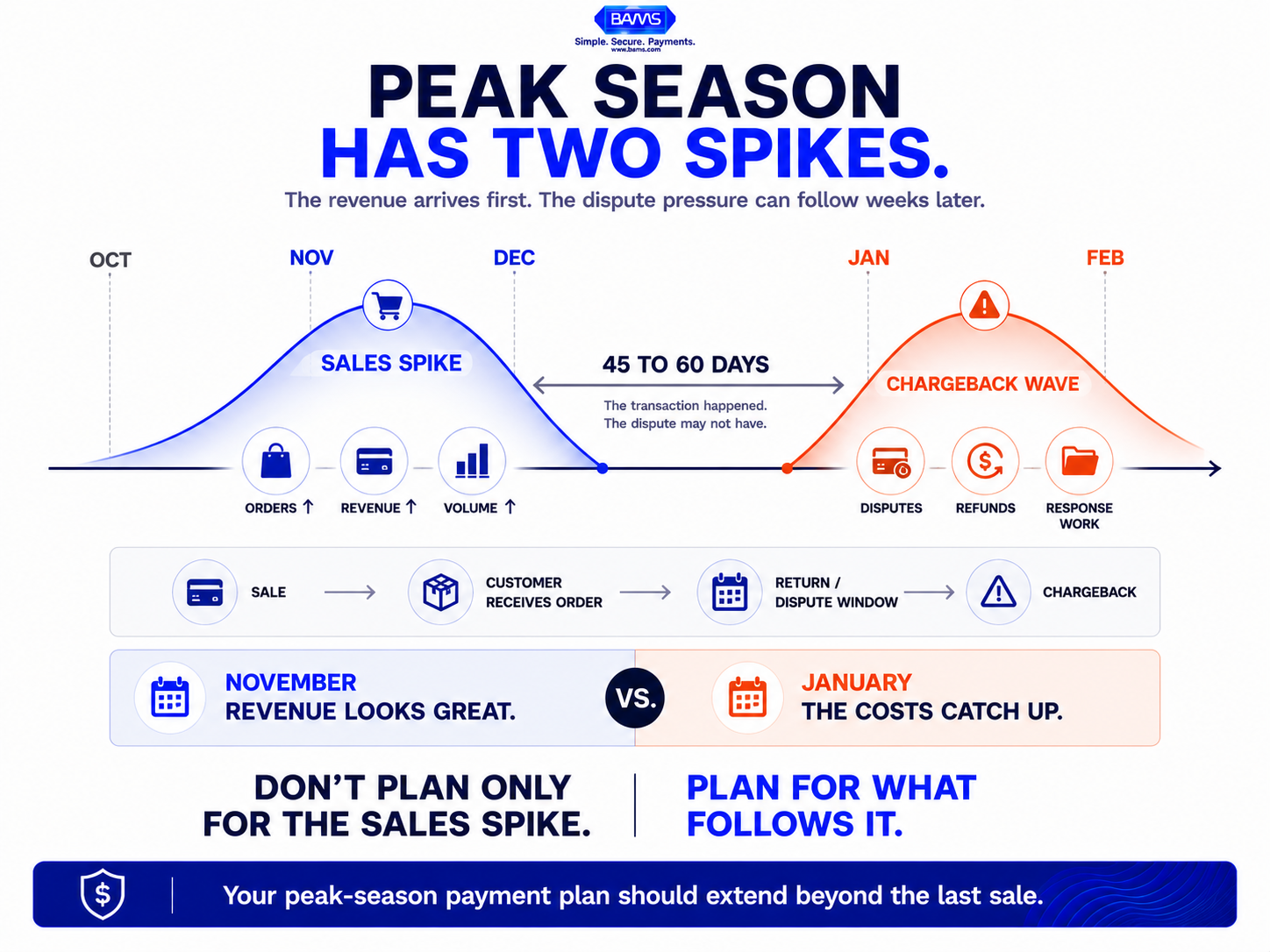
- Chargebacks follow sales by 45 to 60 days – Your November revenue spike creates a January cost spike. Roughly one-third of annual chargebacks land in the first two months after the holiday season. Plan for the aftermath, not just the rush.
- Surprise volume triggers processor holds – If your actual sales exceed your approved processing volume, your processor may impose reserve holds or delay deposits. Contact them 8 to 12 weeks before peak season to increase your limits.
- Deposit delays compound during peak season – A two-to-three-day funding delay on $10,000 per day means $20,000 to $30,000 in inaccessible cash at any given time. Next-day funding eliminates this gap when you need capital most.
- Documentation during peak season wins chargebacks after it – Shipping confirmations, delivery tracking, 3DS records, and return policy visibility are your defense evidence. Collect them in real time so you’re not scrambling when disputes arrive.
- Treat this as a seasonal discipline, not a one-time fix – Each peak cycle gives you better data and tighter processes. Start by calculating your true effective processing rate from last season, then work the four-phase framework before your next volume surge.
Guide Orientation: What This Covers and Who It’s For
This guide is built for eCommerce managers at established online businesses who already know how to prepare for a sales spike but haven’t built a system for the processing cost spike that follows. Specifically, it addresses peak season planning as a payments discipline, not just a marketing or inventory exercise.
By the end, you’ll understand how seasonal volume triggers hidden costs (chargebacks, processor holds, reserve requirements, and delayed deposits), and you’ll have a step-by-step framework for building pre-season payment infrastructure that protects your margins well after the rush ends.
This guide does not cover general holiday marketing strategy, platform selection, or checkout UX design. It focuses exclusively on the payment processing side of seasonal business challenges: what spikes your costs, when the damage actually hits, and how to build defenses before volume arrives.
Why Peak Season Planning for Payment Processing Costs Matters Now
Most eCommerce businesses treat peak season as a revenue event. They stock inventory, scale ad spend, and reinforce customer support. But almost none treat it as a payment risk event, and that gap is getting more expensive every year.
Returns and post-purchase fraud create substantial downstream costs for merchants. Mastercard reports that it processed $125 billion in returns in 2024, with more than $17 billion estimated to be fraudulent. That pressure does not end when the initial sale is complete, which is why peak-season planning needs to account for the post-purchase period as well.
The cost of inaction isn’t abstract. It shows up as unexpected processor reserve holds that freeze your capital in January, chargeback ratios that push you into monitoring programs with higher fees, and deposit delays during the exact weeks you need cash to restock and fulfill. If your payment system review happens after the season ends, you’re already absorbing damage you could have prevented.
The businesses that maintain healthy margins through seasonal volume aren’t luckier. They plan for the payments aftermath the same way they plan for the sales surge itself. This guide shows you how.
Core Concepts: The Seasonal Cost Anatomy You Need to Understand
The Post-Purchase Chargeback Lag
Peak season does not end when sales return to normal. Chargebacks can follow the original purchases weeks later, creating a second financial event businesses need to prepare for.
Chargebacks can surface after the initial peak sales period, once orders have been fulfilled and customers begin raising post-purchase disputes. This timing mismatch is why eCommerce managers can feel blindsided: the revenue celebration ends, and then the cost reckoning begins.
Processor Risk Flags and Reserve Requirements
When your transaction volume suddenly doubles or triples, your payment processor notices. Many processors interpret rapid volume increases as a risk signal, especially if your approved processing volume doesn’t match your actual throughput. The result can be a reserve hold (where the processor withholds a percentage of your deposits) or outright funding delays. These aren’t penalties for doing something wrong. They’re automated risk responses that you can prevent with advance communication and account preparation.
The Deposit Timing Gap
Standard processing timelines of two to three business days for deposit funding become a serious cash flow constraint during peak season. When you’re spending aggressively on ads, inventory, and fulfillment, a 48-to-72-hour delay on every sale compounds into a meaningful cash flow gap. The higher your volume, the wider that gap stretches.
Friendly Fraud vs. True Fraud
Not all chargebacks come from stolen cards. Visa reports that friendly fraud represents around 20% of fraudulent disputes globally and up to 30% for high-volume online merchants. “Friendly fraud” occurs when a legitimate transaction is disputed by the cardholder, making it a meaningful source of post-purchase losses for ecommerce businesses.
The Seasonal Payment Defense Framework
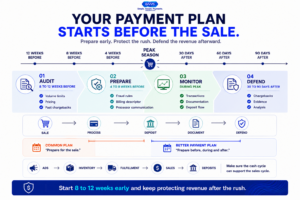
Modern BAMS timeline showing how payment preparation begins 8 to 12 weeks before peak season and continues through the post-season chargeback period.
Instead of treating each chargeback or cost spike as an isolated incident, this guide uses a four-phase framework that aligns your payment operations with the natural rhythm of seasonal selling:
- Phase 1: Pre-Season Audit (8 to 12 weeks before peak). Review your processor relationship, pricing structure, volume limits, and chargeback history.
- Phase 2: Infrastructure Hardening (4 to 8 weeks before peak). Implement fraud filters, update transaction descriptors, and establish communication with your processor.
- Phase 3: In-Season Monitoring (during peak). Track dispute signals in real time, manage fulfillment documentation, and protect deposit flow.
- Phase 4: Post-Season Defense (30 to 90 days after peak). Execute chargeback response protocols, analyze dispute data, and adjust for the next cycle.
Each phase builds on the previous one. Skipping the audit and jumping to in-season monitoring is like installing smoke detectors during a fire. The sections below walk through each phase in detail.
Step-by-Step Breakdown: Building Your Seasonal Payment Defense
Step 1: Conduct a Pre-Season Payment System Review (8 to 12 Weeks Out)
Objective: Identify every element of your payment setup that could create cost exposure or operational friction when volume increases.
Start by pulling your processing statements from the last two peak seasons. Look at your effective rate (total fees divided by total volume), your chargeback ratio, and your average ticket size during high-volume months. Compare these to your off-season numbers. The gap between them reveals where seasonal volume inflates your costs disproportionately.
Next, check your approved monthly processing volume with your current processor. Many eCommerce businesses set this limit when they first opened their account and never revisited it. If your approved volume is $50,000 per month and you’re about to process $150,000 in November, your processor may flag the overage and impose holds. Contact your processor proactively to request a temporary or permanent volume increase.
This is also the right time to evaluate your pricing model. If you’re on flat-rate processing, the math gets worse as volume climbs, because you’re paying the same inflated percentage on every transaction regardless of card type or risk level. Interchange-plus pricing typically saves higher-volume merchants significant money during peak periods.
Anti-patterns: Don’t assume your processor will automatically accommodate higher volume. Don’t wait until you see a hold on your account to investigate your approved limits. Don’t treat your processing agreement as a set-it-and-forget-it document.
Success indicators: You know your effective rate by season, your approved volume matches your forecast, and you’ve confirmed your pricing structure is optimized for higher throughput.
Step 2: Harden Your Transaction Infrastructure (4 to 8 Weeks Out)
Objective: Reduce the surface area for disputes before the first peak-season order is placed.
The single highest-impact change you can make is updating your billing descriptor. This is the business name that appears on your customer’s credit card statement. If it doesn’t clearly match your storefront name, customers file chargebacks simply because they don’t recognize the charge. During peak season, when people are making dozens of purchases across multiple retailers, unclear descriptors cause a disproportionate number of “I don’t recognize this” disputes.
Next, review your fraud detection setup. Implement or tighten Address Verification Service (AVS) and CVV matching requirements. Consider velocity checks that flag multiple orders from the same IP address or shipping address in a short window. These filters catch true fraud before it becomes a chargeback, but they need to be calibrated carefully. Overly aggressive filters reject legitimate customers and cost you revenue.
Update your return and refund policies so they’re visible at checkout, in confirmation emails, and on your website footer. Making your return process frictionless reduces the number of customers who skip the return and go straight to their bank.
Finally, ensure your payment authentication flow includes 3D Secure (3DS) for transactions that meet your risk thresholds. 3DS shifts liability for fraud-related chargebacks to the card issuer, which can save you thousands during high-volume periods.
Anti-patterns: Don’t deploy new fraud rules during peak season without testing them first. Don’t hide your return policy behind multiple clicks. Don’t ignore your billing descriptor because “it’s always been fine.”
Success indicators: Your billing descriptor matches your brand, fraud filters are tested and calibrated, return policies are prominent, and 3DS is active for high-risk transactions.
Step 3: Secure Your Cash Flow Before the Rush (2 to 4 Weeks Out)
Objective: Ensure that increased sales volume translates to accessible capital, not trapped revenue.
The deposit timing gap becomes a genuine operational risk during peak season. If you’re processing $10,000 per day but your deposits arrive on a two-to-three-day delay, you could have $20,000 to $30,000 in limbo at any given time. During a period when you’re also paying for expedited shipping, increased ad spend, and seasonal staff, that gap can force you into short-term borrowing or missed supplier payments.
Evaluate whether your current processor offers next-day funding. This single feature can eliminate the deposit timing gap entirely. BAMS, for example, provides next-day funding as a standard feature for its merchant accounts, which means peak-season revenue is available the next business day rather than sitting in a processing queue.
Beyond funding speed, confirm that your processor won’t impose rolling reserves during high-volume periods. A rolling reserve typically holds 5% to 10% of your processed volume for 90 to 180 days. For a business processing $200,000 during peak season, that’s $10,000 to $20,000 locked up precisely when you need it most. If your processor uses rolling reserves as a standard risk tool, negotiate terms in advance or explore alternatives.
Build a cash flow forecast that accounts for processing fees, potential chargebacks, and deposit timing.
Model a scenario where your chargeback rate doubles compared to off-season. US merchants faced an average chargeback rate of 0.84% in Q4 2023, up from 0.72% in the previous quarter. If your baseline is 0.5%, plan for 1% during and after peak season.
Anti-patterns: Don’t assume your current deposit schedule is adequate for peak volume. Don’t ignore the possibility of processor-imposed reserves. Don’t build a cash flow forecast that treats chargebacks as zero.
Success indicators: You have next-day or same-day funding confirmed, no surprise reserve requirements, and a cash flow model that accounts for realistic chargeback costs.
Step 4: Monitor and Document During Peak Season
Objective: Create the evidence trail and early-warning system that will protect you during the post-season chargeback wave.
Once peak season begins, your primary payment operations task shifts from prevention to documentation and monitoring. Every order that ships should generate a tracking number tied to the transaction record. Every digital delivery should include a download confirmation or access log. This documentation is your defense evidence when post-purchase chargebacks arrive.
Set up daily or weekly monitoring of your chargeback ratio. Card networks like Visa and Mastercard have specific thresholds (typically 0.9% to 1% of transactions), and exceeding them triggers monitoring programs that come with additional fees and operational requirements. If you see your ratio climbing during peak season, you can take immediate action: tighten fraud filters, increase customer communication, or pause advertising to high-risk segments.
Track customer service inquiries related to billing confusion, unrecognized charges, or delivery issues. These are leading indicators of future chargebacks. A spike in “where is my order” emails often precedes a spike in disputes. Resolve these proactively and you prevent the chargeback before the customer contacts their bank.
Use real-time analytics from your payment dashboard to watch for unusual patterns: sudden increases in declines, clusters of orders from specific geographies, or abnormal refund request rates. These signals help you distinguish between normal peak-season friction and emerging fraud patterns.
Anti-patterns: Don’t stop tracking chargebacks once the sales rush ends (the disputes haven’t even started yet). Don’t treat customer complaints as a support problem separate from your payment operations. Don’t wait for your monthly statement to discover your chargeback ratio.
Success indicators: Every transaction has associated fulfillment documentation, you’re monitoring chargeback ratios in real time, and customer service escalations are being logged as chargeback risk signals.
Step 5: Execute Post-Season Chargeback Defense (30 to 90 Days After Peak)
Objective: Respond to the chargeback wave with organized evidence and a systematic process, not case-by-case scrambling.
This is where most eCommerce businesses fail. Roughly one-third of all chargebacks merchants face in a given year are expected in the first two months following the holiday season. If you’ve followed the previous steps, you have the documentation and monitoring infrastructure to respond effectively. If you haven’t, you’re fighting each dispute from scratch.
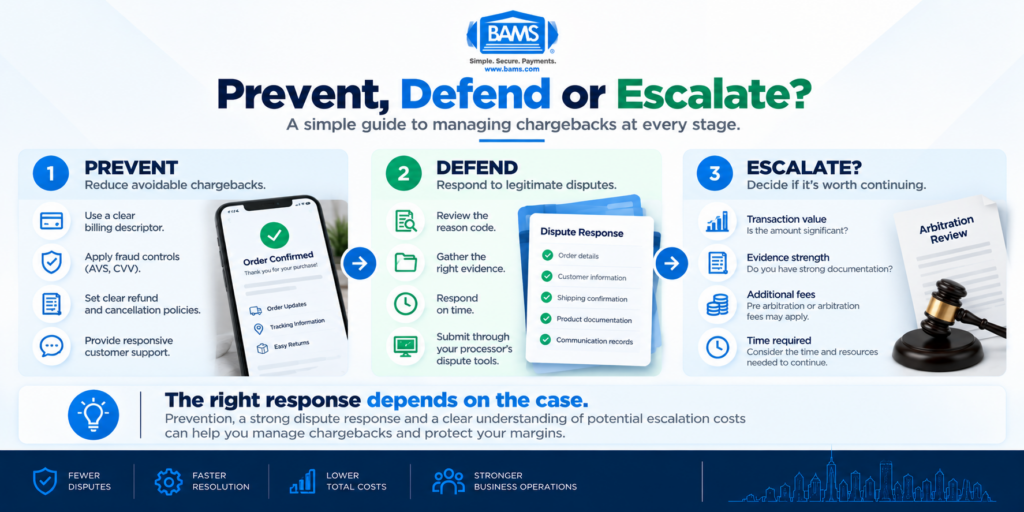
Organize your chargeback responses by reason code. The most common post-season codes fall into three categories: “product not received” (countered with shipping and delivery confirmation), “not as described” (countered with product listing screenshots and return policy evidence), and “unauthorized transaction” (countered with 3DS authentication records and AVS/CVV match data). Build response templates for each category and populate them with order-specific evidence.
Prioritize disputes by dollar value and win probability.
A $200 chargeback with strong delivery evidence is worth contesting. A $15 chargeback with ambiguous documentation may cost more in time than the recovery is worth. Set a threshold below which you accept the loss and focus resources on winnable cases.
Consider working with a processor that offers proactive chargeback defense as part of its service. BAMS provides proactive chargeback defense and dedicated account management, which means disputes are flagged and addressed before they escalate, rather than landing on your desk as a surprise deduction. This kind of support is especially valuable during the post-season surge when dispute volume can overwhelm internal teams.
Anti-patterns: Don’t ignore chargebacks and accept all losses by default. Don’t respond to every dispute with the same generic letter. Don’t treat chargeback defense as a one-time project rather than a 90-day operational commitment.
Success indicators: You have templated responses organized by reason code, a triage system based on dollar value and evidence strength, and a systematic process that runs for 90 days after peak season ends.
Step 6: Analyze, Adjust, and Prepare for the Next Cycle
Objective: Turn this season’s data into next season’s competitive advantage.
Once the post-season chargeback window closes (typically 90 to 120 days after peak), conduct a full retrospective. Pull your total processing costs for the peak period, including fees, chargebacks, chargeback fees, and any reserve holds. Calculate your true cost of processing as a percentage of peak-season revenue, not just the per-transaction rate on your statement.
Identify your top chargeback sources. Were they concentrated in specific product categories, marketing channels, or customer segments? Chargeflow’s 2024 report found dispute counts spike in July, August, and December, matching seasonal transaction-volume surges. Understanding your own dispute calendar helps you align your next pre-season preparation with your specific risk profile.
Document what worked and what didn’t. Did your fraud filters catch genuine fraud without blocking legitimate customers? Did your billing descriptor reduce “unrecognized charge” disputes? Did your cash flow forecast accurately predict your post-season chargeback costs? Feed these findings into your planning for the next peak period.
Review your merchant services relationship holistically. Ask whether your processor provided the support, transparency, and funding speed you needed when volume was highest. If the answer is no, the off-season is the right time to explore alternatives, not the week before your next sale launches.
Anti-patterns: Don’t skip the retrospective because the season is over and you’re tired. Don’t assume next season will look the same as this one. Don’t evaluate your processor only on per-transaction cost without accounting for funding speed, support quality, and chargeback assistance.
Success indicators: You have a documented cost-per-season figure, identified your highest-risk chargeback sources, and created a written action plan for the next peak period.
Practical Example: How the Timing Gap Creates Real Damage
Consider an online home goods retailer doing $40,000 per month in off-season sales. During November and December, volume jumps to $120,000 per month. Their processor has a two-day deposit delay and an approved monthly volume of $60,000.
In the first week of November, the retailer processes $30,000. The processor flags the velocity as unusual and places a 10% rolling reserve on all transactions. That’s $3,000 held back immediately. Deposits are arriving two days late, so the retailer has $60,000 in sales but only $24,000 in accessible cash by mid-month. Meanwhile, they’ve committed $35,000 to inventory and advertising.
By January, chargebacks begin arriving. The retailer’s Q4 chargeback rate climbs to 1.1%, triggering a card network monitoring program that adds $0.10 per transaction in additional fees. The retailer spends 15 hours per week responding to disputes with inconsistent documentation because they didn’t build a response system during the season.
Now compare this to a retailer who followed the framework above. They contacted their processor in September to increase approved volume to $150,000. They confirmed next-day funding. They updated their billing descriptor and implemented 3DS. They documented every shipment. When chargebacks arrived in January, they had templated responses and won 65% of disputes. Their effective processing cost for the season was 0.4% lower than the unprepared retailer, saving over $900 on the same volume. Over multiple seasons, that compounds into tens of thousands in preserved margin.
Common Mistakes and Pitfalls in Seasonal Payment Processing
Treating chargebacks as a customer service problem. Chargebacks are a payments operations problem. Customer service can help prevent them, but the response process requires transaction data, shipping evidence, and processor-specific protocols that live outside the support team’s workflow.
Optimizing only for the sales spike. The sales spike is the easy part. The cost spike follows 30 to 90 days later, and that’s where margins are won or lost. Your seasonal plan must extend well past the last sale.
Ignoring processor communication. Your processor is not a utility. It’s a partner that makes risk decisions about your account. Surprising them with a 3x volume increase is one of the fastest ways to trigger holds and reserves. A five-minute phone call in advance can prevent thousands in frozen funds.
Assuming flat-rate pricing is “simpler” during peak season. Simplicity in pricing does not equal lower cost. At peak volumes, the gap between flat-rate and interchange-plus pricing widens significantly. Run the math before the season, not after.
What to Do Next
Start with one action: pull your processing statements from your last peak season and calculate your true effective rate, including chargebacks and fees. Compare it to your off-season rate. The difference is your seasonal cost exposure, and it’s the number that justifies everything else in this guide.
From there, work backward from your next peak period. If it’s 12 weeks away, you’re in Phase 1 territory. If it’s 4 weeks away, jump to Phase 2 and prioritize billing descriptor updates, fraud filter calibration, and processor communication. If you’re in the middle of peak season right now, focus on documentation and monitoring (Phase 3) and build your chargeback defense system before the disputes arrive.
This framework isn’t a one-time project. It’s a seasonal discipline. Each cycle gives you better data, tighter processes, and lower costs. Treat it as infrastructure, revisit it before every peak period, and let the compounding savings do the work.
Frequently Asked Questions
When should businesses review their payment processing setup before peak seasons?
Start your payment system review 8 to 12 weeks before your expected volume increase. This gives you enough time to negotiate volume limit increases with your processor, evaluate your pricing structure, and implement fraud prevention tools without rushing. If you’re less than 4 weeks out, prioritize processor communication and billing descriptor updates as the highest-impact quick wins.
Why do chargebacks spike after peak season instead of during it?
Most chargebacks occur 45 to 60 days after the original purchase. Customers need time to receive their orders, decide they want a return, and (if the return process feels difficult) contact their bank instead. This delay means a November or December sales surge produces a January and February chargeback wave. Planning for this lag is essential to protecting your margins.
How can payment processors optimize their services for seasonal fluctuations in volume?
The best processors offer proactive account management, where they work with you before peak season to adjust approved volume limits, confirm funding timelines, and prepare chargeback defense protocols. Look for processors that provide next-day funding, transparent pricing (ideally interchange-plus), and dedicated support during high-volume periods. These features directly reduce the cash flow and cost risks that seasonal volume creates.
What is a seasonal volume playbook in merchant services optimization?
A seasonal volume playbook is a documented, repeatable plan that covers your payment operations before, during, and after each peak selling period. It includes pre-season tasks (processor communication, fraud filter setup, pricing review), in-season tasks (transaction monitoring, fulfillment documentation), and post-season tasks (chargeback response, cost analysis, process improvement). Think of it as the payments equivalent of your marketing launch plan.
How can businesses use data to forecast transaction volume for seasonal planning?
Pull processing statements from your last two to three peak seasons and track total volume, average ticket size, chargeback count, and effective processing rate for each period. Layer in your planned marketing spend and promotional calendar for the upcoming season. Use these inputs to model expected volume, anticipated chargeback costs, and cash flow timing. Even a simple spreadsheet forecast is dramatically better than no forecast at all.
Can seasonal volume spikes trigger processor holds on my account?
Yes. Most processors set an approved monthly processing volume when you open your account. If your actual volume significantly exceeds that limit (which commonly happens during peak season), the processor’s risk system may impose a rolling reserve, delay deposits, or even freeze your account temporarily. The fix is simple: contact your processor weeks in advance to request a volume increase that matches your seasonal forecast.
Sources