Fee Reconciliation: A Step-by-Step Guide for eCommerce
Last Updated on October 14, 2026 by Dimitri Akhrin
How to verify your processor’s deductions match your merchant agreement terms and recover lost revenue
Learn how to build a repeatable fee reconciliation process that catches discrepancies between what your payment processor charges and what you agreed to pay. This guide helps eCommerce operators without dedicated finance teams verify settlements and stop silent revenue loss.
TL;DR
- Your dashboard and bank balance measure different things – The dashboard shows gross sales; your bank receives what’s left after your processor deducts fees, chargebacks, refunds, and reserves. The gap between them is where money disappears unnoticed.
- Your merchant agreement is the only benchmark that matters – Every fee deducted from your settlement should trace back to a specific term in your contract. If it doesn’t, you’ve found a discrepancy worth disputing.
- Calculate your effective rate, don’t trust the stated rate – Divide total fees by gross sales to see what you’re actually paying. Compare that number to what your agreement predicts. Even small gaps (0.2-0.3%) represent thousands of dollars annually at meaningful volume.
- Categorize mismatches before reacting – Timing variances (deposits delayed by weekends or batch cutoffs) resolve in one to three days. Real exceptions (unauthorized fees, overdue reserves, rate increases) require investigation and dispute.
- Fee reconciliation is a revenue recovery habit, not a one-time audit – Run the process weekly. Over time, you build pattern recognition that catches problems earlier and gives you predictable, verifiable cash flow.
Guide Orientation: What This Covers and Who It’s For
This guide walks you through fee reconciliation as a practical, repeatable process for diagnosing why the number in your bank account doesn’t match the number on your payment dashboard. It’s built for eCommerce managers at established online businesses who process meaningful volume but don’t have a dedicated finance team parsing every settlement file.
By the end, you’ll understand exactly where money disappears between a completed sale and a bank deposit, how to verify whether your processor’s deductions match your merchant agreement terms, and how to build a lightweight system that catches discrepancies before they compound into real revenue loss.
This guide does not cover multi-currency reconciliation, enterprise ERP integrations, or gateway-level technical troubleshooting. It focuses on the gap between what you agreed to pay and what’s actually being taken from your settlements.
Why Fee Reconciliation Matters More Than You Think
Most eCommerce operators check their dashboard, glance at their bank balance, and move on. The two numbers rarely match, and the assumption is usually “fees” or “timing.” That assumption is expensive.
Card acceptance costs represent a significant expense across the payments ecosystem. The Federal Reserve Bank of St. Louis reports that U.S. banks collected nearly $66 billion in interchange fees in 2025, up from $64 billion in 2024 and $52 billion in 2021. Even a fraction of a percent in misapplied charges, incorrectly held reserves, or undisclosed fee increases can represent thousands of dollars for a mid-size eCommerce business over the course of a year.
The problem isn’t that payment processor fees exist. The problem is that most merchants never verify whether the fees being deducted match what they signed up to pay. Processors adjust rates, apply downgrades, hold reserves, and deduct chargeback fees. These deductions happen automatically, buried inside settlement files that most operators never open.
The cost of inaction isn’t dramatic. It’s gradual. It’s the slow erosion of margin that makes inventory restocks feel tighter than they should, ad budgets harder to justify, and cash flow projections unreliable. Fee reconciliation isn’t a back-office chore. It’s a revenue recovery habit that turns your payment stack into something you control rather than something that happens to you.
Core Concepts: Understanding What Happens Between Sale and Deposit
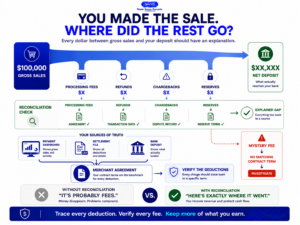
Modern BAMS infographic showing the deductions between gross eCommerce sales and net merchant deposits and how reconciliation verifies each deduction.
Gross Sales vs. Net Deposits
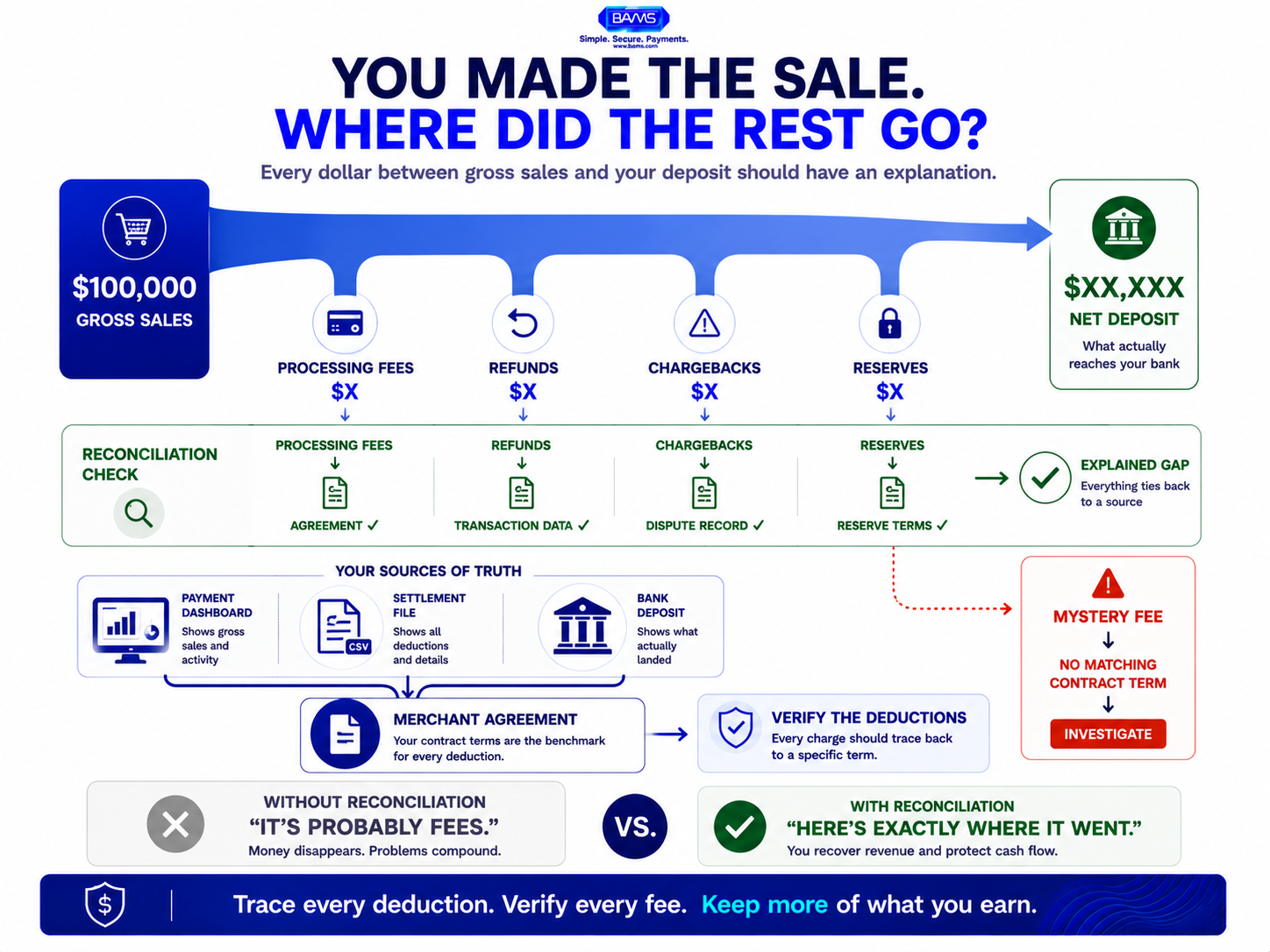
Your dashboard shows gross sales: the total value of completed transactions before anything is subtracted. Your bank receives net deposits: what’s left after your processor deducts interchange fees, assessment fees, processor markup, chargeback fees, refunds, and any reserves. The gap between these two numbers is where money goes missing, and where reconciliation begins.
The Settlement File
Every processor generates a settlement file (sometimes called a funding report or deposit detail report) that itemizes what was deducted and why. This is the document most merchants ignore. It’s also the only document that tells you whether you’re being charged what you agreed to pay. If you’re not downloading and reviewing this file, you’re trusting your processor to self-audit.
Timing Variances vs. Real Exceptions
Not every mismatch is a problem. Some are timing variances: a Friday sale that doesn’t settle until Monday, or a batch that closes after the processor’s cutoff time. These resolve themselves within one to three business days. Real exceptions are different. They include unexpected fee line items, reserves held beyond the agreed period, chargebacks deducted without notification, or rate increases applied without disclosure. Knowing the difference saves you from chasing false alarms and missing genuine overcharges.
Your Merchant Agreement as the Source of Truth
Your merchant agreement (or merchant processing agreement) defines the rates, fee structures, reserve terms, and chargeback policies your processor committed to. It’s the contract. Every deduction in your settlement file should be traceable back to a specific term in this document. If it isn’t, you’ve found a discrepancy worth investigating.
The Framework: A Four-Phase Reconciliation System
Fee reconciliation works best as a repeating cycle rather than a one-time audit. The framework below gives you a system you can run weekly (or daily, if volume warrants it) without enterprise software or a finance degree.
Phase 1: Capture — Collect the raw data from your dashboard, settlement files, and bank statements for the same time period.
Phase 2: Match — Align transactions across all three sources, identifying what reconciles cleanly and what doesn’t.
Phase 3: Diagnose — Classify every mismatch as either a timing variance or a real exception, then trace exceptions back to your merchant agreement terms.
Phase 4: Act — Dispute confirmed overcharges, adjust your cash flow projections, and log patterns that indicate systemic issues.
These four phases interconnect. What you learn in Phase 4 sharpens what you look for in Phase 1 the next time around. Over a few cycles, you develop pattern recognition that makes the process faster and catches problems earlier. For a more detailed daily workflow, the deposit reconciliation guide for eCommerce breaks down the operational cadence in granular detail.
Step-by-Step: Diagnosing and Closing the Gap
Step 1: Pull Your Three Data Sources Into Alignment
Objective: Create a single view of the same time period across your payment dashboard, processor settlement file, and bank statement.
Start by selecting a specific date range (one week is ideal for your first pass). Export your gross sales data from your eCommerce platform or payment gateway dashboard. Then download the settlement or funding detail report from your processor’s merchant portal. Finally, pull the corresponding deposit records from your bank account for the same period.
The critical detail here is date alignment. Your dashboard records a sale on the day the customer pays. Your processor may batch that transaction and settle it one or two days later. Your bank may post the deposit on yet another day, especially over weekends or holidays. You need to map each deposit in your bank to the specific batch or settlement period it represents, not to the original transaction date.
Anti-pattern: Comparing today’s dashboard total to today’s bank deposit. These will almost never match because of settlement timing, and you’ll waste hours chasing variances that resolve themselves.
Success indicator: You can trace every bank deposit back to a specific settlement file, and every settlement file back to a specific batch of dashboard transactions. No deposits are unaccounted for.
Step 2: Calculate Your Effective Rate and Compare It to Your Agreement
Objective: Determine the actual percentage you’re paying in total fees and verify it against the rates in your merchant agreement.
Take the total fees deducted (visible in your settlement file) and divide by your total gross sales for the same period. This gives you your effective rate. Visa notes that merchants negotiate and pay a merchant discount to their financial institution, which may include a range of processing services. Your effective rate therefore depends on your pricing model, card mix, transaction size, and processor terms.
Now open your merchant agreement. Find the section that specifies your interchange rate, processor markup, and any additional per-transaction or monthly fees. If you’re on interchange-plus pricing, you should be able to calculate your expected effective rate by adding your markup to the average interchange for your card mix. If your actual effective rate is meaningfully higher than what the agreement math predicts, something is off.
Common culprits include interchange downgrades (transactions that qualified at a higher rate because of missing data fields), PCI non-compliance fees, or markup increases that were applied without clear notification. For a deeper audit process, the merchant services optimization guide covers how to identify hidden fee categories specifically.
Anti-pattern: Accepting the processor’s stated rate at face value without calculating the effective rate yourself. The stated rate is what you agreed to. The effective rate is what you’re actually paying. They diverge more often than you’d expect.
Success indicator: Your calculated effective rate is within 0.1-0.2% of what your agreement predicts. If the gap is larger, you have specific line items to investigate.
Step 3: Isolate and Categorize Every Exception
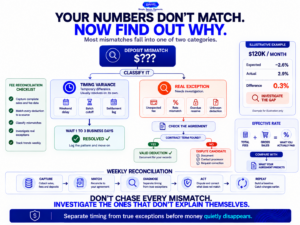
Modern BAMS graphic helping eCommerce merchants classify settlement mismatches as temporary timing variances or real fee exceptions requiring investigation.
Objective: Separate legitimate timing variances from genuine fee discrepancies, reserve issues, or unauthorized deductions.
With your data aligned and your effective rate calculated, go line by line through any transaction or deposit that doesn’t reconcile. Create two categories: timing variances and real exceptions.
Timing variances include deposits that arrive one to three business days after the expected settlement window, batches that split across two bank deposits, and weekend or holiday delays. These are normal. Log them, note the pattern, and move on.
Real exceptions require investigation. These include fee line items that don’t appear in your merchant agreement, chargeback deductions you weren’t notified about, reserve holds that exceed the percentage or duration specified in your contract, and rate changes applied without written notice. If your processor is deducting dispute fees for chargebacks you weren’t aware of, those costs can compound quickly.
Pay special attention to reserves. The Office of the Comptroller of the Currency notes that acquirers may establish merchant reserve or holdback accounts and fund them by withholding a portion of merchant proceeds. Check your agreement for the reserve percentage, release schedule, and other applicable terms, then verify them against your actual settlement history.
Anti-pattern: Treating all mismatches as “just fees” and writing them off without categorizing. This is how systematic overcharges go undetected for months.
Success indicator: Every mismatch is categorized. Timing variances have expected resolution dates. Real exceptions have specific dollar amounts and are linked to identifiable fee line items or contract terms.
Step 4: Trace Every Exception Back to Your Merchant Agreement Terms
Objective: Determine whether each real exception is contractually justified or represents an overcharge.
For each real exception you identified in Step 3, find the corresponding clause in your merchant agreement. This is where most merchants stall, because merchant agreements are dense documents with layered fee schedules. Focus on these sections: interchange and markup rates, monthly and annual fees, chargeback and dispute fees, reserve terms (percentage, duration, release conditions), and rate adjustment or amendment clauses.
If a deduction matches a specific term in your agreement, it’s legitimate (even if it’s painful). If a deduction doesn’t correspond to any term, or if the amount exceeds what the agreement specifies, you have a documented overcharge. Common findings include PCI non-compliance fees that were never disclosed during onboarding, batch processing fees that exceed the agreed per-transaction amount, and “miscellaneous” or “regulatory” fees that have no contractual basis.
The monthly processor audit checklist provides a structured approach for identifying these fee categories systematically, especially for merchants processing $50K or more per month.
Anti-pattern: Calling your processor to dispute a charge without first locating (or ruling out) the relevant contract clause. You need to lead with specifics, not frustration.
Success indicator: Each exception is either confirmed as contractually valid or flagged as a dispute candidate with the specific contract clause (or absence of one) documented.
Step 5: Dispute Overcharges and Negotiate Corrections
Objective: Recover money you’ve been incorrectly charged and prevent the same deductions from recurring.
Contact your processor’s merchant support team with your documentation. For each disputed charge, provide the settlement file line item, the dollar amount, the date, and the specific contract term it violates (or the absence of a covering term). Be factual and specific. Processors respond to documented disputes far more effectively than general complaints.
Request three things: a refund or credit for the overcharge, a written explanation of why the charge was applied, and confirmation that it won’t recur. If your processor can’t explain a charge or refuses to correct it, that’s a signal worth paying attention to. It may indicate a pricing model that’s working against you or a processor relationship that lacks the transparency you need.
This is where the choice of processor matters significantly. Partners like BAMS build their model around transparent pricing and dedicated account management, which means disputed charges get resolved by a person who knows your account rather than a support ticket queue. That difference in responsiveness directly affects how quickly overcharges get corrected and whether they recur.
Anti-pattern: Accepting a vague explanation like “that’s a standard industry fee” without requesting the specific contract clause that authorizes it. Every fee should be traceable.
Success indicator: You receive a credit or clear contractual justification for every disputed charge. Recurring overcharges are corrected at the source, not just refunded once.
Step 6: Build a Recurring Reconciliation Cadence
Objective: Turn fee reconciliation from a one-time investigation into a sustainable weekly or monthly habit.
The first pass through this process will take the longest. Subsequent cycles get faster because you’ve already mapped your settlement timing, identified your baseline effective rate, and established what “normal” looks like for your account. Set a recurring calendar event (weekly for high-volume merchants, monthly at minimum) to run through the four-phase cycle.
Create a simple tracking spreadsheet or document with columns for: date range, gross sales, expected fees, actual fees deducted, effective rate, number of timing variances, number of real exceptions, and resolution status. Over time, this log becomes your financial audit trail. It reveals patterns (seasonal rate changes, recurring mystery fees, reserve hold extensions) that you’d never catch from a single snapshot.
For eCommerce businesses processing significant volume, the compounding effect of this habit is substantial. Interchange fee revenue collected by U.S. banks has increased in recent years, which makes accurate fee verification increasingly important for merchants trying to protect their margins.
Anti-pattern: Running one audit, finding nothing dramatic, and never doing it again. Fee discrepancies often emerge gradually through small rate adjustments or new line items that appear months after onboarding.
Success indicator: You have three or more consecutive reconciliation cycles logged, your effective rate is stable and explainable, and you can predict your net deposit within 1-2% accuracy before checking your bank.
Practical Examples: What This Looks Like in the Real World
Scenario A: The Mystery 0.3% Gap
An eCommerce apparel brand processing $120K per month on interchange-plus pricing notices their effective rate is 2.9% despite an agreement specifying interchange + 0.25%. Their expected effective rate, based on their card mix, should be around 2.6%. After pulling settlement files for three months, they find two culprits: a PCI non-compliance fee of $99/month they were never told about, and a pattern of interchange downgrades on international card transactions where AVS data wasn’t being passed correctly.
The PCI fee gets removed after they provide their compliance certificate. The downgrade issue gets fixed by updating their gateway’s transaction data fields. Combined recovery: approximately $360/month, or $4,320/year. None of this required enterprise tooling. It required reading the settlement file and comparing it to the agreement.
Scenario B: The Reserve That Overstayed
A subscription box company classified as moderate-risk has a merchant agreement specifying a 5% rolling reserve with a 90-day release. After six months of operation, they notice their reserve balance keeps growing but nothing is being released. A review of their settlement files confirms reserves are being withheld but never returned. When they contact their processor with the specific contract clause and a spreadsheet showing the unreleased amounts, the processor releases $8,400 in held funds within two weeks.
Without reconciliation, that money would have sat in the processor’s reserve account indefinitely, unavailable for inventory purchases, advertising, or operations.
Scenario C: Chargeback Fees Without Chargebacks
A home goods eCommerce store finds $175 in “dispute fees” on their monthly settlement summary but has no record of any chargebacks in their dashboard. After investigating, they discover the charges relate to retrieval requests (pre-chargeback inquiries) that their processor bills at $15 each. The merchant agreement mentions retrieval request fees in a footnote, but the amount listed is $10, not $15. The $5 per-incident overcharge across 35 retrieval requests over several months adds up. Even pre-dispute fees can become a meaningful cost center if left unchecked.
Common Mistakes and Pitfalls
Assuming your dashboard is your accounting system. Your payment dashboard shows gross transaction data. It doesn’t show what your processor deducted, what your bank received, or whether those numbers are correct. The dashboard is a starting point, not a conclusion.
Reconciling monthly instead of weekly. Monthly reconciliation is better than nothing, but it means discrepancies compound for 30 days before you catch them. Weekly checks take 20 to 30 minutes once you have the process down.
Not keeping your merchant agreement accessible. If you can’t find your agreement, you can’t verify charges. Download it, save it somewhere searchable, and flag the sections on rates, fees, and reserves.
Ignoring small discrepancies. A $12 mystery fee this month becomes $144 over a year. Multiply that by three or four unexplained line items and you’re looking at real money. Small discrepancies are diagnostic signals, not rounding errors.
Blaming everything on timing. Timing variances are real, but they’re also the most convenient excuse for not investigating further. If a variance doesn’t resolve within three business days, it’s not timing. It’s an exception.
What to Do Next
Start with one reconciliation cycle. Pick last week’s transactions, pull your three data sources, and calculate your effective rate. Compare it to your merchant agreement. You don’t need to build a perfect system on day one. You need to see, once, what’s actually being deducted from your settlements.
If you find discrepancies, document them and contact your processor with specifics. If everything checks out, you’ve just established a baseline that makes future reconciliation faster and more reliable.
Treat this guide as a reference you return to, not a checklist you complete once. The value of fee reconciliation compounds over time as you develop pattern recognition and build the financial audit trail that protects your margins. The merchants who treat reconciliation as a revenue recovery habit, rather than an accounting task they’ll get to eventually, are the ones who keep more of what they earn.
Frequently Asked Questions
What is deposit reconciliation in merchant services?
Deposit reconciliation is the process of matching the gross sales recorded in your payment dashboard to the net deposits that arrive in your bank account. The difference between those two numbers consists of processor fees, interchange costs, chargebacks, refunds, and reserves. Reconciliation verifies that every deduction is accurate, authorized by your merchant agreement, and applied at the correct rate.
Why does my bank balance never match my payment dashboard?
Your dashboard shows gross transaction totals before any deductions. Your processor subtracts interchange fees, their markup, assessment fees, chargeback costs, and potentially reserve holds before depositing the remainder into your bank account. Settlement timing also plays a role: a sale processed on Friday may not appear in your bank until Monday or Tuesday. The combination of fee deductions and timing delays creates the gap.
How often should I perform fee reconciliation?
Weekly reconciliation is ideal for eCommerce businesses processing consistent volume. It takes 20 to 30 minutes once you’ve established the process and catches discrepancies before they compound. At minimum, reconcile monthly. Daily reconciliation makes sense for high-volume merchants or businesses where cash flow timing directly affects operations like inventory purchasing.
What factors affect the timing of merchant service deposits?
Several factors influence when deposits arrive: your processor’s batch cutoff time, the funding speed specified in your agreement (standard is two to three business days; next-day funding is available through some processors), weekends and bank holidays, and the card networks’ own settlement schedules. International transactions and certain card types (corporate cards, rewards cards) may also settle on different timelines.
How can I tell if my processor is overcharging me?
Calculate your effective rate by dividing total fees deducted (from your settlement file) by your gross sales for the same period. Compare that rate to what your merchant agreement specifies. If the effective rate is meaningfully higher than expected, review individual fee line items in the settlement file and trace each one back to a specific contract term. Unexplained line items, rates that exceed your agreement, or reserve holds beyond the agreed duration are all signs of potential overcharging.
What should I do if I find a fee discrepancy with my processor?
Document the discrepancy with the specific settlement file line item, the dollar amount, the date, and the relevant clause in your merchant agreement (or the absence of one). Contact your processor’s support team with this documentation and request a refund or credit, a written explanation, and confirmation the charge won’t recur. If your processor can’t justify the charge or refuses to correct it, consider whether your current processing relationship offers the transparency your business needs.