

Mobile Payment Security: The Fraud Gap No One Tells Merchants
Last Updated on August 13, 2026 by Dimitri Akhrin
Biometric authentication protects consumers but quietly arms friendly fraud with airtight-looking evidence
Learn why the same mobile payment security features that protect consumers—biometric authentication and tokenization—create a dangerous evidence gap for merchants fighting chargebacks. This piece exposes the disconnect between the consumer safety narrative and the fraud patterns merchants actually face.
TL;DR
- Biometric authentication protects consumers, not merchants – Face ID and Touch ID prevent unauthorized access, but that biometric proof stays on the customer’s device and is never available to you during a dispute.
- “Airtight” transactions are easier to dispute, not harder – When a tokenized, biometrically verified purchase is challenged, merchants have fewer data points to contest the chargeback, and friendly fraud thrives in that gap.
- Fraud is shifting from unauthorized use to disputed fulfillment – As tokenization reduces traditional payment fraud, merchants face a growing need to defend against friendly fraud and post-purchase disputes that biometric authentication cannot prevent.
- Invest in evidence infrastructure, not just fraud filters – Delivery documentation, clear refund policies, and proactive chargeback defense (through partners like BAMS) protect revenue far more than relying on the wallet’s built-in security.
The Security Story Nobody Tells the Merchant
Every time a customer holds their phone to a terminal or taps “Pay with Apple Pay” at checkout, a small miracle of mobile payment security unfolds. Biometric authentication fires. A unique token replaces the card number. The transaction sails through, encrypted end to end. It looks bulletproof.
And that’s exactly the problem. Because when that same customer files a chargeback eight weeks later claiming they never made the purchase, you’re left arguing against a transaction that looks airtight on paper. The very technology designed to protect consumers has quietly made it harder for you to protect your revenue.
Why Everyone Thinks Tokenization Solved the Fraud Problem
The prevailing narrative around Apple Pay and mobile wallets is straightforward: biometric authentication plus tokenization equals safer transactions. And at the consumer level, that’s true. Face ID and fingerprint recognition help prevent unauthorized users from initiating payments, while tokenization keeps sensitive card credentials out of the merchant environment. Apple’s official Apple Pay documentation explains how biometric authentication and device-based security work together to authorize transactions without exposing the customer’s payment credentials.
Payment networks, issuers, and wallet providers have invested billions building this narrative. It resonates because it’s partially correct.
Tokenization genuinely reduces data breach risk and limits exposure of sensitive payment credentials. Mastercard Developers explains how network tokenization replaces card numbers with device-specific payment tokens, reducing the usefulness of stolen payment credentials while preserving secure transaction processing.
So the industry celebrates. Merchants breathe easier. And everyone assumes the fraud problem is shrinking. But the fraud problem isn’t shrinking. It’s shapeshifting.
The Inconvenient Truth About “Airtight” Transactions
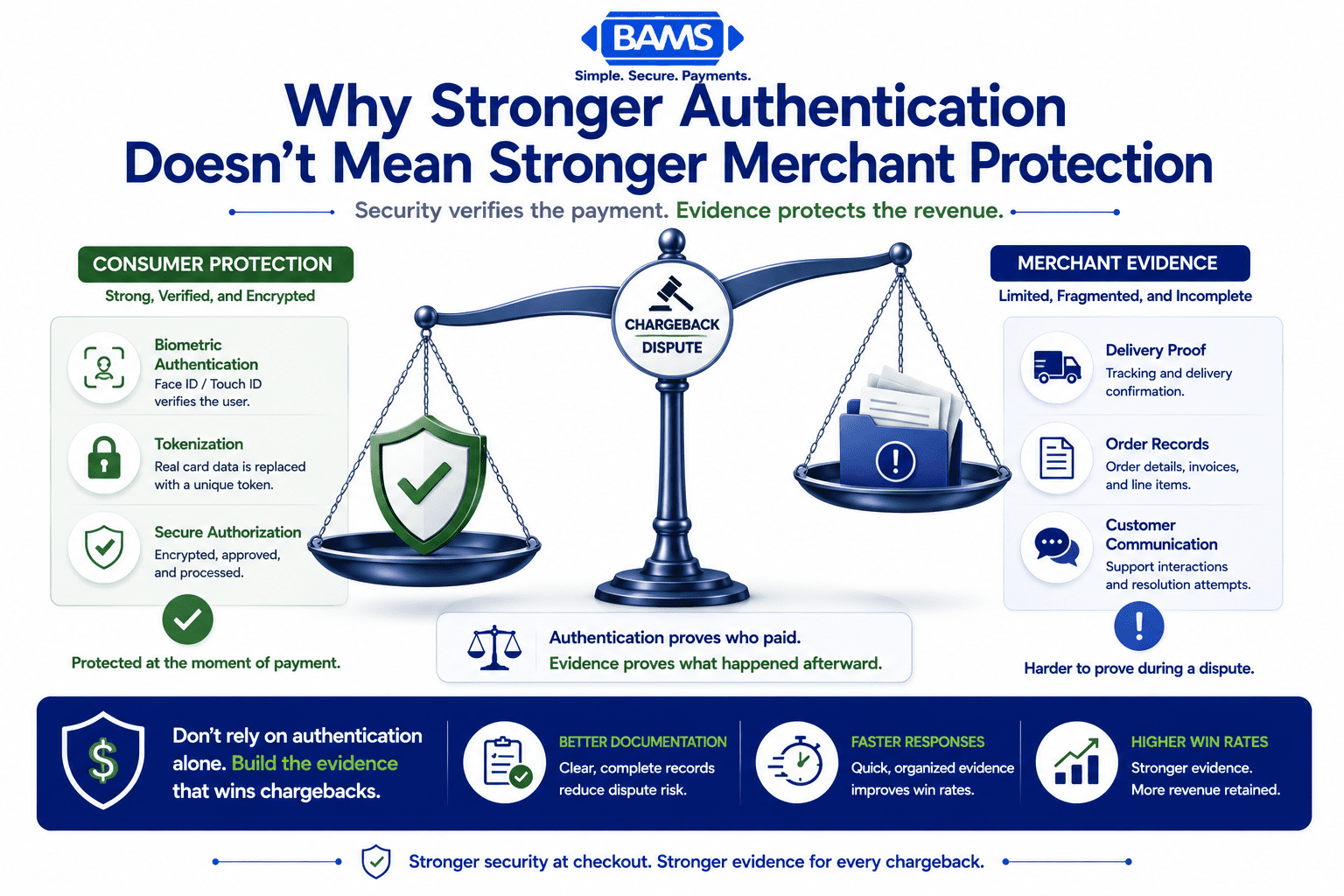
Here’s what we actually believe: biometric authentication protects the consumer, not the merchant, and the stronger the authentication looks, the weaker your dispute position becomes when friendly fraud strikes.

Mobile wallets strengthen payment authentication, but merchants still need independent evidence to defend chargebacks. Security alone doesn’t guarantee successful dispute outcomes.
Mobile Payment Security Protects the Wrong Side
Let’s walk through what actually happens when a customer pays via Apple Pay on your eCommerce store. They authenticate with Face ID or Touch ID. Apple generates a one-time token. The payment processes. You ship the product.
Six weeks later, a chargeback lands. The customer says they didn’t authorize the purchase, or the item never arrived, or it wasn’t as described. You pull up the transaction record.
Here’s what you find: a tokenized transaction with no card number to cross-reference, no signature, no IP address tied to the biometric scan, and no way to prove the account holder’s face was the one that unlocked the phone. The biometric data stays on the customer’s device. Apple doesn’t share it with you. The issuer doesn’t have it either.
You’re left with a shipping confirmation and an order ID. The customer has a bank that sees a “verified” transaction and a dispute claim. And because the transaction was biometrically authenticated, the bank’s fraud team often assumes the purchase was legitimate, which paradoxically makes them more sympathetic to the customer’s claim that something else went wrong (item not received, not as described). The fraud shifts from “unauthorized” to “service dispute,” and the evidence burden falls squarely on you.
Although tokenization significantly reduces unauthorized payment fraud, merchants continue to face chargebacks driven by fulfillment disputes, friendly fraud, and post-purchase disagreements. The operational challenge has shifted from protecting payment credentials to building evidence that supports successful dispute resolution.
Consider the pattern we’ve seen across small and midsize eCommerce operations: Apple Pay chargeback rates climbing not because of criminal fraud, but because the dispute process treats biometrically authenticated transactions as inherently trustworthy. The merchant’s ability to contest is undermined by the very security that processed the sale.
This is the gap nobody talks about.
Industry analysts confirm that AI-driven fraud detection is now the primary security tool in payments, precisely because biometric data alone can’t flag friendly fraud patterns like unusual purchase velocity or post-purchase dispute frequency. The “airtight” purchase is only airtight until someone disputes it.
Merchants who work with partners like BAMS gain an advantage here because proactive chargeback defense catches these patterns before they compound. Instead of reacting to disputes after the money is gone, you get ahead of them with transaction-level monitoring and dedicated support that understands the nuances of tokenized payment disputes.
What This Means for Your Bottom Line
If this thesis is right, then every eCommerce merchant accepting Apple Pay online needs to rethink their dispute preparation, not their fraud filters. Your fraud filters are catching criminals. They’re not catching the customer who received the order, forgot about it, and filed a chargeback when the charge looked unfamiliar on their statement.
It means your chargeback ratio can climb even as your actual fraud rate drops. It means the cost isn’t just the lost sale; it’s the compounding effect on your processing fees and your standing with your payment processor. And it means that treating mobile wallet transactions as “safer” without adjusting your operational response is leaving revenue undefended.
The merchants who protect their margins aren’t the ones with the best fraud detection. They’re the ones with the best evidence collection and dispute workflows for the transactions that look clean but go sideways anyway.
Mobile wallets securely protect payment credentials, but fulfillment records, customer communications, and delivery proof remain the merchant’s responsibility.
A New Way to Think About Fraud Patterns in the Wallet Era
Stop thinking of fraud as a binary: authorized or unauthorized. Start thinking of it as a spectrum of disputability. Every transaction carries a dispute risk score, and that score has almost nothing to do with whether biometric authentication was used.
The real question isn’t “Was this purchase secure?” It’s “Can I prove this purchase was fulfilled, satisfactory, and undisputed if challenged 60 days from now?”
That reframe changes everything. It shifts your investment from prevention technology (which the wallet already handles) to evidence infrastructure: delivery confirmation with photos, detailed product descriptions that match what ships, clear refund policies surfaced at checkout, and transaction records that tie the order to fulfillment at every step. Accepting digital wallets is smart. Accepting them without adjusting your dispute posture is expensive.
The Lock on the Front Door Doesn’t Help When the Dispute Comes Through the Window
Mobile wallets are here to stay. Biometric authentication will only get stronger. And the narrative that these tools protect everyone in the transaction will only get louder.
We believe merchants who win in this environment won’t be the ones who trust the lock. They’ll be the ones who document every room in the house. Security isn’t your problem. Proof is.
Frequently Asked Questions
Which fraud patterns are commonly associated with Apple Pay transactions?
The dominant pattern isn’t unauthorized use; it’s friendly fraud, where a legitimate cardholder completes a biometrically authenticated purchase and later disputes it as not received or not as described. Because the authentication looks clean, the evidence burden falls on the merchant.
How does tokenization enhance the security of Apple Pay transactions?
Tokenization replaces real card numbers with a unique Device Account Number, so your systems never store or transmit sensitive card data. This dramatically reduces data breach risk, but it also means you have fewer identifiable data points to reference when contesting a chargeback.
What are the risks of using Apple Pay for online transactions?
The primary risk for merchants is a weakened dispute position. Biometric data stays on the customer’s device and isn’t available as evidence, so when friendly fraud occurs, the transaction’s strong authentication can actually work against you in the chargeback process.


