7 Payment Option Expansion Strategies for Faster Deposits
Last Updated on May 22, 2026 by Dimitri Akhrin
How eCommerce managers can reduce cash flow gaps while boosting customer retention through smarter payment infrastructure
Learn specific payment expansion techniques that cut deposit delays from days to hours. This guide covers processor selection, alternative payment methods, and security upgrades that improve cash flow and keep customers coming back.
TL;DR
- Digital wallets and one-click checkout speed deposits – These payment methods process faster and often qualify for accelerated settlement, with digital wallets now representing 49% of global eCommerce transactions.
- BNPL pays you upfront – Buy Now, Pay Later providers settle with you immediately while managing customer installments, combining faster cash flow with 30-50% repeat purchase rates.
- Next-day funding is often negotiable – If you have a clean chargeback history and decent volume, you may qualify for next-day settlement without changing processors.
- Chargeback prevention protects deposit speed – High chargeback ratios trigger reserve holds and slower settlement tiers, making fraud prevention a cash flow strategy, not just a loss prevention one.
- Start with one high-impact change – Negotiate settlement terms first if you are on 2-3 day funding, then layer in payment method expansion based on your specific customer base and markets.
Why Delayed Deposits Cost More Than You Think
You sold the product. The customer paid. But the money sits somewhere between their bank and yours for days, sometimes longer. For eCommerce managers running established online businesses, this cash flow gap creates real operational strain. According to NACHA, modern payment networks continue to evolve to support faster and more efficient fund transfers.
Delayed deposits force difficult choices: delay inventory orders, postpone marketing spend, or tap credit lines to cover payroll. Each day your revenue stays locked in processing limbo costs you flexibility and opportunity.
The problem often traces back to limited payment infrastructure. When you rely on a single payment method or processor with slow settlement times, you inherit their timeline. More businesses are recognizing that expanding payment options improves both customer satisfaction and cash flow predictability.
This shift matters more in 2025 than ever. Customer expectations have evolved, processing technology has advanced, and the gap between businesses with optimized payment stacks and those without continues to widen.
What This Guide Covers
This listicle targets eCommerce managers at businesses with 10-50 employees who face chronic deposit delays and want practical solutions. You will not find generic advice about “improving customer experience” or vague suggestions to “optimize checkout.”
Instead, you get specific payment option expansion techniques that directly address deposit timing, customer retention methods tied to payment flexibility, and payment security enhancements that protect revenue without slowing it down.
Each strategy connects expanded payment options to faster access to your funds and reduced processing friction.
How We Selected These Strategies
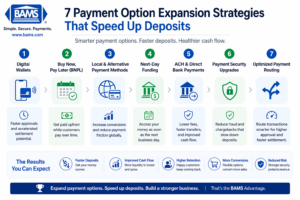
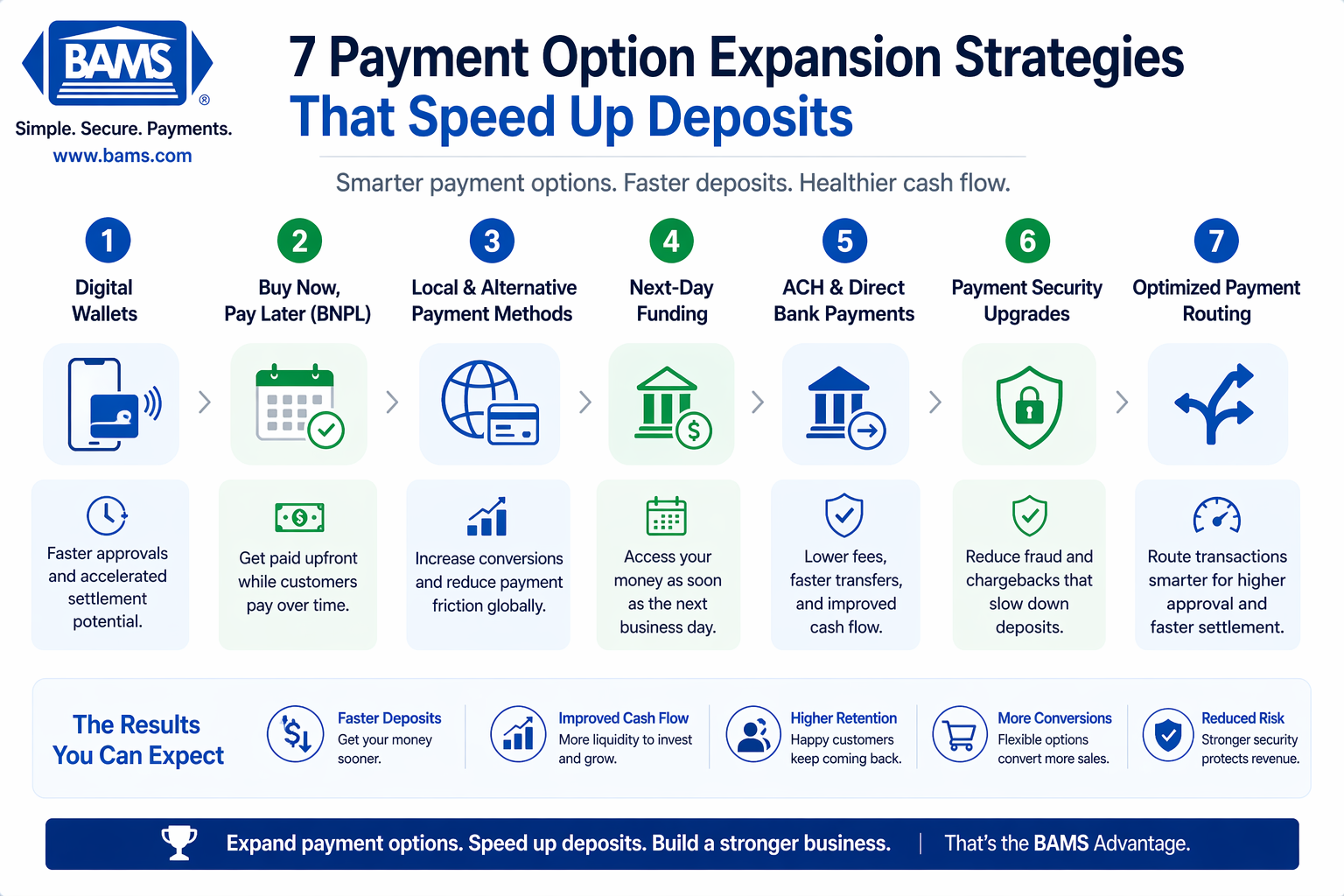
Expanding payment options strategically helps businesses accelerate deposits, improve cash flow, and increase customer retention.
Every technique here meets three criteria: it must demonstrably reduce time-to-deposit or improve cash flow predictability, it must be implementable by mid-size eCommerce operations without enterprise budgets, and it must have measurable impact on either conversion rates or customer retention.
We excluded strategies that require complete platform migrations or carry significant fraud risk without corresponding security measures.
7 Payment Expansion Techniques That Speed Up Deposits
1. Integrate Digital Wallet Payments as Primary Options
Why it matters: Digital wallets process faster than traditional card payments because they reduce authentication friction and carry lower fraud rates. Many processors offer accelerated settlement for wallet transactions due to their pre-verified nature.
What it looks like today: Digital wallets now represent a significant share of eCommerce transactions and continue to grow as consumers prioritize speed and convenience. Apple Pay, Google Pay, and PayPal dominate, but regional options like Shop Pay gain ground in specific markets.
How to apply it: Prioritize wallet options in your checkout flow rather than burying them below card fields. Configure your processor to route wallet transactions through faster settlement channels when available. Monitor which wallets your customers actually use and optimize for those first.
According to the Bank for International Settlements, improvements in payment infrastructure and processing systems are key drivers of faster and more efficient fund transfers.
2. Implement One-Click Checkout for Returning Customers
Why it matters: Stored payment credentials enable instant authorization, which often qualifies for faster deposit processing.
What it looks like today: Platforms like Shopify, BigCommerce, and WooCommerce offer native one-click solutions. Third-party options like Bolt and Fast (before its shutdown) demonstrated both the demand and the implementation challenges.
How to apply it: Enable tokenized payment storage through your gateway. Ensure your PCI compliance covers stored credentials. Start with your highest-value repeat customers and measure both conversion lift and deposit timing changes.
3. Add Buy Now, Pay Later Without Slowing Settlement
Why it matters: BNPL providers like Klarna, Affirm, and Afterpay pay you upfront while managing customer installments. You get immediate settlement (often next-day) while customers get flexibility. Buy Now, Pay Later options often increase repeat purchases by giving customers more flexibility at checkout.
What it looks like today: BNPL has matured beyond fashion retail into electronics, home goods, and B2B. Integration complexity has decreased, with most platforms offering plug-and-play options.
How to apply it: Compare BNPL provider settlement terms carefully. Some offer same-day funding, others take 2-3 days. Factor their fees against your average order value increase. Position BNPL prominently for orders above your average transaction size.
4. Localize Payment Methods for International Markets
Why it matters: Offering region-specific payment options reduces failed transactions and speeds authorization. Localized payment methods typically improve conversion rates by aligning with how customers prefer to pay in each market.
What it looks like today: iDEAL dominates Netherlands eCommerce. Bancontact leads in Belgium. PIX transformed Brazilian payments. Each carries different settlement characteristics and fraud profiles.
How to apply it: Identify your top three international markets by revenue. Research the dominant local payment methods and their typical settlement windows. Work with a processor that supports multi-currency settlement to avoid conversion delays.
5. Negotiate Next-Day Funding Terms
Why it matters: Standard processing agreements often default to 2-3 day settlement, but next-day funding is increasingly available for established businesses with clean transaction histories. This single change can recover 24-48 hours of cash flow on every sale.
What it looks like today: Many processors now offer next-day funding as a standard feature rather than a premium add-on. The key factors are your chargeback ratio, processing volume, and business tenure.
How to apply it: Review your current processing agreement for settlement terms. If you are on 2-3 day settlement with a clean chargeback history, request next-day funding. If denied, ask what metrics would qualify you. Consider processors that offer next-day funding as a baseline feature.
6. Implement Proactive Chargeback Prevention
Why it matters: Chargebacks do not just cost you the transaction amount. They trigger reserve holds, delay future deposits, and can push you into slower settlement tiers. Chargeback prevention strategies protects your deposit velocity as much as your revenue.
What it looks like today: Modern chargeback prevention combines pre-transaction fraud screening, real-time alerts from card networks, and rapid response protocols. Tools like Verifi and Ethoca enable you to resolve disputes before they become chargebacks.
How to apply it: Connect to card network alert systems through your processor. Establish clear internal protocols for responding to alerts within the required timeframes. Track your chargeback ratio monthly and investigate any upward trends immediately.
7. Optimize Authorization Rates Through Payment Security Enhancements
Why it matters: Failed authorizations mean delayed revenue and frustrated customers. Payment security enhancements like 3D Secure 2.0 actually improve authorization rates by shifting liability and providing richer authentication data to issuers.
What it looks like today: 3DS2 has replaced the clunky redirect experience of original 3D Secure with frictionless authentication for low-risk transactions. Network tokenization further improves authorization by keeping card credentials current.
How to apply it: Enable 3DS2 for markets where it is required (EU, UK) and test it in others. Implement network tokenization for stored cards to reduce declines from expired credentials. Monitor your authorization rate by payment method and investigate any that fall below 95%.
The Pattern Across These Strategies
Each technique shares a common thread: reducing friction in the payment flow accelerates both customer completion and fund settlement. The businesses seeing the fastest deposits are not just adding payment options randomly. They are building integrated systems where each method serves a specific customer segment and settlement need.
Notice the tradeoff between breadth and depth. Adding every possible payment method creates maintenance overhead and can fragment your reporting. The smarter approach targets methods that serve your actual customer base while qualifying you for faster settlement tiers.
The Federal Reserve notes that payment system design plays a critical role in how quickly funds move between institutions. Security and speed are not opposing forces here. Better fraud prevention and stronger authentication improve authorization rates, which improves both conversion and deposit timing.
Where to Start Without Overwhelming Your Team

A simple framework helps businesses prioritize payment strategies based on cash flow, conversion, growth, and risk goals.
You cannot implement all seven strategies simultaneously, nor should you try. Start with the highest-impact, lowest-effort changes for your specific situation.
If you are on 2-3 day settlement with a clean history, negotiate next-day funding first. That single conversation can recover more cash flow than weeks of checkout optimization.
If your repeat customer rate is strong but conversion lags, prioritize one-click checkout and digital wallet prominence. If international sales are growing, localize payment methods for your top market before expanding further.
Measure deposit timing changes alongside conversion metrics. The goal is not just more sales but faster access to the revenue from sales you already make.
Frequently Asked Questions
What are faster deposit strategies in merchant services?
Faster deposit strategies include negotiating next-day funding terms with your processor, using payment methods with accelerated settlement (like digital wallets), maintaining low chargeback ratios to avoid reserve holds, and working with processors that prioritize settlement speed as a core feature rather than a premium add-on.
Why is payment optimization important for businesses?
Payment optimization directly impacts cash flow, conversion rates, and customer retention. Optimized payment flows reduce cart abandonment, improve authorization rates, and can qualify your business for faster settlement tiers. For mid-size eCommerce operations, even a one-day improvement in deposit timing can significantly improve working capital management.
How can I improve my payment authorization rates?
Implement 3D Secure 2.0 for frictionless authentication, use network tokenization to keep stored card credentials current, offer multiple payment methods so customers can choose their preferred option, and ensure your billing descriptors are clear to reduce false declines from confused cardholders.
When should I consider expanding my payment options?
Consider expansion when you see high cart abandonment at checkout, when entering new geographic markets, when your customer base requests specific payment methods, or when your current payment mix results in slower settlement times. Data showing that 74% of businesses improve retention through customer payment choice suggests most businesses benefit from strategic expansion.
Which payment processing fees can I reduce to optimize costs?
Focus on interchange optimization through proper transaction categorization, negotiate lower markup rates based on your processing volume, reduce chargebacks to avoid penalty fees, and consider cost-plus pricing models that provide transparency into actual costs versus bundled rates that obscure markup.
What role does fraud protection play in payment optimization?
Fraud protection directly impacts deposit timing by preventing chargebacks that trigger reserve holds and settlement delays. Effective fraud screening also improves authorization rates by providing issuers with confidence in transaction legitimacy. Modern fraud tools like 3DS2 and real-time alerts protect revenue without adding checkout friction.
Sources